
You know that smell you get when you walk past a garden in June, and it stops you dead on the sidewalk? Warm roses, something honey-ish underneath, a bit of that green pepper smell from box hedging in the sun.
It’s not one thing. It’s about six things you can’t quite pick apart. For me, it reminds me of my Grandma’s garden. That, apparently, is what the trendsetters and forecasters call scent stacking.
It’s been big in interior design for a couple of years, and for 2026 it’s crossed over into garden design. But how do you achieve it without spending an absolute fortune on plants and flowers?
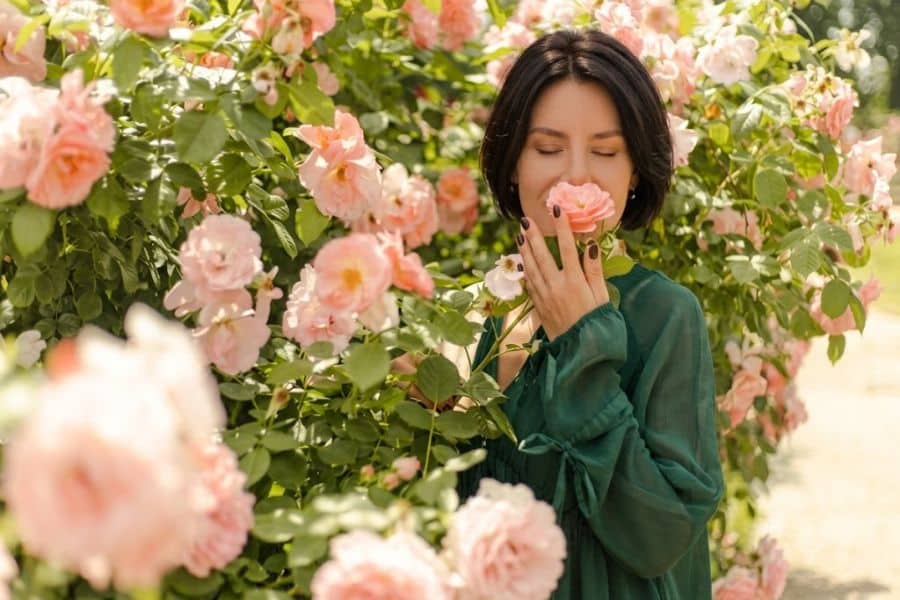
So What Is Scent Stacking?
The idea is simple enough. You choose fragrant plants that bloom at different times, and you plant them close enough together that the scents overlap where you’ll actually be, near a bench, a doorway, a path, the kitchen window you leave open in summer. That’s it. That’s the whole trend.
Where it differs from just planting a few nice-smelling things is the sequencing. A scent-stacked bed is built so that as one plant finishes blooming, another starts, and ideally there’s a two- or three-week overlap in the middle when both are in bloom.
That overlap is where the magic happens, because that’s when you get the layered smell that reminds people of childhood gardens. A single rose is a rose. A rose with sweet peas climbing up beside it and lavender at its feet is a memory.
The other bit that makes it work is height. You want fragrance at ground level (lavender, pinks, thyme), fragrance at nose level (roses, phlox, lilies), and fragrance up high (honeysuckle, jasmine, wisteria if you’ve got the patience for it).
When the air moves through all three, that’s the walk-past-and-stop-dead effect.
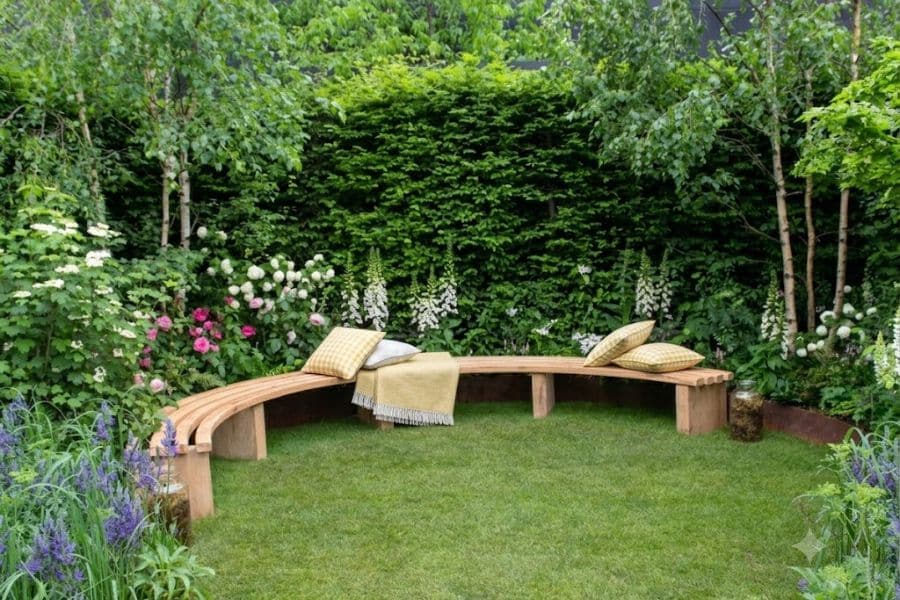
Start With the Spot, Not the Plants
Before you buy a single plant, work out where you actually spend time. Not where the garden looks best from the kitchen window. Where you sit, where you walk, where the door is that you leave open in July.
For most people that’s three spots at most: a seating area, a path to somewhere, and one or two windows or doorways. Those are the places worth stacking scent. Everywhere else, plant whatever you like, but don’t waste your fragrant plants on the far corner nobody visits.
The other thing to consider is sun and shelter. Scent carries best in warm, still air, which is why old walled gardens smell so intense; the walls trap the heat and the scent.
If you have a sunny fence or wall, that’s your prime real estate. A breezy open spot will still smell nice up close, but the scent won’t hang the way it does in a sheltered corner.
So if you’ve got a warm patch by a wall where you can put a bench, that’s where you want your best-smelling plants doing their thing.

Building the Sequence From Spring Through Fall
Here’s where I’d actually put the plants, month by month, and you can pick and mix depending on your climate and what you already have. I’m going to keep the list short on purpose, because the whole point is that you don’t need 40 plants. You need a few good ones, blooming in sequence.
For early spring, March into April, the workhorse is wallflowers. That warm, spicy, slightly clove-y smell that hits you on a mild March afternoon is pure old-fashioned garden. Pair them with a hyacinth or two near a doorway, and you’ve got your first stack. Wallflowers are cheap and easy.
Late spring into early summer, May and June, is when the big guns come in. Old roses, especially the shrub roses and ramblers with actual perfume (a lot of modern roses have been bred for looks and lost the smell, so read the labels or ask), plus sweet peas climbing up something nearby, and pinks (dianthus) at the front of the bed for that clove note down low.
High summer, July and August, is lavender’s moment, and lilies, and phlox. Phlox is one I keep meaning to plant more of; it has that soft, powdery smell that fills a whole yard in the evening. Lavender does the low, warm, herbal layer, and a tall Oriental lily in a pot near the bench does the up-high layer. Three plants, three heights.
Late summer into fall, September and October, is where a lot of gardens go quiet on scent, but they don’t have to. Sweet autumn clematis if you have a fence for it, late phlox, and heliotrope in a pot (that one smells of cherry pie) will keep something going right up until the first proper cold night.
The Cheat’s Version if You Only Want to Buy Six Plants
If all of that sounds like a lot, here’s what I’d do if I were starting from scratch tomorrow and had one sunny corner near a bench to work with. Six plants, spring to fall, done.
- A patch of wallflowers for March and April. Cheap, cheerful, and the smell is pure childhood. I plant mine in a rough clump rather than a tidy row because they look better that way and the scent seems to carry further.
- One properly fragrant old rose, something like a Gertrude Jekyll or a Munstead Wood if you want the deep smell, planted where you’ll brush past it.
- A wigwam of sweet peas next to the rose, sown from seed in March or bought as young plants in May. Keep picking them, and they keep flowering; stop picking, and they stop, which is a lesson I’ve had to relearn every year.
- A row of lavender at the front, whichever variety does well in your zone. I go for the English ones because they smell stronger to my nose, but the French lavenders flower for longer if that matters more to you.
- A pot of Oriental lilies you can move around. The scent from one stem in full bloom is honestly enough to perfume a whole seating area, and if you get bored of them, you shove the pot somewhere else.
- Heliotrope in another pot for September. It’s the surprise plant that most people don’t know about, and every time I have it near the back door, someone asks what smells of cake.
That’s it. Six plants, one bench, and something in bloom and smelling of something from March to October. If you want to add more later, add more. But you don’t have to.
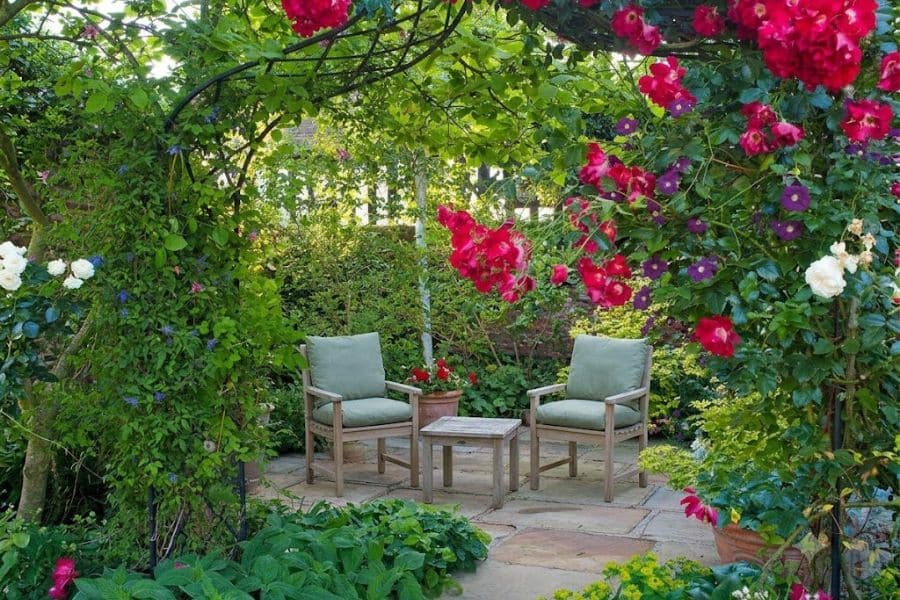
Creating the Magic Smell of Your Grandma’s Garden
There’s one more thing that separates a nicely fragrant garden from the kind that stops you in your tracks, and it’s not a plant. It’s the ground.
Old cottage gardens smelled the way they did partly because everything was packed in tight, with herbs and low-growing things spilling over paths and steps, so that every time you walked through, you crushed a bit of thyme or brushed a lavender stem, releasing the oils.
You can do this deliberately. Plant creeping thyme in the cracks of a paving path. Let chamomile self-seed at the edge of a step. Tuck a rosemary bush where you’ll knock it with your elbow when you sit down.
Every one of these releases scent when you touch it. It also solves the problem of what to do with the little gaps and awkward corners; herbs are happy in poor soil and don’t need much water once they’re in.
And the last thing I’d say is that fragrant gardens reward slowness. You actually have to go sit in them at the right time of day. Most flowers smell strongest in the early evening, when the air is still warm but starting to cool, because that’s when they’re trying hardest to attract moths and pollinators.
If you plant all this beautifully and then only ever look at the garden through the window at lunchtime, you’ll miss half of it. Take your coffee out at seven in the morning, or your glass of something at eight in the evening, and you’ll really experience what scent stacking is all about.
Disclaimer: This article is for general information only and is not professional advice. It may contain affiliate links. Please see our full Editorial Policy for details.

Kylie Lang is a nationally syndicated travel journalist with bylines on the Associated Press Wire & more, a lifestyle writer, and the founder and editor of Your Lifestyle Library (yourlifestylelibrary.com). She holds a BA (Honours) in History from the University of Kent and is a member of the British Guild of Travel Writers.