
You walk into the kitchen, stand there a moment, and try to remember what it was you went in there for. We’ve all done it, and if you’re female and over fifty, you undoubtedly put it down to being menopausal. And if you’re male, you put it down to age.
Age is part of it, sure, but a much bigger part is that most of us stopped actively stretching our brains somewhere around the time we finished school, and the brain, like every other bit of you, stops working effectively when you don’t use it.
But all’s not lost, and there are plenty of things we can do to help raise your IQ over 50 and avoid cognitive decline that don’t involve doing Sudoku or spending hours on brain training apps.
How To Raise Your IQ Over 50 and Avoid Cognitive Decline
IQ in the classroom sense, the number you’d get from a formal test, is fairly stable across adult life. What shifts, and what these habits target, is the everyday performance of your brain: how quickly you recall names, how well you hold a phone number in your head long enough to dial it, how nimble you are at switching between tasks, how well you sleep, and how clearly you think the next morning.
1. Learn Something With Your Hands You Find Hard

Motor skills that require you to inhibit one movement while performing another, juggling being the classic, are one of the fastest ways to lay down new white matter in an adult brain.
Knitting, playing a musical instrument, calligraphy, learning to touch type, throwing pottery on a wheel, tying fishing flies, all count.
The important bit is that you’re bad at it at first, and your hands have to fight your brain for a while.
Beginner discomfort is where the growth is, so you’re aiming for that slightly frustrated, this-is-ridiculous, my-hands-won’t-do-what-my-brain-is-telling-them feeling for the first few weeks.
Once a skill becomes automatic, the brain-building effect drops off sharply, so the trick is to keep raising the difficulty. If you learn to juggle three balls, move to four. If you can knit a scarf, try a jumper. Comfort is the enemy here, which is hard, because comfort is what most of us are after by our 50s.
2. Pick Up A Second Language

This is one I can speak to directly, because I moved to rural France in 2016 with schoolgirl French. Fumbling through a conversation with the plumber about a broken septic tank does more for your brain than any app ever will, because you can’t opt out.
Bilingualism is associated with a delay in the onset of dementia symptoms of around 4 to 5 years on average, according to work by Ellen Bialystok at York University. You don’t have to become fluent to get some of that benefit.
Steady, effortful practice is what does the work, so 20 minutes a day on something like Duolingo, Pimsleur, or Language Transfer, plus a weekly conversation with a real human on italki or a local meetup, will move you along nicely.
Pick a language you’ve a good reason to want, because motivation is what carries you through. Planning a trip to Italy next fall? Learn Italian. Got German grandparents? Learn German. The subject you care about is the one you’ll still be doing in 6 months.
3. Walk Somewhere You Don’t Know

The hippocampus, the bit of your brain most involved in memory, is also the bit that builds and holds spatial maps. London taxi drivers who’ve done The Knowledge have measurably larger hippocampi than the rest of us, and the effect grows with the years they’ve been driving, per research by Eleanor Maguire at UCL.
You don’t need to memorize 25,000 streets to get some of this. What you need to do is stop outsourcing your navigation to your phone. Walk to a new neighborhood without Google Maps, get a bit lost, work out where you’re from landmarks, and find your way home.
Try a new hiking trail every weekend and read the paper map at the trailhead instead of following the little blue dot. Drive to the next town over on back roads instead of the highway.
If you can, plan a trip somewhere the streets aren’t laid out on a grid. Small French, Italian, or Spanish medieval towns are brilliant for this, because the streets curl and double back and nothing lines up, and your brain has to build an actual 3D map to cope.
4. Play A Strategy Game Against A Real Person Every Week

Chess is the obvious one, and research shows that regular chess players show slower cognitive decline than non-players.
Chess isn’t the only option, though, and it’s not for everyone. Bridge, Go, backgammon, Scrabble, cribbage, mahjong, and even a serious game of poker with friends all work the same muscles: planning ahead, holding multiple possibilities in your head, reading another person, and updating your strategy on the fly.
A weekly game night with friends or family is one of the most powerful anti-decline habits going, because it combines strategy, memory, and social engagement.
The social bit matters as much as the strategy bit. Loneliness is one of the biggest independent risk factors for cognitive decline in older adults, and a Tuesday-night bridge four is a very pleasant hedge against it.
If you don’t have anyone local to play with, chess.com and Lichess will pair you with a real human anywhere in the world in seconds, both free. Play slower games (15 minutes or more per side) rather than the 3-minute blitz stuff, because slow chess is where the actual thinking happens.
5. Do Your Sums In Your Head

Keep the mental muscle that holds multiple pieces of information in play at once. Working out the tip on a restaurant check without reaching for your phone, adding up your grocery cart as you shop, converting Fahrenheit to Celsius on the fly, and calculating how many miles per gallon your car got on the last tank all help.
Every time you do a calculation in your head instead of tapping it into a calculator, you’re keeping the machinery serviced. The moment we stopped needing to remember phone numbers is roughly the moment a lot of us stopped being able to remember phone numbers.
If you want to make a proper practice of it, apps like Mathemagics or the free daily puzzles on the Art of Problem Solving website will push you further than restaurant math ever could. Ten minutes a day is plenty.
6. Take Sleep As Seriously As You Take Exercise

Your brain does its housekeeping while you sleep, specifically during deep slow-wave sleep, and one of the things it clears out is beta-amyloid, the sticky protein that builds up in Alzheimer’s disease.
Chronic poor sleep in midlife is associated with a meaningfully higher risk of dementia later, per work from Séverine Sabia and the Whitehall II study.
Try to stick to the same bedtime and wake time every day, even on weekends. Bedroom cool, dark, and phone-free. No caffeine after lunchtime, and try to limit alcohol as it wrecks slow-wave sleep even when it knocks you out.
Women going through perimenopause and menopause often see sleep quality decline; I certainly have, and it’s worth talking to your doctor about. Poor sleep in your 50s is not something to just live with, because the compounding effect on your brain over the next 20 years is substantial.
7. Get Your Heart Rate Up Three Times A Week

Aerobic exercise is the closest thing we have to a magic bullet for the aging brain. It increases blood flow to the brain, promotes the growth of new neurons in the hippocampus, and appears to actually increase the volume of that region in older adults who take it, per work by Kirk Erickson and colleagues.
Brisk walking, cycling, swimming, dancing, and hiking with some hills will get your heart rate up. The target most researchers point to is around 150 minutes a week of moderate-intensity movement, which breaks down to 30 minutes 5 days a week or 45 minutes 3 or 4 days a week.
Moderate means you’re a bit breathless and could hold a conversation but couldn’t sing.
The person who walks briskly for 30 minutes 5 days a week is doing more for their brain than the person who does one grueling gym session a week and then does nothing for the rest of it.
8. Test Yourself Instead Of Rereading

When you want to learn or remember something (a book you’ve read, the names of the people at the new club, the layout of a route, the plot of a series you’re watching), the single most effective thing you can do is force yourself to recall it from scratch rather than passively reread it.
This is called active recall or retrieval practice, and it’s the technique medical students, language learners, and memory champions all rely on. So instead of reading the back of a book to tell someone about what you’re reading, put the book down and tell them from memory.
Try writing out your route before reaching for Google Maps, and after a conversation with a friend, go away and try to recall every little detail of that conversation.
9. Argue Properly About Something You Know Little About

One of the best things you can do for the aging brain is to put yourself in situations where you have to defend an idea, listen to a counter-argument, and either update your view or find a better argument for it.
Book clubs where people disagree, philosophy discussion groups, a course at your local community college that involves seminars, even a well-run online forum on a topic you care about, all give you this.
It’s hard, and it exercises the part of your brain that considers evidence, weighs it, and updates its opinion. The algorithm-driven feeds most of us live in are the opposite of good for this, because they show us more of what we already think.
A good rule of thumb: once a month, read a long-form piece by someone you’re pretty sure you disagree with, and try to write down the strongest version of their argument before you tear it apart. This is what philosophers call steelmanning, and it’s one of the harder mental exercises you can do.
10. Try The N-Back Memory Exercise
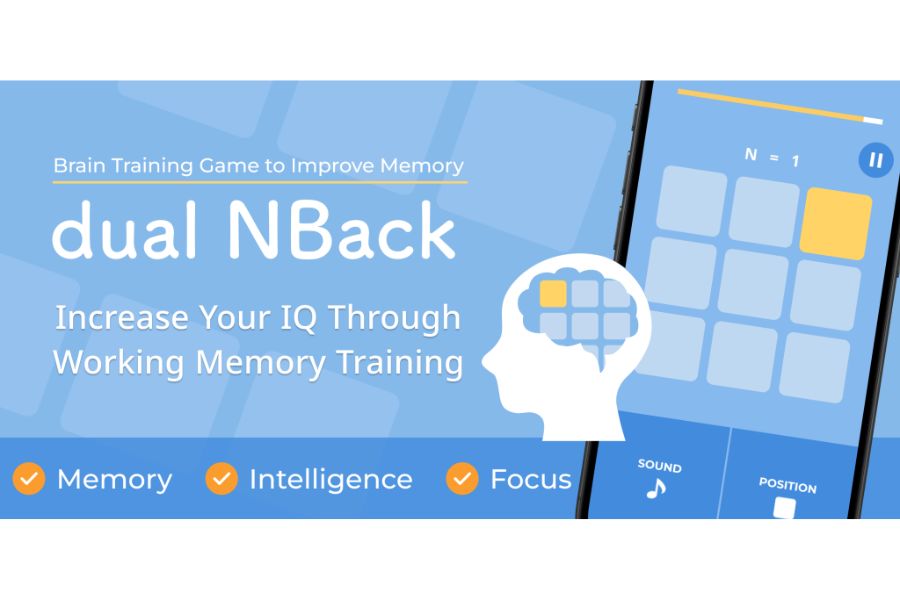
The dual N-back is a specific working memory exercise. You watch a sequence of squares appearing on a grid while hearing a sequence of letters, and you have to press a key when the current square or letter matches the one from N steps ago. Start at N=1 and build up.
In the first few sessions, you’ll feel stupid, then something clicks, and you can suddenly manage N=3, then N=4, and your brain has upgraded itself while you weren’t looking.
The evidence on whether N-back training transfers to general intelligence is mixed, but the training improves working memory, which is the resource you use every time you try to hold a thought in your head while someone interrupts you.
Brain Workshop is a free open-source dual N-back that’s been around forever, and there are dozens of phone apps too. Most studies used 10 to 15 minutes a day, 4 or 5 days a week, for a couple of months.
Disclaimer: The content in this article is for informational purposes only and is not intended to replace professional medical advice, diagnosis, or treatment. Always consult your doctor, physical therapist, or healthcare provider before starting a new exercise program, particularly if you have existing joint, cardiovascular, or balance conditions.
Disclaimer: This article is for general information only and is not professional advice. It may contain affiliate links. Please see our full Editorial Policy for details.

Kylie Lang is a nationally syndicated travel journalist with bylines on the Associated Press Wire & more, a lifestyle writer, and the founder and editor of Your Lifestyle Library (yourlifestylelibrary.com). She holds a BA (Honours) in History from the University of Kent and is a member of the British Guild of Travel Writers.