
My mom will be 89 this year, and she’s still as sharp as a tack. She grew up during the Second World War, so she certainly didn’t have it easy in her early years. She’s seen more change than nearly any other generation, and she’s showing no signs of slowing down.
More and more of her age group are living into their 90s, and I can’t help wondering what their secret is. Do they have some magic drink that’s an elixir to eternal life? Or is it a wonder pill they take every day that’s keeping them going?
The answer is nothing quite as farcical and really quite simple. No formulas, wonder pills, or anything like that, just some very simple and easy habits that you and I can adopt and incorporate without any fuss into our everyday lives.

The Science Behind Why People Are Living Longer
It turns out that genes account for only about 20 to 30 percent of how long we live. The other 70 to 80 percent comes down to the choices we make every single day.
According to the U.S. Census Bureau, there were around 101,000 Americans aged 100 and older in 2024. That figure is projected to quadruple to roughly 422,000 by 2054.
Japan already has 146,000 centenarians, the most of any country in the world, and their longevity has long been studied for clues.
A 2023 review found that lifestyle factors, including diet, physical activity, sleep quality, and chronic inflammation, all have a cumulative effect on brain health over a lifetime. The keyword there is cumulative. The habits stack up over decades, and the people thriving in their 80s and 90s have usually been building them for years.
The brain is far more adaptable than we once thought. The way we live directly shapes how our neurons function and how resilient we stay as we age.
Our habits are doing a lot of the heavy lifting when it comes to how long and how well we live.
9 Brain-Boosting Habits For a Longer Life
It turns out that the secret to a longer life can’t be found in a bottle but is down to lifestyle choices and daily routines. The research backs it up, and the proof is in the pudding, so to speak, and my mom is part of that proof.
No. 1 They Stay Mentally Stimulated

There’s a reason my mom’s brain is so sharp, and it isn’t because she’s sat there watching mindless TV all day. Oh no, she’s a reader and a conversationalist. She loves nothing more than a good debate and a good book.
She keeps herself up to date with what’s going on in the world and can hold her own on any discussion about current affairs.
She also does crosswords, sudoku, and all letters are written by hand. Part of this is because Mom literally repels technology. But she is from the generation that doesn’t do email, and there is something different about actually writing rather than typing.
A 2025 study found that people who maintained a mentally stimulating lifestyle in later life showed cognitive decline almost 47 percent slower than those who did not. That is a staggering difference.
The brain responds to challenge. When you read, learn a new skill, or even tackle a tricky puzzle, you’re building what researchers call cognitive reserve. Learning a few words in a new language, trying a new recipe, or picking up a craft you’ve never tried before all count. The brain loves novelty, and novelty keeps it sharp.
No. 2 They Have a Healthy Lifestyle

Mom doesn’t overindulge. Now that doesn’t mean she doesn’t enjoy the odd tipple or bar of chocolate now and again, but she doesn’t live on takeaways, microwave meals, or stuff full of additives, preservatives, and goodness knows what else. She still cooks all her own meals and ensures she has plenty of fruit and veg in her diet.
She also exercises. Granted, she isn’t down the gym every day, but she does what her body will allow her to do. She tries to make sure she does 5,000 steps a day, not the 10,000 you and I aim for, but it’s all relative.
The US Department of Health and Human Services recommends 150 minutes of moderate activity per week. That works out to about 20 minutes a day. Most long-lived adults hit this not by going to the gym but simply by building movement into their everyday routine.
No. 3 They Have a Positive Outlook On Life

My mom has never been one to feel sorry for herself. Sure, when my dad died, it was hard for her, but she’s from the stiff upper lip brigade who don’t believe the world needs to see their grief.
She’s a trooper, always has a smile for people, and is generally an outwardly happy person. Her trusty motto is that there is always someone worse off than herself, and I think that really helps her stay positive.
She won’t allow herself to wallow in self-pity about the things she can no longer do; instead, she’s grateful for all the things she did when she was able to. She’s the first to find the bright side, even when the bright side takes a bit of squinting to spot.
A study found that higher optimism was directly linked to a longer lifespan and a significantly greater chance of reaching 85 and beyond. And a 10-year follow-up study of older adults found that optimism and healthy behaviors were both independently associated with lower mortality risk.
No. 4 They’re Happy To Say “No”

If mom doesn’t want to do something, she’ll say so. She certainly isn’t someone who’s afraid to say “no” in case she hurts that person’s feelings. And the result of this is that she only does the things that give her pleasure.
This was a revelation to me when I first thought about it. The people I know who are thriving in old age don’t overcommit. They are not people-pleasers. They know their limits, and they respect them without a second thought.
Research on stress and aging consistently shows that chronic stress accelerates biological aging and increases the risk of cognitive decline.
When you say yes to everything, you pile on stress you don’t need. When you learn to say no, you protect your nervous system, your sleep, your energy, and ultimately your health. It’s one of the simplest and most underrated acts of self-care out there.
No. 5 They Have a Good Social Network

Mom has a better social life than I do. Between book club, history group, friendship club, and arts and crafts, she has it all going on. She also has a great group of friends her age, so there is always someone to have a cup of tea and a chat with.
An analysis of 148 studies found that people with strong social bonds had a 50 percent greater chance of survival than those with poor social relationships. The Harvard Study of Adult Development, which ran for over 80 years, reached the same conclusion.
Social connection reduces inflammation, lowers blood pressure, and buffers the body against the effects of stress. You don’t need a packed diary; just regular contact with a few people you care about does the job.
No. 6 They Have a Routine

Babies need routines, and so do adults. I love going on holiday, but after a couple of weeks, I’m missing the daily routine of my life, and that doesn’t change just because you get older. My mom’s days have a shape to them. Tea in the morning, a walk before lunch, friends or a social activity in the evening, and reading her book before bed. She has kept roughly the same rhythms for decades.
Research looking at Blue Zone populations found that daily routines and rituals that reduce stress are a consistent feature of communities where people live the longest. Okinawans take a moment each day to connect with their ancestors. Sardinians have a form of daily happy hour with friends. Seventh-day Adventists in Loma Linda, California, who have some of the longest average lifespans in the US, structure their days around rest, movement, community, and faith.
Routine creates predictability, and predictability reduces the daily mental load we carry. Your brain doesn’t have to work as hard when life has a structure, which frees up energy for everything else.
No. 7 They Set Boundaries
This overlaps with saying no, but it goes a step further. Setting limits means deciding who and what gets access to your time, your energy, and your emotional space. It means not allowing relationships or situations that drain you to have unlimited access to your life.
Older adults who thrive tend to have a quiet clarity about what they will and won’t put up with. They’ve usually learned this the hard way over the years, and they’ve stopped being apologetic about it.
It’s also about not taking on too much, being aware of how much you can do, and structuring your day accordingly. So, for example, I know my mom doesn’t like going out in the evenings now, so if we’re going for a meal, it will be lunch rather than dinner.
No. 8 They Surround Themselves With Positive People
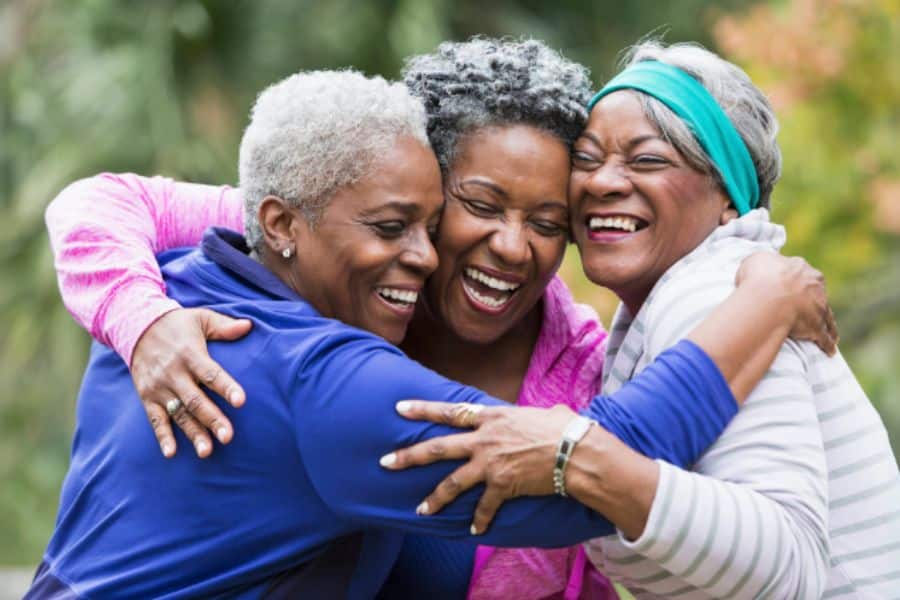
There’s a phrase that gets thrown around a lot: you are the average of the five people you spend the most time with. For older adults, this appears to be more than just a motivational quote. Certainly for my mom, she doesn’t suffer fools gladly, speaks her mind, and doesn’t want to spend time with people who don’t add something good to her life.
As she always says, “I probably don’t have long left, so I want to spend it with people I actually like.” And I don’t blame her.
People who are happy, engaged, and curious are simply more pleasant to be around. And spending time with them rubs off on you. They inspire you to stay active, to keep laughing, and to stay interested in life. That interest in life, researchers believe, is a significant driver of how long people thrive.
No. 9 They Allow Themselves to Be Free

Letting go of the things that no longer serve you, whether that’s a relationship, a grudge, or simply someone else’s opinion of how you should live, is one of the wisest things you can do for your long-term health.
I think I’ve got better at this as I’ve gotten older. I used to be completely consumed by what other people thought of me. Now, I don’t really care, and it’s so liberating. Many of the oldest and healthiest people are remarkably free of guilt, resentment, and rigid thinking. They don’t carry old grudges. They don’t spend much energy worrying about what other people think. They live life on their own terms.
Disclaimer: This article is for informational purposes only and is not intended as medical advice. Always consult a qualified healthcare professional before making any changes to your diet, exercise routine, or health regimen. The studies referenced are provided for informational context and do not constitute personal medical recommendations.