
It’s no great secret that I’m a history fan, and I’ll never forget the first time I walked through a truly medieval town. The cobblestones under my feet had been worn smooth by centuries of footsteps, the stone walls were thick enough to have held off armies, and somewhere in the distance, church bells rang just as they had for the past 800 years. This place had survived plagues, wars, revolutions, and everything else history could throw at them.
Living in southwest France, I’m surrounded by towns and villages that look like they’re stuck in a time warp. If it weren’t for the cars, you’d never know you’re in the 21st century, and you can just feel the history oozing from the walls. Close your eyes, and you can almost imagine knights riding through on horseback.
Europe has literally thousands of medieval towns, some have been rebuilt beyond recognition, and others are so overrun with tourists that the magic disappears. But these nine places have held onto something special.

9 Stunning Medieval Towns in Europe
Each of these towns and cities offers that rare combination of authentic medieval architecture, fascinating history, and enough preservation that you can almost imagine what life was like 700 years ago.
No. 1 Rothenburg ob der Tauber, Germany

Rothenburg was once Germany’s second-largest city with 6,000 residents and enough wealth to build walls that still stand intact today. The Hohenstaufen dynasty founded the town in 1170, building a castle on a plateau above the Tauber River that gave the place its name, Red Castle above the Tauber.
By 1274, Rothenburg had become a Free Imperial City, answering directly to the Holy Roman Emperor rather than any local lord, which brought the kind of power and prosperity that built the elaborate half-timbered houses lining its streets.
The Thirty Years’ War nearly destroyed everything. In 1631, Catholic forces under General Tilly besieged the Protestant town, and after the gunpowder tower exploded, Rothenburg had to surrender. The city fell into poverty and irrelevance for the next 200 years, too poor to tear down the old buildings and replace them with something modern. That economic decline accidentally preserved the medieval core that makes Rothenburg extraordinary today.
The town has 42 gates and towers still standing, and you can walk almost the entire 1.5-mile circuit of walls for free. In 1945, American bombs destroyed about a third of the town, but the outer walls survived, and locals rebuilt using the same architectural style, so the new construction blends seamlessly with structures that date back to the 1300s.
What You Won’t Want To Miss
- The Medieval Crime and Punishment Museum houses one of Europe’s most extensive collections of torture devices and legal artifacts spanning 1,000 years. Iron maidens, shame masks, and witch trial documents fill room after room, all explained in English.
- St. Jakob’s Church contains a masterpiece by Tilman Riemenschneider, the greatest German woodcarver of the Renaissance. His Holy Blood altarpiece, carved between 1500 and 1505, sits in the church’s western gallery and features intricate detail work that seems impossible given the tools available at the time. The church itself dates back to 1311, and climbing the tower gives you views across Rothenburg’s red-roofed medieval skyline.
- Walk the Tauber Valley trail down from the town to Toppler Castle, the 600-year-old summer home of mayor Heinrich Toppler, who ruled Rothenburg during its golden age in the late 1300s. The narrow tower house sits beside the river, and the walk there takes you past mills, apple orchards, and countryside that looks remarkably similar to what Toppler would have seen. The trail continues to Detwang, a village actually older than Rothenburg itself, with another Riemenschneider altarpiece in its church.
No. 2 Carcassonne, France
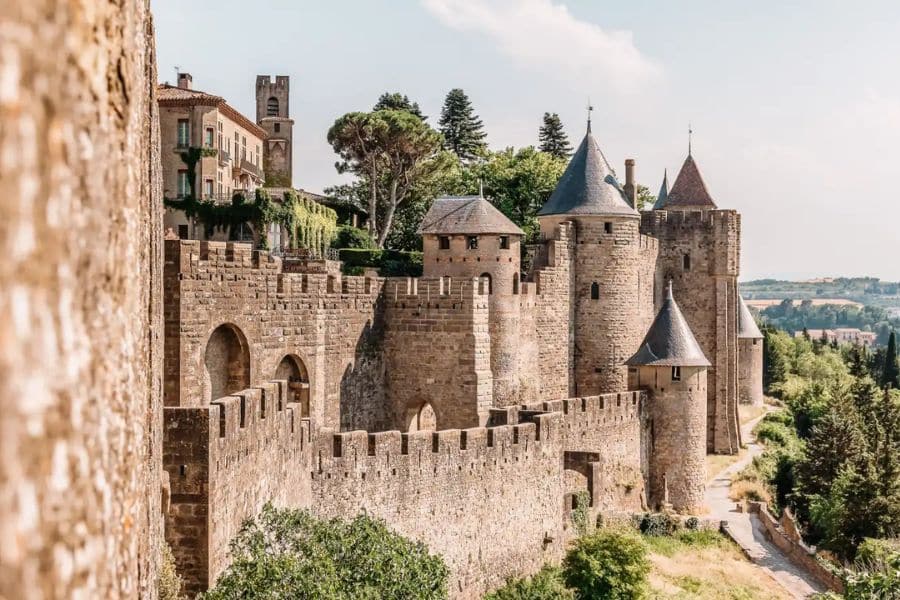
I’m in love with Carcassonne, and whilst it certainly attracts the tourists, if you go in September or October, the crowds have gone home. It sits on a hilltop in Languedoc, guarding the gap between the Pyrenees and the Black Mountains, a strategic gateway that has been vital for over 2,500 years.
The Romans built the first fortifications here in the 1st century BC, then the Visigoths took over in the 5th century, followed by the Moors briefly in the 8th century. The real transformation came in the 13th century when French kings, having conquered this region during the brutal Albigensian Crusade against the Cathars, decided they needed an impregnable fortress to hold the south.
They built double walls with 53 towers, turning Carcassonne into medieval Europe’s textbook example of military architecture. The outer wall runs nearly two miles around the hilltop, and the inner wall rises even higher, creating a defensive system so formidable that nobody successfully stormed it for centuries. When you stand between those two walls today, in that narrow passage called the lices, you can see exactly how defenders would trap attackers and rain down arrows, boiling oil, and stones from above.
By the 1800s, the French government had decided to demolish Carcassonne because the fortress had become outdated and was falling apart. A local archaeologist, Jean-Pierre Cros-Mayrevieille, fought to save it, eventually convincing the architect Eugène Viollet-le-Duc to restore the entire citadel.
The restoration work, which took decades, gave us the Carcassonne we see today. Some historians argue that Viollet-le-Duc took liberties with his restorations, adding conical slate roofs to towers that were probably originally flat-topped with terracotta. But his work saved the fortress from total destruction, and in 1997, UNESCO designated it a World Heritage Site.
What You Won’t Want To Miss
- Walk the complete circuit of the outer ramparts. The path runs between the two sets of walls, giving you views of the towers, the city below, and the Pyrenees in the distance. The full walk takes about an hour at a leisurely pace and really shows you the scale of this defensive system.
- The Château Comtal sits at the western edge of the citadel with its own moat and drawbridge. This 12th-century castle within the fortress served as the home of viscounts and later French royals. The interior museum explains the fortress’s history and Viollet-le-Duc’s controversial restoration work.
- The Basilica of Saint-Nazaire combines Romanesque and Gothic architecture, with stained glass windows that survived centuries of war and revolution. The rose windows are particularly stunning, especially when afternoon light streams through them, casting colored patterns across the stone floors. The church dates back to the 11th century and contains the tomb of Simon de Montfort, who led the Albigensian Crusade that brought this region under French control.
No. 3 Siena, Italy

While Florence grabbed Italy’s headlines during the Renaissance, Siena was building a Gothic masterpiece on three hills in the heart of Tuscany. The city reached its peak in the 13th and 14th centuries as a powerful republic that rivaled Florence in wealth, art, and influence.
Banking families made fortunes, the Sienese school of painting produced masters like Duccio and Simone Martini, and the city built monuments that still define it today. The Black Death arrived in 1348 and killed half the population in a matter of months, ending Siena’s golden age and leaving it suspended in its Gothic glory.
The Piazza del Campo, the shell-shaped main square, has been the center of Sienese life since the 13th century. Built on a slope with nine sections radiating from the bottom, it represents the Council of Nine, who governed the medieval republic. Twice a year, this square transforms into a racetrack for the Palio, a bareback horse race that dates back to 1633 and still drives the city absolutely wild with partisan passion.
Siena’s 17 contrade, or neighborhoods, compete in the Palio with an intensity that makes modern sports rivalries look tame. Each contrada has its own church, museum, colors, and symbols, and the allegiance passes down through generations.
What You Won’t Want To Miss
- The Duomo, Siena’s black and white striped cathedral, took nearly 200 years to build and stands as one of Italy’s most spectacular examples of Italian Gothic architecture. The floor is covered with 56 marble panels depicting biblical and historical scenes, created by over 40 artists across several centuries. The Piccolomini Library inside contains frescoes by Pinturicchio showing the life of Pope Pius II.
- Climb the Torre del Mangia, the tower next to the Palazzo Pubblico in Piazza del Campo. Built in 1338 and standing 285 feet tall, it offers the best views of Siena’s medieval roofscape and the Tuscan countryside rolling away in every direction. The climb is 400 steps with no elevator, but the view from the top is worth it.
- Walk the Terzo di Città, one of the three main districts of medieval Siena, where narrow streets barely wider than your outstretched arms wind between brick buildings that lean toward each other overhead. You’ll stumble across unexpected courtyards, hidden chapels, and tiny shops selling traditional Sienese products.
No. 4 Ávila, Spain

Ávila sits on a bare plateau 3,715 feet above sea level, surrounded by walls so perfectly preserved they look like Hollywood’s idea of what a medieval fortress should be. The Romans called this place Abula, but after the Moors conquered it around 714, it changed hands repeatedly during centuries of warfare between Christian and Muslim kingdoms.
When Alfonso VI finally recaptured it for the Christians in 1085, he understood that holding this strategic high ground meant building defenses strong enough to withstand another Moorish attack.
Construction of the walls began around 1090, with Christians, Jews, and even Moorish residents who’d chosen to stay all contributing to the massive project. The completed fortifications stretch 1.5 miles in an irregular rectangle, with 87 semicircular towers and nine gates flanked by twin towers, each rising 66 feet. The walls average 40 feet high and 10 feet thick, built from granite blocks that gleam in the intense Castilian sun.
This was the birthplace of Saint Teresa of Ávila, the 16th-century mystic and Carmelite reformer whose writings made her one of the most important figures in Catholic mysticism. Her influence earned Ávila the nickname “City of Saints and Stones,” though honestly, those stones are what draw most visitors.
The medieval core inside the walls remains remarkably intact, with Romanesque churches, Gothic palaces, and stone houses lining narrow streets that haven’t changed much since Teresa walked them 500 years ago.
What You Won’t Want To Miss
- Walk along the top of the walls from the Cathedral section to the Puerta del Alcázar, the most dramatic gate with its twin towers. You can access about half the total length of walls, and the views from up there show you both the medieval city within and the stark Castilian landscape beyond. The walk takes about an hour, though you’ll stop constantly to take photos and marvel at the medieval engineering.
- The Cathedral of Ávila, built between 1091 and the 15th century, is Spain’s first Gothic cathedral and serves double duty as both a church and part of the defensive walls. The apse forms a rounded bulge in the eastern wall, designed to act as a fortified tower if enemies breached the gates. Inside, the cathedral combines Romanesque and Gothic elements, with an altarpiece by Pedro Berruguete and choir stalls carved by Cornelis de Holanda. The cathedral museum houses religious art spanning centuries.
- Cross the Adaja River to the Cuatro Postes, a simple monument of four columns marking the spot where young Teresa and her brother were caught trying to run away to fight the Moors. Whether that story is true, I have no idea. You see the entire walled city spread before you, towers and ramparts rising from the plain, looking almost exactly as it did in medieval times when this was Spain’s front line against Moorish kingdoms to the south.
No. 5 Bruges, Belgium

Bruges built its medieval fortune on wool and weaving, becoming one of northern Europe’s wealthiest cities by the 13th century. The city sat at the center of a trading network that stretched from Italy to Scandinavia, with Flemish cloth prized across the continent. Merchants from Venice, Genoa, and the Hanseatic League maintained trading houses here, and the city’s population swelled to 45,000, enormous for medieval times.
The Belfry rising above the market square symbolized Bruges’ independence and prosperity, while canals linked the city to the sea at Damme, allowing ships to sail directly to its warehouses.
The river Zwin, which connected the city to the North Sea, started silting up in the 15th century. By 1490, large ships could no longer reach Bruges, and trade shifted to Antwerp. The city’s economy collapsed, its population shrank, and Bruges spent the next four centuries as a backwater too poor to modernize. When Belgium industrialized in the 1800s, Bruges was left behind, its Gothic architecture and medieval street pattern preserved only because no one had the money to replace them.
That accidental preservation made Bruges a tourist destination in the 20th century. UNESCO designated the entire historic center a World Heritage Site in 2000, and the city now attracts millions of visitors who come to experience a perfectly preserved medieval townscape.
What You Won’t Want To Miss
- Climb the Belfry of Bruges, all 366 steps to the top of the 272-foot tower that’s dominated the Market Square since 1240. The climb is steep and narrow, but halfway up, you can stop at the room housing the 47-bell carillon, which still plays concerts regularly. The view from the top shows you Bruges’ medieval layout, canals threading between stepped-gable houses, church spires rising from the roofscape, and flat Flemish countryside stretching to the horizon.
- The Basilica of the Holy Blood houses a relic said to contain Christ’s blood, brought to Bruges in 1150 by Thierry of Alsace after the Second Crusade. Every year on Ascension Day, the Procession of the Holy Blood carries the relic through Bruges’ streets, a tradition dating back to 1304 that involves thousands of participants in medieval costume.
- Take a canal boat tour from the Rozenhoedkaai, the most photographed spot in Bruges, where the canal curves past the Belfry. The boat glides under stone bridges and past medieval houses that lean toward the water, their facades reflected in the still surface. Tours run year-round and last about 30 minutes.
No. 6 Český Krumlov, Czech Republic

The Vltava River makes a nearly perfect loop around Český Krumlov, creating a natural moat around what became one of Bohemia’s most important medieval towns. The Lords of Krumlov built a castle here in the 13th century, and by 1302, the town had its own brewery and minting rights. The Rožmberk family took control in 1302 and ruled for nearly 300 years, turning a frontier fortress into a Renaissance gem while somehow preserving its Gothic core.
The town survived wars, plagues, and centuries of political upheaval remarkably intact. World War II barely touched it, and when Czechoslovakia fell under communist rule after 1948, the lack of investment ironically protected Český Krumlov from the kind of modernization that destroyed other historic cities.
The Iron Curtain kept Western tourists away, so the town languished as a sleepy provincial backwater with crumbling medieval buildings and empty cobblestone squares.
The Velvet Revolution in 1989 changed everything. Within a few years, UNESCO designated Český Krumlov a World Heritage Site, restoration work began after centuries of neglect, and tourists discovered this extraordinarily well-preserved medieval town hidden in southern Bohemia.
What You Won’t Want To Miss
- Český Krumlov Castle, the second largest castle complex in the Czech Republic after Prague Castle, dominates the town from its hilltop perch. Built over five centuries from the 13th to the 18th century, it combines Gothic, Renaissance, and Baroque styles in a sprawling complex of courtyards, gardens, and towers. The highlight is the Baroque theater dating from 1682, one of the world’s oldest still-functioning theaters with original stage machinery and painted sets.
- Walk the entire old town, a peninsula enclosed by the river’s dramatic loop. The medieval street layout has barely changed since the 1400s, with narrow lanes winding past burgher houses painted in ochre, pink, and gold. The main square, Náměstí Svornosti, has been the town’s commercial heart since medieval times, with Gothic and Renaissance buildings surrounding a plague column erected in 1716.
- Climb the Castle Tower for views over Český Krumlov‘s orange rooftops and the river looping around the old town. The cylindrical tower, originally Gothic but given a Renaissance facelift in the 16th century, rises 177 feet and offers panoramic views of the surrounding Bohemian Forest. The climb is easier than it looks.
No. 7 York, England

I used to live not far from York for about 6 years and went regularly because it’s such a beautiful place to spend time, and a lot of it has been pedestrianized. The Romans founded York in 71 AD as Eboracum, a military fortress that became one of the empire’s most important northern cities and the base from which several emperors ruled Britain.
Vikings captured it in 866, renamed it Jorvik, and made it the capital of their northern kingdom for over 200 years. The Normans arrived in 1066 and built castles and walls on the Roman foundations. By medieval times, York had grown into England’s second city after London, growing wealthy on the wool trade that made Yorkshire famous.
Each wave of conquerors left their mark, and York today offers one of the most complete medieval townscapes in England. The city walls, built by the Romans and expanded throughout the Middle Ages, still circle the old town in an almost complete 2-mile circuit that you can walk for free. The Shambles, a street of overhanging timber-framed buildings dating to the 14th century, remains one of Europe’s best-preserved medieval streets, so narrow you could shake hands with someone across the way from their window.
York Minster, the largest medieval cathedral in northern Europe, dominates the skyline just as it has since construction began in 1220. The cathedral took 250 years to build and contains half of the surviving medieval stained glass in England today. The Great East Window, completed in 1408, is the size of a tennis court and the largest expanse of medieval stained glass in the country.
What You Won’t Want To Miss
- The York Dungeons bring the city’s darker history to life through a combination of live actors, special effects, and rides that make most museum visits look tame. I took my daughter there with my parents, and she was petrified as I got called upon to act the part of a witch on trial and, predictably, I was found guilty. You’ll meet Viking invaders, survive the plague, witness witch trials, and encounter Guy Fawkes before his failed attempt to blow up Parliament.
- Walk the medieval city walls starting from Bootham Bar, one of the four main gates. The elevated walkway gives you views over York’s rooftops and into private gardens, showing you why this location mattered so strategically. You pass through gatehouse towers where guards once checked everyone entering the city, walk along sections rebuilt after Civil War damage, and end at Monk Bar, which houses a small museum about Richard III.
- Explore The Shambles and the surrounding medieval lanes where butchers once hung their meat in open shop fronts. The street, mentioned in the Domesday Book of 1086, still has the overhanging upper floors and narrow width that kept sunlight off the meat and helped preserve it in the days before refrigeration. Today, those medieval shopfronts house chocolatiers, jewelry stores, and cafes, but the architecture remains remarkably authentic.
No. 8 Tallinn, Estonia
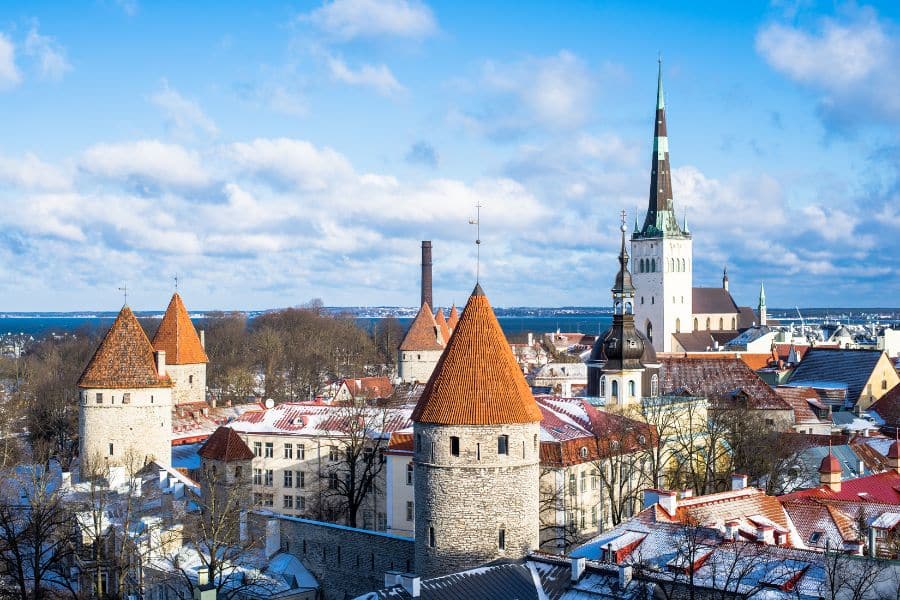
Tallinn sits on the Baltic coast, where medieval merchants needed a safe harbor between Scandinavia and Russia. The Danes conquered the area in 1219 and built a fortress on Toompea Hill, though German merchants from the Hanseatic League actually ran the city and made it one of northern Europe’s most important trading posts.
By the 14th century, Tallinn was shipping grain, furs, wax, and honey west while bringing salt, wine, cloth, and manufactured goods east. The wealth from this trade built the Gothic churches, merchant houses, and defensive walls that still define Tallinn’s old town.
The city changed hands repeatedly over the centuries, ruled by Danes, Germans, Swedes, and Russians at various times, yet the medieval core somehow survived. Even Soviet occupation from 1944 to 1991 couldn’t destroy it, though communist authorities largely ignored it, letting the old town slowly deteriorate while building Soviet-style concrete blocks outside the medieval walls. When Estonia regained independence in 1991, restoration work began on the centuries of neglect, and in 1997, UNESCO designated Tallinn’s Old Town a World Heritage Site.
Long stretches of the 13th-century city walls still stand with their walkways accessible to visitors. Of the original 46 defensive towers, 26 survive, including the particularly impressive ones nicknamed Fat Margaret and Kiek in de Kök (Low German for “peek into the kitchen” because guards could see into houses below).
What You Won’t Want To Miss
- Walk the northern section of the medieval walls starting from the Towers’ Square. You can climb up into several towers and walk along the restored rampart sections, getting views over the old town’s red-tiled roofs and out toward the Baltic Sea. The walls here date mostly from the 14th century, built when Tallinn was flush with Hanseatic trading wealth and could afford proper fortifications. The restored sections contrast with crumbling original stonework, showing exactly what nearly 700 years of weathering does to medieval construction.
- The Town Hall Square, surrounded by Gothic merchant houses with their distinctive stepped gables, has been Tallinn’s commercial heart since at least 1302. The Town Hall itself, completed in 1404, is the only surviving Gothic town hall in northern Europe. The building’s council chamber upstairs retains its original carved benches and painted beams, while the pharmacy on the square’s corner has been operating since 1422, making it one of Europe’s oldest continuously functioning pharmacies.
- Climb Toompea Hill to the upper town, where nobility and clergy lived separate from the merchants below. The Alexander Nevsky Cathedral’s onion domes dominate the skyline, though this Russian Orthodox church dates only from 1900. More interesting is Toompea Castle next door, parts of which date back to the Danish conquest in 1219. From the viewing platforms here, you get panoramic views across Tallinn’s lower town with its medieval towers and red roofs.
No. 9 Rhodes Old Town, Greece

The Knights Hospitaller, officially the Order of St. John of Jerusalem, seized Rhodes in 1309 after being driven from the Holy Land and turned this Greek island into their Mediterranean headquarters.
They built one of Europe’s most formidable fortress cities, with walls thick enough to withstand cannon fire and a harbor fortified to control shipping lanes between Europe and the East. For over 200 years, the Knights ruled Rhodes as an independent state, raiding Ottoman shipping and providing Christian Europe with a strategic toehold in the eastern Mediterranean.
The Ottomans finally conquered Rhodes in 1522 after a six-month siege that saw both sides suffer horrific casualties. Sultan Suleiman the Magnificent was so impressed by the Knights’ defense that he allowed the survivors to leave with full honors.
The Ottomans then settled into the Knights’ fortress, converting churches into mosques and adding minarets to the Gothic skyline. When Italy took control in 1912, they launched extensive restorations, sometimes controversially rebuilding structures to match their imagined medieval glory.
The Street of the Knights, lined with the Order’s “inns” where members from different countries lodged, looks remarkably as it did in 1500. The entire old town is pedestrian only, with 200 streets and alleyways to explore, most of them too narrow for anything but foot traffic and the occasional delivery scooter.
What You Won’t Want To Miss
- The Palace of the Grand Master sits at the highest point in the old town, built by the Knights in the 14th century on the foundations of a Byzantine fortress. The Ottomans used it as a prison after 1522, then an ammunition depot that exploded spectacularly in 1856, destroying much of the structure. Italian authorities rebuilt it in the 1930s, creating something between restoration and fantasy, with elaborate mosaics from Kos decorating the floors.
- Walk the Street of the Knights from the Palace down to the harbor. This cobbled street, lined with the seven inns that housed Knights from different countries, has barely changed since the 15th century. Each inn features Gothic architecture mixed with elements from its country of origin, creating a fascinating comparison of medieval styles from England, France, Italy, Spain, and Provence all on one street.
- Walk or bike the circuit of medieval walls, among the best-preserved fortifications in the Mediterranean. The Knights built layer upon layer of defensive walls, some sections 40 feet thick, designed to absorb cannon fire rather than simply deflect arrows like earlier castle walls. You can walk sections of the moat and climb parts of the ramparts, seeing exactly how these fortifications evolved as military technology changed from bows to gunpowder. The walls stretch for 2.5 miles, taking several hours to explore properly, and show you medieval military architecture at its most sophisticated.
Disclaimer: This article is for general information only and is not professional advice. It may contain affiliate links. Please see our full Editorial Policy for details.

Kylie Lang is a nationally syndicated travel journalist with bylines on the Associated Press Wire & more, a lifestyle writer, and the founder and editor of Your Lifestyle Library (yourlifestylelibrary.com). She holds a BA (Honours) in History from the University of Kent and is a member of the British Guild of Travel Writers.