
Traveling for me is all about finding new places and spaces and then discovering the stories behind them. And one of my favorite things to do is to people watch from a cafe or coffee shop. Many of these places have a past, a history, and walls that, if they could talk, would tell you some amazing tales.
I’m talking about places where revolutionaries plotted uprisings, famous authors penned novels, and where the coffee recipe has been a guarded secret for over a century. You never know what you’re going to find, which is what makes it so much fun.
Europe has a history stretching back centuries, and these coffee shops in some of Europe’s oldest cities are not only stunning but also allow you to imagine the world that came before you. You can’t help but wonder who may have sat in this seat before you.

9 Beautiful and Historic Cafés in Europe
Now, of course, beauty is in the eye of the beholder, and it’s definitely subjective, so I hope you’ll find at least one cafe to fall in love with on this list. It will give you the perfect excuse to explore the city and discover more of its secrets.
New York Café, Budapest, Hungary

Often called the most beautiful café in the world, the New York Café was opened in 1894 by the New York Insurance Company. This Italian Renaissance-style café is full of gorgeous frescoes, marble columns, gilded details, chandeliers, and a grand piano to finish it all off.
Writers and poets made this their headquarters in the late 19th century. Legend says journalists threw the café keys into the Danube River so it would never close. Today, it functions as both a café and a restaurant. It survived both World Wars and decades of decline before being beautifully restored. The interior is so spectacular, you might forget about your coffee.
Budapest is a beautiful city, and surprisingly affordable compared to many other places in Europe.
Three things not to miss:
- Going before 9 am to avoid massive tourist crowds
- Traditional Hungarian pastries
- Simply looking up at the ceiling
Address: Budapest, Erzsébet krt. 9-11, 1073 Hungary
Peggy Porschen, London, England
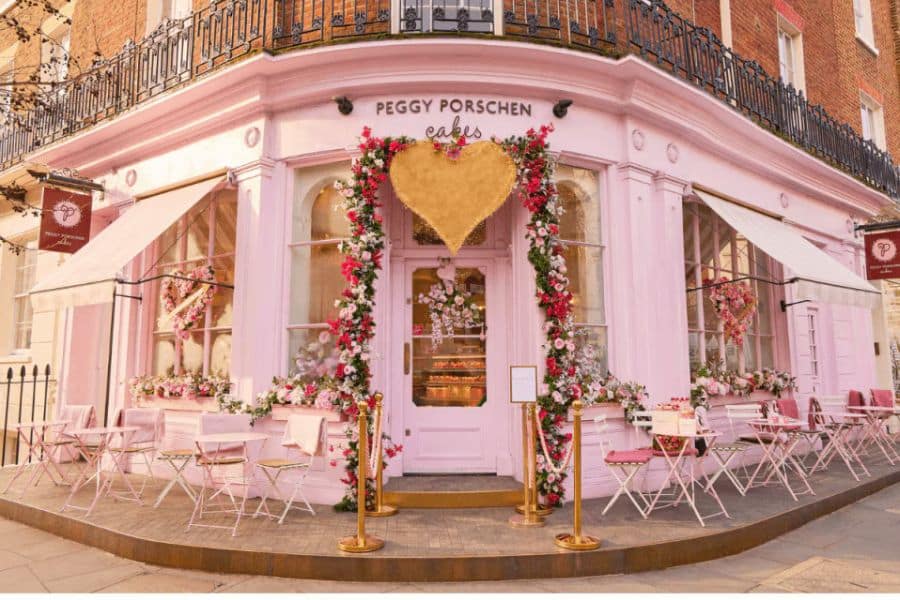
Peggy Porschen may not have a long history, but according to 750,000 Instagram followers, it’s the prettiest café in the world. This Belgravia bakery is wrapped in a fairy-tale pink facade covered in seasonal flowers.
The exterior changes throughout the year, from blooming roses in spring to a winter wonderland complete with snowflakes at Christmas. Inside, the whimsical pink parlor continues the fantasy with pastel colors and modern romance, creating an escape into a world of prettiness.
Founded in 2010 by award-winning cake designer Peggy Porschen, who trained at Le Cordon Bleu, this isn’t just about Instagram shots. Her client list includes Elton John, Kate Moss, Madonna, and Gwyneth Paltrow. Vanity Fair called it “cupcake heaven,” and they’re not wrong.
The cupcakes are edible works of art, beautifully crafted treats made by expert pastry chefs in the kitchen daily. You can book for breakfast, brunch, or their seasonal afternoon tea, or simply walk in for coffee and cake.
Three things not to miss:
- The floral terrace (walk-ins only)
- Red velvet cupcakes with real, made-from-scratch icing
- Taking photos in front of the seasonal flower display
Address: 116 Ebury St, London SW1W 9QQ, United Kingdom
Caffè Florian, Venice, Italy

Not that you need an excuse to visit Italy, but picture sitting beneath frescoed ceilings while orchestras play in St. Mark’s Square. It really doesn’t get any more romantic than that. Founded in 1720, Italy’s oldest operating café features ornate rooms decorated in mid-19th century style. Each room tells a different story: the Senate Hall with masonic symbols, the Chinese Hall with exotic paintings, and the Liberty Room with Art Nouveau mirrors and hand-painted details.
Marble columns, gilded details, and chandeliers create an atmosphere where time slows down. Yes, it’s pricey (expect around €16 for signature drinks), but you’re paying for over 300 years of history.
Casanova, Goethe, Charles Dickens, and Lord Byron all sipped coffee here. During the 1848 uprising, the café even served as a temporary hospital for wounded revolutionaries.
Three things not to miss:
- Sitting during evening orchestra performances (there’s a music surcharge)
- The original hot chocolate recipe
- The view of the Basilica from the outdoor tables
Address: P.za San Marco, 57, 30124 Venezia VE, Italy
Voyage, La Samaritaine, Paris, France
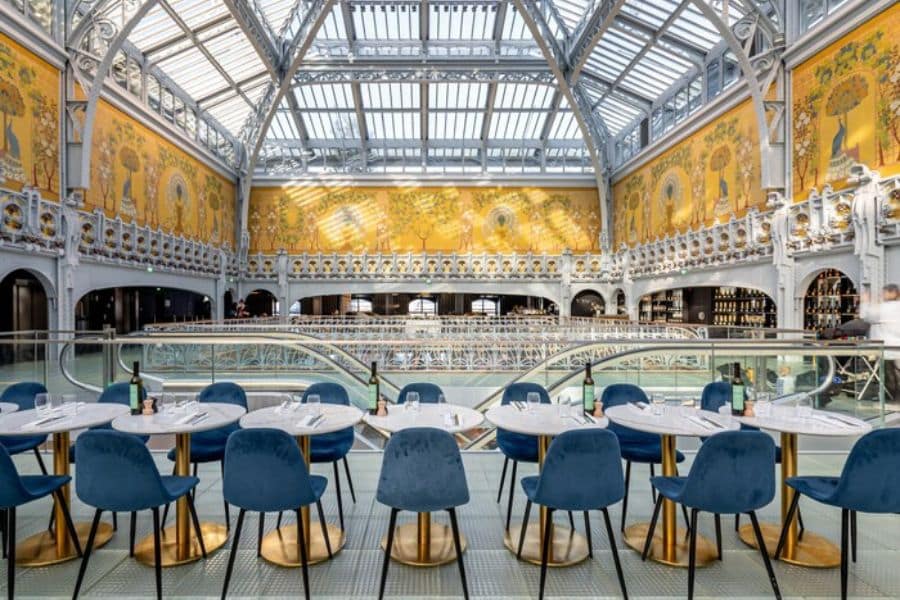
Under an Art Nouveau glass ceiling with a peacock fresco, Paris’s legendary department store serves coffee with a view. Located on the fifth floor of the historic La Samaritaine department store, Voyage sits beneath an emblematic Art Nouveau glass roof that floods the 1,000-square-meter space with natural light.
The iconic peacock fresco watches over diners as they enjoy views across Parisian rooftops. This isn’t just a café, it’s a complete transformation of a Belle Époque landmark. Led by Michelin-starred chef Mathieu Viannay, the open kitchen creates refined, light dishes throughout the day. The space transforms from elegant daytime dining to evening events with music and cocktails.
The department store itself dates back to 1870 and reached its golden age in the 1960s. The recent restoration preserved every Art Nouveau detail while adding modern amenities. The restaurant stays open until 2 am on weekends.
Three things not to miss:
- The Heritage 1905 menu celebrates the building’s history
- Cocktails from the Moët Hennessy collection
- Views of the Saint-Germain l’Auxerrois Church and the Louvre
Address: 9 R. de la Monnaie, 75001 Paris
Café Central, Vienna, Austria

Here’s a frightening thought: Café Central is where Stalin, Trotsky, Freud, and Hitler all shared coffee and conversation. Opened in 1876 inside the spectacular Palais Ferstel, this café features vaulted ceilings, marble columns, and an interior that transports you back to a world of old Vienna glamor. The Venetian-Florentine architecture was cutting-edge for the 1860s.
Known as “the Chess School,” intellectuals spent entire days here playing chess, debating philosophy, and writing the ideas that would shape the 20th century. Today, you can still enjoy traditional Viennese coffee served with a glass of water (with the spoon placed face-down to show it’s freshly poured).
They serve 320,000 cups of coffee annually and 55,000 portions of their famous apple strudel. Half a million visitors walk through these doors each year.
Three things not to miss:
- The Sachertorte (25,000 slices served yearly)
- Wiener Schnitzel for a full meal experience
- Going early (around 8 am) when locals outnumber tourists
Address: Herrengasse 14, 1010, Vienna, Austria
Café Majestic, Porto, Portugal

J.K. Rowling allegedly drafted parts of Harry Potter here, and once you step inside, you’ll understand the magic. This Art Nouveau masterpiece opened in 1921 and feels like stepping into Belle Époque Paris. Mirrors framed in carved woodwork, brass fittings, chandeliers, marble countertops, and leather upholstered benches create an atmosphere of complete elegance.
Located on Porto’s main shopping street, this café was where intellectuals, bohemians, and high society ladies gathered. The space was designed by architect João Queiroz and reopened in 1994 after careful restoration, bringing back its 1920s glory.
Expect queues, especially during peak times. Prices reflect the historic setting (around €30 for a Francesinha), but the experience of sitting in one of the world’s most beautiful cafés justifies the splurge.
Three things not to miss:
- Rabanadas (Portuguese French toast) with Port wine
- The winter garden at the back
- Taking photos of the stunning interior before it fills up
Address: R. de Santa Catarina 112, 4000-442 Porto, Portugal
Municipal House Café, Prague, Czech Republic
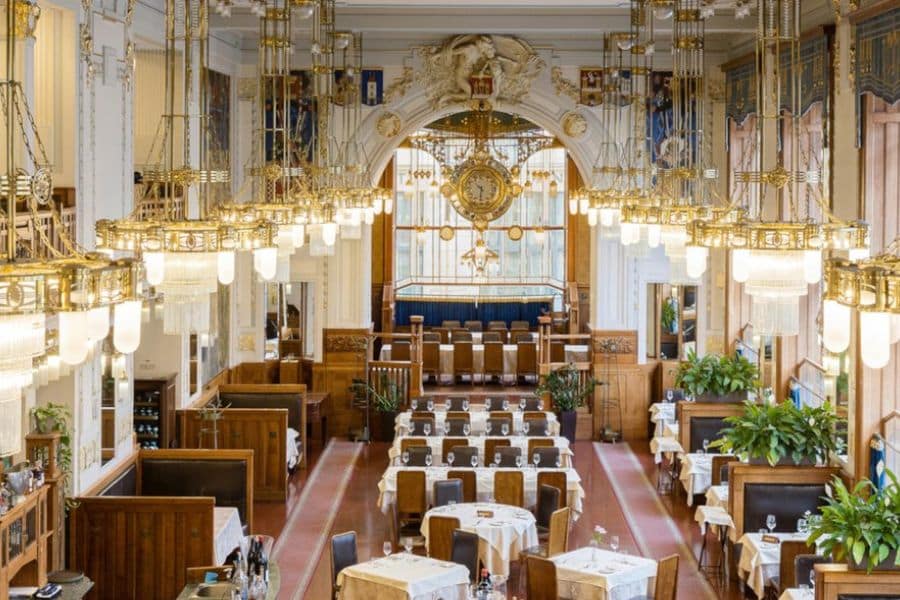
Inside Prague’s Art Nouveau museum, Municipal House Café, built between 1905 and 1911, features some of the finest Art Nouveau architecture in Europe. The café has fabulously high ceilings adorned with crystal chandeliers, large windows flooding the space with light, mirrors galore, and floral ornamentation that takes you straight back to the Belle Époque era. At the back stands the Carrara Nymph, a large marble statue watching over guests like a guardian.
This was where Prague’s elite gathered during the Czech Republic’s glory days. Famous Czech Art Nouveau artist Alfons Mucha contributed to the interior decorations, and the building itself represents Czech ideals of democracy and freedom. Czechoslovakia’s independence was declared on the first floor in 1918.
The entire building underwent extensive restoration between 1994 and 1997, restoring it to its 1912 glory. Everything from chandeliers to tapestries was either restored or remanufactured based on historical images. Even the smallest details, from dishes to menus, match the architectural style.
Three things not to miss:
- The cake trolley that’s wheeled from table to table
- Sitting near the windows for natural light
- Going for breakfast when it’s quieter (served 8 am to 11 am)
Pedrocchi Café, Padua, Italy

The café has a secret coffee recipe so confidential that baristas are sworn to secrecy. This neoclassical masterpiece opened in the 1830s and quickly became one of Italy’s finest examples of architectural elegance. Multiple rooms showcase different styles, each more impressive than the last.
The signature Pedrocchi coffee is served with mint cream and cocoa powder on top. You’re not supposed to stir it, and no spoons are provided. The dark blend’s precise brewing method remains a closely guarded secret.
Students at Padua’s famous university traditionally don’t enter until after graduation, believing that doing so will curse them with failure. Who knows if it’s just a myth, but I wouldn’t want to put it to the test, would you?
Three things not to miss:
- The signature Pedrocchi coffee (don’t stir!)
- The neoclassical architecture inside
- Being part of Padua’s centuries-old café culture
Address: Via VIII Febbraio, 15, 35122 Padova PD, Italy
Café Iruna, Bilbao, Spain

In a city known for Basque culture, this 1903 café brings Moorish magic to the heart of Bilbao. Opened on July 7, 1903, Café Iruña features unique Mudejar-inspired decoration that’s rare in the Basque Country.
High-quality tiles cover the walls, polychrome ceilings soar overhead, and an extensive collection of recently restored mural paintings depicting dreamy rural scenes creates an exotic atmosphere. The 300 square meters are divided into different intimate spaces.
Founded by Navarrese entrepreneur Severo Unzué Donamaría, this café sits across from the popular Jardines de Albia gardens and has become an inseparable part of Bilbao’s civic heritage. It was declared a “Singular Monument” in 1980 and won the Special Prize for Best Café in Spain in 2000.
Three things not to miss:
- The famous “pincho moruno” (Moorish skewers)
- Coffee in the room overlooking the square
- The painted artesonado ceiling
Address: Colón de Larreátegui K., 13, Abando, 48001 Bilbao, Bizkaia, Spain
Disclaimer: This article is for general information only and is not professional advice. It may contain affiliate links. Please see our full Editorial Policy for details.

Kylie Lang is a nationally syndicated travel journalist with bylines on the Associated Press Wire & more, a lifestyle writer, and the founder and editor of Your Lifestyle Library (yourlifestylelibrary.com). She holds a BA (Honours) in History from the University of Kent and is a member of the British Guild of Travel Writers.