
It’s really easy to mistake a hoverfly for a wasp; I’ve done it plenty of times myself. You’re out in the yard doing the fall tidy-up, cutting back the last of the sedum or deadheading whatever’s still hanging on, and one of those little yellow-and-black things zips up and hovers an inch from your face.
You flap. It hovers. You flap harder. It moves about six inches to the left and carries on hovering.
But before you’re tempted to swat it, take another look. There’s a very good chance the thing pestering you isn’t a wasp at all, and that it’s one of the hardest-working little insects in your yard right now.
So what is it, and why does it seem so interested in you and your borders in September?
What Is a Hoverfly?
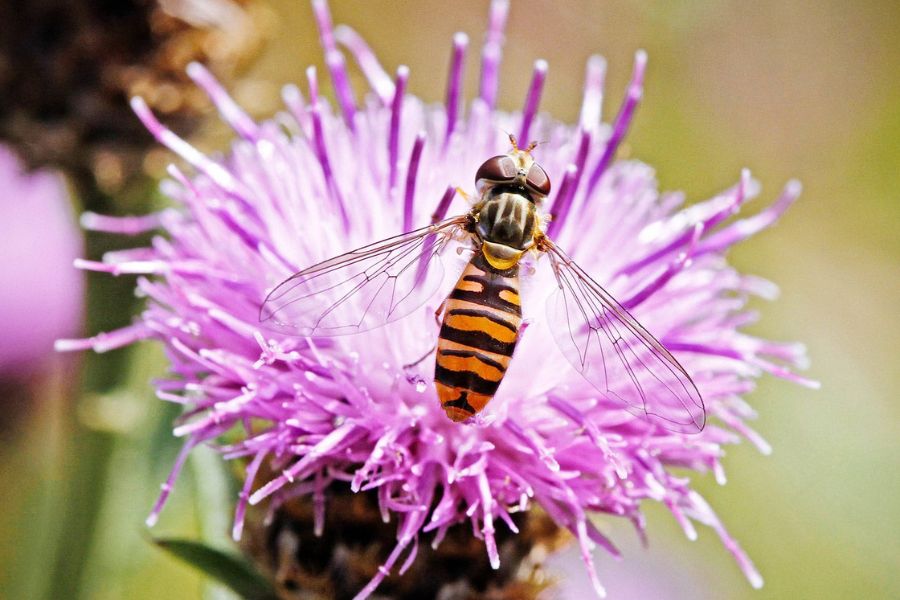
The reason people mistake hoverflies for wasps is that a lot of them have evolved to look like wasps on purpose. It’s a survival trick.
Birds and other predators leave wasps alone because they’ve learned that wasps sting, so a harmless fly that wears the same yellow-and-black outfit gets left alone too.
Once you know what to look for, you can spot the difference from a few feet away. A hoverfly has two wings, not four, and it holds them out to the sides when it lands. Its body is flatter and shorter than a wasp’s, with no narrow waist.
The big giveaway is right there in the name: hoverflies hover. They hang in mid-air like a tiny helicopter, dart sideways a few inches, then hang again. A wasp on a mission is somewhere else in a second, usually heading straight for your glass of wine.
There are around 6,000 species worldwide, and roughly 270 in the UK and a similar number across North America, so the ones showing up in your borders will vary depending on where you garden.
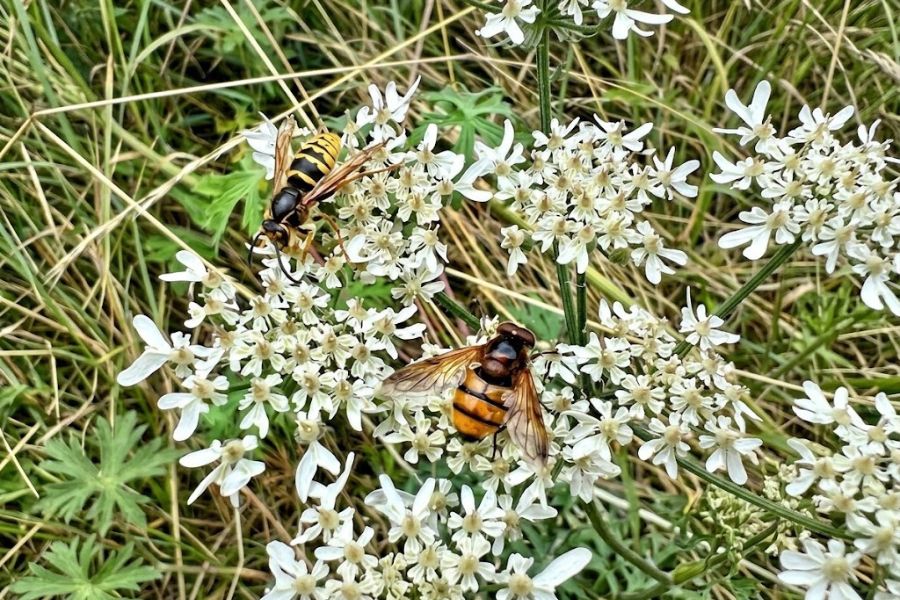
Some are tiny and shiny; some are big and furry, looking more like little bees. All of them are completely harmless to you. No sting, no bite, no interest in your drink.
The Two Jobs They’re Doing While You Weed Around Them
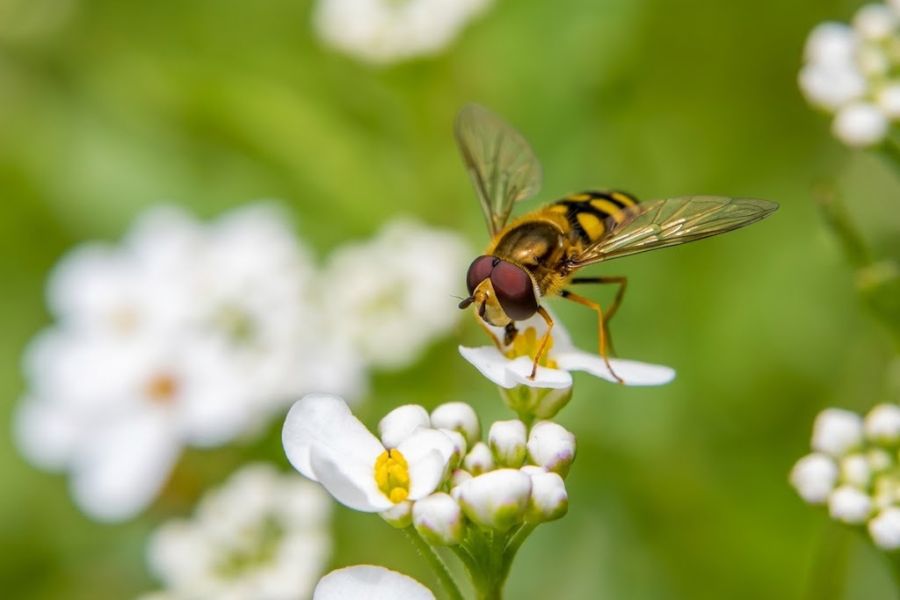
Hoverflies work a double shift in a garden, which is why they’ve been getting more attention lately as gardeners think harder about who actually pollinates what. The adults you see hovering over your asters and late cosmos are pollinators.
They drink nectar and eat pollen, and as they move from flower to flower, they carry pollen with them, in the same way bees do. They’re not as efficient as honeybees at any one flower, but there are usually a lot of them, and they’ll fly in cooler, cloudier weather when bees are still tucked up. In the fall, when bee numbers drop off, hoverflies are often doing most of the pollinating in a yard.
The second job is happening where you can’t see it. Most hoverfly larvae, the little maggoty things, eat aphids. A single hoverfly larva can get through hundreds of aphids before it pupates.
If you’ve ever had a rose bush covered in greenfly one week and mysteriously clean the next, without you doing anything, there’s a good chance a hoverfly laid eggs among the aphids and her offspring cleared the lot.
So the adult you’re waving away in September is very possibly the mother of next spring’s aphid patrol. She’s out looking for the last of the nectar to fuel egg-laying, and she’s checking your plants for aphid colonies to lay those eggs near.
This is why they seem so interested in you when you’re doing the fall tidy-up: they’ve come to the last blooms in the yard, and there you are hacking them back.
Why the Fall Yard Matters More Than the Spring One
Fall is when many insect populations either build up reserves for winter or don’t, and the difference between a yard that helps them and one that doesn’t is usually a handful of small choices made in September and October.
Hoverflies overwinter in several ways, depending on the species. Some hibernate as adults, tucked into leaf litter, hollow stems, log piles or the back of a shed. Some overwinter as larvae or pupae in the soil. Some, like the marmalade hoverfly, actually migrate, and huge numbers cross from continental Europe to Britain and back again every year.
The ones staying put need somewhere to shelter and something to eat between now and the first frost.
A yard that’s been stripped to bare soil, with every stem cut down to an inch and every leaf raked into a bag by the end of October, is a hungry, exposed place for an insect. A yard with a few seed heads left standing, a corner of unraked leaves under a shrub, and a couple of late-flowering plants still going is a completely different proposition.
Small Tweaks That Bring More of Them In
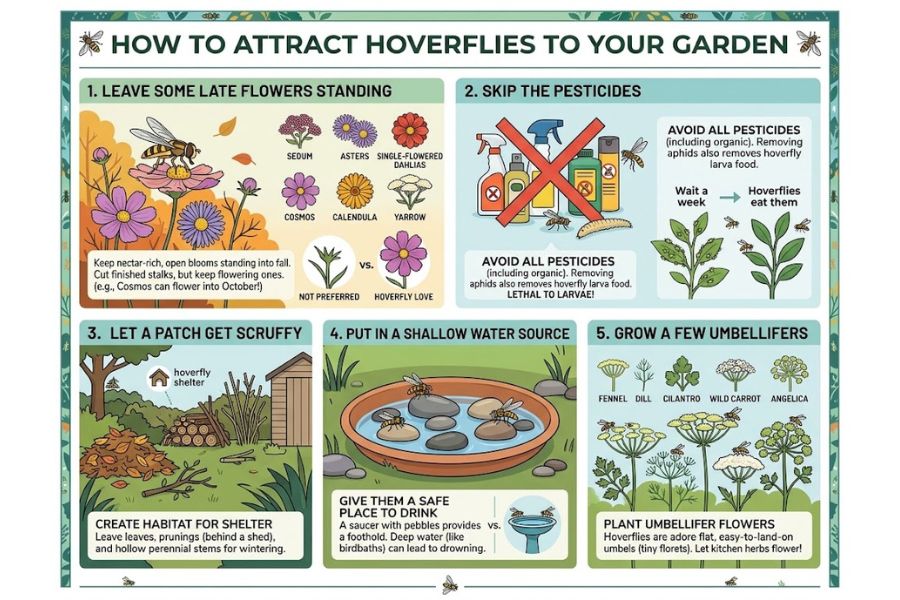
Here are some things you can do to attract more hoverflies to your garden:
- Leave some late flowers standing. Sedum (now often sold as Hylotelephium), asters, single-flowered dahlias, cosmos, calendula and yarrow all keep producing nectar into fall, and hoverflies love the flat, open, easy-to-land-on blooms.
- Skip the pesticide, even the organic ones. Anything that kills aphids also removes the hoverfly’s food source and, worse, kills the larvae doing the work for you. If a plant has aphids, wait a week before you do anything. Nine times out of ten, something eats them.
- Let a patch of the yard get a bit scruffy. A pile of prunings behind the shed, a corner where the leaves stay put, a few hollow stems left on the perennials over winter. All of it is hoverfly shelter. If you can’t bear a scruffy front, hide it round the back where only you and the dog know it’s there.
- Put in a shallow water source. A saucer with a few pebbles in it gives hoverflies (and bees, and everything else) somewhere safe to drink. They can’t land in a birdbath without drowning. The pebbles give them a foothold.
- Grow a few umbellifers. Fennel, dill, cilantro allowed to bolt, wild carrot, angelica: anything with those flat umbrella-shaped flower heads made up of dozens of tiny florets. Hoverflies adore them. If you let a couple of your kitchen herbs flower instead of pinching them out, you’ve done the job.
What to Do When One Won’t Leave You Alone
When a hoverfly won’t leave you alone, it can be annoying, and the ones that do it are almost always male, and they’re setting up a little patrol territory. They pick a spot with good light and defend it against other males, and if you happen to walk into their patch, they’re warning you off.
If you stand still for 30 seconds, they usually drift off to check something more interesting. If you flap, they’ll dodge and come back, because a flapping human doesn’t register as a threat to something that lives its whole life dodging birds. The trick is to move slowly and get on with what you were doing. They lose interest fast.
And if you’re still not sure whether the thing buzzing your ear is a hoverfly or a wasp, watch it for a couple of seconds. If it hovers, it’s a hoverfly. If it lands on your cake, it’s a wasp, and you have my sympathy.
The Yard That Works for Them Works for You Too
The gardens with the most hoverflies tend to be the ones where the gardener has stopped trying to control every square foot. There are still late flowers in bloom in October, a patch of grass that doesn’t get cut as often as the rest.
The compost pile is a proper pile, not a sealed bin, and something is always flowering somewhere from March to the first hard frost.
This isn’t a big project. It’s mostly a permission slip to do less: less cutting back, less tidying, less raking, less spraying. The plants you already have will do most of the work if you let them go to seed and stand through winter. The insects you already have will do the rest.
Disclaimer: This article is for general information only and is not professional advice. It may contain affiliate links. Please see our full Editorial Policy for details.

Kylie Lang is a nationally syndicated travel journalist with bylines on the Associated Press Wire & more, a lifestyle writer, and the founder and editor of Your Lifestyle Library (yourlifestylelibrary.com). She holds a BA (Honours) in History from the University of Kent and is a member of the British Guild of Travel Writers.