
My mom was forever telling me to sit up straight and stop slouching when I was a kid. I had a tendency to hunch my shoulders and curve my spine, especially when I was concentrating. She told me I’d end up with a hunchback like the Hunchback of Notre Dame if I didn’t stop doing it.
Sounds harsh, but it worked, and even into adulthood, it’s made me think about my posture. However, sometimes it’s not the first thing you think about, and it’s quite natural to want to cross your legs or crane your neck to look at your computer screen. The problem is that when done regularly, these cause massive issues for your spine.
After 50, the stakes get higher. Your discs have less fluid in them, your muscles take longer to recover, and the cumulative effect of years of poor posture starts to show up as pain, stiffness, and reduced mobility. Luckily, a lot of this is reversible once you know what to look for.

9 Everyday Sitting Positions Slowly Destroying Your Spine
Here are nine destructive sitting habits that chiropractors see every single day, and what you can do about each one.
Sinking Into Soft Furniture
Your sofa may be incredibly comfortable, but it could also be one of the worst things for your lower back.

When you sink into a plush couch or try to work from your bed, your hips drop lower than your knees. That reverses the natural inward curve of your lower spine, pushing your lumbar discs into a flexed position that forces the soft inner material of the disc toward the nerves behind it.
It feels fine at first because your muscles are relaxed. The structural damage builds up silently session after session. Here’s the breakdown:
- Reverses the natural lumbar curve
- Increases the risk of bulging discs
- Encourages rounded shoulders as a knock-on effect
- Fix: Use a firm lumbar cushion and keep hips level with or above your knees
The fix is straightforward. Place a firm cushion or rolled towel behind your lower back to maintain the natural curve, and make sure your hips stay at the same height as your knees, or slightly higher.
If you’re working from home, save the sofa for actual downtime and use a proper chair with back support for anything that takes longer than a few minutes.
Crossing Your Legs
I think most women are guilty of this one. It’s a default sitting position for a huge number of people, and most have no idea it’s causing problems.

Crossing one leg over the other locks your pelvis into a rotated position and stops your sit bones from bearing weight evenly. Your lower spine then has to twist to compensate and keep your body upright.
Do this for an hour a day, every day, and you’re putting repeated rotational stress on the ligaments and joints of your lower back. It can also restrict blood flow in the legs, which brings its own set of issues over time. Here’s the breakdown:
- Rotates the pelvis out of its natural position
- Strains lower back ligaments with repeated twisting
- Restricts circulation in the legs
- Fix: both feet flat on the floor, hip-width apart, with even weight through both sit bones
The simplest fix is to place both feet flat on the floor, hip-width apart. If you find yourself automatically crossing your legs again within minutes, try pressing the soles of your feet firmly into the floor.
That gentle grounding sensation gives your nervous system something to focus on and makes it easier to hold a neutral position.
Sitting on Your Wallet

This one’s for the men in the audience. Did you realize that a thick wallet in your back pocket acts as a wedge under one side of your pelvis every time you sit? That tilts your pelvis unevenly, which forces your spine to curve sideways to rebalance your upper body.
In many cases, the pressure lands directly on the sciatic nerve, the large nerve that runs from your lower back down through your leg. That’s what causes the sharp, shooting pain that can travel all the way to your foot. Here’s the breakdown:
- Creates an uneven pelvic tilt that curves the spine sideways
- Directly compresses the sciatic nerve
- Fix: move your wallet to a front or jacket pocket, especially before driving
- Clinically known as Wallet Neuritis
The fix takes about three seconds. Move your wallet to a front pocket or jacket pocket before you sit down. If you drive regularly, make it a habit to take it out of your back pocket before you get in the car, since that’s when the compression is most sustained.
Letting Your Head Drop Forward

Every inch your head tilts forward adds roughly 10 pounds of effective weight to your cervical spine. At a 60-degree tilt, which is about the angle most people use when checking their phone, your neck is managing the equivalent of 60 pounds rather than the 10 to 12 pounds your head actually weighs.
Your neck muscles were not built for that kind of sustained load. Over time, the muscles at the back of the neck become overstretched and weak, while the muscles at the front tighten up. The result is chronic neck pain, tension headaches, and accelerated wear on the discs in your cervical spine. Here’s the breakdown:
- Every inch of forward tilt multiplies the effective weight on your spine
- Overstretches the muscles at the back of the neck
- Causes chronic tension headaches
Raise your phone or screen to eye level rather than dropping your head to meet it. It feels awkward at first, but your neck will thank you within days. A simple chin tuck exercise, where you gently pull your chin straight back as if to make a double chin, helps retrain the deep neck muscles and counteract the forward pull.
Forgetting Your Glutes Exist
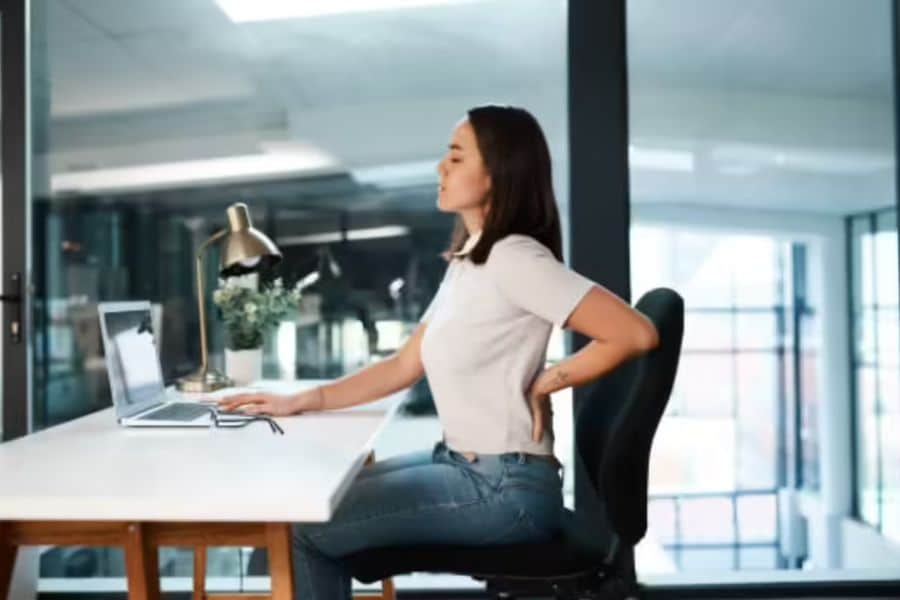
After around 45 minutes of sitting, the constant pressure on your gluteal muscles restricts blood flow and weakens the neurological signal your brain sends to activate them. Your brain starts to forget how to properly fire those muscles. That’s where the term Gluteal Amnesia comes from.
When your glutes switch off, your lower back has to take over their job of stabilizing your pelvis and torso. Your back muscles are not designed for that workload, and they let you know about it fairly quickly. Here’s the breakdown:
- Occurs after as little as 45 minutes of continuous sitting
- Forces the lower back to overcompensate for inactive glutes
- A primary driver of chronic lower back pain
- Fix: stand and move every 45 minutes, or do seated glute squeezes if you can’t get up
Set a timer for every 45 minutes and stand up. Even a two-minute walk to the kitchen and back is enough to reactivate those muscles and restore blood flow. If standing isn’t an option, try seated glute squeezes. Simply contract your glutes firmly while sitting for ten seconds, release, and repeat ten times. It looks like you’re doing nothing, but it keeps the neurological connection alive.
Perching on the Edge of Your Chair
Perching on the front edge of your chair means your back muscles are doing all the work with zero support. Your lumbar muscles have to contract constantly just to keep you upright. By mid-afternoon, those muscles are exhausted, and the spine collapses into a slouch as they give up.
What started as a seemingly active posture ends up creating more tension and fatigue than sitting in a properly supported chair would. Here’s the breakdown:
- Removes all lumbar support from the lower back
- Forces back muscles to work continuously without rest
- Leads to compensatory slouching by the end of the day
- Fix: sit fully back in your chair with lower back supported, feet flat on the floor
Sit all the way back in your chair, so your lower back makes contact with the backrest or lumbar support. Your feet should be flat on the floor, and your knees should be at roughly a 90-degree angle. If your chair has no lumbar support, roll up a small towel and position it at the curve of your lower back. That simple addition changes everything.
Leaning Your Head Toward the Screen

You probably don’t notice yourself doing it, I know I don’t. You’re concentrating, the text is small, or you’ve forgotten your glasses. But the habit of jutting your head forward toward a screen is one of the most common posture problems chiropractors see in people over 50.
That forward lean compresses the vertebrae at the top of the neck and restricts blood flow to the nerves that travel down into your arms. Your shoulders then round forward to compensate, and suddenly the whole upper body is out of alignment. Here’s the breakdown:
- Compresses vertebrae at the top of the neck
- Restricts blood flow to nerves in the arms
- Triggers burning pain between the shoulder blades
- Fix: screen at arm’s length, top of monitor at eye level, and get your eyes tested if needed
The first thing to check is your screen distance and text size. Your monitor should sit roughly an arm’s length away, with the top of the screen at or just below eye level. If you’re squinting, increase the text size rather than leaning in.
And if you haven’t had your eyes tested recently, that’s worth doing. Outdated prescriptions are one of the most overlooked reasons people unconsciously crane toward screens.
Raising Your Shoulders to Reach the Keyboard

If your desk, keyboard, or mouse is even slightly too high, your shoulders will creep up toward your ears without you realizing it. Your upper trapezius muscles stay in a state of near constant contraction just to hold that position.
That sustained tension creates hard, painful knots and restricts movement in the neck. The tightness then travels upward into the base of the skull, and by the afternoon, you’re dealing with a tension headache that seems to come from nowhere. Here’s the breakdown:
- Keeps the upper trapezius in constant contraction
- Creates painful knots in the neck and shoulders
- A leading cause of afternoon tension headaches
- Fix: adjust keyboard height so elbows sit at 90 degrees with shoulders fully relaxed
Lower your keyboard or raise your chair so your elbows sit at roughly 90 degrees when your hands are on the keys, with your shoulders completely relaxed and dropped away from your ears. If you use a mouse, keep it close to the keyboard so your arm isn’t reaching out to one side.
A simple shoulder roll check every hour, where you consciously roll your shoulders back and down, helps reset the position before tension has a chance to build.
Driving With Your Seat Too Far Back

So many drivers push their seats further back than necessary, thinking it gives them more room or makes them feel more relaxed. What it actually does is force you to detach your shoulder blades from the backrest and reach forward to the steering wheel.
That reaching posture rounds the upper back and locks the chest muscles in a shortened, tight position. Over time, those tight chest muscles pull your shoulders forward permanently, even when you’re not driving. It’s one of the main reasons people develop that rounded upper back posture, which becomes harder to correct the longer it’s left. Here’s the breakdown:
- Rounds the upper back with every drive
- Tightens the chest muscles and pulls shoulders forward permanently
- A major contributor to chronic upper back pain
- Fix: move seat forward so your back stays against the rest with a slight elbow bend at the wheel
Move your seat forward until you can rest your back fully against the seat back and still hold the steering wheel with a slight bend in your elbows. Your wrists should rest comfortably on top of the wheel without your shoulders lifting.
If you drive for long stretches, a lumbar support cushion behind your lower back makes a significant difference on journeys over 30 minutes.
Disclaimer: The content in this article is for informational purposes only and is not a substitute for professional medical advice, diagnosis, or treatment. Always consult your doctor, chiropractor, or a qualified healthcare provider before making changes to your routine, especially if you are experiencing back or neck pain.