
I was looking after my friend’s daughter a few weeks ago, and I was shocked that even at ten, her hand was practically glued to her phone 24/7. came round one Saturday last spring with a tablet welded to her hand and absolutely no intention of letting go of it. I was determined to get her away from her screen and out into the fresh air in the garden.
So I put my thinking cap on and teased her outside with a pack of sunflower seeds, an old yogurt pot, and the promise that hers might grow taller than mine. She was outside within ten minutes. The phone stayed on the kitchen table, forgotten, for almost three hours, which is no mean feat when they’re as addicted as she is.
So with summer not far off and the school holidays bearing down on every parent and grandparent I know, I’ve been thinking about the garden activities that actually work with kids. The ones they ask to do again.
The trick, I’ve learned, is competition, creatures, or making something a bit gross. Anything that involves a race, a worm, or a face made out of soil is usually a winner. Anything that involves the words “now we wait six weeks” is usually not.
Kids want fast feedback and a bit of ownership. If it’s their pot, their seed, their bug, their pond, you’re halfway there. If they have to share it with a sibling and follow a rota, you might as well hand the phone back.
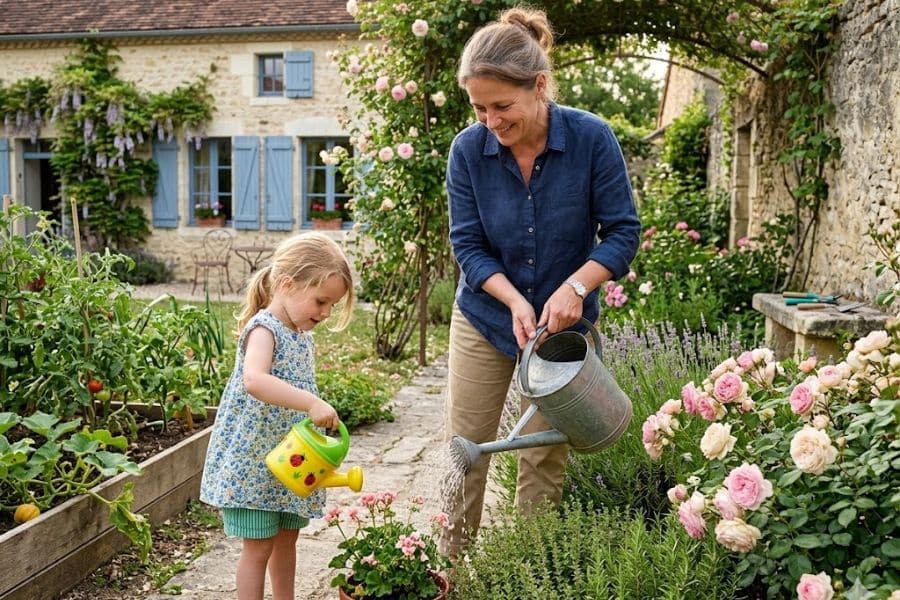
My granddaughter, who is two, is coming to stay with us for a week in July. I’ve already bought her a little watering can and created a small patch of soil for her to plant some particularly hardy perennials that can be planted at almost any time.
I know from her mom that she loves to water the plants, so that’s an easy win, and something she can see the minute she’s planted will help too.
5 Garden Activities the Kids Will Love This Summer
Most of what follows costs almost nothing. A few seeds, some bits from the recycling bin, and an old washing-up bowl. You don’t need a big garden or any particular skill. My Grandma did most of this stuff with me in a tiny little area at the back of her garden, and I still remember every bit of it.
The Sunflower Race
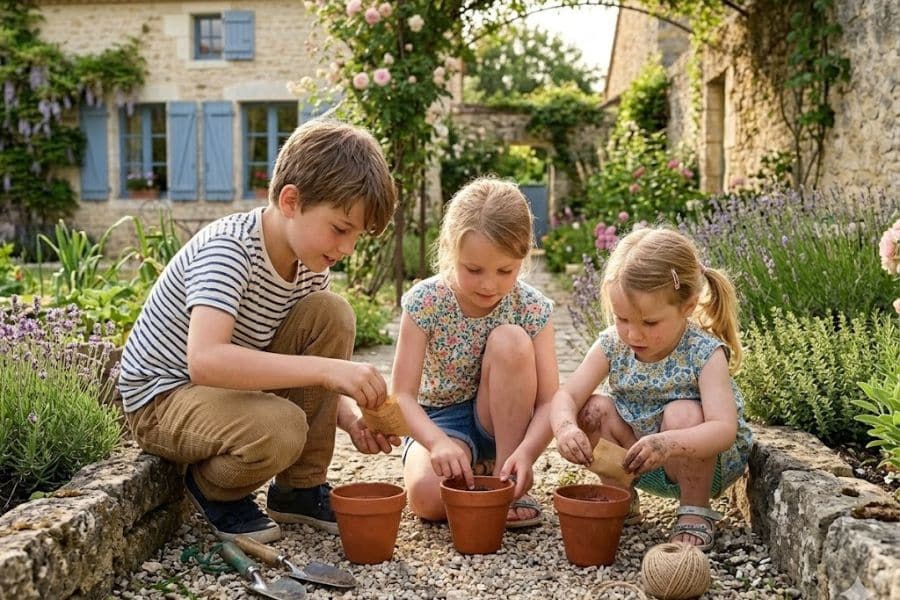
This is the one. If you do nothing else this summer, do the sunflower race. Get a packet of giant sunflower seeds (Russian Giant or Mammoth are the usual suspects, and they’re easy to find), give each child a pot, and tell them they’re competing to grow the tallest one by the end of August.
Pot first on a sunny windowsill, then out into the ground or a bigger pot once they’re a few inches tall and the nights have warmed up. The seedlings come up within a week, which is the bit kids care about. Nothing kills enthusiasm like a seed that sulks for a month.
A few things that make this work better in practice:
- Let them decorate or name their pot. We all love to name things we’re attached to.
- Stick a bamboo cane in early so they can mark the height each week with a bit of ribbon or marker pen. The visual progress is half the fun.
- Plant a spare one yourself, in secret, in case a slug gets one of theirs. The heartbreak otherwise is not worth it, trust me.
- Take a photo of them next to their sunflower each week. By August, you’ve got a little growth chart of both the plant and the kid.
Build a Bug Hotel from Stuff You’d Otherwise Throw Out
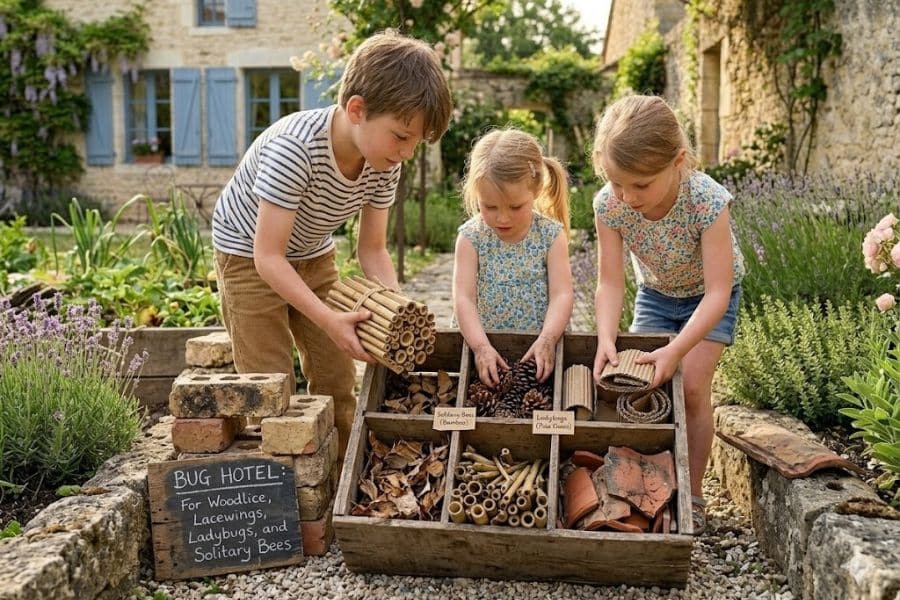
Bug hotels are the activity I wish someone had set me up with as a kid. You’re basically building a small block of flats for woodlice, lacewings, ladybugs, and solitary bees out of whatever you can find lying around.
It looks like a proper project, costs nothing, and the kids get to poke about in the shed for materials, which they love.
The basic version: an old wooden crate or a stack of bricks with gaps, filled with layers of different stuff. Pine cones, bits of bamboo cane cut into short lengths, rolled-up corrugated cardboard, broken terracotta, dry leaves, hollow plant stems, or a bit of old roof tile.
Each layer is a different kind of room for a different kind of bug. The more variety, the more guests you’ll get.
Put it somewhere sheltered, ideally against a fence or a wall, with a bit of sun on it but not full blast in a heatwave. Then leave it alone. Within a few weeks, the kids can have a look and see who’s checked in.
Ladybugs in the leaves, lacewings in the cardboard, sometimes a little solitary bee nesting in one of the bamboo tubes. My nephew kept a notebook of the “residents.”
A word of warning. You will, at some point, encounter a spider the size of a 50p piece, and someone will scream. It’s all part of the process.
Make a Mini Pond in a Washing-Up Bowl
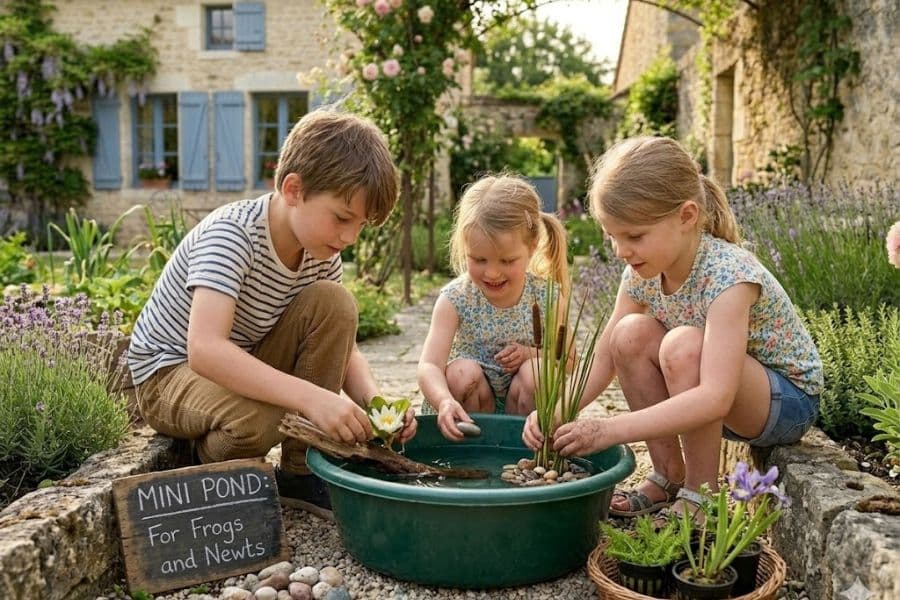
You don’t need a proper pond for this; it’s all about using what you’ve got. It’s recycling at its kiddie best. A mini pond made from an old washing-up bowl, a recycling crate, or a big plant pot with the drainage hole plugged is enough to bring in pond skaters, dragonflies, and, if you’re lucky, a frog by the end of summer.
Sink it into the ground if you can, or set it on a patio with a few stones and a ramp of bricks beside it so any wildlife that falls in can get out. Fill it with rainwater rather than tap water if possible (a few days in a watering can will do if you’ve only got tap), add a couple of stones and a small bit of pond plant from a garden center, and that’s basically it.
Kids can help with all of it, especially the bit where they get to arrange the stones approximately 87 times.
Within a few weeks, you’ll have things turning up that nobody invited. Water boatmen rowing about on the surface, mosquito larvae, which are brilliant because birds will come and eat them.
A few practical notes:
- Never leave very young children unsupervised near any water, even a few inches deep. This is the only stern bit, I promise.
- Don’t bring in tadpoles or frogs from elsewhere. Let them find you. They will.
- Skip the goldfish. They’ll eat everything interesting that turns up.
Cress Heads and Other Silly Indoor-Outdoor Crossovers
Cress heads were the gateway plant of my entire childhood. You take an empty eggshell, draw a face on it with a marker, fill it with a bit of damp cotton wool, sprinkle cress seeds on top, and within a few days, you have an egg with green hair. Egg and cress sandwiches, anyone?
The reason these work so well is the speed. Cress germinates in two or three days. By day five, you’ve got proper green hair. By the end of the week, the egg is having a haircut.
There’s almost no waiting, almost no failure rate, and the whole thing costs about thirty pence. My Grandma did these with me on her kitchen windowsill, and we also did this as part of a school project, I seem to remember.
Here’s a few variants worth trying:
- Microgreens in old takeaway tubs. Pea shoots are sweet and grow fast, and kids will actually eat them straight off the plant.
- A potato in a jar of water held up with toothpicks. The roots come down, the shoots go up, and it’s weirdly fascinating to watch.
- An avocado stone suspended in water the same way, though I’ll warn you these take ages and look dead for weeks before anything happens. Manage expectations.
- tops in a saucer of water. The frilly green regrowth is pretty, and you can do it with the bit you’d normally chuck.
A Pizza Garden, a Scavenger Hunt, and Other Easy Wins
If you’ve got space for a small pot or a corner of a bed, a pizza garden is a great hook. You plant the things that go on a pizza: a tomato plant, a basil plant, some oregano, maybe a little pepper if you’re feeling ambitious.
The kids water it, watch it grow, and then at some point in August, you make pizzas with what they’ve grown. They’re far more likely to eat a tomato they’ve waited three months for than one you’ve put on their plate from the grocery store.
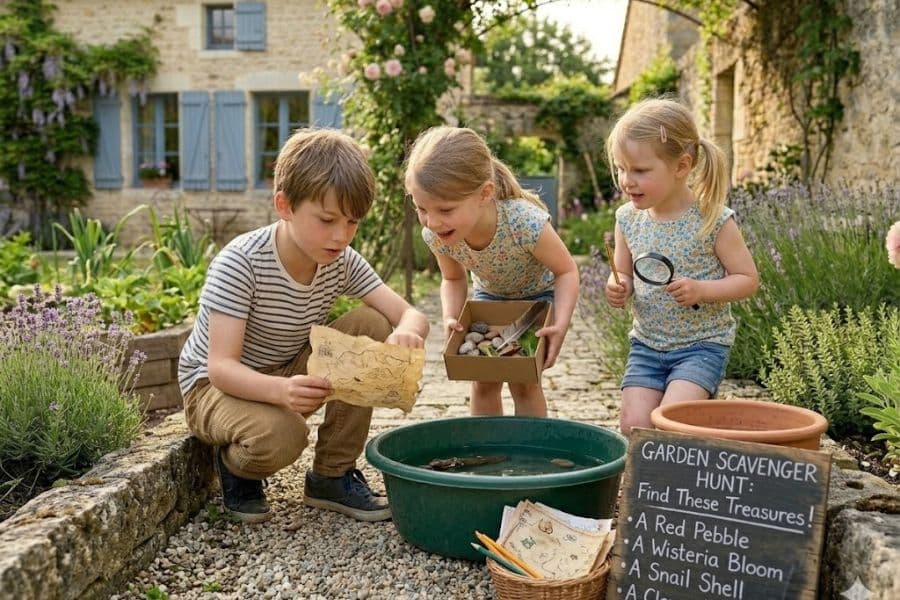
A garden scavenger hunt is the other one I keep coming back to. Write a list of things to find: something rough, something smooth, a yellow flower, a feather, a snail, a leaf bigger than your hand, a stone shaped like a heart.
Give them a paper bag or an old egg carton to collect bits in. It buys you a solid forty minutes, sometimes longer if they get competitive about it, and they end up looking properly at the garden rather than wandering through it.
A few more low-effort wins that have worked for me:
- Painting stones to hide around the garden for someone else to find. Acrylic paint on a smooth pebble, left to dry on a bit of newspaper. Cheap, calming, and the painted stones turn up months later in odd corners.
- A worm-watching jar. A clear jar, alternate layers of soil and sand, a few worms from the compost bin, leaves on top, and a tea towel around the outside to keep it dark. After a few days, they’ll have mixed the layers up. Tip them gently back into the garden afterward.
- A garden picnic with food they’ve helped grow or pick, even if it’s just a few strawberries and some mint in the lemonade.