
One of the biggest complaints I hear from my older clients is that getting up from a soft sofa takes a bit more effort than it used to. And getting up off the floor is a major operation, since you need something nearby to help haul yourself up. Oh, the joys of aging.
From what my mom has said, it seems to creep up slowly, catching you unawares. But luckily, there are plenty of things you can do to build that strength back and to keep you off that walker as you get older.
None of these exercises are hard, and you can do them all at home with a chair, making them easy to fit into your daily routine.
Why Chair Exercises Help As You Get Older
Around age 30, we lose muscle a little at a time. A review in Current Opinion in Clinical Nutrition and Metabolic Care puts the loss at about 3 to 8% of our muscle mass every decade, and it speeds up after 60. You can’t see muscle loss happening, which makes it harder because you don’t notice it creeping up on you.
The big muscles in your thighs and bottom do the work every time you stand up, climb the stairs, or step off a curb, so when your legs weaken, those everyday moves get harder.

The Aging Test Doctors Use
Standing up from a chair is one of the tests doctors use to check how well you’re aging. In a study of more than 1,100 people over 70 published in the New England Journal of Medicine, researchers timed each person as they stood up from a chair 5 times, walked 8 feet, and checked how well they could hold their balance.
Four years later, the people with the lowest scores were 4.2 to 4.9 times more likely to have a disability than those with the highest scores. That meant struggling to walk half a mile or climb stairs without help, or needing help with daily tasks like getting dressed.
The CDC uses a similar test to spot people at risk of a fall. In its 30-second chair stand test, you cross your arms over your chest and get up and sit down multiple times without stopping for 30 seconds.
For a woman aged 60 to 64, fewer than 12 is below average, and a below-average score means a higher risk of falling.
Can You Reverse It?
In 1990, a group of researchers put 10 elderly nursing home residents with an average age of 90 through 8 weeks of strength training. Their strength went up by an average of 174%, the muscle in their thighs grew by about 9%, and their speed on a heel-to-toe walking test improved by 48%.
Then, in 2007, a study in PLOS ONE looked inside the muscles themselves. Before training, a group of healthy older adults was 59% weaker than a group of young adults. After doing strength training for six months twice a week, the gap had shrunk to 38%.
Most of the genes in their muscle that had changed with age also shifted back toward the younger group’s levels, which is why the researchers called their paper “Resistance exercise reverses aging in human skeletal muscle.”
Both studies used gym machines, so what about a chair? A 2021 review of 25 studies found that chair exercises improved grip strength, arm strength, and how many times people could stand up from a chair in 30 seconds.
The authors concluded that chair-based exercise should be promoted as a simple way for older adults to keep and build their strength.
Found this useful? Get more like it in your inbox as a Lifestyle Library Insider.
5 Simple Chair Exercises To Start at 60
All you need is a sturdy chair without wheels or arms, pushed back against a wall so it can’t slide. A kitchen or dining chair is ideal. Wear shoes with a good grip, keep a glass of water nearby, and go at your own pace.
Do the moves in this order, and the whole routine takes 10 to 15 minutes.
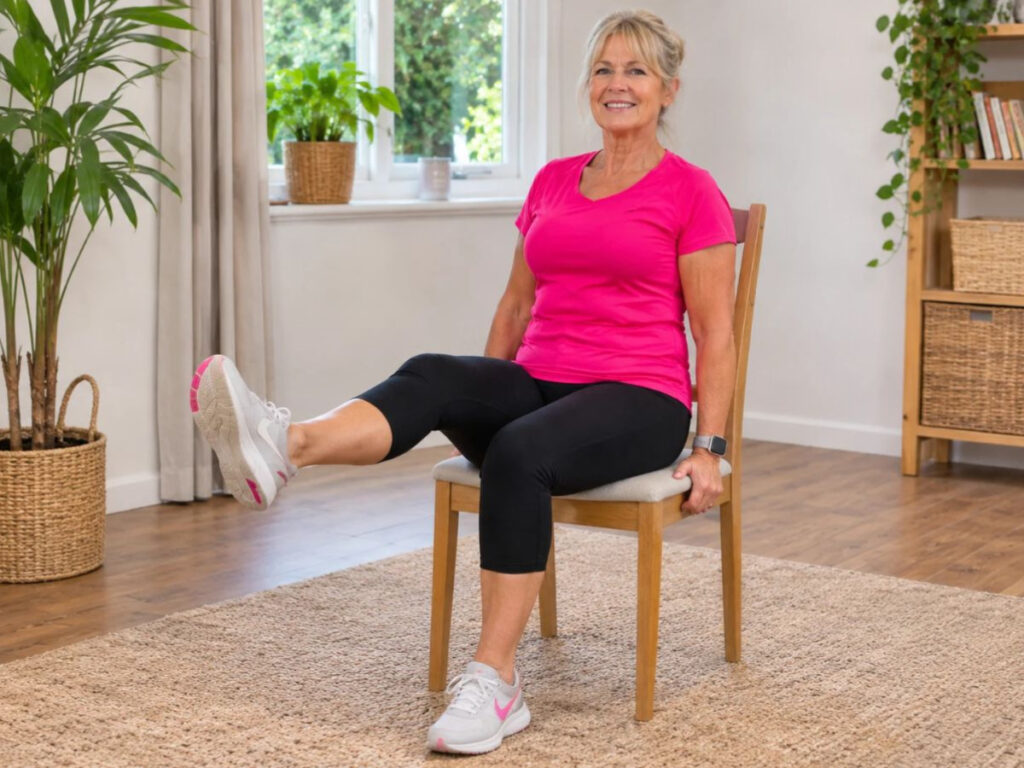
1. Seated Leg Lifts
This one works the front of your thighs, hip flexors, and lower tummy muscles, which can weaken when we spend a lot of time sitting. Strong thighs support your knees and help keep you steady when you walk.
How to do it:
- Sit tall near the front of the chair and keep your back straight with your feet flat on the floor.
- Hold the sides of the seat.
- Straighten one leg out in front of you until it’s level with your hip, or as high as you can comfortably go.
- Hold for 3 seconds, then lower it slowly.
- Swap legs.
Watch out: Don’t lean back to get your leg higher. Keep your back tall and let your thigh do the work.
Make it harder: Point your toes up toward the ceiling while you hold, or add a light ankle weight.
| Seated leg lifts at a glance | |
|---|---|
| Works | Front of your thighs, hips and lower tummy |
| Reps | 10 to 12 on each leg |
| Helps with | Walking, your knees and your balance |
| Make it harder | Toes up, or a light ankle weight |
2. Chair Squat Hover
This is the most useful move in the routine, because it trains the exact movement you make every time you get out of a chair, the car, or the bathtub. It works your glutes, your thighs, and your core.
How to do it:
- Stand in front of the chair with your feet hip-width apart.
- Push your hips back and bend your knees as if you’re about to sit down.
- Stop just before your bottom touches the seat and hold for 2 seconds.
- Press through your heels to stand back up tall.
Watch out: Keep your knees in line with your toes, and don’t let them fall inward.
Easier version: Sit all the way down between each one, and use your hands on your thighs to help you up until your legs are stronger.
| Chair squat hover at a glance | |
|---|---|
| Works | Glutes, thighs and core |
| Reps | 10 to 15, slow and controlled |
| Helps with | Getting up from a chair, the car or the toilet |
| Easier version | Sit all the way down and use your hands to help |
3. Seated Arm Press
Your arms and shoulders lose strength too, and you notice it when you lift a suitcase into the overhead bin or put the good plates back on a high shelf.
This press works your shoulders, the backs of your arms, and your upper back, which also helps your posture.
How to do it:
- Sit tall with your feet flat and your tummy pulled in.
- Hold a light weight or a water bottle in each hand at shoulder height, with your palms facing forward.
- Press both arms up over your head until they’re straight.
- Lower them slowly back to your shoulders.
Watch out: Keep your back still as you press up. If you feel it arching, use lighter weights.
Easier version: Start with no weights at all, or press one arm at a time.
| Seated arm press at a glance | |
|---|---|
| Works | Shoulders, backs of your arms and upper back |
| Reps | 12 to 15, slow on the way down |
| Use | Water bottles or light hand weights |
| Helps with | Lifting, carrying and standing up straight |
4. Seated Knee Pull-Ins
This one works the deep core muscles that wrap around your middle and support your spine. A strong core helps you stay upright and steady, so you’re less likely to wobble when you reach or turn.
How to do it:
- Sit near the front of the chair and hold the sides of the seat.
- Lean back a little and stretch both legs out in front of you, with your heels just off the floor.
- Bend your knees and pull them in toward your chest, squeezing your tummy muscles.
- Push your legs back out slowly without letting your feet touch the floor.
Watch out: Stop if you feel it in your lower back. Lean back less and keep the move small.
Easier version: Keep one foot on the floor and pull one knee in at a time.
| Seated knee pull-ins at a glance | |
|---|---|
| Works | Deep core and hips |
| Reps | 10 to 12 |
| Helps with | Balance, and sitting and standing tall |
| Easier version | One knee at a time, other foot on the floor |
5. Seated Torso Twist
The last move keeps your spine moving, which makes everyday things like looking over your shoulder when you reverse the car or reaching for the seat belt a lot easier.
It also works the muscles along the sides of your middle and can ease a stiff back.
How to do it:
- Sit tall with your feet flat and your knees together.
- Hold a small ball or a water bottle in front of your chest, or just clasp your hands.
- Turn your upper body slowly to one side, keeping your hips and knees facing forward.
- Come back to the middle, then turn to the other side.
Watch out: Turn slowly and smoothly from your ribs, and never bounce or force it. If you have osteoporosis, check with your doctor before adding twists to your routine.
Make it harder: Hold a heavier ball, or hold your arms straight out in front of you as you turn.
| Seated torso twist at a glance | |
|---|---|
| Works | The sides of your middle and your spine |
| Reps | 10 to 15 to each side |
| Helps with | Turning, reaching and a stiff back |
| Make it harder | A heavier ball, or arms straight out |
About this article: Our health articles are based on published studies and advice from experts such as physiotherapists and dietitians, and the sources are linked in the article.
Disclaimer: The content in this article is for informational purposes only and is not intended to replace professional medical advice, diagnosis, or treatment. Always consult your doctor, physical therapist, or healthcare provider before starting a new exercise program, particularly if you have existing joint, cardiovascular, or balance conditions. This article may contain affiliate links.
Become a Lifestyle Library Insider
Health tips, money know-how, travel deals and garden ideas for life after 50, straight to your inbox.
Summer Williams is a lifestyle writer and social media manager and a writer and editor of Your Lifestyle Library (yourlifestylelibrary.com). She holds a BA (Honours) in Journalism from Sheffield Hallam University. She is also a qualified fitness instructor, holding the NCFE Level 2 Certificate in Fitness Instructing. She also creates content under her brand Summer Elizabeth Creative.