
I’ve never been a runner but have always enjoyed walking. I have a border collie who needs a lot of exercise, so I walk out of necessity and for enjoyment. Once I put on my playlist, I’m off, walking to the music, and because I live in the middle of nowhere in France, I’m usually singing my heart out.
Usually, I try to powerwalk to really get my heart pumping, but as I’ve gotten older, I’ve noticed my walking speed has slowed a bit. I can still do the distance, but not quite as fast as I did when I was ten years younger. Being a little out of breath, I put it down to the singing.
But a slower walking pace isn’t always about getting older; it’s often about how you walk. Once you know what to change, you’ll be surprised at the difference it makes.

Why Walking Speed Matters After 60
After having a full-body MOT (health check), something offered as part of our health insurance once you’re over 55, I’ve had a lot of health information thrown at me. Luckily, most of the professionals involved spoke pretty good English.
The main doctor grilled me on how much exercise I did, whether I got out of breath, how many times a week, the exertion level, etc. It was quite intense.
What I didn’t know was that your walking speed tells doctors a surprising amount about how well your body is holding up. A 2011 study pooled nine studies covering 34,485 adults aged 65 and over, and followed them for an average of 12 years.
Every 0.1 meters per second faster people walked was linked to roughly a 10 percent lower risk of dying during that time. Someone walking at about 2.5 mph was around 20 percent less likely to die than someone walking at 2 mph.

Why We Slow Down
Most of the time, your stride has simply shrunk without you noticing, so each foot lands a little closer to the other.
Three things feed into each other here. Your glutes don’t push the leg back as far as they used to. Your calves and ankles lose some of their spring.
And once you’ve had a wobble or two, your brain shortens your step on purpose to make you feel safer, which only slows you down more.
Found this useful? Get more like it in your inbox as a Lifestyle Library Insider.
5 Exercises For Restoring Your Walking Speed
The obvious answer is to walk more, and that’s good for you. But if every step is already too short, you’re just taking more short steps. Over time, shorter steps make you less steady; being less steady makes you more cautious; and being more cautious means you sit more and walk less.
To break it, the step itself has to get longer and stronger. That means building up the muscles behind it and practicing the movement until it feels natural again. So which exercises do trainers say actually work?
1. Banded Standing Hip Extension
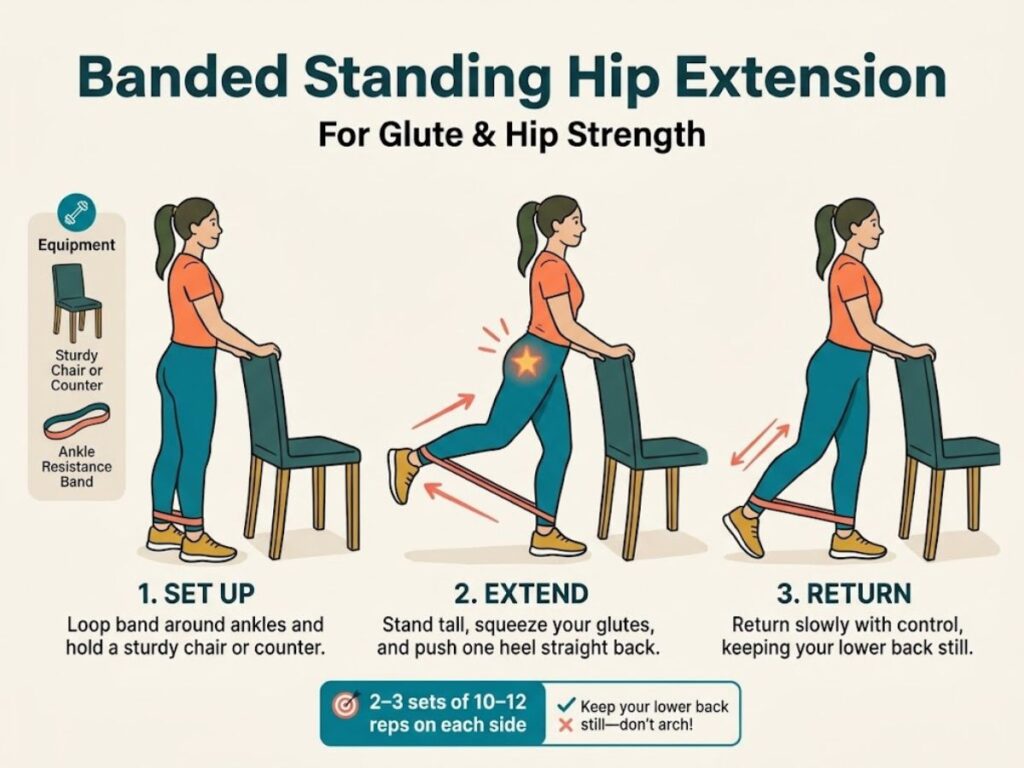
A longer step starts behind you, not in front. When your hip stops extending properly, your front foot lands short, and your pace drops.
This move teaches your glutes to drive the leg back against resistance, which is exactly what they need to do with every step.
- Loop a resistance band around both ankles and hold onto a kitchen counter or the back of a sturdy chair.
- Stand tall, squeeze the glute on the working side, and push one heel straight back.
- Keep your hips square and your lower back still, then bring the leg back slowly against the band’s pull.
- Do 10 to 12 reps on each side, 2 or 3 sets.
If your lower back starts to arch, you’ve taken the leg too far. Smaller, cleaner reps do far more good.
2. Sit-to-Stand for Stride Power

Matthew Cifelli, a physical therapist at Attain Physical Therapy, says, “The sit-to-stand exercise helps strengthen the quadriceps and glutes, which are the primary muscles responsible for forward propulsion during walking”.
They’re the muscles that fire every time your back leg pushes you into the next step.
- Sit on the front half of a sturdy dining chair with your feet flat and about hip-width apart.
- Lean your chest forward over your knees, press through your heels, and stand up without using your hands.
- Lower yourself back down slowly, tapping the chair rather than flopping onto it. Do 8 to 12 reps, 2 or 3 sets.
If standing up without your hands is too much at first, put a cushion on the chair to raise the seat and work down from there. Once 12 reps feel easy, hold a light dumbbell at your chest.
3. Seated Marches to Restore Walking Strength
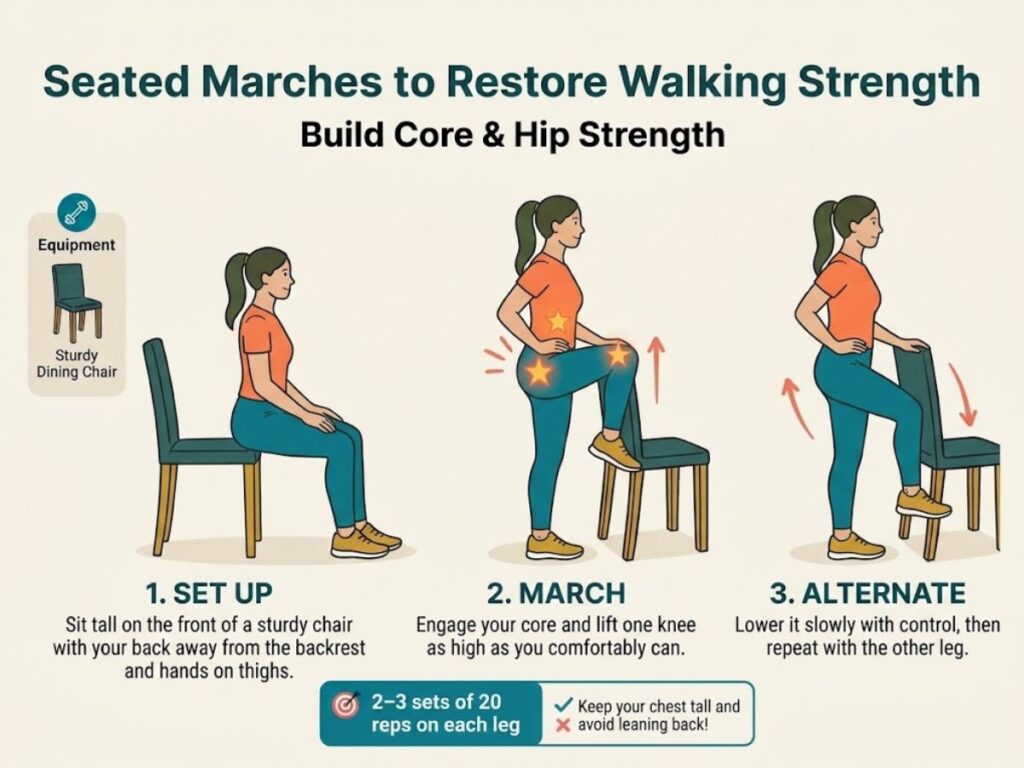
James Brady, a certified personal trainer at OriGym, says, “Seated marches are one of the best chair exercises for restoring walking strength.”
They wake up the hip flexors that lift your knee at the start of every step, and those are often the first muscles to fade when you’ve been sitting more and walking less.
- Sit tall in a sturdy chair with your feet flat and your hands on your thighs.
- Lift one knee as high as you comfortably can, lower it slowly, then lift the other.
- Sit forward so your back isn’t resting against the chair, and your core has to do some work too.
- Aim for 20 lifts on each leg, 2 or 3 sets.
Once that feels easy, speed up a little and swing your arms to match, left arm forward as your right knee lifts. You’re basically walking in place in your chair.
4. Squats and Lunges for Power
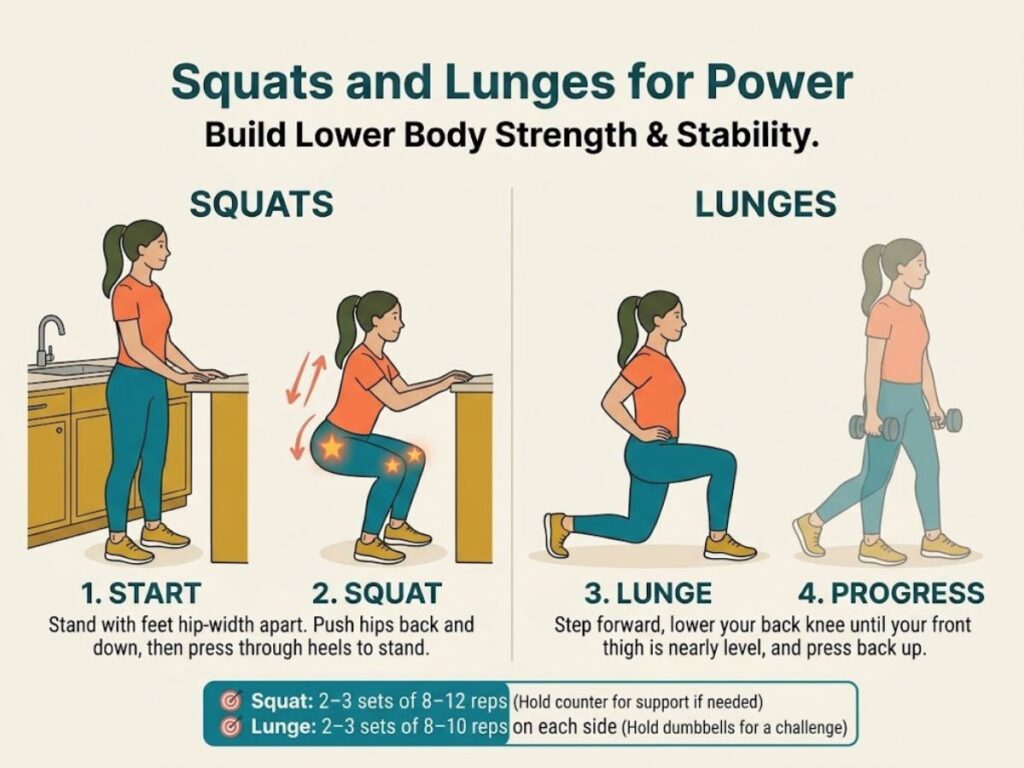
Ronny Garcia, a certified personal trainer at Blink Fitness, says. “Exercises such as squats, lunges, and leg presses help improve strength and power, which are essential for faster walking”.
Strength is how much force your muscles can make. Power is how quickly they can make it, and a brisk step needs both.
- For a squat, stand with your feet hip-width apart
- Push your hips back and down as if you’re sitting into a chair, then press through your heels to stand up.
- Do 8 to 12 reps, 2 or 3 sets, and hold onto a counter if you need to.
- For a lunge, step one foot forward and lower your back knee toward the floor until your front thigh is nearly level, then press back up.
- Do 8 to 10 on each side.
- Once that feels manageable, hold a light dumbbell in each hand.
5. Figure-8 Walk for Stride and Turning
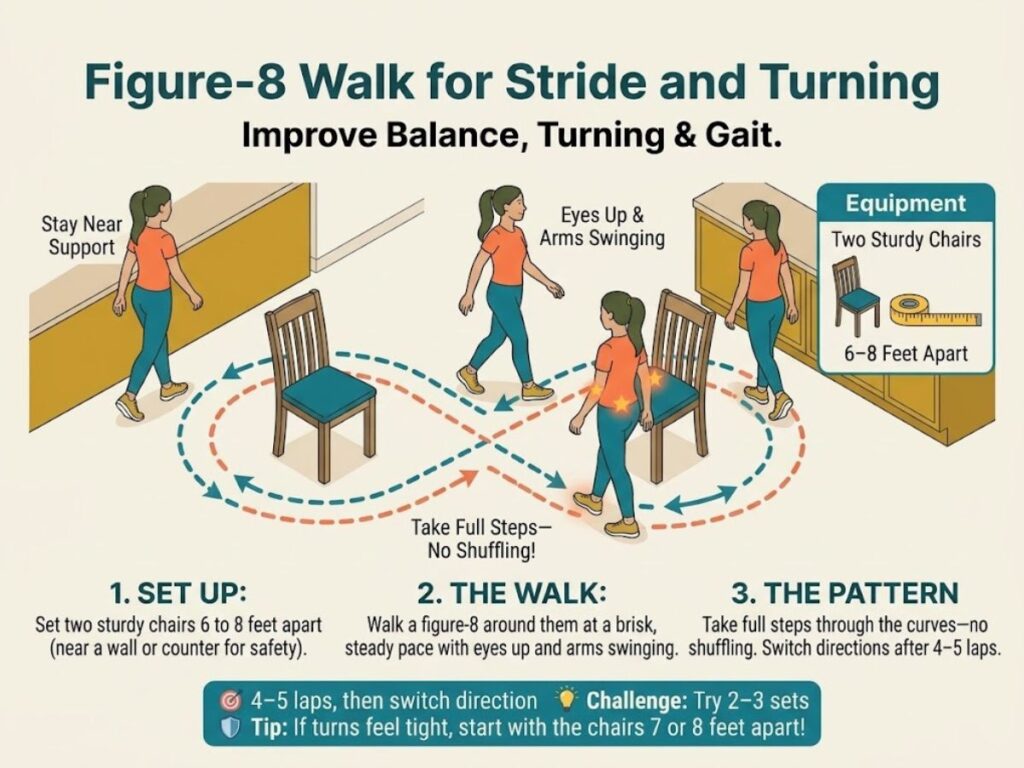
Turning is where a lot of us slow right down, because the brain shortens the step to keep us upright around the bend. Practicing the turn on purpose teaches you to keep your step full all the way around.
In a trial of adults with an average age of 80, a standing program built around the timing and coordination of walking improved mobility more than a seated program focused on strength and flexibility.
- Set two sturdy chairs about 6 feet apart in a hallway or across the kitchen.
- Walk a figure-8 around them at a brisk but steady pace, eyes up and arms swinging, and keep each step full through the curve instead of shuffling.
- Do 4 or 5 laps, then switch direction.
- If the turns feel tight, start with the chairs 7 or 8 feet apart, and keep a wall or counter within reach the first few times.
About this article: Our health articles are based on published studies and advice from experts such as physiotherapists and dietitians, and the sources are linked in the article.
Disclaimer: The content in this article is for informational purposes only and is not intended to replace professional medical advice, diagnosis, or treatment. Always consult your doctor, physical therapist, or healthcare provider before starting a new exercise program, particularly if you have existing joint, cardiovascular, or balance conditions. This article may contain affiliate links.
Become a Lifestyle Library Insider
Health tips, money know-how, travel deals and garden ideas for life after 50, straight to your inbox.

Kylie Lang is a nationally syndicated travel journalist with bylines on the Associated Press Wire & more, a lifestyle writer, and the founder and editor of Your Lifestyle Library (yourlifestylelibrary.com). She holds a BA (Honours) in History from the University of Kent and is a member of the British Guild of Travel Writers.