
A friend texted me a couple of months ago asking if I’d heard of Zone 2 cardio. She’d seen three different people mention it in one week, on three different podcasts, and she wanted to know if it was another wellness fad or something worth paying attention to.
I told her I’d look into it, mostly because I’d been seeing it too, and as a middle-aged woman, I’m always looking for different ways to try and lose my menopause belly. So I did.
I read the studies, talked to a couple of people who’d tried it and whose opinions I trust, and gave it a proper go myself. Turns out it’s actually pretty good and not just the latest fad with a load of hype that doesn’t follow through.
What Is Zone 2 Cardio?
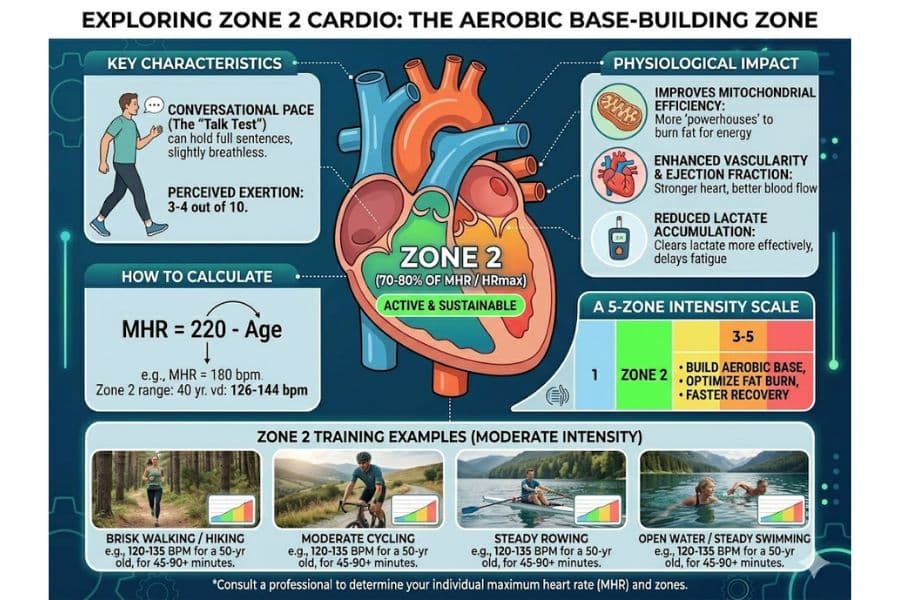
Zone 2 is a pace, not a workout style. The idea comes from a five-zone system coaches use to talk about heart rate, where Zone 1 is basically a stroll and Zone 5 is an all-out sprint that you can hold for maybe thirty seconds before you want to lie down.
Zone 2 sits low on that scale. It’s the pace at which you’re working, but you could still hold a conversation. Not a comfortable conversation, mind you, but a real one with full sentences.
In terms of numbers, Zone 2 usually falls between 60 and 70 percent of your maximum heart rate. A rough way to find yours is to subtract your age from 220, then take 60-70% of that.
For a 45-year-old, that’s roughly 105 to 122 beats per minute. The talk test works just as well if you don’t have a watch. If you can chat but you’d rather not be asked to recite a poem, you’re probably there.
Why Zone 2? Well, it’s where your body burns fat as its main fuel and trains the mitochondria, the tiny power plants inside your cells, to work more efficiently. A 2024 study looking at low-intensity endurance training found measurable improvements in mitochondrial function and metabolic flexibility, which is fancy talk for how well your body switches between burning fat and burning carbs.
That ability to switch is linked to everything from energy levels to blood sugar control.

Why The Slower Pace Does More Than You’d Expect
This suits me down to a tee because it’s what I already do most days. When I walk my dog, I go for about an hour, and at least two-thirds of that is at a brisk pace that gets my heart rate going. It’s almost power-walking but not quite.
Low-intensity steady-state work builds what’s called your aerobic base, which is essentially the size and efficiency of the engine you use for everything that isn’t a sprint. A bigger aerobic base means you recover faster from harder efforts, you have more energy across the day, and your resting heart rate tends to drop over time.
One study found that polarized training, where most of the work is done at low intensity and only a small slice is done at high intensity, produced greater endurance gains than spending all your time in the middle zone.
There’s also the matter of stress. Hard workouts spike cortisol, and while that’s fine in small doses, doing it five days a week on top of work stress and not enough sleep can leave you wrung out.

What 12 Weeks Of Zone 2 Looked Like For Me
I started in early March with a goal of five Zone 2 sessions a week, each one between 40 and 60 minutes. Now, this wasn’t hard because of my dog walks, but I was paying more attention to my heart rate. Time for my FitBit to earn its keep.
The first two weeks were interesting because to stay in Zone 2, I had to walk slower than I wanted to, especially uphill. Every hill kicked my heart rate up into Zone 3, and I’d have to slow to almost a saunter to bring it back down.
By week six, things shifted. I could walk faster at the same heart rate. Hills that used to send me into the red were doable at a steady clip. My resting heart rate had dropped by about four beats per minute, which doesn’t sound like much but is a real change in a short window.
I wasn’t losing weight dramatically, and I want to be straight about that because Zone 2 isn’t marketed as a fat-loss miracle and shouldn’t be. What I noticed instead was that I felt steadier throughout the day. Less of that mid-afternoon crash where I’d want to put my head down on the desk or reach for the cookie jar.
How To Fit It Into A Normal Week
The standard recommendation is around 150 to 180 minutes of Zone 2 per week, split into sessions of at least 30 minutes. That sounds like a lot until you realize it includes things you might already be doing, like a long walk with the dog or a brisk walk to work. The threshold to count is just that your heart rate has to be in the zone and stay there.
A few things that helped me actually stick with it:
- Use a heart rate monitor for the first month. After that, you’ll know the feel of it. I rarely check mine now unless I’m on a new route, because I can tell from my breathing whether I’m in the zone. Chest straps are more accurate than wrist devices for this purpose, and you can find decent ones for around $ 40.
- Don’t try to add it on top of everything else you’re already doing. If you’re already exercising five days a week, swap two of those sessions for Zone 2 rather than tacking them on. Adding more volume to an already full week is how people burn out in a fortnight.
- Count the easy stuff. A long walk counts. Gardening that gets your heart rate up counts, and yes, mowing the lawn counts.
- Expect the first few weeks to feel slow. Mine did. The slower you have to go to stay in the zone, the more you actually need this kind of training. That’s the bit that surprised me most.
Who Should Be Careful With It
Zone 2 is about as low-risk as exercise gets, which is part of why it’s becoming popular with older adults and people returning from injury. But there are still a couple of things worth flagging.
If you’re on beta blockers or any medication that affects your heart rate, the standard formulas won’t apply to you, and you’ll want to use the talk test or check with your doctor to find your actual target zone.
If you have any heart condition, even a managed one, get clearance before you start anything new, even something this gentle. The pace is easy, but the duration adds up, and an hour of sustained effort is still an hour of sustained effort.
I also wouldn’t recommend Zone 2 as someone’s only form of movement long-term. Strength training matters too, especially as we get older, because muscle mass and bone density don’t maintain themselves. Two days of resistance work alongside your Zone 2 is a much stronger setup than Zone 2 alone.
The other thing to remember is that Zone 2 takes time, both per session and in how long it takes to see results. If you’re someone who needs the satisfaction of a sweaty, hard workout to feel like you’ve done something, this style of training will frustrate you for a while.
Disclaimer: This article is for general information and isn’t a substitute for advice from your doctor or a qualified healthcare provider. If you have any underlying conditions or are starting a new exercise routine, check in with them first.