
My neighbor is turning 60 this year. He runs four times a week, six or seven kilometers each time, and puts me to shame. I’m five years younger than him. I walk my dog every single day, often covering similar distances, but I can’t run like that.
My knees would stage a full revolt within a kilometer. Every time I see him heading off in his sneakers, looking annoyingly fit and full of energy, I get what I’ve decided to call Exercising FOMO. He’s clearly doing something right. So shouldn’t I be doing it too?
Maybe you know the feeling. There’s a friend, a neighbor, or a sibling out there who seems to have cracked the fifty+ fitness code, and you’re left wondering whether you’ve been doing it all wrong. Well, I’m here to tell you that running isn’t the be-all and end-all.
My neighbor’s running is great for him, but it’s not actually the best thing he could be doing for a long, healthy life. Neither is walking. Neither is cycling. Neither is yoga.
The single most powerful exercise you can do after 60 to add years to your life is strength training. And the experts are saying it should be non-negotiable.

What the Research Actually Says
Let’s get the science out of the way quickly because I know you don’t want a lecture.
A study followed more than 115,000 people aged 65 and over for nearly eight years. Those who did strength training at least twice a week had a significantly lower risk of dying than those who didn’t. When strength training was added to 2.5 hours of regular cardio per week, the risk of death during the study period dropped by 30%.
Let that sink in for a minute. A 30% lower risk of dying.
Mayo Clinic researchers studying muscle tissue from nearly 200 people concluded that resistance training can actually reverse age-related changes in muscle, even in people who don’t start until after age 70. As Mayo Clinic’s Dr. Andrew Jagim put it, you can keep building muscle into your 80s and beyond.
Then there’s grip strength, which is one of the most reliable predictors of how long you’ll live. Grip strength reflects overall muscle strength, and overall muscle strength tells your body’s story.
So why does this matter so much more after 60?
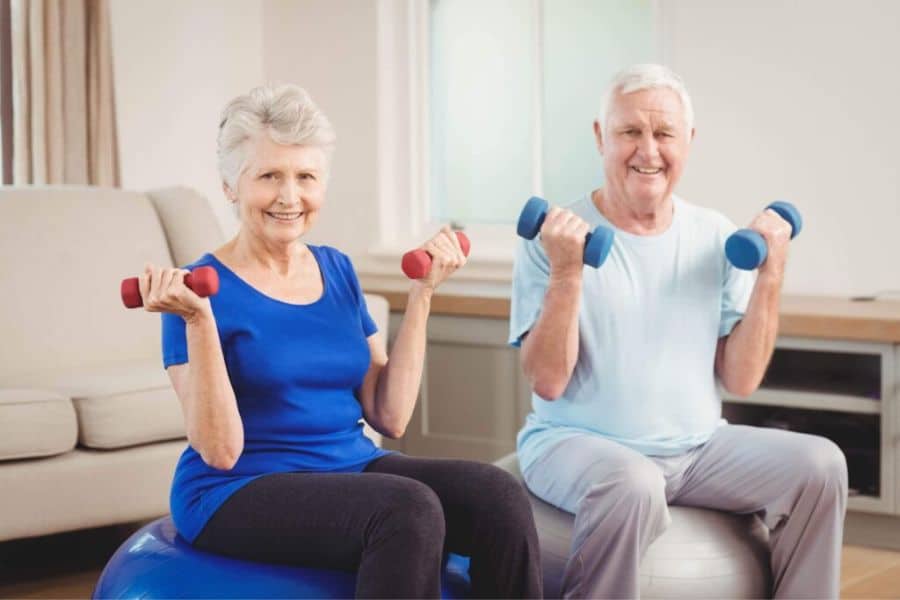
Why Muscle Becomes Your Lifeline After 60
After we hit 30, we start losing between 3% and 8% of our muscle mass every decade. After 60, that loss accelerates. The medical name for it is sarcopenia, and most of us have never heard of it until our balance starts going or we struggle to open a jar.
Lose enough muscle, and you lose more than physical strength. You lose balance, bone density, and the metabolism that keeps weight off. You lose your ability to recover from a fall, the flu, or a hospital stay. The people who end up in nursing homes are rarely there because they couldn’t run a marathon, but because they couldn’t get out of a chair on their own anymore.
Running, walking, and cycling are wonderful for your heart and lungs. But they don’t build the muscle you need to keep getting up off the floor when you’ve been gardening too long. Strength training does.
It also has a list of side effects, such as lower blood pressure, better blood sugar control, stronger bones, improved sleep, better mood, and sharper memory. The Mayo Clinic research I mentioned earlier showed an average 7-point drop in systolic blood pressure for people over 60 who trained consistently.
The really good news for those who aren’t fitness fanatics? You don’t need much.
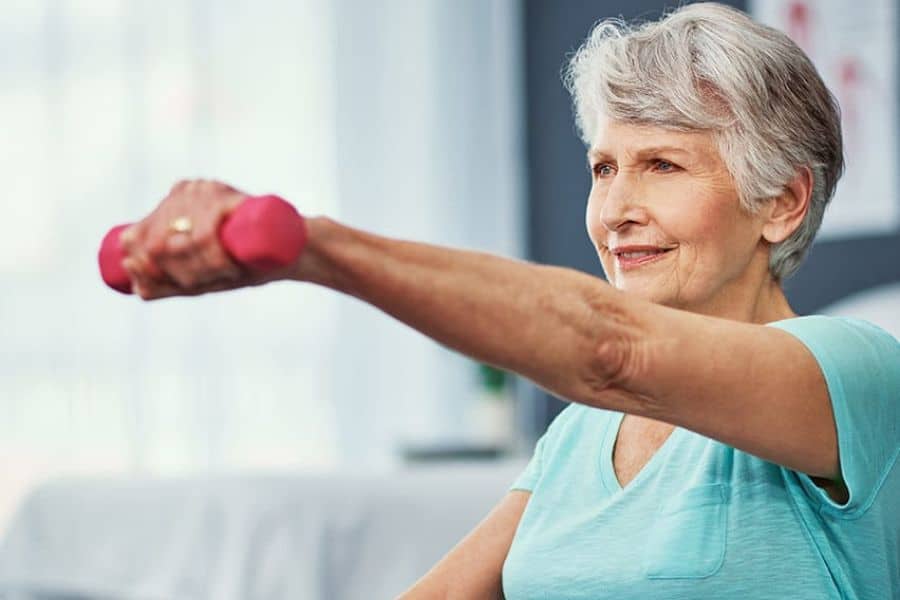
How Much Strength Training You Actually Need
Most studies point to the same sweet spot. Around 30 to 60 minutes a week, spread across two or three sessions, is enough to deliver almost all of the longevity benefits.
That’s it. Two short sessions a week. No daily commitment.
Some research suggests doing more than that doesn’t add much extra benefit and can occasionally do harm if you push too hard. So if you’ve been putting it off because you thought you’d need to live in a gym, breathe a sigh of relief.
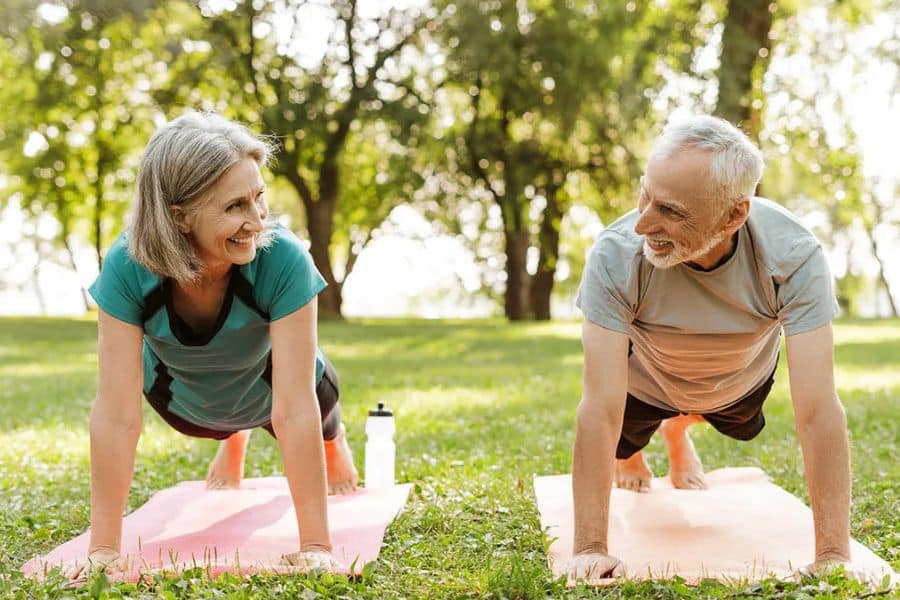
The At-Home Strength Routine for People Over 55
You don’t need a gym or any fancy equipment. I live in rural France, where the nearest gym is 45 minutes away, so this matters to me too.
Everything below uses just your own body weight, a sturdy chair, and a wall. If you have a couple of soup cans or full water bottles, even better, but they’re optional.
Here are seven moves that hit the muscles you need most. Aim for two sessions a week, doing two sets of each exercise.
1. Sit-to-Stands
This is the single most useful exercise you can do. Sit on a sturdy chair, feet flat, then stand up without using your hands. Lower yourself back down with control. That’s one rep.
Aim for 10 to 15. If you’re struggling, use a higher chair or rest your hands lightly on your thighs.
This trains the exact movement you do dozens of times a day and is the difference between staying independent and not.
2. Wall Push-Ups
Stand about an arm’s length from a wall. Place your hands on the wall at shoulder height. Bend your elbows and lean in toward the wall, then push back. Aim for 10 to 12 reps.
This builds chest, shoulder, and arm strength without putting any pressure on your wrists or knees.
3. Calf Raises
Stand behind a chair, holding the back lightly for balance. Rise up onto the balls of your feet, hold for a second, then lower slowly. Aim for 15 reps.
Strong calves are what stop you from stumbling on uneven sidewalks and stairs. Some experts call them the body’s second heart because they help pump blood back up your legs.
4. Glute Bridges
Lie on your back, knees bent, feet flat on the floor. Squeeze your bottom and lift your hips toward the ceiling, hold for two seconds, then lower. Aim for 10 to 12 reps.
This wakes up the muscles that go to sleep when we sit too much. They protect your lower back and stabilize your hips when you walk.
5. Step-Ups
Use the bottom of a staircase or a low, sturdy step. Step up with your right foot, bring your left foot up to meet it, then step down. Repeat with your left foot leading. Do 8 to 10 per side.
This single exercise targets nearly every muscle in your lower body and improves balance at the same time.
6. Bicep Curls With Soup Cans
Hold a can of beans or a small bottle of water in each hand, arms by your sides. Bend your elbows to lift the cans toward your shoulders, then lower slowly. Aim for 12 reps.
Don’t laugh at the soup cans. They’re more than enough resistance for someone just starting out.
7. Standing Side Leg Raises
Hold the back of a chair for balance. Slowly lift one leg out to the side, keeping it straight, then lower with control. Do 10 per side.
This strengthens the smaller muscles around your hips that protect you from falls. They’re often the first to weaken with age, and the easiest to wake back up.
A Few Things to Keep in Mind
Start slowly. If you’ve never done any strength training before, even one set of each exercise is a wonderful beginning. Build up gradually over a few weeks.
Don’t skip the warm-up. Five minutes of walking in place, gentle marching, or arm circles will help prevent strain.
Listen to your body. Mild muscle soreness for a day or two is normal and means it’s working. Sharp pain is not, and you should stop and check with your doctor.
If you have any health conditions, particularly heart problems, osteoporosis, or arthritis, have a chat with your doctor or a physical therapist before starting.
The real beauty of strength training at our age is that it works fast. Most people notice better balance, more energy, and a feeling of being steadier on their feet within just a few weeks. The visible muscle changes follow a few weeks after that.
So if you’ve been feeling Exercising FOMO watching your fitter friends, here’s the secret. You don’t need to keep up with the runners; just doing two short strength sessions a week, in your own kitchen or bedroom, will likely outlast their marathons.
I think it’s time I stopped envying my neighbor and started building the kind of strength that’ll have me bouncing around long after his knees give out.
Disclaimer: This article is for general information only and is not medical advice. Please speak with your doctor or a qualified physical therapist before starting any new exercise program, especially if you have existing health conditions.