
Have you ever fired off an angry email and regretted it five minutes later?
You know the one. Your blood is up, your fingers are flying, and you hit send before your rational brain has a chance to catch up. By the time you’ve made a cup of tea, you’re cringing at what you’ve just done.
Acting on panic with your retirement fund works exactly the same way.
The market wobbles, the news is full of doom, and suddenly you’re tempted to pull everything out and stuff it under the mattress. But like that angry email, decisions made in fear almost always come back to bite you. Act in haste, repent at leisure, as my mother used to say.
I’m five years out from my own planned retirement at 60, and looking at the world right now, I haven’t got half the things in place that I should. My retirement advisor and I have a meeting next week to start putting new plans in place because, frankly, the volatility lately has me thinking harder about all of this.
If you’re in the same boat, or already retired and watching your nest egg with worried eyes, this one’s for you. There’s a simple framework called the 10-5-3 Rule that can help you sleep at night.

Why Panicking Costs Your Retirement Fund More Than Riding It Out
Before we get to the rule itself, let’s tackle the panic problem head-on.
When markets crash, the worst thing you can do is sell. According to Hartford Funds research, about 42% of the S&P 500’s strongest days over the last 20 years happened during bear markets. Another 36% of the market’s best days happened in the first two months of a bull market, before anyone even realized the recovery had started.
Translation? If you bail when things look bad, you’ll almost certainly miss the very days that would have brought your portfolio back.
The COVID crash of March 2020 saw the market fall 34%. It fully recovered in just four months. The 2022 downturn took 18 months to bounce back. Even the worst crashes eventually recover, with the S&P 500 averaging a recovery time of about 2.5 years.
The market always recovers. The question is whether you’re still in it when it does.
What Is the 10-5-3 Rule?
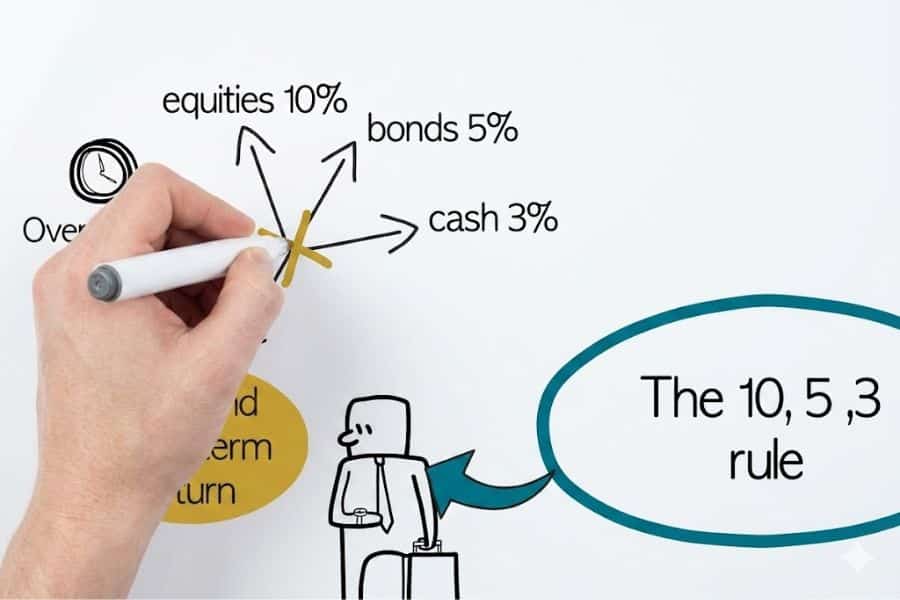
The 10-5-3 Rule is a long-standing rule of thumb that estimates the average annual returns you can expect from three main investment types over the long haul.
- Stocks: around 10% per year
- Bonds: around 5% per year
- Cash and savings: around 3% per year
Originally coined by James O’Donnell in his 2008 book “The Shortest Investment Ever,” the rule does two jobs at once. It sets realistic expectations for what each asset class can deliver and gives you a framework for splitting your portfolio across those three buckets.
It’s not a guarantee, and any financial advisor will tell you actual returns can vary year to year. But it’s stood the test of time as a simple way to anchor your thinking when everyone else is losing their heads.
Why the Rule Works So Well in Volatile Markets
The 10-5-3 framework forces you to spread your money across three different risk levels. Stocks bring growth, bonds bring stability, and cash brings safety and access. When one part takes a hit, the other parts cushion the blow.
This matters more than ever as you approach or enter retirement because of something called sequence of returns risk. Fancy term, simple meaning. If you suffer big market losses in the first few years of retirement, while you’re also withdrawing money to live on, you can do permanent damage to your portfolio. The money you sell at low prices isn’t there to grow when the market recovers.
Morningstar calls the first five years of retirement the “danger zone” for exactly this reason. Research by retirement expert Wade Pfau found that about 77% of your final retirement outcome is determined by the average return of your first decade of retirement.
That’s a sobering statistic. But the 10-5-3 Rule helps you build the kind of portfolio that can weather those early years without forcing you to sell stocks when they’re down.
How to Apply the 10-5-3 Rule to Your Own Portfolio
The basic idea is to use those return expectations to decide how much of your money to allocate to each asset class, based on your age, timeline, and risk tolerance.
A common approach for retirees and near-retirees looks something like this:
- A larger slice in bonds for stability and predictable income
- A smaller but meaningful slice in stocks for ongoing growth (because retirement can last 30 years or more)
- A solid cash buffer to cover one to two years of living expenses without ever needing to touch your investments
That cash buffer is the secret weapon. When markets drop, you’re not forced to sell anything. You just live off your cash for a year or two while the rest of your portfolio recovers.
Most financial advisors recommend shifting your allocation toward more bonds and cash about three to five years before retirement. If you’re already retired, the work shifts toward keeping that buffer topped up and rebalancing once a year so the percentages stay roughly where you want them.

A Real-World Example: Meet Nancy
I don’t know about you, but I’m a visual gal and like to see how things work in reality. In this case, we’re using a fictitious retiree called Nancy.
Nancy is 65 years old and has just retired with a portfolio worth $750,000. She wants to enjoy her retirement, travel a bit, help her grandkids with college, and still leave something behind. She’s worried about the markets but doesn’t want to be so cautious that inflation eats her savings.
Using a 10-5-3-inspired allocation suited to a new retiree, Nancy might split her money like this:
Stocks: 50%, or $375,000 Bonds: 35%, or $262,500 Cash and short-term savings: 15%, or $112,500
That cash bucket gives her around two years of living expenses if she needs $50,000 a year to cover her costs. Her bonds provide steady, predictable returns of around 5% on average, generating roughly $13,000 in interest each year. Her stocks continue to work for long-term growth, expected to average around 10% over time.
Now imagine the market drops 25% in Nancy’s first year of retirement. Scary, right?
Here’s what actually happens. Her stock portion falls from $375,000 to about $281,000 on paper. But she doesn’t have to sell a single share. Instead, she pulls her living expenses from her cash and bond buckets while the market recovers.
When the market eventually bounces back (and history shows us it will), her stocks recover too. She’s still got her nest egg, she’s still got her income, and most importantly, she’s still got her sanity.
Compare that with Nancy’s neighbor, who panicked, sold his stocks at the bottom, and locked in those losses forever. He’ll never get that money back.
What to Do When the Market Is Crashing
Here’s your panic-proof checklist for when the news is full of doom and gloom, and your stomach is in knots.
Don’t check your portfolio every day. Seriously. Watching the daily ups and downs is the fastest way to make bad decisions. Once a month is plenty.
Live off your cash buffer. This is exactly what it’s for. Let your stocks ride out the storm.
Resist the urge to sell. Selling locks in your losses. Holding gives you the chance to recover.
Talk to your advisor before making big moves. Just like asking a trusted friend to read your angry email before you send it, a second opinion can save you from yourself.
Rebalance once a year, not in a panic. If your stocks have dropped significantly, your overall mix may need adjustment. But do it deliberately and unemotionally.
Remember the timeline. Even bad bear markets recover within a few years. Your retirement might last 25 or 30 years. The crash of today is a blip in that timeline.
A Few Things to Keep in Mind
The 10-5-3 Rule is a starting point, not a finished plan. Your personal situation, including your other income sources, your health, your tax bracket, and your goals, all affect what your ideal mix should look like.
Inflation also chips away at returns over time, so the real-world numbers may be lower than the rule suggests. The 5% bond return assumption hasn’t always held up since 2008, and current interest rates change the picture, too.
This is why having a qualified financial advisor in your corner matters. They can help you adapt these guidelines to your actual life, not the textbook version. If you don’t have one, this is the moment to find one. Most offer a free first consultation, and the right advisor can pay for themselves many times over.
Markets will keep doing what markets do. They’ll rise, they’ll fall, and they’ll rise again. The retirees who thrive aren’t the ones who tried to time it perfectly. They’re the ones who built a sensible plan and stuck with it through the bumps.
Take a breath. Don’t send the angry email. Your future self will thank you.
Disclaimer: This article is for general information only and is not financial advice. Investment values can rise and fall, and past performance is not a guarantee of future results. Please speak with a qualified financial advisor before making any decisions about your retirement portfolio.