
Ever since I hit my 50s, I’ve started thinking more seriously about retirement. Now, I know it should have been on my radar long before this, but for many reasons, it wasn’t. I was a single mom raising a daughter who figure skated competitively, so all my time, money, and energy went on that.
Then, all of a sudden, that wasn’t my main focus anymore. My daughter retired from the sport, went to university, I met my husband, and we moved to southwest France. And just like that, in the blink of an eye, retirement was looming on the horizon.
Like most people, I have a retirement nest egg, but quite frankly, I don’t really understand how it all works. Nobody has ever explained what to actually do with the money once you stop working. Do you put it all in stocks? Keep it in savings? Start drawing it down immediately?
I feel like you need a PHD in finance to understand all the ins and outs, until my brother, who is a couple of years younger than me and who works in finance, sat me down and outlined a very simple system.

Why the Standard Retirement Advice Fails
The conventional wisdom goes something like this: put 60% of your money in stocks and 40% in bonds, and you’ll be fine.
The trouble is that formula tells you what to own, but it says nothing about which money to spend first, how to survive a market crash without selling everything at a loss, or how to make sure your money keeps growing fast enough to outpace inflation. It gives you a snapshot but no roadmap.
Women, statistically, also need that money to last longer. The average American woman lives to 87. If you retire at 65, you’re potentially planning for more than two decades of living expenses. That’s a long runway, and getting the strategy wrong early can have consequences that follow you for years.
The Strategy: The Bucket Approach to Building a Retirement Portfolio
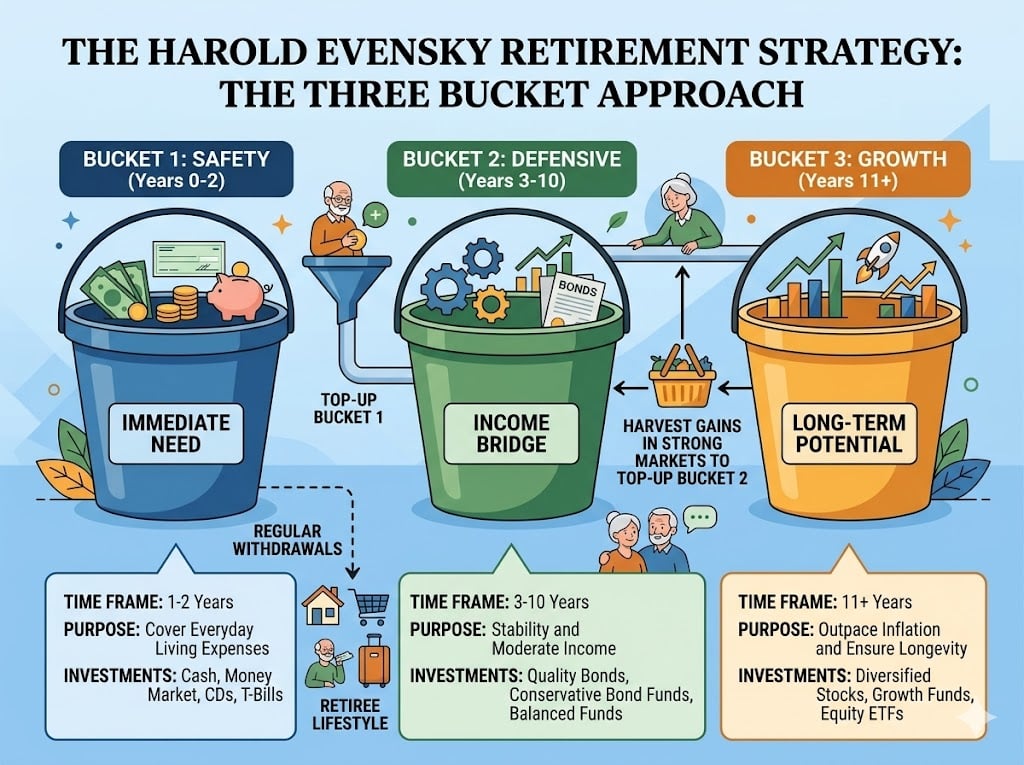
In 1985, a wealth manager named Harold Evensky came up with a deceptively simple idea. Instead of lumping all your retirement savings into one big pot and hoping for the best, he suggested dividing it into separate buckets, each with a specific job to do.
The idea evolved over time, and Morningstar helped bring it to mainstream attention. Today, it’s one of the most widely recommended frameworks in retirement planning, precisely because it works on two levels. It makes both mathematical and psychological sense. When you can see your money organized by purpose, you make calmer, smarter decisions.
The three buckets are simple.
Bucket One keeps your money safe and accessible for the near term. Bucket Two generates a steady income to replace your paycheck. Bucket Three grows your wealth over the long haul to fight inflation.
That’s it. Three buckets, three jobs, one clear plan.
Bucket One: The Money You Never Have to Worry About

Think of Bucket One as your financial breathing room. This is the money sitting in safe, easily accessible accounts that you can live on without touching your investments.
The goal is to hold one to two years of living expenses here. If you need $60,000 a year, Bucket One holds $60,000 to $120,000.
Good options for Bucket One include high-yield savings accounts (currently earning around 4 to 5% in 2026), short-term certificates of deposit, Treasury bills, and money market funds. The point is not to earn a spectacular return. The point is that this money is there when you need it, no matter what the stock market is doing.
When markets get rocky, and they will, you live off Bucket One and leave your other investments alone. This single move prevents the most common and costly mistake in retirement: selling investments at a loss because you need cash and have no other option.
Here’s where the first big mistake creeps in. Fear makes people overfill this bucket. It feels safe to have three or four years of expenses sitting in a savings account. But cash sitting in a low-yield account while inflation runs at 3% is losing purchasing power every single year.
Keep Bucket One lean. One to two years of expenses, not more.
Bucket Two: Your New Paycheck

Once you stop working, you stop getting a monthly paycheck. Bucket Two is what replaces it.
This bucket holds investments that generate regular income, things like dividend-paying stocks, bond funds, and REITs (real estate investment trusts). These are steady, income-producing assets that pay you on a schedule, much like a paycheck did.
Bucket Two typically holds 30 to 50% of your total portfolio. The income it generates flows into Bucket One to keep it topped up, which means your safety net refills itself without you having to sell anything.
A word of caution here. High dividend yields can look tempting, but a stock paying an 8 or 9% dividend is sometimes doing so because the company is in trouble and the dividend is about to be cut. Focus on companies with long, consistent dividend histories rather than the highest dividend on offer.
From a tax perspective, try to hold dividend stocks in taxable accounts and bonds in tax-deferred accounts, such as your 401(k) or IRA. Bond interest is taxed as ordinary income, which can be as high as 37%, while qualified dividends are taxed at the much lower capital gains rate.
Bucket Three: The Bucket That Keeps Your Money Young

This is the one that confuses people. Why would a retiree keep money in stocks? Because inflation is relentless, and a retirement fund that doesn’t grow is one that slowly shrinks.
Here’s a number worth sitting with. At 3% annual inflation, $100,000 today is worth about $74,000 in ten years. In twenty years, it’s closer to $55,000. If your money just sits still, your lifestyle gets smaller, whether you notice it or not.
Bucket Three, which holds 30 to 60% of your portfolio depending on your age and risk comfort, is the part that fights back. Stock index funds and growth investments have historically outpaced inflation over the long term. The S&P 500 averaged around 10.5% annual returns from 1970 to 2020. Even after accounting for inflation, that’s real growth.
The key rule for Bucket Three is one that sounds simple but is never sell during a market crash.
In March 2020, the market dropped 34% in a matter of weeks. Those who panicked, moved everything to cash, and locked in those losses missed the recovery that followed. By the end of 2020, the market had fully recovered and then some. Those who sat on their hands and did nothing came out ahead, and those who sold at the bottom did not.
This is exactly why Buckets One and Two matter so much. They give you the financial runway to leave Bucket Three alone during downturns, which is the only way to let it do its job.
How Much Goes Where (And How To Know If You’ve Got It Right)

The right split across your three buckets depends on your age, health, and how comfortable you are with risk. Here are some general starting points.
If you’re between 60 and 65, you likely have 20 to 25 years ahead of you. A reasonable split might be 10 to 15% in Bucket One, 35 to 40% in Bucket Two, and 50 to 55% in Bucket Three. Growth still matters a lot at this stage.
Between 65 and 75, you’re in the sweet spot most retirement planners focus on. Something like 15 to 20% in Bucket One, 45 to 50% in Bucket Two, and 35 to 40% in Bucket Three gives you income stability with meaningful long-term growth.
At 75 and beyond, it makes sense to shift toward more income and safety. Around 20 to 25% in Bucket One, 50 to 55% in Bucket Two, and 25 to 30% in Bucket Three works well for most people at this life stage.
If you’re married, plan for the longer of the two lifespans. Women typically outlive men by five to seven years, and the surviving partner needs that growth bucket to keep working for decades.
Don’t get too hung up on hitting these numbers exactly. Review your split every year or two and adjust as your life changes.
The One Move You Must Make Every Year

Setting up your three buckets is not a one-and-done exercise. The market will shift your allocations over time without you doing a thing. A growth bucket that starts at 40% of your portfolio could easily become 60% after a strong stock market run, which means you’d be taking on far more risk than you planned for.
Once a year, check your percentages and rebalance back to your targets. If your growth bucket has done well, sell some of those gains and move the proceeds into Bucket One and Two. This locks in profits and refills your income and safety layers simultaneously.
In a strong bull market, when stocks are up significantly, consider moving a bit more from Bucket Three to the other two buckets. In a downturn, stop drawing from Bucket Three entirely and rely on Bucket One and the income from Bucket Two while the market recovers.
The Biggest Mistakes That Can Wreck the Whole Plan
The three-bucket strategy is simple, but simple things can still go sideways. These are the three mistakes that most often derail it.
Keeping too much in Bucket One. Fear feels like prudence, but excess cash in a savings account loses ground to inflation every year. One to two years of expenses is enough. More than that is costing you growth.
Panic selling from Bucket Three. This is the one that does the most lasting damage. Selling stocks during a crash turns a temporary paper loss into a permanent real one. The entire point of having Buckets One and Two is so you never have to touch Bucket Three at the wrong moment. Trust the system.
Never rebalancing. Set it and forget it sounds appealing, but markets will drag your allocation away from where you want it. An annual check-in and a few adjustments keep the whole system working the way it’s supposed to.
The bucket strategy works. It has worked for retirees since Harold Evensky first sketched it out forty years ago. But it only works if you follow it consistently, especially when markets are making you feel like doing the opposite.
The content in this article is for informational purposes only and does not constitute financial advice. Please consult a qualified financial advisor before making any decisions about your retirement savings or investment strategy.