
You’ve worked hard your whole life, saved what you could, and now you’re standing at the door of retirement, wondering what to do with the money you’ve built up.
The stock market seems like a smart move. And it can be. But it’s also a place where it’s easy to make costly mistakes, especially when you’re new to it.
But it’s like most things, a little knowledge goes a long way. Most of these mistakes are entirely avoidable once you know what to look out for.

The Basics of Investing for Retirees
Investing in retirement is completely different from investing in your 30s or 40s. Back then, if the market dropped, you had decades for it to recover. Now, the timeline is shorter, and the stakes are higher because this is the money you’re actually living on, or soon will be.
That doesn’t mean avoiding the stock market altogether. With retirement potentially lasting 20 to 30 years, leaving everything in cash or low-yield savings accounts means you’re leaving money on the table with no way to add to the pot.
Most financial experts suggest that even in retirement, your portfolio needs some exposure to stocks to keep pace with rising costs. The general thinking from T. Rowe Price is that someone in their 60s might hold somewhere between 45% and 65% in stocks, with the rest in bonds and cash. Someone in their 70s might dial that back to around 30% to 50%.
But those are just percentages on a piece of paper. How much risk you can handle emotionally is just as important as how much you can afford to take financially.
The key is going in with clear eyes. The stock market is not a shortcut to fast money, but a long-term tool, and it works best when you treat it like one.
6 Mistakes New Investors Make On the Stock Market
These are the easy mistakes many new investors make, and most of them have nothing to do with picking the wrong stock. They’re easy traps to fall into.
No. 1 Skipping the Research

This is so easy to do. A friend of mine fell into this trap and lost a considerable sum of money. A friend mentioned a stock that had done well for them. My friend had also read about it online and heard something on the news, and thought it sounded like a great investment. Unfortunately, it wasn’t, and he’d not done his due diligence on the company behind it all.
Buying stocks and shares without understanding the financial story behind them is the investment equivalent of booking a flight without checking where it’s going. You might end up somewhere you wanted to be. But it’s mostly luck.
Before putting money into any individual stock, look at the basics. What does the company actually do? Is it making a profit? Does it have debt? What are its growth prospects? If you can’t explain in a sentence or two why you’re buying it, you’re not ready to buy it.
If that all seems too much, then try Index funds and ETFs. They spread your money across hundreds or thousands of companies at once, removing the need to pick winners. They’re lower-cost and lower-risk, and they’ve historically outperformed most actively managed funds over the long term. More on that in a minute.
No. 2 Treating It as a Get Rich Quick Scheme

The stock market has made people wealthy, but it has also wiped people out, almost always when they were chasing fast returns.
The idea of doubling your money in a few months is appealing. But investing is a long game. The S&P 500 has historically returned around 10% per year, over decades, not months. Some years are up 25%. Others are down 30%. Over time, the direction has consistently been upward. But only for people who stayed in.
New investors who treat it as a casino tend to trade constantly, react to every bit of news, and buy into whatever is hot at the moment. That approach generates high transaction costs, potential tax liabilities on short-term gains, and more often than not, lower returns than simply holding steady.
No. 3 Allowing Your Emotions to Rule
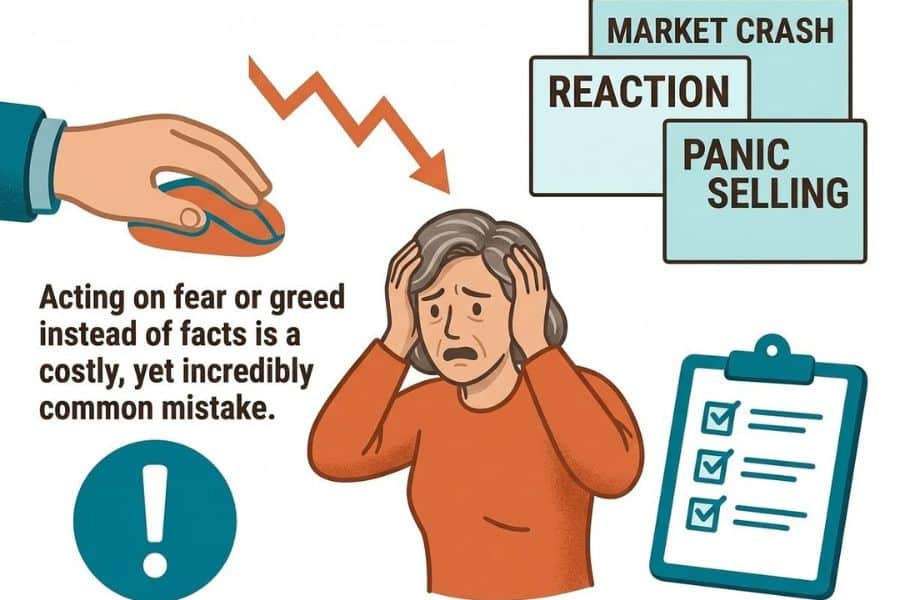
The market drops 10% in a week, and your stomach drops with it. Every instinct is screaming at you to sell before it gets worse.
This is the moment that separates successful investors from unsuccessful ones.
Emotional investing, where you buy when you’re feeling optimistic and sell when you’re scared, is one of the most reliable ways to lose money. You end up selling low after prices have already fallen and buying again later, when prices have recovered and feel “safer.” That’s the exact opposite of what you want to do.
Market corrections, those sharp drops of 10% to 20%, are a normal part of investing, as are bear markets. They’re scary, but they also pass.
No. 4 Not Diversifying Your Portfolio

Putting all your money in a single stock, sector, or asset type is a significant risk that many new investors underestimate.
Think about what happened to technology stocks in 2000 when the dot-com bubble burst, or bank stocks in 2008. Investors heavily concentrated in those areas lost enormous amounts of money, while those who were spread across different sectors fared much better.
Proper diversification means spreading your money across different industries, geographic regions, and asset types, such as stocks, bonds, and cash. Then, if one area takes a hit, the rest of your portfolio cushions the blow.
For most retiree investors, a total market index fund or a mix of a few broad index funds automatically achieves this. You don’t need dozens of individual stocks to be properly diversified. You just need to avoid putting everything in one place.
Also worth noting: diversifying within stocks is only part of the picture. Holding some bonds alongside your equities provides stability when stock markets get rocky. The right mix depends on your age, your income needs, and how much volatility you can comfortably sit with.
No. 5 Ignoring the Fees

This one is sneaky, because the fees don’t show up as a separate bill. They’re deducted in the background, and most investors have no idea how much they’re paying.
Every fund you invest in charges an expense ratio, an annual percentage of your assets taken to cover management and operating costs. For an index fund, that might be as low as 0.03% to 0.14%. For an actively managed mutual fund, the average is around 0.40%, and some charge considerably more. Advisory fees on top of that typically run between 1% and 1.5% of your assets annually.
Those numbers sound small, but they compound over time. A 1% fee on a portfolio doesn’t just cost you 1% of what you have today. It costs you 1% per year on a growing balance for as long as you’re invested. Research suggests that even a 1% annual fee can reduce your total returns by around 20% over 20 years.
Nearly 73% of investors have no idea how much they’re actually paying in fees. Before you invest in anything, check the expense ratio. Compare it to what a low-cost index fund would charge. And if you’re paying an advisor, make sure you know exactly what that costs and what you’re getting in return.
The FINRA Fund Analyzer is a free tool that lets you compare fees across more than 18,000 funds and see how they affect your returns over time. It’s worth spending an hour there before making any decisions.
No. 6 Overthinking Your Investments

On the other end of the spectrum from not doing enough research is doing too much of it. Checking your portfolio every day, reading every piece of financial news, and constantly second-guessing your choices is a fast track to making decisions you’ll regret.
Paradoxically, more activity often leads to worse outcomes. The more you tinker, the more opportunities you create to make costly moves based on short-term noise rather than long-term strategy.
A good investment plan, reviewed quarterly or twice a year, is enough for most people. If you’ve chosen a diversified mix that matches your goals and your risk tolerance, the best thing you can do most of the time is leave it alone.
Think of it like planting a garden. You water it, you tend it occasionally, you keep an eye on it. But you don’t dig up the roots every week to check if anything is growing. You let it do its thing.
The investors who sleep best are usually the ones with the simplest portfolios. A couple of low-cost index funds, a sensible allocation between stocks and bonds, and the discipline to stay the course. It doesn’t have to be complicated to work.
Disclaimer: The information in this article is for general informational purposes only and does not constitute financial advice. Every investor’s situation is different, and the stock market carries risk, including the potential loss of capital. Please consult with a qualified financial advisor before making any investment decisions.
Disclaimer: The content in this article is for informational purposes only and is not intended as financial, investment, or tax advice. Always consult a qualified financial advisor or tax professional before making decisions about your money, investments, or retirement planning.

Kylie Lang is a nationally syndicated travel journalist with bylines on the Associated Press Wire & more, a lifestyle writer, and the founder and editor of Your Lifestyle Library (yourlifestylelibrary.com). She holds a BA (Honours) in History from the University of Kent and is a member of the British Guild of Travel Writers.