
A couple of weeks ago, I was visiting my mom in England, who has now reached the grand old age of 88. She asked me to open a jar of honey for her because her grip was strong enough. I struggled with it too and resorted to putting on a pair of rubber gloves to get a better grip.
It turns out that the strength of our grip tells us quite a lot about our body and what’s happening to it. Not only that, grip strength has become one of the most powerful predictors of how long you’ll live.
There’s a simple 30-second hand grip test you can do at home that cardiologists use, along with exercises you can do to strengthen and improve your grip for better results.

What Your Hand Grip Strength Is Actually Telling Doctors
For doctors who specialize in longevity and cardiovascular health, it’s a snapshot of your entire physiological system.
Grip strength is what researchers call a biomarker of aging. It doesn’t just reflect the condition of your hands and forearms, but serves as a reliable proxy for your total muscle mass, your neuromuscular health, and how well your cardiovascular system is actually functioning beneath the surface.
Dr. Peter Attia, one of the leading longevity physicians working today, consistently points to grip strength as one of the most telling indicators of physical robustness. When grip is weak, the broader system is usually struggling.
The Study That Changed How Doctors Think About Longevity

The most significant data on this subject came from the PURE study, which tracked just under 140,000 adults aged 35 to 70 across 17 countries over four years.
Grip strength predicted all-cause mortality more accurately than systolic blood pressure. Every single 5kg drop in grip strength was associated with a 16% higher risk of dying from any cause. The link extended to cardiovascular death, non-cardiovascular death, heart attack, and stroke. The study included 140,000 people from different income levels, cultures, and countries.
A separate large-scale study from the UK Biobank followed more than 500,000 participants aged 40 to 69 and confirmed that lower grip strength was associated with higher rates of cardiovascular disease, respiratory conditions, and all-cause mortality.
For women specifically, the hazard ratio per 5kg drop in grip strength was even slightly higher than for men.
Why This Matters More for Women in Midlife
Grip strength doesn’t decline uniformly over a lifetime. For women, there’s a specific accelerated window of muscle loss that begins during the perimenopause and continues into postmenopause. This is the period when estrogen drops sharply, and estrogen, it turns out, plays a direct role in maintaining skeletal muscle.
Research found that estrogen binds to receptors in skeletal muscle and influences muscle protein synthesis, metabolism, and inflammatory response. When estrogen falls, those protective mechanisms weaken.
Postmenopausal women can lose around 0.6% of muscle mass every year, and grip strength is often the first measurable sign that this process is underway.
A study examining muscle mass across menopausal stages found that lean mass was approximately 10% lower in late perimenopausal women than in those in early perimenopause. The prevalence of sarcopenia, the clinical term for significant muscle loss, jumped from roughly 3% in early perimenopause to 30% in late perimenopause.
That shift happens fast, and most women have no idea it’s occurring.
The reason grip strength matters so much as a measure is that it captures these changes early, long before they show up in the way you look or feel day to day. It’s a number you can track, test, and actively move in the right direction.
How to Do the 30-Second Hand Grip Test at Home
You don’t need a doctor’s appointment to get a baseline reading. There are two main ways to test at home.
The most accurate method is a handheld dynamometer, a small handheld device you can find online for around $20 to $30. This is the same type of tool cardiologists use in clinical settings.
To use it: stand comfortably with your arm at your side and your elbow bent to 90 degrees. Squeeze the device as hard as you can for 3 to 5 seconds. Rest for at least 60 seconds, then repeat. Do three squeezes per hand and record the average. Make sure to test both hands on the same day.
What matters more than any single result is your trend over time. Testing every three to four months gives you a meaningful picture of whether your grip is holding steady, improving, or declining.
If you don’t have a dynamometer yet, try the dead hang test as a quick pass-or-fail check.
Find a pull-up bar, door pull-up frame, or a sturdy overhead bar. Grip it with both hands, shoulder-width apart, and lift your feet off the ground. Hang for as long as you can.
Thirty seconds or more is a pass. Under thirty seconds, and your grip needs work. Under ten seconds is a signal to take this seriously and start training.
How Do Your Numbers Stack Up?
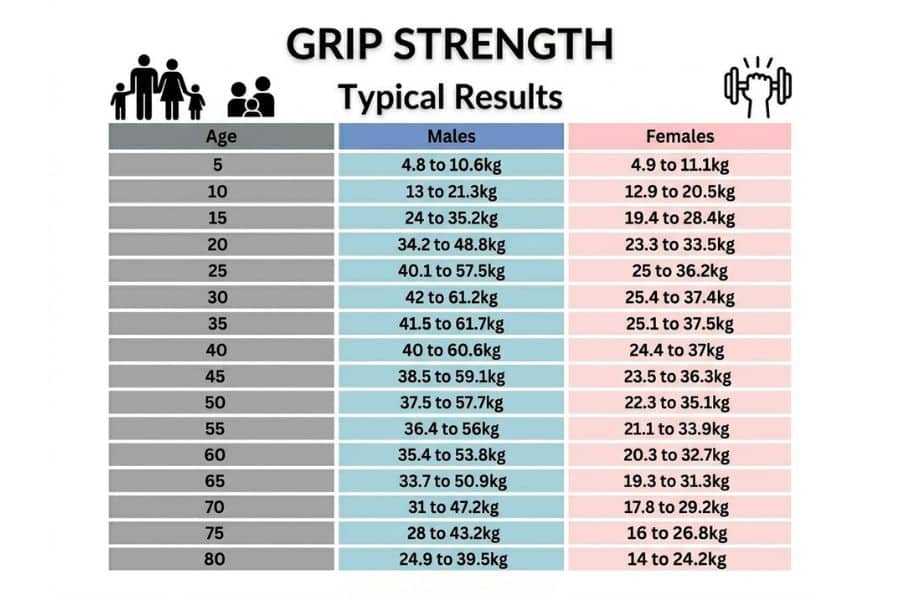
For women aged 40 to 50, a reading below 16kg is considered clinically weak, a danger zone associated with significantly elevated health risk. Below 20kg is weak. Around 29kg is normal. Above 35kg is strong.
For women aged 50 to 60, the numbers shift slightly. Below 15kg is the danger zone. Below 18kg is weak. Around 26-27kg is normal. Above 32kg reflects a strong grip.
If you’re in the normal to strong range, the goal is to maintain it. The natural trajectory is decline, so maintaining your numbers year on year is itself a meaningful result.
If you’re in the weak or danger zone, the exercises below are your starting point, and the earlier you begin, the faster you’ll see improvement.
Men’s benchmarks differ significantly. For men aged 40 to 50, a normal reading is closer to 46kg combined, with strong readings above 55kg.
5 Exercises to Build Grip Strength
One thing worth clearing up before we get into the exercises: Squeezing a stress ball won’t move the needle on your longevity markers. It builds almost no real strength. To see measurable improvement, you need load, resistance, and progressive challenge.
Here are five exercises that deliver exactly that.
Hand Squeezes
Grab a tennis ball or a stress ball, whichever you have to hand. Squeeze it as firmly as you comfortably can, hold for three to five seconds, then release completely. That full release matters just as much as the squeeze, so don’t rush it.
Do 10 to 15 repetitions per hand. One round takes about two minutes.
This exercise targets the finger flexors, the muscles in your palm, and the forearm muscles that power grip. It’s simple, effective, and one of the few exercises you can do while watching television or waiting for the kettle to boil.
Finger Extensions with a Rubber Band
Loop a rubber band around the outside of all four fingers and your thumb. Slowly spread your fingers apart, pushing against the band’s resistance. Hold for a second at full extension, then bring your fingers back together with control.
Do 10 to 15 reps per hand. If the band snaps off immediately, try a thicker one or fold it once for more resistance. If you can’t feel any resistance at all, double it up.
Training the finger extensors alongside the flexors reduces the risk of overuse problems in the tendons and improves dexterity in a way that purely squeezing exercises can’t. Your hands work as a system, and this exercise keeps that system balanced.
Towel Wringing
Take a small hand towel or a cloth, dampen it slightly if you like, and twist it firmly in both hands as if you’re wringing out water. Twist clockwise for 15 to 20 seconds, then reverse direction for another 15 to 20 seconds. Rest for 30 seconds, then repeat 3 times.
The reason this works so well is that it mimics the rotational demands your hands deal with in daily life. Opening jars, turning taps, twisting caps. Those movements draw on the deep muscles of the forearm and wrist, not just the surface-level grip muscles that most exercises target.
Wrist Curls
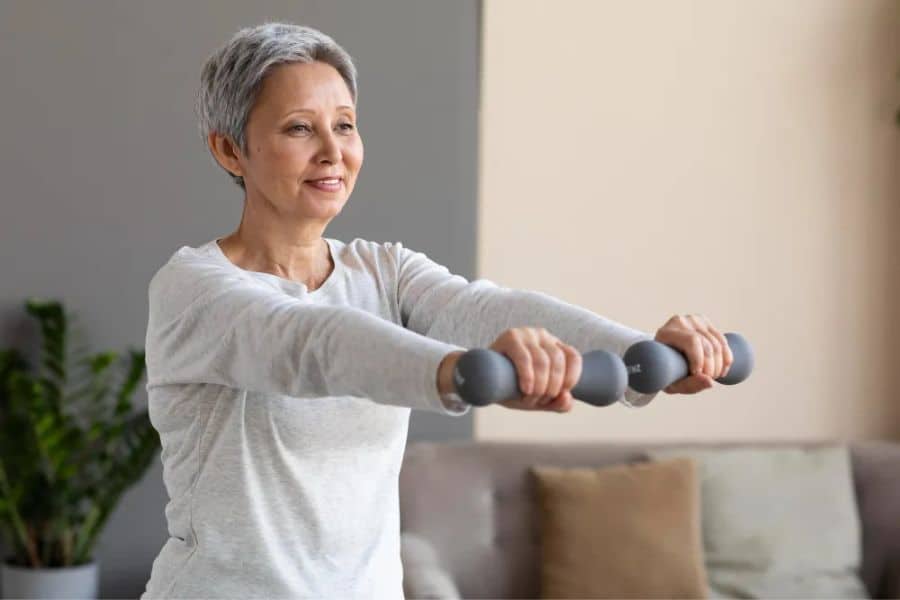
Pick up a light dumbbell or a full water bottle. Sit in a chair, rest your forearm along your thigh or on the edge of a table, and let your wrist hang slightly off the edge with your palm facing upward.
Slowly curl your wrist upward as far as it comfortably goes, hold for a count of one, then lower it back down in a controlled way. The downward phase is when much of the strengthening happens, so don’t let gravity do the work for you.
Do 10 to 15 reps per hand. Use a weight that feels manageable for the first few reps but challenging by the last three.
Grip Holds
Pick up a dumbbell, a filled grocery bag, or any reasonably weighted object. Hold it at your side with a firm grip and simply stand there. Aim for 10 to 30 seconds per hand before switching. Repeat three to five times on each side.
What this exercise trains is your ability to sustain grip under load, something that translates directly to everyday life. Carrying shopping, holding luggage, and steadying yourself. The muscles involved are the same ones your dynamometer is measuring when you take the test, which means this is one of the most direct ways to drive your numbers up over time.
Start with whatever you can hold comfortably for 10 seconds. Within four to six weeks of consistent practice, you’ll likely find you’re reaching 30 seconds without much effort.
How Often Should You Train Grip Strength?
Two to three sessions per week is the sweet spot. This provides your hands and forearms with sufficient stimulus to adapt, with adequate recovery between sessions.
Grip training is low-impact compared to heavy compound lifting, making it easy to add to an existing routine without causing a recovery problem. Farmer’s carries, for example, can go at the end of a lower body session. Dead hangs and plate pinches work well as a five-minute finisher after any workout.
One thing worth knowing: tendons and connective tissue in the hands adapt more slowly than muscle does. You may feel stronger in your forearms within three to four weeks, but your grip test scores typically improve most noticeably at around the six to eight week mark. Stick with it past the point where you expect to see progress.
Women who are just starting resistance training of any kind may also want to introduce grip work gradually to avoid overloading tendons that aren’t yet conditioned. Starting with two sessions per week and building to three over four weeks is a sensible approach.
The health content on Your Lifestyle Library is for informational purposes only and does not replace professional medical advice. Always consult with your healthcare provider before making changes to your exercise routine, particularly if you have existing joint, cardiovascular, or bone health concerns.