
As you get older, exercise becomes harder. That challenging workout you used to do at the gym now leaves you exhausted, and you don’t have the energy to go full pelt on the treadmill anymore. Even walking the dog takes more out of you than it used to.
Then there are other things to consider, such as your health. It might be your health prevents you from going to the gym or doing any type of workout. So instead of looking for alternatives, you stop altogether. This results in you losing your confidence, and everything starts to feel too hard. It’s a familiar pattern many people experience.
Whether you’re at that point or not, there are certain realities we all have to face. Your body can’t handle the same things at sixty as it could at fifty, and so on. It’s just nature doing its thing. You can’t fight nature, but you can give it a helping hand.
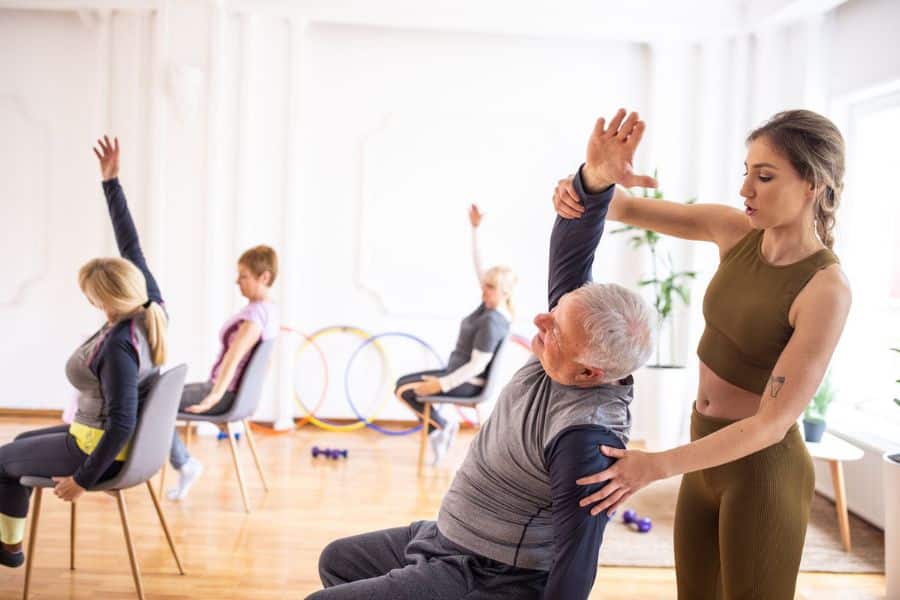
A 10 Minute Yoga Routine for People in Their 60s and 70s
I was moaning about all of this to my friend Becky the other day. She’s a yoga teacher who lives near me here in southwest France, and she works with a lot of older students who come to her feeling exactly like this. Nervous about hurting themselves, a bit achy, not sure where to start anymore.
So I asked her to put something together that anyone could actually do at home in the morning, and this is what she came up with.
It takes about 10 minutes, and most of it you can do sitting down. You’ll want a yoga mat or a soft rug, maybe a folded blanket or cushion for a bit of extra padding, and a sturdy chair somewhere nearby for the standing bits. Wear something comfy and just take your time.
If something doesn’t feel right, skip it. Becky’s first rule is always that nothing should hurt. A bit of a stretch is fine, pain is not.

1. Seated Breathing (1 Minute)
Every yoga routine starts with the breath, and there’s a good reason for it. Spend a minute just breathing, and you’ve already told your body it’s safe to relax, which is half the battle when you’re feeling stiff or anxious about moving.
Sit on the edge of a chair or cross-legged on your mat, whichever feels easier. Rest your hands on your thighs and close your eyes if that’s comfortable. Breathe in slowly through your nose for a count of four, hold for one, and breathe out through your nose for a count of six.
Just do that for a minute. That’s it. The longer exhale is the bit that does the work, so don’t rush the breath out.
2. Seated Neck Rolls (1 Minute)
I always start with my neck because it’s the first thing to seize up on me, especially after a long stretch at my desk or hunched over the garden pulling weeds. If you spend any time looking at a phone or laptop, you’ll probably feel it too.
Sitting tall, drop your right ear gently toward your right shoulder and hold for a breath. Then slowly roll your chin down toward your chest, hold, and continue over to your left shoulder. Come back up through the center. Do three slow rolls in one direction and three in the other.
Becky’s Top Tip: Keep everything small and slow. Don’t throw your head back on these; just keep it to gentle half-circles from ear to chest to ear.
Found this useful? Get more like it in your inbox as a Lifestyle Library Insider.
3. Seated Shoulder Rolls (1 Minute)
This one is so easy and feels so good. I do it half a dozen times a day without even thinking about it.
Still sitting, lift both shoulders up toward your ears and roll them back, squeezing your shoulder blades together as they go. Then down, forward, and back up again. Like you’re drawing slow circles with your shoulders. Five rolls backward and five rolls forward is about right.
If you’re anything like me and you spend too much time at a screen, your shoulders are probably creeping forward and rounding without you realizing. This kind of unwinds them without you having to think about it too much.
4. Seated Cat-Cow (1 Minute)
Seated cat-cow wakes up your whole spine and is great if you spend a lot of time sitting down, as I do. The seated version is nice because you don’t have to get down on all fours, which is a relief if your wrists or knees aren’t keen on the floor.
Sit tall with your hands resting on your knees. Breathe in, then gently arch your back, lifting your chest and looking slightly upward. Breathe out and round your spine the other way, tucking your chin toward your chest and pulling your belly in. Just flow between the two for about a minute, letting your breath set the pace.
Start the movement from your pelvis and let your head be the last thing to move. And keep it small. You’re not trying to do a full backbend here, just letting your spine do a bit of waking up.
5. Seated Side Stretch (1 Minute)
Side stretches allow you to feel everything along your ribs open up. It’s a lovely feeling.
Sit tall and rest your left hand on the chair beside you or on the floor. Breathe in and lift your right arm up, then breathe out and tilt gently to the left, reaching your right arm overhead. Hold for three breaths, come back to center, and switch sides.
Becky’s Top Tip: The key is to make sure both sit bones stay planted on the seat. The temptation is to lean and lift one hip up, which kind of cancels out the whole stretch. So stay grounded and let the reach come from your waist.
6. Seated Spinal Twist (1 Minute)
Twists are wonderful for stiffness in the back, and Becky tells me they’re also good for digestion.
Sit tall. Place your right hand on the outside of your left knee and your left hand behind you on the chair or the floor. Breathe in and lengthen your spine, breathe out and gently twist to the left, looking over your left shoulder. Hold for three to five breaths, slowly come back, and switch sides.
Becky’s Top Tip: Lead with your belly, not your head. The twist should start low and travel up your spine, with your neck being the last thing to turn. It’s a small distinction, but it makes a real difference.
7. Standing Forward Fold with Chair (1 Minute)
Time to stand up. Put a sturdy chair in front of you with the seat facing you.
Stand with your feet about hip-width apart. Breathe in and reach your arms overhead, then breathe out and fold forward, resting your forearms on the chair seat. Let your head hang heavy between your arms. Stay there for a minute, just breathing slowly.
Becky’s Top Tip: Bend your knees as much as you need to. The point isn’t to touch your toes or anything like that; it’s just to let your back lengthen and let your head get below your heart for a moment. Bent knees are absolutely fine.
8. Standing Chair Lunge (1 Minute, 30 Seconds Each Side)
This is the only pose that asks for a bit of strength from you, and it’s worth doing because it opens up the front of your hips. That’s where most of us hold tension from sitting too much, whether it’s at a desk or in the car.
Stand behind the chair with your hands on the chair back for balance. Step your right foot back about 3 feet, keeping both feet pointing forward. Bend your left knee gently, making sure it stays stacked over your ankle, and you should feel a stretch along the front of your right hip. Hold for 30 seconds and then switch sides.
Becky’s top tip: Tuck your tailbone slightly, almost like you’re tucking in a shirt at the back. That small adjustment is what turns it from a vague stretch into a really good one.
9. Standing Calf Stretch with Chair (1 Minute, 30 Seconds Each Side)
Tight calves are a really sneaky cause of balance problems and ankle stiffness, and most of us never bother stretching them out. Definitely worth fixing.
Stand behind the chair with your hands on the chair back. Step your right foot back, keeping the heel pressed firmly down and the leg straight. Bend your left knee in front. Hold for 30 seconds and then switch sides.
Becky’s Top Tip: The key thing is keeping that back heel pinned to the floor. If your heel keeps lifting, just take a smaller step back. A smaller stretch done properly is much better than a big stretch with your heel floating off the ground.
10. Legs Up the Chair (1 Minute)
This is the reward at the end, and after a long day in the garden, this works wonders.
Lie on your back on the floor with your bottom close to the chair, and rest your calves on the chair seat so your knees end up bent at about a 90-degree angle. Arms relaxed at your sides, palms facing up. Close your eyes and just breathe slowly. Stay there for a full minute, or longer if you’ve got the time.
This pose is brilliant for tired legs, helps blood flow back toward the heart, and basically tells your nervous system to calm down. It’s the perfect way to finish.
So that’s 10 minutes a day yoga routine, more or less, on your bedroom floor with a chair. The trick is just doing it most days. Even if you only manage half of it some mornings, that still counts.
A short routine done five days a week beats a 90-minute class once a month every single time. Remember the golden rule: consistency beats intensity. At our age, that’s probably the rule worth living by.
About this article: Our health articles are based on published studies and advice from experts such as physiotherapists and dietitians, and the sources are linked in the article.
Disclaimer: The content in this article is for informational purposes only and is not intended to replace professional medical advice, diagnosis, or treatment. Always consult your doctor, physical therapist, or healthcare provider before starting a new exercise program, particularly if you have existing joint, cardiovascular, or balance conditions. This article may contain affiliate links.
Become a Lifestyle Library Insider
Health tips, money know-how, travel deals and garden ideas for life after 50, straight to your inbox.

Kylie Lang is a nationally syndicated travel journalist with bylines on the Associated Press Wire & more, a lifestyle writer, and the founder and editor of Your Lifestyle Library (yourlifestylelibrary.com). She holds a BA (Honours) in History from the University of Kent and is a member of the British Guild of Travel Writers.