
Have you ever walked back to your car in an empty parking lot or down a dodgy looking underpass with your phone clamped to your ear, pretending to talk to someone? Most of us have done something like it at some point, and most of us have no idea what we’d do if someone came at us despite our little decoy.
The older we get, the more concerned we become. I live in France, and the recent demonstrations that have turned into riots are truly scary. It keeps me safely at home at night, not wanting to go out in the bigger towns or cities.
I’ve watched far too many superhero movies, and in my head I’d pull off some fancy karate move, disarm whoever grabbed me, and sprint off down the street. Realistically, I’d last about 2 seconds, and that’s a bit of a worry.
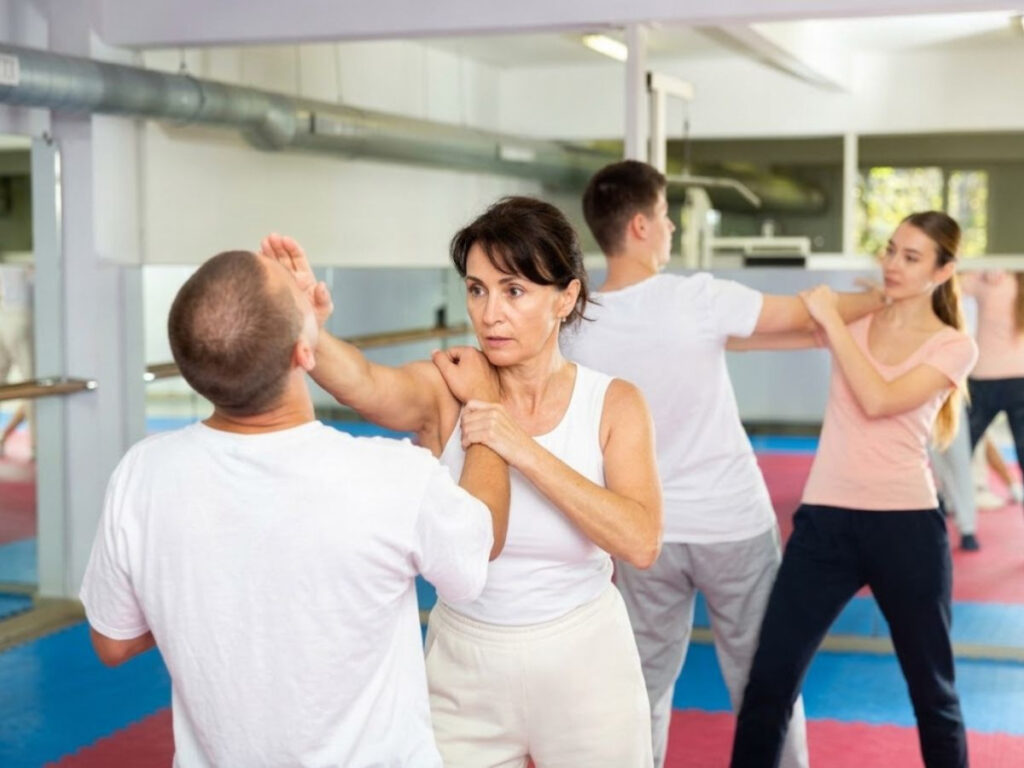
So I went to a self-defense class in our village hall. It was all in French, of course, but I picked the moves up quite quickly. I even managed to fend off the instructor on one of them! Each move is simple enough to remember, and they really do work.
I realized that self-defense at this age has very little to do with strength or fighting and everything to do with knowing the key points in the body to aim for and how to perform each move correctly. So much for my imaginary karate moves.
Why We Need Self-Defense Moves
We tend to imagine a stranger in a dark alley, but most trouble happens much closer to home. According to the Bureau of Justice Statistics, about 59% of violent crime against people 65 and older happened at or near their own homes.
Strangers were responsible for 43%, and about 1 in 5 attacks involved a weapon.
The good news is that older adults are attacked far less often than younger people, and fewer of them are injured. Even so, it’s worth knowing what to do on your own doorstep, in your own driveway, and in the parking lot of your local grocery store.
5 Self-Defense Moves For Seniors
Every move below has one job: to buy you a few seconds to get away. If you can walk off, call for help, or hand over your purse, do that first. Your phone and your wallet can be replaced, but you can’t.
The moves start with the gentlest and finish with the 2 you’d only use if you were in real danger.
1. Hands Up
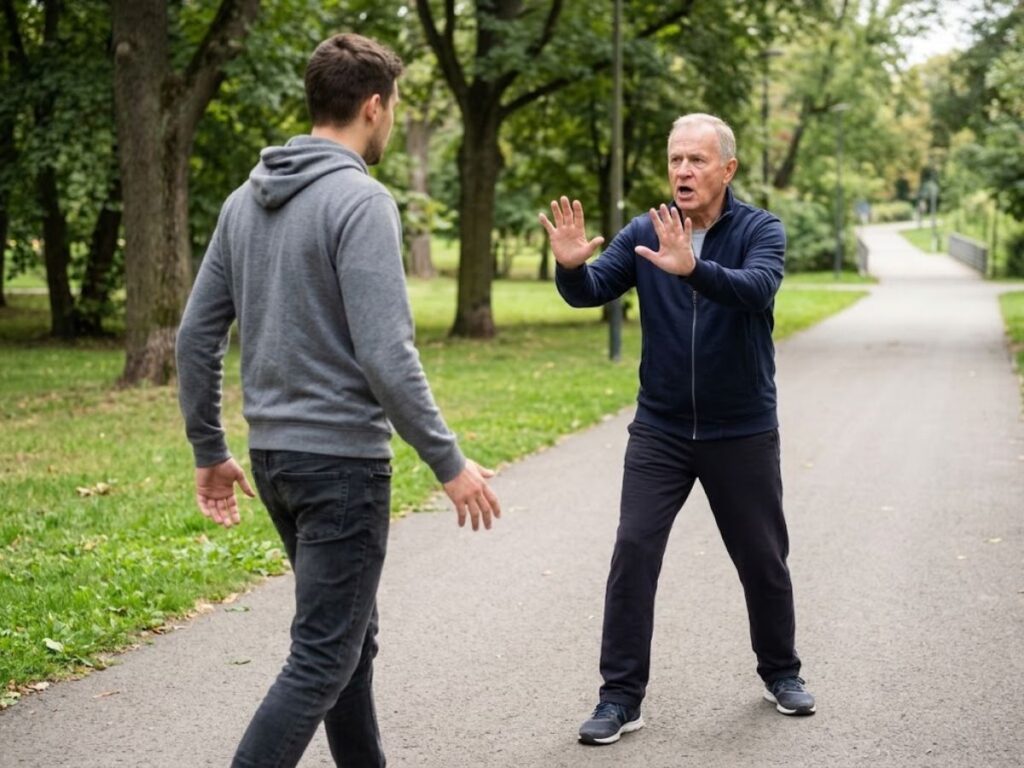
This is the move you’ll use most, because it stops trouble before anyone touches you. If someone walks toward you in a way you don’t like, put both hands up in front of your chest, palms out, and tell them firmly to stop.
To anyone watching, you look like the calm one, and your hands are already up if you need them.
How to do it:
- Put one foot half a step behind the other. It’s much harder for anyone to knock you over when you stand like this.
- Raise both hands to chest height with your palms facing out, your fingers relaxed and your elbows bent.
- Keep your hands about a forearm’s length in front of you, which leaves a little gap between you and them.
- Look them in the face and say “Stop” or “Back off” in a low, loud voice.
- Keep your hands up as you step back or sideways toward a door, a shop, or other people.
Watch out: Don’t let your hands drop the moment you start talking, and skip the apologies. A firm “Stop” works far better than “Sorry, I’m just trying to get to my car.”
| ✋ Hands up at a glance | |
| 🎯 Use it when | Someone comes toward you and you feel uneasy |
| 🧍 Stance | Feet apart, knees soft, elbows slightly bent |
| 🗣️ Say it | “Stop!” or “Back off!” loud enough for others to hear |
| 🚶 Then | Step back or sideways toward people or a door |
| 🏠 Practice | In front of a mirror, then add one step back |
Found this useful? Get more like it in your inbox as a Lifestyle Library Insider.
2. Wrist Release
If someone grabs your wrist, your first instinct is to pull straight back, which almost never works against a stronger grip and can hurt your shoulder.
The weak spot in any grip is the gap between the thumb and fingers, so you twist your arm toward their thumb and pull through that gap.
It takes a few tries to feel natural, so practice slowly until it does.
How to do it:
- Look at their hand and find their thumb, because that’s the side you’re heading for.
- Make a fist with your grabbed hand, which stiffens your wrist and makes it harder to hold.
- Bend your elbow and bring it in toward your body, so your arm isn’t stretched out straight.
- In one quick move, roll your wrist toward their thumb and pull your arm out through the gap between their thumb and fingers.
- Step back as your hand comes free, then walk away toward other people.
Watch out: Pulling straight back turns it into a tug of war, and they’ll usually win. If they use both hands on one arm, reach between their arms with your free hand, grab your own fist, and pull up hard toward their thumbs.
Easier version: If your wrists or shoulders are sore, practice the roll with no grip at all at first, then ask your partner to hold you loosely.
| 🤚 Wrist release at a glance | |
| 🎯 Use it when | Someone grabs your wrist with one hand |
| 🔄 The trick | Twist your arm toward their thumb |
| 💪 Add power | Bend your elbow and step back as you twist |
| ⚠️ Won’t work | Against a 2-handed grip or if you’re pinned to a wall |
| 🏠 Practice | With a partner holding your wrist very gently |
3. Foot Stomp
If someone has hold of you from behind or is pressed up close, bringing your heel down hard on the top of their foot can make them let go. Your heel is the hardest part of your foot, so use that rather than your toes.
The catch is that you have to stand on one leg for a second, which isn’t easy if your balance isn’t great.
If you’ve had a fall or you have arthritis in your knees, skip this one.
How to do it:
- Shift your weight onto the leg that’s staying on the ground.
- Lift your other knee only a few inches, as high as you can without wobbling.
- Drive your heel straight down onto the top of their foot, in the bony area between the ankle and the toes.
- As soon as their grip loosens, twist out of it and move away.
Watch out: This works much better in firm shoes than in soft slippers or bare feet, and there’s no need to stamp more than once.
Easier version: Instead of lifting your foot, scrape the edge of your shoe down the front of their shin and finish on top of their foot. Your foot barely leaves the ground.
| 🦶 Foot stomp at a glance | |
| 🎯 Use it when | Someone holds you from behind or close up |
| 👣 Aim | Your heel onto the top of their foot |
| ⚠️ Skip if | Your balance is shaky or you’ve had a fall |
| 🏠 Practice | Gentle taps on the floor, holding a kitchen counter |
4. Ear Slap
This one is for emergencies only. With your hand open and slightly cupped, swing it sideways into the side of their head, turning your body with it so the power comes from your hips rather than your arm.
A hard slap can cause dizziness and can burst an eardrum, so it’s never for someone who’s simply being rude or standing too close.
How to do it:
- Cup your hand as if you were scooping up water, with your fingers together.
- Keep your elbow slightly bent rather than locked straight.
- Turn your hips and shoulders together and swing your hand into the side of their head, right over the ear.
- Use the second they flinch to push them away and leave.
Why the cupped hand: A cupped hand traps air against the ear, and it’s that rush of air that causes the pain and ringing. A flat slap does far less.
Watch out: Never use a fist. It’s easy to hurt your own hand or wrist on someone’s head.
| 👂 Ear slap at a glance | |
| 🎯 Use it when | You’re being attacked and can’t get away |
| ✋ Hand shape | Open and slightly cupped, never a fist |
| 🔁 Power | Turn your body with the swing |
| ⚠️ Careful | Skip big swings if your shoulders are sore |
| 🏠 Practice | Slowly in the air, never on another person |
5. Eye Jab
This is the last resort. With your fingers slightly bent and relaxed, push your hand toward their eyes so they flinch, close their eyes, or turn away, and use that moment to run.
It can cause permanent damage to someone’s eyes, so it’s only for the moment you believe you’re in serious danger, and you should never practice it on anyone.
How to do it:
- Keep your fingers loose and slightly curled, as if you were holding a tennis ball.
- Push your hand straight out from your chest toward their face, like you’re flicking water at them.
- Pull your hand straight back so it can’t be grabbed.
- Turn and head for people or a door straight away, because they’ll recover in seconds.
Worth knowing: Most people blink and jerk their head back when a hand comes at their face, so even a move that only gets close can give you time to get away.
Watch out: Stiff, straight fingers are easy to jam or sprain, which is why you keep them loose.
| 👁️ Eye jab at a glance | |
| 🎯 Use it when | You fear serious harm and nothing else has worked |
| 🖐️ Hand shape | Fingers loose and slightly bent |
| 🏃 Then | Turn and head for people straight away |
| 🏠 Practice | Slowly in the air with your feet steady |
Which Move Should You Do When
| 🧭 Your quick guide | |
| 🚶 Someone comes too close | Hands up and step back |
| 🤚 They grab your wrist | Wrist release, then walk away |
| 🫂 They hold you from behind | Foot stomp if your balance allows |
| 🚨 You can’t get away | Ear slap or eye jab, then run |
| 💰 They want your purse | Hand it over |
About this article: Our health articles are based on published studies and advice from experts such as physiotherapists and dietitians, and the sources are linked in the article.
Disclaimer: The content in this article is for informational purposes only and is not intended to replace professional medical advice, diagnosis, or treatment. Always consult your doctor, physical therapist, or healthcare provider before starting a new exercise program, particularly if you have existing joint, cardiovascular, or balance conditions. This article may contain affiliate links.
Become a Lifestyle Library Insider
Health tips, money know-how, travel deals and garden ideas for life after 50, straight to your inbox.

Kylie Lang is a nationally syndicated travel journalist with bylines on the Associated Press Wire & more, a lifestyle writer, and the founder and editor of Your Lifestyle Library (yourlifestylelibrary.com). She holds a BA (Honours) in History from the University of Kent and is a member of the British Guild of Travel Writers.