
When we moved into our home in rural France, the backyard was an unholy mess. There was no structure to it at all, barely any plants other than a huge rosemary bush that took over the patio. I stood at the back door with a cup of tea, looked at it, and thought, right, where on earth do I start?
I had more ambition than money, as all our money was going on renovations, and a husband who, as ever, flatly refused to garden. That first year, I bought way too much, planted it in the wrong places, and watched about half of it die over a hot July. My quick fix garden didn’t work.
So if you’ve just moved somewhere with a bit of a sad looking yard, or you’ve inherited a plot that’s been neglected for years and you’re staring at it, wondering where on earth you start, this is the garden I’d plant now if I had to start over with a tight budget.
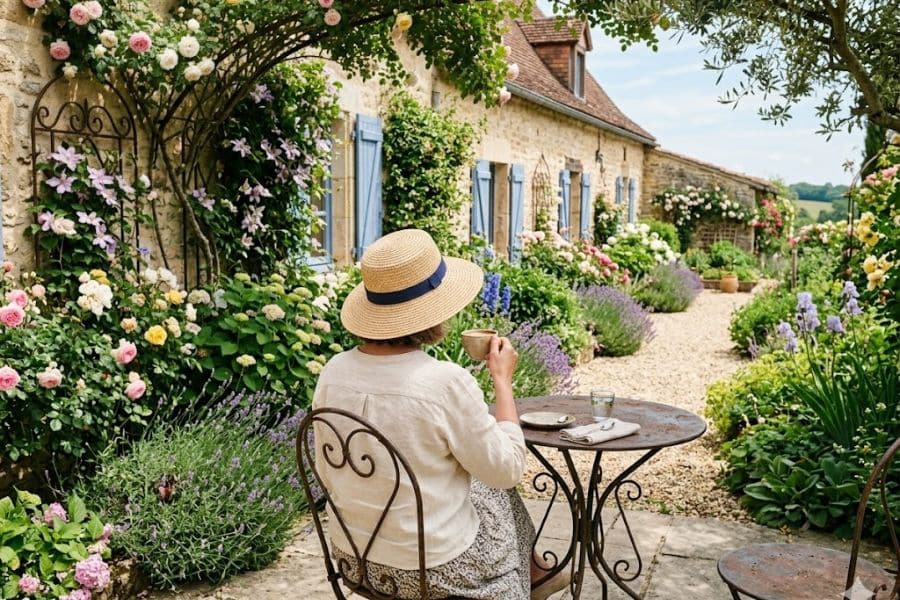
The Garden I’d Plant If I Were Starting From Scratch on a Tight Budget
Before I bought a single plant, I’d spend the first weekend just looking. Where does the sun hit at 10 am, at 2 pm, at 6 pm? Where does water pool after a storm? Which corner does the wind whip through?
Don’t skip this bit because it will make all the difference to whether your plants make it through the first season or simply wither and die. It’s exactly why my hydrangea gave up the ghost, because it hates full sun all the time. Lesson learned.
The budget side of this matters because garden centers in June are basically designed to separate you from your money. Everything’s in flower, and looks gorgeous, and you walk out $180 lighter with a trunk full of annuals that’ll be brown by September.
I’d rather spend $40 on three good perennials that come back every year than $80 on petunias I’ll be ripping out in October.
So the plan I’d follow now is roughly this: bones first (the shrubs and the one climber), then a small handful of hardy perennials, then fillers from seed and cuttings, then a few cheap thrills for color while I wait for the rest to grow in. That’s it. No grand design or Pinterest mood board, just a functional space till I know my garden a little better.

Start With the Bones: Two Shrubs and a Climber
If I had $100 to spend on the whole structure of a small yard, I’d put it into two shrubs and one climber for the fence. Shrubs do the heavy lifting in a garden. They give you something to look at in February when everything else is mud, and they grow bigger every year without too much required from you, which is my favorite quality in a plant.
My two would be a hydrangea (paniculata, the cone-shaped one, because it tolerates more sun and isn’t affected by soil pH the way the mophead ones are) and a viburnum. The viburnum gives you spring flowers, summer leaves, and berries for the birds in fall, which is about as much value as you can ask from one plant.
I’d buy both as the smallest size the garden center sells, usually a 1-gallon pot for around $15 to $20. They look like sticks for the first year, but then double in size by year two.
For the climber, I’d put a clematis on the fence. Specifically, one of the easier viticella types, which you cut back hard in February and forget about until they explode in July. A honeysuckle works too if you’ve got a shadier spot.
One climber, one fence panel, about $18, and within two summers, you’ve covered up the worst bit of the boundary without paying for a single panel of trellis fancier than the cheap one from the hardware store.

The Perennials I’d Actually Buy
Perennials are where the budget gets interesting, because a $9 plant that comes back for 10 years is the bargain of the century, and a $9 plant that dies in August because you didn’t water it for a week is just a $9 mistake. I’ve made both kinds.
If I were starting over, I’d buy small numbers of tough, generous perennials and let them bulk up. Here’s what I’d consider buying:
- Hardy geranium (the cranesbill kind, not the red windowbox ones). They flower for months, they don’t care about your soil, and you can split them into three plants after two years.
- Salvia ‘Caradonna’ or any of the upright purple ones. Bees adore them; they flower in June, and if you cut them back after the first flush, you often get a second round in late summer.
- Sedum (the autumn joy kind, with the broccoli-looking heads that turn pink). Drought-proof and basically indestructible.
- Catmint. Fills a gap fast and flowers forever.
- Echinacea. Slower to settle in than the others, but once it’s happy, it gives you those big daisy flowers from July to September, and the goldfinches come for the seedheads in fall.
Five perennials, maybe three of each over time, and you’ve got something flowering from May to October without buying a single annual.

Free Plants Are the Best Plants
Now this is the part where the budget actually starts working in your favor, because once you start looking, free plants are everywhere. Half of what’s in my borders now didn’t cost me anything.
The local Facebook gardening group is the first stop. People split perennials in spring and fall and give away the extras because they don’t have room. My French teacher donated some hardy geraniums, hostas, and daylilies, and once, an entire bucket of irises. I gave her a jar of chutney and a bottle of wine. I’d call that a fair swap.
Seeds are the other big one. A packet of cosmos costs about $3 and gives you 50 plants. Same with calendula, nasturtiums, sweet peas, and zinnias. You scatter them in May, you ignore them, and by July, you’ve got more flowers than you know what to do with. I’d skip the fiddly stuff that needs heat mats and grow lights and stick to the seeds you can sow straight into the ground. If the packet says “direct sow,” that’s the one for me.
And then there’s cuttings. A piece of lavender snipped off in June, stuck in a pot of compost on a windowsill, will root in a few weeks. Same with rosemary, sage, salvia, and most of the hardy geraniums.

The Vegetable Bit: Keep It Small
If you’ve got the room and the inclination, I’d put in one small vegetable bed, about 4 feet by 6 feet, made from whatever wood you can scavenge or four cinder blocks at the corners, and filled with a mix of the cheapest topsoil you can get and a couple bags of compost.
In it, I’d grow the things that are cheaper or better to grow than to buy, such as zucchini (one plant, that’s all you need, trust me), green beans up a few bamboo poles, and a couple of cherry tomato plants if you’ve got a sunny spot. That’s about $15 in seeds and seedlings, and it’ll feed you bits and pieces from June through September.
I’d skip the things that take up a lot of space for little return when you’re starting out. No pumpkins, no sweet corn, no cauliflower that gets eaten by caterpillars. Pick the easy wins.
The Stuff That’s Actually Worth Spending On
Here’s where I’d spend a bit of the budget on things that aren’t plants, because the wrong tools and a leaky hose will sap your enthusiasm faster than any slug.
- A decent pair of pruning shears (the bypass kind, not the anvil kind, which crush stems) for about $25.
- A real garden fork, not the bendy one that comes in a $15 set.
- A watering can that holds more than half a gallon, because otherwise you’ll be back and forth to the faucet 14 times.
- A hose that doesn’t kink is worth its weight in gold. You’ll use it every day from May to September.
- The last thing I’d spend on is mulch. A few bags of bark or, even better, a load of homemade compost spread 2 inches thick across the beds. Mulch keeps moisture in, keeps weeds down, and means you water less and weed less, which is the whole point of gardening, as far as I’m concerned. I started mulching properly about four years ago, and the difference in how much I have to fuss with the borders in July is the closest thing to magic I’ve found.
And then you sit on the back step with a cup of tea and watch it for a year, because the first year of any garden is mostly waiting. The second year, it starts to look like something resembling a garden, and by year three, it’s coming into its own.