
For years, I kept a protein shake in a shaker bottle on the kitchen counter, pre-measured, ready to go after my walk with Lottie, my border collie. I’d read somewhere that you had 30 minutes after exercise to get protein in or you’d basically waste the whole workout.
Apparently, what I was doing was a complete waste of time, effort, and energy. The fitness world has been very loud about post-workout protein for a long time. Probably something to do with wanting to sell more protein powder.
But there’s a lot more to it than doing a workout and slugging down a protein shake. And I made a promise to myself at the start of the year, not to blindly follow advice I’d read somewhere online without actually doing some research, and here’s what I found.

Where the 30-Minute Window Came From
The anabolic window idea took hold in the 1990s and early 2000s, and it stuck. Work out, refuel within 30 minutes, watch the gains roll in. Supplement companies took up the mantra because it sold a lot of powders, bars, and ready-to-drink shakes with urgent-looking labels.
The early lab work behind it was done mostly on fasted men lifting heavy weights first thing in the morning, with no food in their systems for ten or twelve hours. In that very specific scenario, getting protein into your body soon after training did make a measurable difference.
The problem is that scenario doesn’t describe most people. It doesn’t describe me eating oatmeal at 7 a.m. and going for a walk-jog at 10. It doesn’t describe someone lifting after lunch, or doing a yoga class in the evening after dinner.
A position paper from the International Society of Sports Nutrition carefully reviewed the timing literature and concluded that the window is much wider than 30 minutes, probably several hours on either side of training for most people who’ve eaten a normal meal beforehand.

What Actually Moves the Needle: Total Daily Protein
If timing isn’t the magic ingredient, what is? Well, it’s actually the total amount of protein you eat across the whole day. That’s the lever that keeps showing up as the one that actually matters for building and keeping muscle.
A meta-analysis pooled data from 49 studies and found that protein timing did not yield meaningful differences once total daily protein intake was accounted for. The number that did matter was around 0.7 grams of protein per pound of body weight per day for people doing resistance training, give or take.
For a 150-pound person, that’s roughly 105 grams a day. For someone heavier or training harder, more.
That’s a lot more than most of us actually eat, especially women, and especially anyone over 40. I weighed and tracked my own food for a couple of weeks out of curiosity. I was averaging about 55 grams a day. Half of what I needed. The post-workout shake was the smallest part of the problem.
Food Quality and Protein Sources Most People Skip
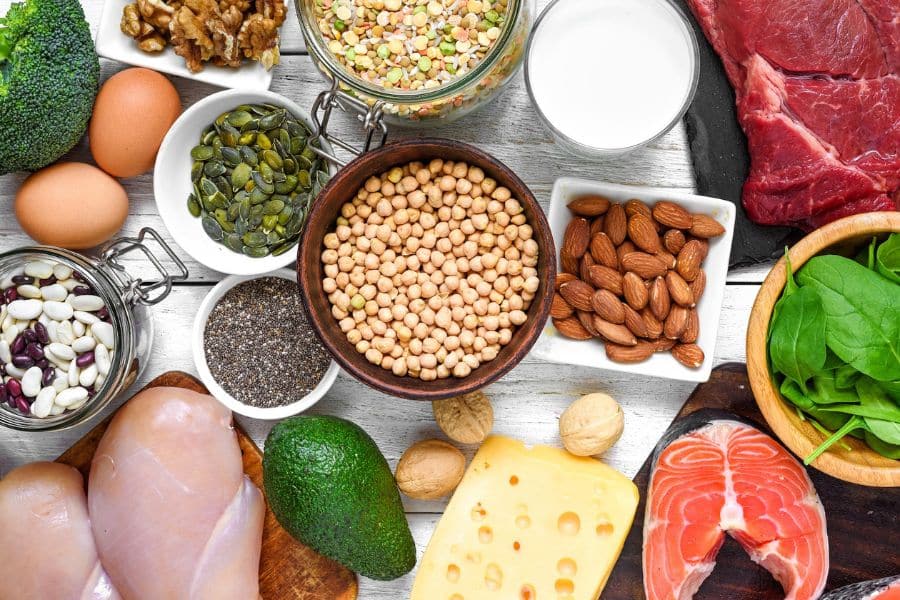
Not all proteins are built the same way, and this is where the waters are muddied by people selling something. The thing that matters is whether the protein you eat contains enough of the essential amino acids, particularly leucine, which is the one most involved in flipping the switch on muscle building.
Animal sources, eggs, dairy, fish, chicken, and beef tend to be naturally complete and leucine-rich. Plant sources can absolutely do the job too, but you generally need a bit more of them and a bit more variety. Soy, lentils, tofu, tempeh, edamame, and a mix of beans and grains over the day will get you there. A single slice of toast with peanut butter, lovely as it is, won’t.
Some examples of what 25 to 30 grams of protein looks like in reality:
- Two large eggs plus a cup of Greek yogurt.
- A 4-ounce chicken breast, about the size of a deck of cards.
- A cup of cottage cheese
- A cup of cooked lentils plus a couple of tablespoons of hemp seeds stirred through.
- A can of tuna, drained, which is roughly 25 grams in a single tin.
- One scoop of whey or pea protein in water or milk.
If you build three meals around something from that kind of list, you’re already most of the way there.
Spread It Across the Day, Not All at Dinner
Here’s the one timing-related thing worth caring about, and it’s not the 30 minute window. It’s how evenly you spread protein across your meals. Most of us eat a tiny bit at breakfast, a bit more at lunch, and then a huge slab of it at dinner, which is the worst possible distribution if muscle is what you’re after.
Studies suggest muscle protein synthesis responds best to roughly 25 to 40 grams of high-quality protein per meal, and that the response sort of resets a few hours later. Eat 80 grams in one go at dinner, and a chunk of it gets used for other things.
Eat 30 grams three or four times a day, and you stimulate the muscle-building response repeatedly. Same daily total, better outcome.
This is the change that made the biggest difference for me, by miles. I stopped chasing the post-workout shake and actually started putting protein in my breakfast, which used to be just toast and coffee.

When the Timing Matters
If you train fasted, first thing in the morning before eating anything, then yes, getting some protein in within an hour or two afterward is sensible because your body has been running on empty for a while. A boiled egg and toast or a small shake will do.
If you train twice a day, or you’re a competitive athlete in a serious training block, the timing of recovery nutrition becomes more relevant because you need to refuel for the next session. Most of us aren’t in that boat.
If you’ve had a normal meal in the 3 or 4 hours before exercising, your body already has amino acids circulating to work with, and another meal within the next several hours will keep things going.
For everyone else, the older you get, the more the total intake question matters, because we lose muscle mass faster from our 40s onwards, and it gets harder to build back. The fix isn’t taking it straight after working out, it’s hitting a higher daily protein target, spreading it across meals, and doing some kind of resistance work, even just bands or bodyweight, two or three times a week.
What I’m Now Doing
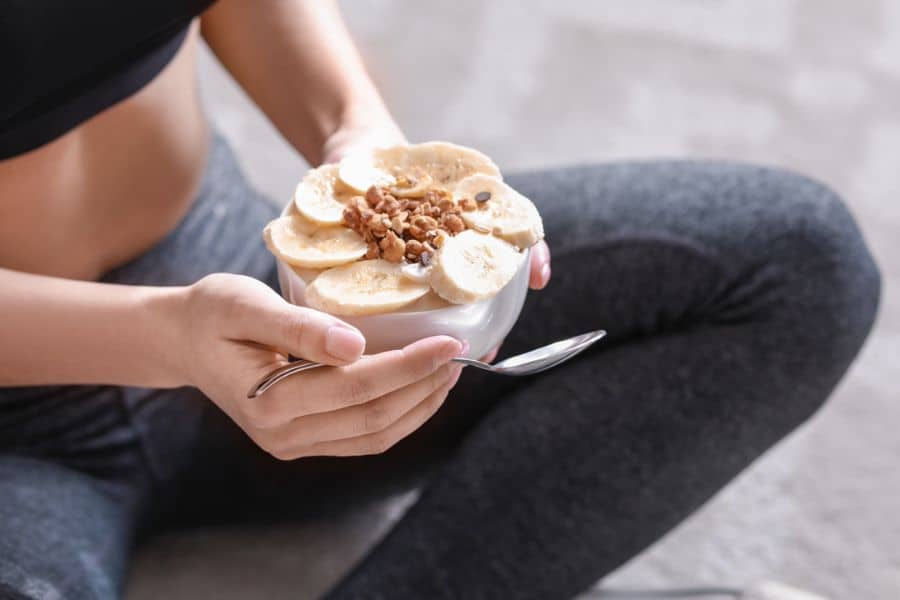
I have a proper breakfast with protein. Protein is at the center of lunch, not an afterthought. I have a normal dinner, which I try to eat before 6 pm, although it’s not always possible. On those days, I do a short after-dinner walk to help digestion. And I do basic weight training twice a week, yoga once a week, and a dog walk most days.
A few practical things that helped me, in case any of them are useful:
- I started keeping hard-boiled eggs in the fridge at all times. They’re the laziest protein delivery system known to humans, and I eat one or two as a snack or alongside toast for breakfast.
- I started weighing my chicken and other meat because I was actually eating double the recommended amount. You soon get used to what 4 oz looks like.
- Cottage cheese came back into my life, and I’m not sure why it ever left, if I’m honest, as I love it, especially with pineapple. It’s 25 grams of protein per cup.
- I still have my protein shake with whatever berries are in season, but I don’t stress about the timing. Just when I want it, and sometimes it’s a great afternoon option instead of reaching for the cookie jar.
- I started doing dedicated weight training, but stuff that’s relevant for my age to help keep my muscles strong.
Disclaimer: This article is for general information and isn’t a substitute for medical advice. If you have a health condition, take medication that interacts with diet, or you’re pregnant, talk to your doctor or a registered dietitian before making big changes to how much protein you eat.