
The first rule of buying protein powders is to read the label. I know that sounds obvious, but you need to know exactly what it’s made from before you buy. Mine’s whey, which comes from milk, like casein does. Plant powders tend to use pea, soy, or rice, often mixed. After that, I check the protein per scoop and added sugar, since some tubs have much more of both than others.
A testing seal like NSF Certified for Sport or Informed Sport is a good sign, as it means an outside lab has checked what’s in there. And don’t skip the serving size. One brand’s scoop can be twice as big as another’s.
The sheer volume of choice out there now makes it confusing. They all promise you the earth, that you’ll build, burn, and recover, and most cost between $35 and $70. Expensive enough that you don’t want to make a mistake.
You don’t need to understand sports nutrition to pick a good one, but you do need to know which five lines on the label to read to choose the one most likely to deliver the results you want.

What to Look For in Protein Powder: 5 Label Checks
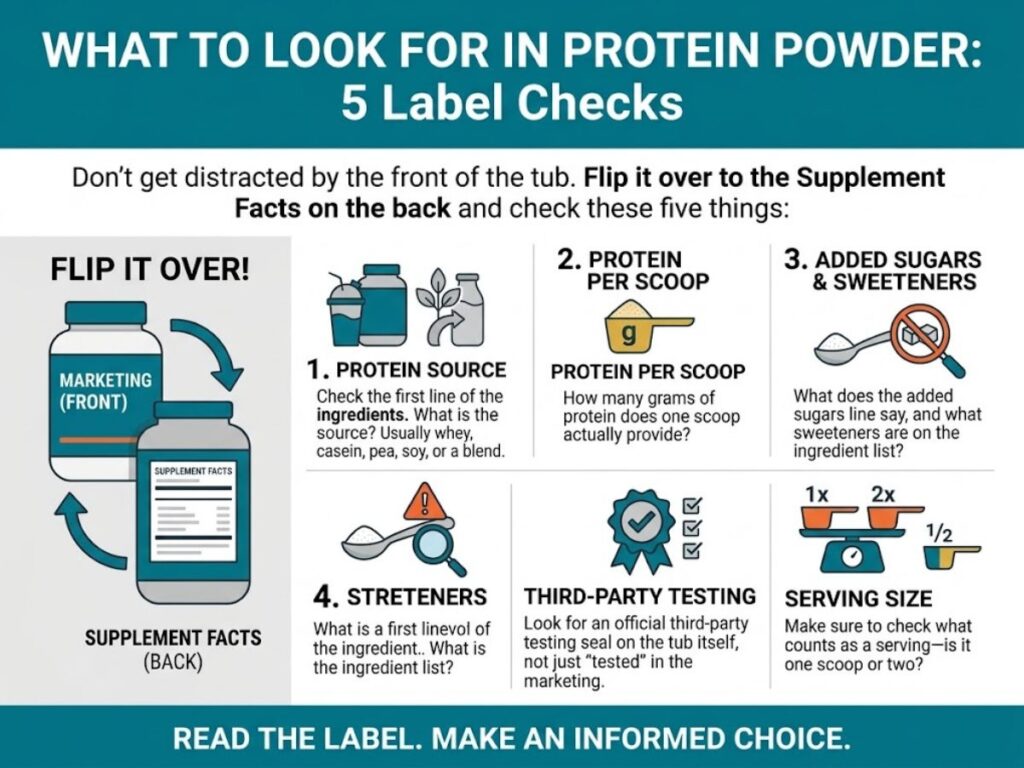
The front of the tub is where you’ll find all the marketing selling you whatever dream it is you’ve got in your head. Flip it over so you’re looking at the Supplement Facts panel on the back, not the marketing on the front.
This is what you’re looking for:
- What’s the protein source on the first line of the ingredients, usually whey, casein, pea, soy, or a blend?
- How many grams of protein per scoop?
- What does the added sugars line say, and what sweeteners are on the ingredient list?
- Is there a third-party testing seal on the tub itself, not just the word ‘tested’ in the marketing copy?
- And finally, what’s the serving size, one scoop or two?
Words like ‘premium’, ‘clean’, ‘natural ‘, and ‘grass-fed’ on the front aren’t regulated the way the nutrition panel is. A tub can say ‘clean protein’ and still contain 8 grams of added sugar per serving.
Whey vs Plant Protein Powder
Whey is the protein that separates when milk is turned into cheese; it digests fast, contains all nine essential amino acids, and is high in leucine, the amino acid most involved in triggering muscle repair.
If you get bloated or gassy after dairy, whey concentrate may do the same, and whey isolate (which filters out most of the lactose) is usually easier on the gut.
Casein is the other milk protein and digests slowly over several hours, so people take it before bed to drip-feed amino acids while they sleep. I wouldn’t recommend buying casein as it’s a specific-use product rather than something you take daily.
Pea protein alone is low in methionine, and rice protein alone is low in lysine, so good plant powders blend them, usually pea and rice, sometimes with hemp or sunflower, to cover the full amino acid profile.
If you’re vegan, dairy-sensitive, or just prefer plant-based, look for a blend rather than a single-source pea or rice powder, and check that it has 20 to 25 grams of protein per scoop.

Found this useful? Get more like it in your inbox as a Lifestyle Library Insider.
Whey Isolate vs Concentrate: Which Should You Buy?
Whey concentrate is about 70 to 80 percent protein by weight, with the rest made up of lactose, fat, and a small amount of other milk solids. Whey isolate is filtered further and is about 90 percent protein, with most of the lactose and fat removed.
Hydrolysate goes a step further and pre-breaks the protein into smaller fragments, which digest faster and cost more.
For most people, concentrate does the job and offers better value, around $1 to $1.50 per 25 grams of protein, while isolate tends to run closer to $1.30 to $2.00 per 25 grams.
If you’re lactose-sensitive, if you’re keeping fat and carbs tight for a specific reason, or if you prefer the thinner texture, isolate is worth the upgrade; otherwise, concentrate is fine.
Hydrolysate is a specialist product. Unless a trainer or dietitian has specifically told you to use it, you’re paying extra for a benefit you likely won’t notice.

What to Look For in Added Sugar on a Protein Powder Label
The line to find is ‘Added Sugars’, which sits underneath ‘Total Sugars’ on the Supplement Facts panel. Total sugars can include naturally occurring sugars like lactose from whey, while added sugars are what the manufacturer adds, and you want that number low, ideally 0 to 2 grams per serving for a straight protein powder.
Added sugar hides under a dozen names on the ingredient list, so watch for cane sugar, dextrose, maltodextrin, brown rice syrup, agave nectar, coconut sugar, honey, and ‘organic cane juice’, which is just sugar dressed up.
Maltodextrin in particular is common because it’s cheap, bulks the powder out, and mixes smoothly, so even a tub with only 1 gram of added sugar can be stacked with it.
Then there are the sweeteners that don’t count as sugar but still make the powder sweet: sucralose, stevia, monk fruit, acesulfame potassium, and sugar alcohols like erythritol and xylitol.
A tub can say ‘zero sugar’ on the front and taste like a milkshake because it’s loaded with sucralose and stevia, and that isn’t automatically a bad thing, but if you dislike that artificial sweetness, read the ingredient list before you buy.
How Many Grams of Protein Per Scoop Should a Powder Have?
This is where you need to be careful. Often, a tub lists the protein per serving on the front, but when you turn it over, you realize you need two scoops a day to get it. That means you’ll get through the tub twice as fast, meaning it costs a lot more. I’ve been fooled by this before.
For asingle-scoop powder, 20 to 30 grams of protein is the range you want.
The fair comparison between two tubs is protein per 100g of powder, which you can work out from the panel if the brand doesn’t list it. Anything below 60 grams of protein per 100g of powder is being bulked out with something else, usually carbs or fiber, and you’re paying protein prices for filler.
The other number worth working out is cost per 25 grams of protein, which is roughly one solid serving. If a ‘premium’ tub works out to $2.50 per 25g while a straightforward one across the shelf is $1, you’re paying for the packaging and the marketing.
What Third-Party Testing Seals on Protein Powder Mean
The supplement industry in the US isn’t pre-approved by the FDA like food and medicine, so what’s on the label and what’s in the tub aren’t always the same, which is why third-party testing is worth looking for. An independent lab buys the product off the shelf, tests it for what’s actually in there, and gives the brand a seal if it passes.
The two seals I’d look for are NSF Certified for Sport and Informed Sport (also sold as Informed Protein). Both test for banned substances that can get athletes disqualified, which helps even if you’re not an athlete because they also catch contamination with heavy metals and undeclared ingredients.
Both also verify that the protein content on the label matches what’s actually in the tub, so if a brand holds one of these seals, you can be reasonably confident the number you’re reading is the number you’re getting.
To confirm a seal is real, look the product up on the certifier’s website. If the tub says ‘GMP certified’ or ‘tested for purity’ with no third party named, the brand has done its own tests, which are nowhere near as reliable as an approved third party.
Protein Powder Red Flags and a Buying Checklist for Beginners
A few label details would send me back to the shelf. ‘Proprietary blend’ is the main one, because it lets a brand list several proteins together under one weight. You don’t know how much of each you’re getting; a tub might call itself a ‘whey and pea blend’ and be 95 percent cheap pea protein with a sprinkle of whey.
Amino acid spiking is the other one. Some brands add free amino acids like glycine, taurine, or creatine to the powder, which boosts the total protein number on the FDA’s nitrogen test but doesn’t give you the complete protein you need to build muscle.
Artificial colors, excessive thickeners (xanthan gum, carrageenan, cellulose gum stacked together), and long filler lists are also worth noting, though they’re less of a dealbreaker than the first two.
About this article: Our health articles are based on published studies and advice from experts such as physiotherapists and dietitians, and the sources are linked in the article.
Disclaimer: The content in this article is for informational purposes only and is not intended to replace professional medical or nutritional advice. Always consult your doctor or a registered dietitian before making significant changes to your diet, particularly if you have a health condition, a food allergy, or take medication. This article may contain affiliate links.
Become a Lifestyle Library Insider
Health tips, money know-how, travel deals and garden ideas for life after 50, straight to your inbox.

Summer Williams is a lifestyle writer and social media manager and a writer and editor of Your Lifestyle Library (yourlifestylelibrary.com). She holds a BA (Honours) in Journalism from Sheffield Hallam University. She is also a qualified fitness instructor, holding the NCFE Level 2 Certificate in Fitness Instructing. She also creates content under her brand Summer Elizabeth Creative.