
How do you use your Health Savings Account? If you’re like most people, you probably use it like a checking account for prescriptions and dental visits. Money goes in, money comes out, and that’s about it. That habit could be costing you quite a bit.
Fidelity’s 2026 estimate puts the average health care and medical spending for a 65-year-old retiring this year at $185,500 over the course of retirement. Now, of course, that’s an average and not aimed at you specifically, but that’s a fair whack either way.
Not knowing the HSA rules could cost you more than you realize. Miss the wrong one, and you could face a 20% penalty, lose a tax benefit, or get a Medicare enrollment that disqualifies you from contributing.

9 HSA Rules You Need To Know
Before you decide what to do with your HSA in 2026, these are the rules you need to be aware of.
Rule 1: Being Able to Open an HSA and Being Able to Contribute Are Two Different Things
Your account belongs to you, and it stays open when you change jobs, switch insurance, or retire.
Contribution eligibility is strict. You generally need qualifying HSA coverage (historically a high-deductible health plan) and no disqualifying medical coverage on the side.
You can’t be enrolled in Medicare, and you can’t be claimed as someone else’s tax dependent.
A general-purpose health FSA that pays your regular medical bills can knock you out of HSA eligibility, and so can a spouse’s FSA if it can reimburse your expenses.
At the start of 2026, bronze and catastrophic health plans became HSA-compatible under new federal rules, whether you buy them on an exchange or off.
So, if you’ve been shut out of an HSA because your coverage didn’t qualify, it’s worth another look.
Rule 2: Know the 2026 Contribution Limit and What Counts Toward It
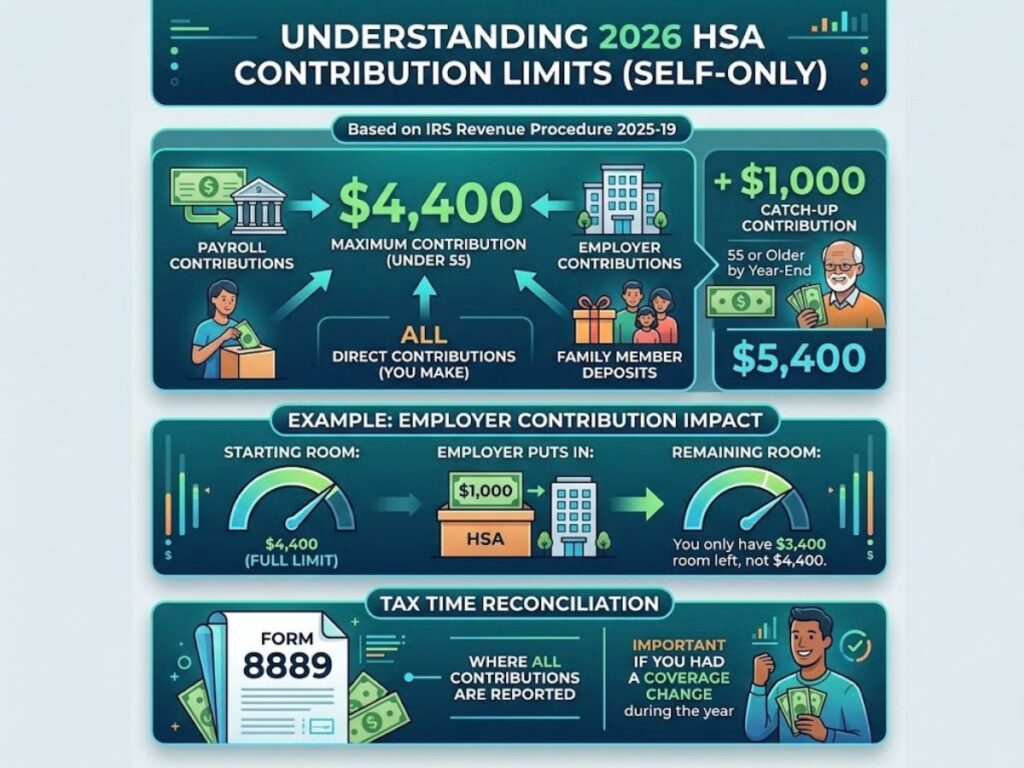
For 2026, the federal HSA contribution limits come from IRS Revenue Procedure 2025-19. The self-only limit is $4,400. If you’re 55 or older by year-end, you get a $1,000 catch-up on top of that.
The part people miss is what counts toward the limit. It isn’t just what comes out of your paycheck. The limit includes your payroll contributions, any direct contributions you make yourself, whatever your employer puts in, and anything a family member deposits on your behalf.
So if your employer puts $1,000 into your HSA in 2026 and you have self-only coverage, you have $3,400 of room left, not the full $4,400.
Form 8889 is where all this gets reconciled at tax time. If you had a coverage change during the year, that form is where you need to look.
Found this useful? Get more like it in your inbox as a Lifestyle Library Insider.
Rule 3: Payroll Contributions Beat Writing a Check
There are two ways to fund an HSA, and they don’t produce the same tax result. You can deposit money directly into the account and claim the deduction on your return, or you can contribute through your employer’s Section 125 cafeteria plan on a pre-tax basis.
The payroll route is usually better. Contributions made through a cafeteria plan are generally excluded from federal income tax withholding, Social Security tax, and Medicare tax.
Direct contributions may reduce your federal income tax, but they don’t refund the Social Security and Medicare taxes already withheld from your paycheck. That FICA difference compounds over a decade.
Pretax payroll contributions only work if your employer offers a Section 125 plan. If your employer doesn’t offer one, the payroll option isn’t on the table, and you’re stuck with direct contributions and the smaller tax benefit.
Once you decide on an amount, automate it.
Rule 4: Keep Some Cash, Invest the Rest
The word “savings” in Health Savings Account misleads many people. Most HSA providers also offer investments, and by the end of 2025, HSAs held nearly $174 billion across 41.7 million accounts, with about 49% of all HSA assets sitting in investments rather than cash.
The best way to deal with this is to keep enough cash on hand to cover a deductible, a prescription refill, or a surprise medical bill without having to sell investments in a bad month. Then consider investing the rest, the money you don’t expect to touch for years.
Before you invest, check the fees. HSA providers vary widely in monthly account fees, required minimum cash balances, investment thresholds, fund expense ratios, and transfer charges. Your employer’s default HSA provider isn’t the only option. An HSA is portable, and IRS guidance allows you to move it to a different qualified trustee than the one attached to your health plan.
Rule 5: Paying Medical Bills Out of Pocket

This strategy is the shoebox rule: contribute to the HSA, invest it, pay current medical bills from your regular checking account, keep every receipt, and reimburse yourself years or decades later.
But be warned, if paying medical bills out of pocket means running a credit card balance, the interest wipes out any tax benefit you’re chasing.
The shoebox approach is only doable when your income and cash reserves are comfortable enough that paying out of pocket doesn’t strain anything.
The reimbursement has rules. The expense must be a qualified medical expense; it must have occurred after the HSA was established, no insurance or other source can have reimbursed it, and you can’t have claimed it as an itemized medical deduction.
Because a tax return stays open for audit for seven years after filing, keep HSA purchase records at least that long. If you can’t prove eligibility in an audit, you’re looking at income tax plus a 20% penalty on the reimbursement.
Rule 6: Stop Contributing Before Medicare Starts, or Pay the Penalty
Medicare and HSA contributions don’t mix. Once you’re enrolled in any part of Medicare, including just Part A, you can’t contribute to an HSA anymore. The account keeps working for spending, but the contributions have to stop.
The tricky part is that many people trigger Medicare enrollment without meaning to. If you claim Social Security retirement benefits at 65 or later, you’re automatically enrolled in Part A, whether you want to be or not.
The practical rule is to stop HSA contributions at least six months before you plan to start Medicare Part A or start Social Security. If you’re 65 or older and still working with HSA-eligible coverage, and you want to keep contributing, don’t file for Social Security yet.
Rule 7: California and New Jersey Play by Different Rules
California and New Jersey are the two states that don’t conform to the federal tax-advantaged treatment of HSAs. In both states, HSA contributions are treated as after-tax for state income tax purposes, and employer and employee payroll contributions get reported as taxable state income in Box 16 of your W-2.
If you live in California or New Jersey, the HSA is still worth having. The federal tax benefit is the bigger piece, and it’s untouched. Investment earnings inside the account are still tax-free at the federal level, though those two states may tax them at the state level. It just changes the math on how much you save, and it means any calculator or explainer you read online is probably overstating your benefit by your state marginal rate.
Rule 8: Keep Every Receipt
Every HSA distribution must be tied to a qualified medical expense, and you have to provide proof. Your provider records the withdrawal amount, but they don’t know what you spent it on.
On a few thousand dollars of receipts you can’t find, the tax hit adds up fast.
The safest habit is to scan or photograph every medical receipt and save it in one folder, digital or paper, organized by year. Note what the expense was for, what you paid, and whether insurance covered any of it.
Keep them longer if you’re using the shoebox approach and planning to reimburse yourself years down the line.
Rule 9: Treat It Like a Retirement Account, Because That’s What It Can Become
Think of it as part of your retirement plan, not a checkbook for co-pays. An HSA is the only account with a triple tax advantage. Contributions go in pre-tax (or as an above-the-line deduction if made outside payroll), growth is tax-free, and withdrawals for qualified medical expenses are tax-free.
A Roth taxes you on the way in. An HSA, used properly, isn’t taxed on either end.
## Sources
fidelity.com. https://www.fidelity.com/learning-center/smart-money/hsa-contribution-limits
devenir.com. https://www.devenir.com/hsa-assets-reach-nearly-174-billion-at-year-end-2025-as-investment-assets-rise-to-85-billion/
newfront.com. https://www.newfront.com/blog/california-and-new-jersey-hsa-state-income-tax-2
fidelity.com. https://www.fidelity.com/learning-center/personal-finance/hsas-and-medicare
The HSA Shoebox Rule. https://www.newfront.com/blog/the-hsa-shoebox-rule
Disclaimer: The content in this article is for informational purposes only and is not intended as financial, investment, or tax advice. Always consult a qualified financial advisor or tax professional before making decisions about your money, investments, or retirement planning.
Become a Lifestyle Library Insider
Health tips, money know-how, travel deals and garden ideas for life after 50, straight to your inbox.

Kylie Lang is a nationally syndicated travel journalist with bylines on the Associated Press Wire & more, a lifestyle writer, and the founder and editor of Your Lifestyle Library (yourlifestylelibrary.com). She holds a BA (Honours) in History from the University of Kent and is a member of the British Guild of Travel Writers.