
When my dad passed away in 2022, my mom did what most newly widowed people do. She got through the funeral, sorted the paperwork, and somehow kept herself running on autopilot while she figured out what her life was going to look like without my dad. The last thing on her mind was her tax return.
And then tax season rolled around the following year. Her tax bill had jumped, and not by a little, but by thousands of dollars, on roughly the same income she and my dad had been living on together.
This is something almost no one warns you about, and it has a name. It’s called the widow’s penalty, or the widow’s tax trap, and it hits the surviving spouse at exactly the moment they’re least equipped to deal with it. So let’s talk about why it happens, who it hits hardest, and what you can do now to make it sting less later.
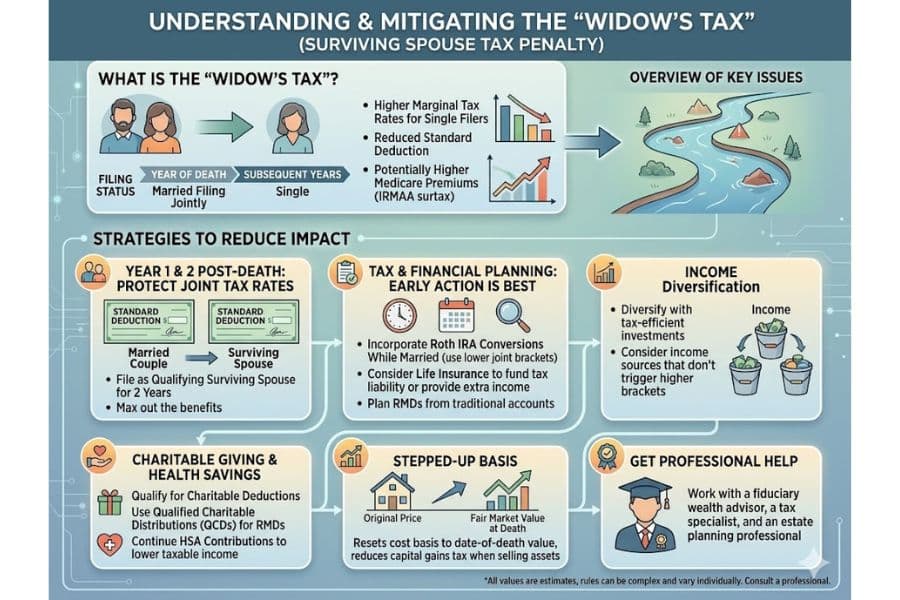
The Widow’s Tax Trap, Explained Without the Jargon
Here’s how the US tax system treats married couples. When you file jointly, you get wider tax brackets, a bigger standard deduction, and a more generous setup, almost across the board. Two people, one return, and the math is built on the idea that two incomes share the load.
The year your spouse dies, you can usually still file jointly for that final tax year. Some people also qualify for something called qualifying surviving spouse status for up to two more years if they have a dependent child, but most older widows and widowers don’t.
After that grace period ends, the surviving spouse files as single. That’s where the trap snaps shut.
The brackets for a single filer are roughly half the width of the married filing jointly brackets, and the standard deduction is half too. So the same household income, minus maybe a bit of Social Security if the smaller benefit went away, suddenly gets squeezed into much narrower tax brackets. More of it gets taxed at higher rates.
The IRS doesn’t care that you’re now running the house on one person’s effort instead of two. The brackets just are what they are.

Why the Income Often Doesn’t Drop the Way People Expect
A lot of couples assume that when one spouse dies, household income falls roughly in half, so the tax hit will balance out. It rarely works like that. Social Security drops, yes, because the surviving spouse keeps the larger of the two benefits and forfeits the smaller.
But pensions, if they were set up with a survivor benefit, often continue at 50, 75, or 100 percent. Investment income from a joint brokerage account doesn’t shrink at all.
Required minimum distributions from IRAs and 401(k)s keep coming, and after the spouse dies, those accounts often get rolled into the survivor’s name, and the RMDs keep flowing.
In my mom’s case, the household income did dip a bit, but nowhere near half. The investment accounts kept paying dividends. The pension survivor benefit was set up properly years before because Dad always believed he’d go first and wanted to make sure Mom was looked after.
So she ended up with maybe seventy percent of the old joint income, filing as a single person, in brackets sized for one modest earner.
The other thing that catches people is Medicare. Medicare Part B and Part D premiums are based on your income from two years prior, through something called IRMAA. So a higher tax bracket can also push you into higher Medicare premium tiers, which is a second financial punch landing alongside the first.

A Real Example of How the Numbers Fall
Let’s say a retired couple has $120,000 in combined income per year from Social Security, a pension, and IRA withdrawals. Filing jointly with the standard deduction for over 65, their federal tax bill might land somewhere in the range of $10,000 to $12,000, give or take.
Now the husband dies, and the wife loses his $1,800 a month Social Security check (she keeps her own larger one, or his, whichever is bigger). The pension continues at 75 percent under the survivor option they chose. The IRA rolls over into her name, and her new income comes to about $95,000.
She files as single, and the standard deduction drops by roughly half. The brackets are narrower. Suddenly, that $95,000 produces a federal tax bill somewhere closer to $14,000 or $15,000, but on less income.
And it doesn’t include the state tax effects, which in some states make it worse, or the Medicare premium creep that shows up two years later. This is essentially what happened to my mom.

What Couples Can Actually Do Now to Soften It
The frustrating part is that almost all the planning has to happen before one spouse dies. Once you’re the surviving spouse filing your first single return, your options shrink fast. So this is one of those topics worth talking about while both of you are still around to make decisions together.
Here are some options:
- Roth conversions while both spouses are alive. Converting some traditional IRA money to a Roth during the joint-filing years means you pay tax at the wider brackets now, and the surviving spouse gets to pull from the Roth tax-free later. This is probably the single most useful tool, and it works best during the gap years between retirement and the start of RMDs.
- Drawing down traditional retirement accounts earlier, even before you technically have to. Same logic. Pay the tax in the lower joint brackets while you can.
- Looking hard at how assets are titled and where the tax basis sits. Inherited assets generally get a step-up in basis, which can wipe out capital gains on appreciated investments. Knowing which accounts to spend down first and which to leave alone makes a big difference
- Considering qualified charitable distributions from IRAs if you’re over 70 and a half, and give to charity anyway. This satisfies part of your RMD while keeping your reported income lower, which helps with both tax brackets and those Medicare premium thresholds.
- Reviewing pension survivor elections well before retirement, because once you pick a single-life payout, you usually can’t undo it. The higher monthly check looks tempting, but it ends the day the pensioner dies, and that can leave the survivor in a much worse spot.
None of this is exciting dinner conversation, granted, but the couples who do this work in their sixties tend to leave behind a much softer financial situation for the one who outlives the other.
What to Do If You’re Already the Surviving Spouse
If you’re reading this and it’s already happened, the planning window is narrower but not closed. The first thing to do is find a tax preparer or fee-only financial planner who has actually walked widows and widowers through this before. Not all of them have.
You want someone who knows the qualifying surviving spouse rules, understands how to time IRA withdrawals around the single-filer brackets, and can model out the next five to ten years rather than just react to last year’s return.
Roth conversions are still on the table, though they now occur within narrower brackets, so the math is tighter. Charitable giving strategies still work. If you have appreciated stock in a taxable account, the step-up in basis you received when your spouse died means you can often sell some holdings with little or no capital gains tax. Most people don’t realize they have it.
The other thing worth doing is checking your withholding and your estimated tax payments. A lot of widows and widowers get hit with an underpayment penalty in their first single-filer year because the withholding on Social Security and pension payments was set up for a joint return and never adjusted. It’s a small fix that prevents an annoying surprise.
Disclaimer: This article is for general information and isn’t tax or financial advice. Talk to a qualified tax professional or fee-only financial planner about your own situation before making decisions.