
Let me say right now, none of these tax avoidance strategies is illegal. They are loopholes for paying less tax, you can quite happily take advantage of without getting into trouble. The issue isn’t the legality; it’s that most people don’t know about them because, let’s face it, when is the tax office going to tell you how you can pay less?
Most people assume that paying less tax is something only the likes of Bill Gates, Elon Musk, and Mark Zuckerberg get to do. Well, that’s where you’re wrong. While these might well be strategies they use, they are also available to the likes of you and me.
Let’s get one thing straight: the IRS doesn’t require you to pay more than the law demands. It actually expects you to take every available legal deduction; it’s just not great at letting you know what they are. So, I’m giving you a helping hand to take full advantage of them.

7 Legal Loopholes For Paying Less Tax
These seven approaches are completely legal, well-established, and available to anyone willing to plan ahead. All of them can put serious money back in your pocket.
One important note before we dive in. Tax rules vary by your income, situation, and state. It’s always worth running these strategies past a qualified tax professional to see how they apply to you personally.
Pump Up Your Retirement Contributions First

This is the single easiest move you can make. Every dollar you put into a traditional 401(k) or IRA reduces your taxable income, dollar for dollar.
For 2026, you can contribute up to $24,500 to a 401(k). If you’re 50 or older, that jumps to $32,500 thanks to catch-up contributions. Those aged 60 to 63 can go even higher, up to $35,750 under the SECURE 2.0 “super catch-up” rule. Add a traditional IRA, and you can shelter another $7,500, or $8,600 if you’re 50-plus.
To put that in real terms: if you earn $85,000 and max out a 401(k), your taxable income drops to $60,500. In the 22% federal bracket, that’s over $5,000 saved.
If you earn too much to contribute directly to a Roth IRA, the backdoor Roth is a legal workaround. You contribute to a traditional IRA and then convert it to a Roth. You pay tax now, but the money grows tax-free forever.
Self-employed? A Solo 401(k) allows you to contribute as both employee and employer, with total contributions potentially reaching $70,000 in 2025. It’s one of the best tax tools available for freelancers and small business owners.
The Business Structure Saving Self-Employed People Thousands

If you run your own business, your tax bill is heavily influenced by how that business is structured. Most people default to a sole proprietorship without realizing how much self-employment tax they’re overpaying.
When you elect S-Corp status for your LLC, you split your income into two buckets: a salary and distributions. You only pay self-employment tax on the salary portion.
Here’s a simple example. Say you earn $100,000 in profit. As a sole proprietor, you owe self-employment tax on all of it, which works out to around $14,130. With an S-Corp election, you might pay yourself a $60,000 salary and take $40,000 as a distribution. You’d only owe self-employment tax on the salary, saving roughly $5,650 per year.
The IRS does require that your salary be “reasonable” for your industry, so you can’t set it at $1 and pocket the rest. But within those guidelines, the savings are real and significant.
Business structure decisions get complicated fast, so this is one worth discussing with an accountant before you make any changes.
Real Estate Tax Advantages That Quietly Build Wealth

Real estate has some of the most powerful tax benefits in the entire tax code. The government wants to encourage property investment, and it shows.
Depreciation alone is remarkable. You can deduct a portion of your rental property’s value each year, even if the property is actually going up in price. A $220,000 residential rental property generates roughly $8,000 in annual depreciation deductions.
Then there’s the 1031 exchange. When you sell one investment property and roll the proceeds into another within certain timeframes, you defer the capital gains tax entirely. Do this repeatedly, and you can keep building your real estate portfolio while pushing that tax bill further and further into the future.
If you actively participate in rental real estate, you may be able to deduct up to $25,000 in rental losses against your regular income, depending on your income level. And those who qualify as Real Estate Professionals under IRS rules can remove that cap entirely.
Your own home offers advantages too. The mortgage interest deduction and property tax deduction are available to itemizers, and when you sell, you can exclude up to $250,000 in capital gains if you’re single, or $500,000 if you’re married and filing jointly, as long as the home was your primary residence for at least two of the last five years.
Turn Investment Losses Into a Tax Win

Nobody likes watching an investment drop in value. But that loss doesn’t have to be purely painful. Tax-loss harvesting lets you sell underperforming investments and use those losses to offset gains elsewhere in your portfolio.
Say you made $10,000 on one stock sale but lost $6,000 on another. Sell both, and your taxable gain drops to $4,000. If your losses exceed your gains, you can deduct up to $3,000 against ordinary income in the same year. Any excess carries forward into future tax years.
The wash-sale rule is the one catch. You can’t repurchase the same or a substantially identical investment within 30 days before or after the sale, or the loss gets disallowed. The workaround is to buy something similar but not identical. For example, swap one S&P 500 index fund for another that tracks nearly the same market.
It’s also worth knowing how long you’ve held an investment before selling. Assets held for more than a year are taxed at the long-term capital gains rate, which is 0%, 15%, or 20% depending on your income. That’s considerably more favorable than ordinary income tax rates.
The Triple Tax Advantage Most People Ignore
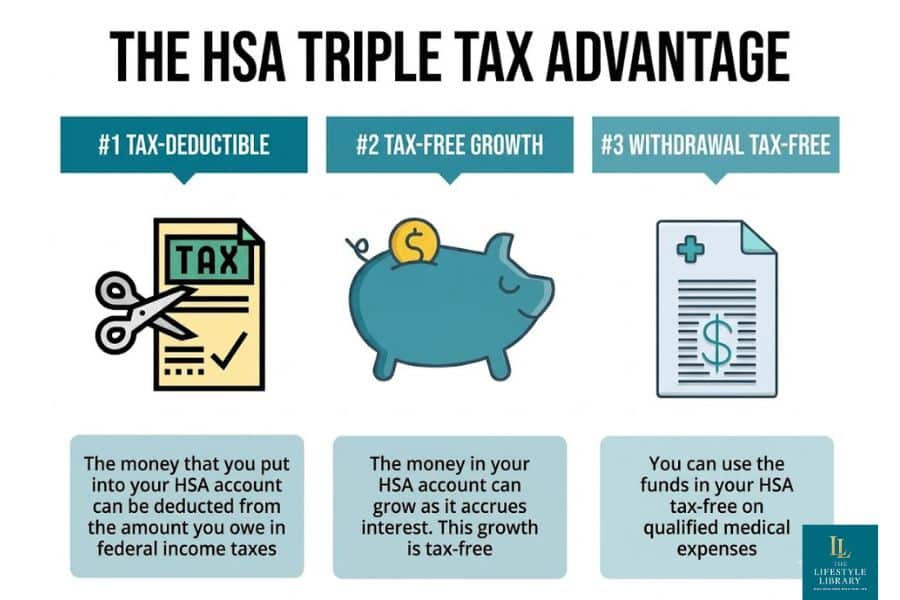
Health Savings Accounts are one of the most underused tools in the tax code. They are the only account that offers three tax benefits at once.
You get a tax deduction on contributions, the money grows tax-free, and withdrawals for qualified medical expenses are also tax-free. No other account does all three.
For 2026, you can contribute $4,400 if you’re on an individual high-deductible health plan, or $8,750 for a family plan. People 55 and older can add an extra $1,000 on top.
To qualify, your health plan deductible must meet IRS minimums: at least $1,700 for an individual or $3,400 for a family in 2026. The out-of-pocket maximum must not exceed $8,500 for self-only coverage or $17,000 for family coverage.
Many people use HSA funds for current medical costs, which is fine, but the smarter long-term move is to invest the money and let it grow. After age 65, you can withdraw for any reason, not just medical expenses. You’ll pay income tax on non-medical withdrawals, similar to a traditional IRA, but there’s no penalty.
Keep your medical receipts. You can reimburse yourself years later and let your contributions compound in the meantime.
Lowering the Tax Burden Across Your Family

When done correctly, spreading income across your family can reduce what you collectively owe.
If your children work in your business, you can pay them a reasonable wage for real work. That income is deductible for your business, and your child pays tax at their own rate, which is likely much lower than yours. Children under 18 working in a sole proprietorship owned by a parent also avoid FICA taxes entirely.
The annual gift tax exclusion lets you give up to $19,000 per person in 2026 without triggering gift tax. Married couples can give $38,000 to each recipient. Over time, this steadily moves money out of your taxable estate.
For education costs, 529 plans let you contribute with after-tax dollars that grow tax-free. Withdrawals for qualified education expenses, including K-12 tuition in many states, come out completely tax-free, too.
Spousal IRAs are another option often overlooked. If one partner doesn’t work, the working spouse can fund a separate IRA for them using earned income. Both get retirement accounts growing in their own names.
Choose Your State Wisely and Time Your Tax Moves
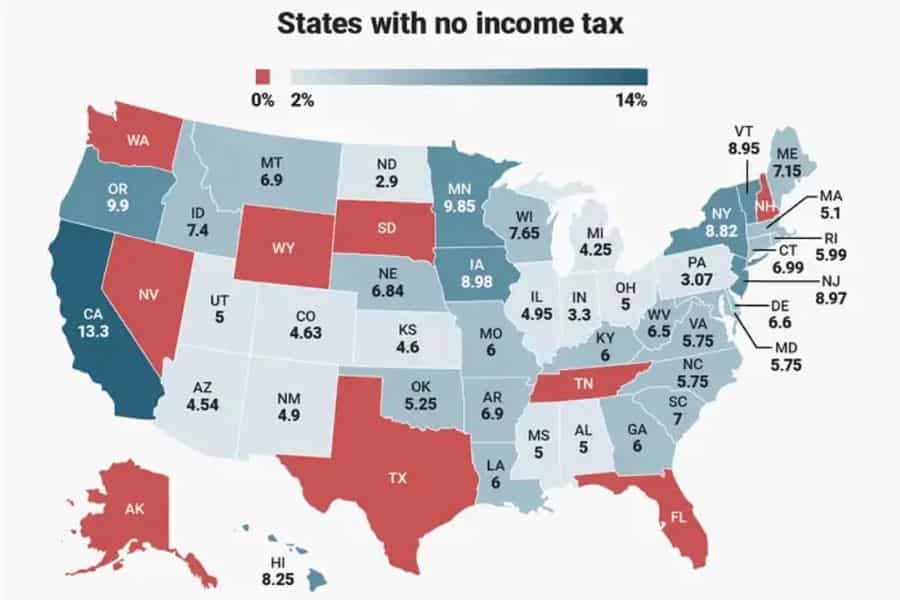
Nine states have no personal income tax: Alaska, Florida, Nevada, New Hampshire, South Dakota, Tennessee, Texas, Washington, and Wyoming.
Moving from a high-tax state like California, which charges up to 13.3% in state income tax, to a no-income-tax state like Florida can save a retiree a substantial amount of money every single year. For someone drawing $80,000 annually in retirement income, that difference alone could mean $10,000 or more back in their pocket.
But you have to follow the rules. Simply spending time in a low-tax state isn’t enough. Most states look at where you live, where you vote, where your driver’s license is registered, and where your primary home is located to determine residency. The rules are strict, particularly for high earners.
If relocation isn’t on the table, the state tax game still has moves. The state and local tax deduction (SALT) is currently capped at $10,000 on federal returns, which limits the benefit of high property and state income taxes for federal purposes. But timing state-taxable events around a planned move, or deferring income into a lower-tax year, are both legitimate planning strategies worth discussing with your accountant.
The content in this article is for informational purposes only and is not a substitute for professional financial or tax advice. Always consult a qualified tax professional before making changes to your tax strategy, business structure, or investment decisions.
Disclaimer: The content in this article is for informational purposes only and is not intended as financial, investment, or tax advice. Always consult a qualified financial advisor or tax professional before making decisions about your money, investments, or retirement planning.

Kylie Lang is a nationally syndicated travel journalist with bylines on the Associated Press Wire & more, a lifestyle writer, and the founder and editor of Your Lifestyle Library (yourlifestylelibrary.com). She holds a BA (Honours) in History from the University of Kent and is a member of the British Guild of Travel Writers.