
A friend of mine pulled up her retirement balance last month, looked at it for about three seconds, and then closed the tab with that awful sinking feeling. She’s 52. She’s been working since she was 19. And the number on that screen made her want to lie down on the kitchen floor.
I think a lot of us have experienced a feeling like this. You open your retirement statement, do the quick math in your head, remember that you’re supposed to have something like three times your salary saved by 40 and six times by 50, according to those finance charts, and then you close everything and go make tea. The reality isn’t something you want to cope with right at that moment.
However, that panic doesn’t help and can’t be allowed to go on for long, not if you actually want to do something about it. There is a catch-up plan, with real numbers, and it works whether you’re 38 and just waking up to this or 62 and counting the years on one hand.

The Catch-Up Plan for Anyone Behind on Retirement Savings
First, let’s put a Band-Aid over the wound to make you feel a little better before we fix the problem. The median retirement savings for Americans aged 55 to 64 is somewhere around $87,000, according to recent Federal Reserve data.
The Instagram version of retirement planning, where everyone maxes out their 401(k) from age 35, is not how most people actually live their lives.
Life happens to most of us. Kids, a divorce, a layoff, a parent who needed care, a business that didn’t work out, a stretch of years where the paycheck barely covered the rent. None of that means you can’t build a retirement now. It just means the plan has to be honest about where you’re starting from and aggressive about what’s still possible.
The math of catching up is less about magic and more about leverage. There are specific levers the tax code hands you once you hit certain ages, and there are behavioral moves that do the heaviest lifting. I’m going to walk through both in the order I’d actually use them if I were starting over at 45, 55, or 60.

Use the Catch-Up Contributions the Tax Code Actually Gives You
This is essentially free money in the sense that it’s tax savings you’re allowed to take, and most people don’t. Once you turn 50, the IRS lets you put extra into retirement accounts on top of the normal limits.
In 2026, the standard 401(k) limit is $24,500, and the catch-up contribution for anyone 50 and older adds another $8,000 on top. That brings you to $32,500 you can shove into a 401(k) in a single year if you have the income to do it.
There’s also a newer wrinkle thanks to SECURE 2.0. If you’re between 60 and 63, the catch-up contribution is even bigger, around $11,250 instead of $8,000, depending on the plan. It’s a narrow window the law carved out specifically for people in the final stretch before retirement. Most employees have no idea this exists, and no HR rep is going to chase you down to tell you about it.
For IRAs in 2026, the contribution limit is $7,500, and if you’re 50 or older, you can add another $1,100 on top. That’s $8,600 a year into a Roth or traditional IRA, on top of anything you do at work.
A few specific moves worth making this year:
- Call your 401(k) provider or log in to check whether your contribution percentage is high enough to qualify for the catch-up. A lot of plans default to the catch-up off, and you have to switch it on manually, which is easy to miss.
- If you have a Health Savings Account through a high-deductible plan, the family limit in 2026 is $8,750 with an extra $1,000 catch-up at 55. HSAs are the most tax-advantaged accounts in the country, and people use them like checking accounts instead of investing them. I treat mine like a stealth retirement account.
- If you’re self-employed, consider a SEP IRA or a Solo 401(k). The contribution limits are dramatically higher than a regular IRA, sometimes north of $70,000 a year, depending on your income.

Figure Out Your Real Number, Not the Scary One
Most retirement calculators ask what you currently earn and assume you want to replace 80 percent of it forever. That’s where the scary number comes from. But your spending in retirement is almost never the same as your spending now, especially if you’ve been raising kids, paying a mortgage, or commuting to a job that requires a wardrobe.
Sit down and write out what you actually expect to spend a month in retirement. Not what some online tool guessed. Your real housing cost (paid-off mortgage? still renting? downsizing?), your real food cost, healthcare (which is the big one and usually underestimated), travel, and the small stuff.
Then subtract any Social Security you’ll get. The Social Security Administration’s website will give you a personal estimate based on your actual earnings history, and it takes about ten minutes to set up an account.
What’s left after Social Security is the gap your savings need to cover. Multiply that monthly gap by 300 to get a rough sense of the lump sum you’d need using the 4 percent withdrawal rule. If your gap is $2,000 a month, you’re looking at roughly $600,000. That’s a real number, not a panic number, and it gives you something to actually aim at instead of a vague feeling of dread.
I did this exercise myself last winter, mostly because I was tired of the dread, and the answer was both better and worse than I expected. Better because the number wasn’t as wild as I’d feared once I subtracted Social Security and assumed a paid-off house.
Worse, because it made me see exactly how much I needed to be saving each month to get there. But I was now working with real figures rather than an estimate, which meant I could put a realistic plan into action.
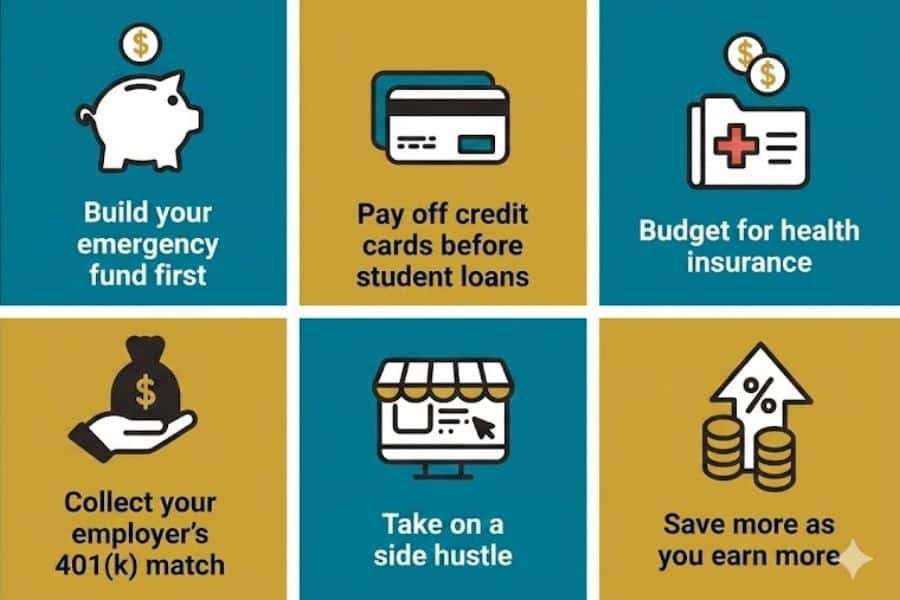
The Moves That Actually Move the Needle Fastest
If you’re behind, the standard advice to “start small and be consistent” is technically true but practically useless. You don’t have 40 years for small to compound into large. You need moves with real torque, and there are only a handful of them.
No. 1 Increase Income Temporarily
A second job, a side business, consulting hours, renting out a room, selling a skill you already have. Every extra dollar you earn in your fifties or sixties, if it goes straight into a retirement account, is worth far more than trying to squeeze more out of a budget that’s already lean.
I know someone who picked up bookkeeping work for three small businesses in her town and put every cent of it into her SEP-IRA for four years. She added almost $200,000 to her retirement that way without touching her household budget at all.
No. 2 Delay Social Security
For every year you wait past your full retirement age up to 70, your benefit grows by about 8 percent. There is no investment on earth that guarantees you 8 percent a year, risk-free, indexed to inflation.
Working until 67 instead of 62, or 70 instead of 67, is one of the most powerful retirement moves available, and it costs you nothing except a few more years of working.
No. 3 Housing
It’s the biggest expense most retirees have, and the lever almost nobody pulls because it feels emotional. Selling a four-bedroom house your kids haven’t lived in for a decade and moving to something smaller, or cheaper, or in a lower-tax state, can free up six figures of equity that immediately goes to work for you.
I’m not saying everyone should do this. I’m saying it should be on the table as a real option, not dismissed in the first sentence. Plus, there are other real estate benefits you can look into here.
A few other levers worth looking at hard:
- Pay off high-interest debt before adding to retirement beyond the employer match. Carrying a 22 percent credit card balance while investing for an expected 7 percent return is just slowly losing money. I had to learn this one twice.
- Take the full employer match, always, even if you can do nothing else. It’s a 50-100% return on the day you contribute. Walking past it is the most expensive thing a behind-on-savings person can do.
- Look at your investment fees. If your 401(k) is full of funds charging 1 percent a year and there are index options charging 0.05 percent, switching can add tens of thousands over a decade.
A Realistic Timeline of Where You’re Starting From
If you’re in your late thirties or early forties and feeling behind, you still have somewhere between 20 and 30 years of compounding. That’s enough time for aggressive but ordinary saving to do most of the work.
Hitting $1,500 a month into retirement accounts at age 40, growing at a reasonable 7 percent average return, lands you near $1.2 million by 65. The lift is real, but it’s not heroic. It’s just consistent.
If you’re in your fifties starting from a modest base, the catch-up contributions become the centerpiece. Maxing a 401(k) with catch-ups from 50 to 65, plus a Roth IRA with catch-ups, plus a working spouse doing the same, can build a meaningful retirement even from a near-zero start.
Two people doing this together can put away $80,000 a year in tax-advantaged accounts. Fifteen years of that, with growth, is real money.
If you’re in your sixties and the number is small, the plan shifts. The focus becomes some combination of working a few more years, delaying Social Security, reducing fixed costs (housing, cars, debt), and making sure whatever you do have is invested appropriately, not sitting in cash, losing ground to inflation.
A part-time job at 67 that covers $20,000 of your expenses is equivalent to having an extra $500,000 saved in terms of your retirement math.
The one thing none of these timelines tolerate is more avoiding. The friend I mentioned at the start, the one who closed the tab on her balance? She opened it back up a week later, sat with it for an hour, using a notepad and a calculator, and walked out with a plan that gave her something to do on Monday morning.
The number on the screen hadn’t changed. But the feeling had, because she knew what the next move was. That’s most of what catching up actually is. Knowing the next move, and then making it, and then making the one after that.
Disclaimer: This article is for informational purposes only and does not constitute financial advice. Please consult a qualified financial advisor before making changes to your retirement savings strategy.
Disclaimer: The content in this article is for informational purposes only and is not intended as financial, investment, or tax advice. Always consult a qualified financial advisor or tax professional before making decisions about your money, investments, or retirement planning.

Kylie Lang is a nationally syndicated travel journalist with bylines on the Associated Press Wire & more, a lifestyle writer, and the founder and editor of Your Lifestyle Library (yourlifestylelibrary.com). She holds a BA (Honours) in History from the University of Kent and is a member of the British Guild of Travel Writers.