
I went looking for my phone the other day while I was actually holding it. I had it in my hand, while my other hand was patting down pockets and lifting up sofa cushions. My husband watched me do this for a solid thirty seconds before he decided to put me out of my misery.
These little brain blips happen to all of us, and most of the time they’re harmless. So, naturally, in the true style of a 20-something, I went on a self-diagnosis mission. I’m happy to report there is nothing wrong with me, but I did end up reading a lot about what actually affects brain volume and memory over time. Some of the biggest culprits are things I do every single day without thinking.
But forewarned is forearmed, and there are plenty of things you can do to reverse the situation. Small, doable changes that don’t require buying any fancy equipment, expensive pills, or signing up for a program with a free trial that takes your credit card details, and you forget to cancel. Sound familiar?.
Below are ten habits worth a second look, and what you can do instead.
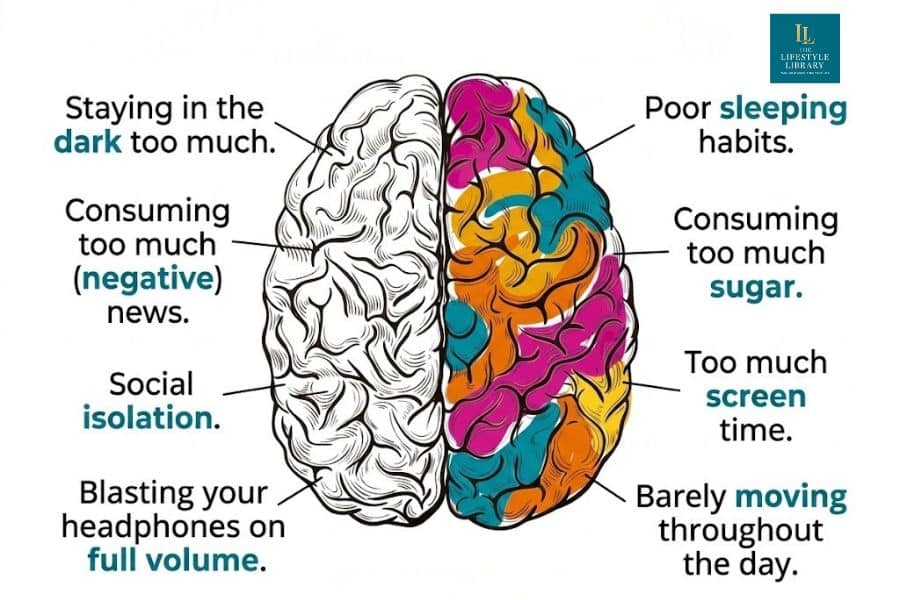
10 Daily Habits That Are Shrinking Your Brain
Before we get into the list, a quick word on what “shrinking” actually means here. Researchers measure brain volume using MRI scans, and over time, certain lifestyle factors have been linked to faster gray matter loss, particularly in the hippocampus, the region associated with memory and learning.
Some shrinkage is part of normal aging. The pace of it, though, is something we can influence more than most of us realize.
A lot of these habits overlap. Poor sleep makes you crave sugar, sugar messes with your mood, a bad mood keeps you on the couch, and so on. So if you only pick one or two of these to work on, you’ll probably get a knock-on effect on the others. Start small and go from there.
No. 1 Sitting for Hours Without Moving

I am so guilty of this one. I get engrossed in researching and writing an article, and before I know it, three hours have passed without my moving from my desk. Long stretches of sitting are linked with thinning in the medial temporal lobe, another memory-related area.
One UCLA study found that adults who sat for more than three hours a day showed measurable thinning in this region, regardless of how much they exercised otherwise. So even a daily workout doesn’t fully cancel out a six-hour Netflix binge or a desk-bound workday.
The fix isn’t an hour at the gym. It’s breaking up the sitting. Set a timer for every 30 to 45 minutes and stand up, walk to the kitchen, do ten squats, anything that gets the blood moving for two minutes. I have a desk that converts into a standing desk, so at least three times a day I wind it up and stand up to work for 30 minutes or so.
A few practical swaps that work:
- Take phone calls walking around the house or garden. I get more steps in on long calls than I do on most of my so-called walks.
- Stand up during TV ad breaks and do something gentle, even just stretching. Or, walk to the kitchen, make a cup of tea, and walk around while you wait for the kettle to boil.
- Park further away, or get off the bus a stop early. You’ll be amazed how quickly that adds up.
No. 2 Skimping on Sleep

Sleep is when your brain does its housekeeping. The glymphatic system flushes out waste proteins, including the ones associated with Alzheimer’s risk. When you regularly clock under six hours, that cleanup gets cut short. A large study found that both short and very long sleep durations were linked with worse cognitive performance and changes in brain structure.
The swap most people need isn’t necessarily more sleep, but a wind-down routine. Phones in another room, lights dim by 9 pm, and something to read for the last twenty minutes.
I switched from reading on my tablet to a paperback before sleep about a year ago, and it’s helped with my sleep.
If you wake up in the middle of the night and can’t get back to sleep, try the 4-7-8 breathing pattern. Breathe in for four seconds, hold for seven, breathe out for eight. It works. I’ve had insomnia for a while, and I used to lie there getting more and more frustrated; this works more times than not.
No. 3 Living on Ultra-Processed Food

Ultra-processed foods are those with long ingredient lists full of ingredients you wouldn’t keep in your own kitchen. Packaged snacks, frozen ready meals, sugary drinks, and most breakfast cereals. A study followed over 10,000 adults and found that those who got more than 20 percent of their daily calories from ultra-processed foods had a 28 percent faster rate of global cognitive decline.
This doesn’t mean you have to cook from scratch every night, but even shifting one meal a day toward whole foods makes a difference. Swap the cereal for eggs and an orange. Swap the lunchtime sandwich meal deal for a tin of sardines on sourdough with some tomatoes. Swap the after-dinner ice cream for Greek yogurt with frozen berries and a drizzle of honey.
And hide the chocolate biscuits, so they aren’t on full display. Or better still, get your partner to hide them so you don’t actually know where they are.
No. 4 Chronic Stress With No Outlet

Stress on its own isn’t the problem. Stress with nowhere to go, day after day, is. Chronically high cortisol is associated with reduced hippocampal volume and poorer memory performance. A study found measurable brain changes in middle-aged adults with elevated cortisol levels before any cognitive symptoms appeared.
The swap is ten minutes of something that actually calms you down. For me, it’s pulling weeds in the garden, which I find more meditative than meditation. For my sister-in-law, it’s swimming, for my neighbor, it’s going for a run. Whatever flips your nervous system from high alert to rest mode counts.
A few things worth trying if you’re not sure what works for you:
- A slow walk outside without your phone. I started doing a 15-minute loop after lunch this spring, and my afternoon brain fog was definitely better.
- Box breathing, which is just breathing in for four, holding for four, out for four, holding for four.
- Writing down three things bugging you in a notebook, then closing it. There’s something about getting them out of your head and onto paper that takes the edge off.
No. 5 Drinking More Than You Think You Do

Even moderate alcohol intake shows up on brain scans. Going from one drink a day to two is roughly about two extra years of aging. Going from two to three? Three and a half extra years. And there really is only one solution, and that’s fewer drinks. Or try the alcohol-free versions of your favorite tipple. They do a very good non-alcoholic gin that I really enjoy.
Or try alternating each alcoholic drink with a glass of water or a soft drink, or pick two or three nights a week that are alcohol-free by default. I started taking Monday through Thursday off and keeping weekends as usual, and after about a month, I wasn’t even thinking about wine on Tuesday nights anymore.
If you’re someone who drinks because it helps you unwind, try replacing the evening drink with a hot bath, herbal tea, or even just changing into comfortable clothes earlier in the evening, which can scratch the same itch.
No. 6 Living in a Bubble of the Same People and Routines

Social isolation and lack of mental stimulation are two of the biggest modifiable risk factors for dementia, according to the Lancet Commission. Talking to other humans, especially in ways that require you to listen, respond, and consider different perspectives, gives your brain a workout you can’t get any other way.
Try being the instigator and call a friend you haven’t spoken to in a while, join something local, even if it’s just a monthly book club or a walking group. I joined a community garden last year, and the mix of new faces, new tasks, and time outside has done more for my mood than anything else I’ve tried.
Similarly, routine is comfortable, but it’s not great for your brain over time. Doing the same thing in the same order every day means your brain stops paying attention. Take a different route home, try a recipe for one of your favorite meals, or brush your teeth with your non-dominant hand. It all counts.
No. 7 Endless Scrolling and Constant Multitasking

Switching between apps, tabs, and conversations all day trains your brain to skim and react rather than focus and think. Heavy media multitasking is linked to poorer working memory and attention in several studies of adults who multitask heavily across digital platforms. The brain also stops filtering out irrelevant information.
The swap is single-tasking for set blocks of time. Twenty-five minutes of one thing, then a five-minute break, is the classic Pomodoro method, and it works because it’s short enough to feel doable. I use it when I’m writing, and it’s the difference between getting an article done in two hours or watching the same blank page for four.
No. 8 Treating Hearing and Vision Changes as No Big Deal
Untreated hearing loss is now considered one of the largest modifiable risk factors for dementia. When your brain has to work overtime to fill in the gaps of what you can’t quite hear, it has less capacity for memory and other functions. The 2024 Lancet Commission update on dementia prevention named hearing loss as a top risk factor that’s actually treatable.
Vision works the same way. If you’re squinting, struggling to read signs, or avoiding social events because you can’t follow conversations, your brain is paying a tax it doesn’t need to pay. Get your eyes and hearing checked. If you’ve been told you’d benefit from hearing aids and you’ve been putting it off, this is your sign.
My dad held out on hearing aids for about five years longer than he should have. Once he finally got them, the change in his engagement at family dinners was so noticeable. Mind you, that didn’t stop the selective deafness.
No. 9 Skipping Strength Training

Cardio gets all the brain-health press, but resistance training has its own set of benefits, particularly for older adults. Building muscle releases compounds that protect brain cells and improve blood flow.
All you need is two short strength sessions a week. Bodyweight squats, push-ups against a wall or the floor, lunges holding a couple of grocery bags, planks for as long as you can manage. Twenty minutes, twice a week, is the minimum effective dose for most people starting out.
I started doing kettlebell workouts at home about 18 months ago, and my posture is better, my back doesn’t hurt the way it used to, and, weirdly, my memory feels sharper, especially in the afternoon, when I used to hit a wall.
No. 10 Letting High Blood Pressure and Blood Sugar Slide

Both high blood pressure and high blood sugar damage the small blood vessels that feed your brain. Over the years, this has led to silent strokes, white matter changes, and accelerated cognitive decline. Midlife blood pressure in particular is strongly tied to dementia risk decades later, which is why doctors push so hard to get it under control in your 40s and 50s.
Get your blood pressure checked at least once a year, more often if you’re already in the borderline range. Same with fasting glucose and HbA1c. If your readings are creeping up, the lifestyle changes that help, less salt, more vegetables, regular walks, and less alcohol, also happen to help your brain.
It takes ninety seconds to do a home blood pressure check, and it will make you more aware of how stress, sleep, and salty meals show up in your readings. Knowing the numbers makes the abstract risk feel concrete, which makes the changes easier to stick to.
Disclaimer: This article is for general information and isn’t a substitute for medical advice. If you have concerns about your memory, cognition, or any of the conditions mentioned, please talk to your doctor.