
I didn’t open my first real investment account until I was 48. I’d been working since I was 19, earning decent money for most of that time, and the sum total of what I had invested in the stock market before that birthday was zero.
I had savings, sure, and a pension, but actual invested money, the kind that compounds while you sleep? Nothing. The reason I kept putting it off is that I thought I needed more money to make it worthwhile. That and a myriad of other things, such as not understanding it properly, doing it when I had more time, or when the market was better, not that I really knew what that looked like.
If you’ve been holding yourself back from investing and telling yourself a version of the same story, I want to talk you out of it today. Not with a get-rich-quick angle, but with the plain math of what happens when you start with $50 a month versus waiting another five years to start with $200.

Why Waiting Costs More Than You Think
I had absolutely no idea what compound growth was until I sat down with someone who explained it in layman’s terms, so I actually understood what it meant and how it worked.
If you invest $50 a month starting at age 35 in a broad stock market index fund, and you assume a long-term average return of around 7% after inflation (which is roughly what the US stock market has delivered over multi-decade stretches), you’d have about $61,000 by age 65.
Now take the same person who waits until 45 to start, but bumps it up to $100 a month to make up for lost time. They’d end up with around $52,000. They put in twice as much per month for 20 years and still landed behind.
That gap is the cost of waiting, and it gets worse the longer you stall. Wait until 55 and try to catch up with $200 a month, and you’d still finish behind the person who started at 35 with $50. The early dollars do the heavy lifting because they have more years to multiply.
Every year you delay, you lose one of your most productive compounding years, and you can’t buy those years back later, no matter how much you throw at it.
And that’s where I found myself. I’m telling you because the same logic that makes waiting expensive also makes starting today, even with a small amount, more powerful than you’ve been giving it credit for.
The $50 Excuse, and Why It’s the One Keeping You Stuck
When I finally opened my brokerage account, I put in $100 to start. I felt a bit like a kid showing up to a poker game with a fistful of nickels, convinced my $100 would be eaten alive by fees and be a complete waste of time.
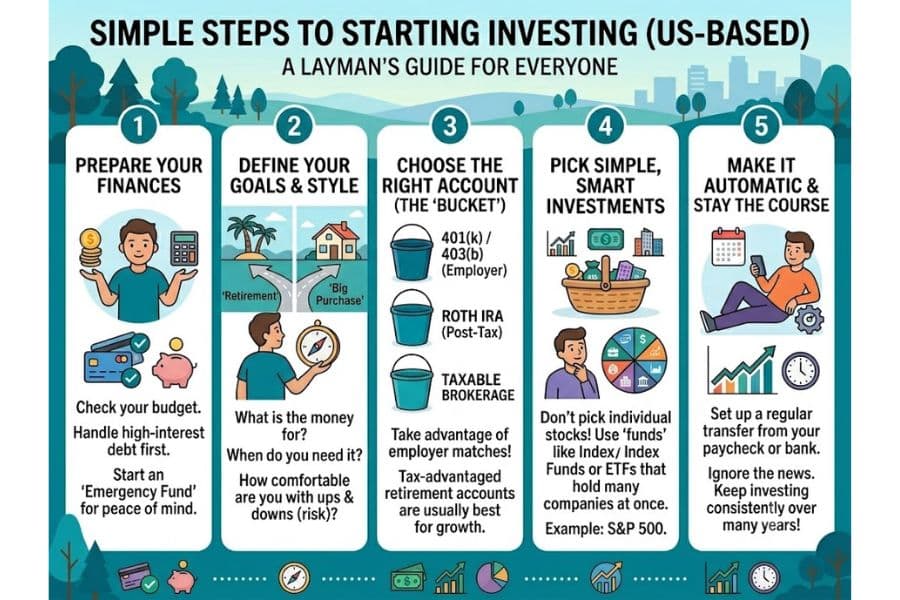
None of that turned out to be true. Most major brokerages in the US, Fidelity, Vanguard, Schwab, will let you open an account with no minimum and buy fractional shares of index funds or ETFs for as little as $1.
There are no monthly fees on these accounts if you pick the right ones. The big low-cost index funds charge expense ratios of around 0.03% to 0.04% per year, which, with a $50 monthly contribution, comes to pennies.
The fear of screwing it all up is real, though, and the one that keeps most of us stuck. It’s the fear of picking the wrong fund, of putting money in right before a crash, of looking like an idiot because you lost your money and didn’t know what you were doing.
What helped me was realizing that doing nothing is also a decision, and it’s the one with the worst long-term track record. Sitting in cash means your money loses value to inflation every year. Over the last few years, with inflation running as high as it has, cash sitting in a regular checking account has been a slow leak.
If you have $50 a month you can spare, you have enough to start. If you don’t have $50, you have a budgeting problem to solve first, and that’s a different article.

What to Actually Buy When You’re Starting Small
You want a broad, low-cost index fund or ETF that holds a big slice of the stock market in one purchase. Two names that come up over and over for good reason: VTI (Vanguard Total Stock Market ETF) and VOO (Vanguard S&P 500 ETF). Fidelity’s FZROX is similar with a zero expense ratio if you’re using a Fidelity account.
What these do, in plain terms, is spread your $50 across hundreds or thousands of US companies at once. You’re not betting on a single stock. You’re buying a tiny slice of the whole American economy, which has historically gone up over long periods, even with plenty of ugly years mixed in. When people say things like “just buy the index,” this is what they mean.
If you want a bit more diversification, you can add an international fund like VXUS to gain exposure to companies outside the US, or a total bond fund like BND for ballast. A perfectly reasonable starter portfolio for someone in their 40s might be 80% VTI, 20% VXUS, with bonds added as you get closer to retirement. You can absolutely refine this later. You don’t need to nail it on day one.
What I’d avoid when you’re starting out: individual stocks based on tips from coworkers or TikTok, anything described as “the next big thing,” actively managed funds with expense ratios above 0.5%, and anything you can’t explain to yourself in one sentence.
If a thing is so complicated you’d be embarrassed trying to describe it, it’s not for your first $50.

Setting It Up So You Don’t Have to Think About It
The single best thing I did for my own investing was automate it. I set up a recurring transfer from my checking account into my brokerage on the day after payday, and I set the brokerage to auto-invest that money into my chosen funds.
Here’s how to do this in about 20 minutes if you’ve been stalling:
- Open a brokerage account with Fidelity, Vanguard, or Schwab. All three have free, no-minimum taxable brokerage accounts. The signup takes around 10 minutes and requires your Social Security number and bank info.
- Link your checking account. They’ll do a small test deposit to verify it; this takes a day or two.
- Set up a recurring transfer for whatever amount you’ve decided on. $50, $100, $200, whatever fits. Pick a date right after your paycheck hits.
- Choose your fund and set it to auto-invest. On Fidelity and Schwab, you can do this directly. On Vanguard, you may need to buy fractional shares manually or use their automatic investment feature for mutual funds.
- Turn on dividend reinvestment. This means any dividends the fund pays out are automatically used to buy more shares.
That’s the whole setup. Once it’s running, the hardest part is leaving it alone. I check mine once a month. Watching it daily is how people talk themselves into selling at the worst possible moment, which brings me to the next bit.
If your employer offers a 401(k) match, do that first before any of this. A 401(k) match is free money, and it’s the highest-return move you’ll ever make in finance. Put in enough to get the full match, then come back here for the rest.
What to Do When the Market Tanks (Because It Will)
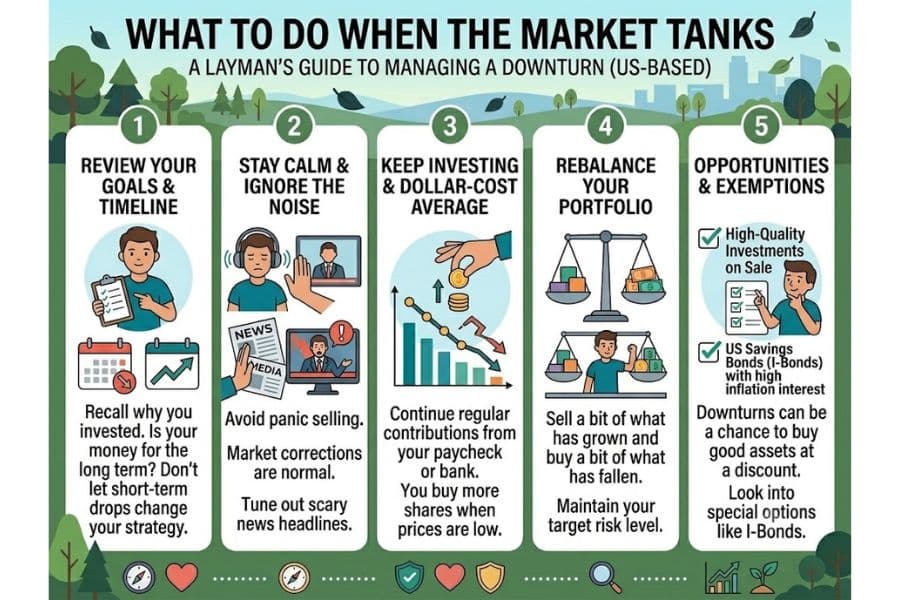
At some point after you start, the market will drop. It might drop 10%, it might drop 30%, it might happen six months in or six years in. Your $50 a month will turn into a balance worth less than the sum you put in, and you’ll feel a powerful urge to stop the bleeding by selling everything and never trusting the stock market again.
This is the moment that separates people who build wealth from people who don’t. The 2008 crash, the 2020 COVID drop, the 2022 selloff, every one of them looked terrifying in the moment, and every one of them was followed by a recovery for people who held on.
The investors who lost money were the ones who sold near the bottom and missed the rebound. The ones who kept their automatic contributions running through the dip ended up buying more shares at lower prices, which paid off handsomely later.
When you’re investing small amounts monthly, dips are arithmetically your friend. Your $50 buys more shares when prices are low. You’re getting more of the thing on sale. It doesn’t feel that way emotionally, of course. It feels like you’re throwing money into a fire. I had to talk myself off that ledge in 2020 and again in 2022, and the only thing that worked was reminding myself I wouldn’t need that money for 18 years.
Write yourself a note now, while you’re calm, and tape it somewhere you’ll see it later. Something like: “I am investing for 15+ years. Short-term drops don’t change my plan. I will not sell during a downturn.” It sounds silly until you need it.
The $50 a month you start today, left alone for 20 or 30 years through every market wobble in between, will do more for your retirement than any clever move you could make trying to time it. Consistent, steady, and automated. Start this week if you can. Future you, the one trying to figure out how to afford things in retirement, will thank present you for finally getting on with it.
Disclaimer: This article is for general information only and isn’t personalized financial advice. Investment returns aren’t guaranteed, and you can lose money in the stock market. Talk to a qualified financial advisor about your own situation before making investment decisions.