
Do you ever get that feeling when you look at your garden beds and just wish you could Mary Poppinize it? Snap your fingers, and it’s all done? I know I do, on a regular basis.
However, as that isn’t possible, my first instinct is usually to rip it all out, start again, and order a stack of new plants. My second instinct, which is usually the better one, is to make a cup of tea and think about it.
Because the truth is, all it needs is a bit of attention in the right places, and maybe $40 or $50 spent carefully. I’ve done this a few times now and been extremely glad I didn’t decide to rip the whole thing to pieces. So here’s how I’d spend $50 on a sad border in June, in roughly the order I’d spend it.
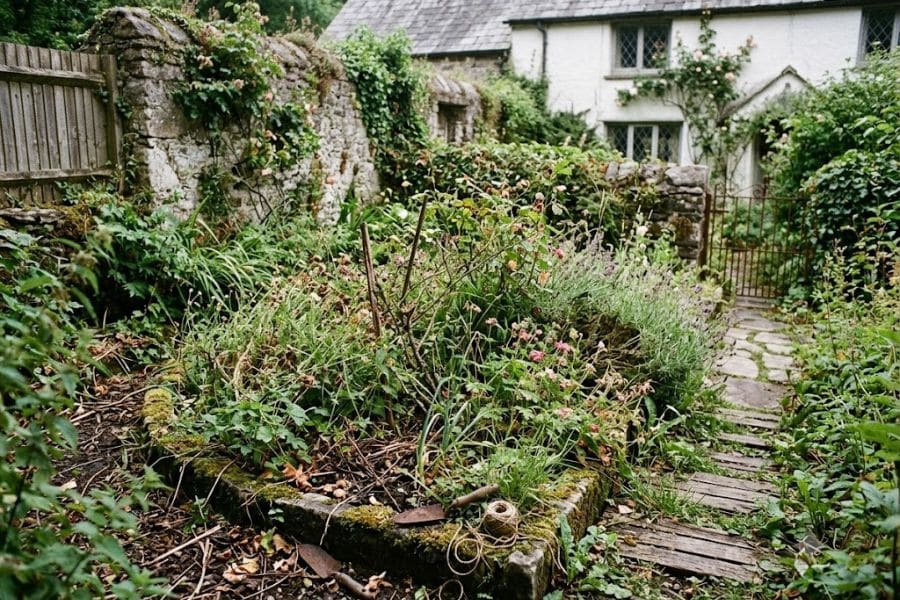
First, Look at What You’ve Already Got
Before you spend a single dollar, go stand in front of the border with your cuppa and just look at it. I mean, really look. What’s actually still alive in there? What’s flowering, even if a little half-heartedly? What’s overgrown and flopping into its neighbor? What’s just dead sticks you’ve been ignoring since last fall?
I did this with my own border and realized I had a perfectly good catmint hiding behind a sprawl of dead lavender stems I’d never cut back. Once I pulled the dead stuff out, I had something to work with. There was a hardy geranium I’d forgotten about and a small salvia that just needed a haircut. The bones were there. They were just buried under a lot of last year’s mess.
Get a pair of pruning shears and a trash bag and spend half an hour cutting back anything brown, snapping out anything woody and dead, and pulling the weeds that have moved in while you weren’t paying attention.
Don’t dig anything up yet. You’re just clearing the view so you can see what you’re actually dealing with. This part costs nothing, and it’s where most of the visible improvement comes from. A border looks 60 percent better the moment the dead stuff is gone.
Spend $8 on a Crisp Edge
A clean edge does more for a tired border than almost anything else. It’s the gardening equivalent of making the bed. The plants can still be a bit chaotic, but if the line where the bed meets the lawn or the path is sharp, it’s like having an instant makeover.
A half-moon edger from the hardware store is around $20 if you don’t already own one, and if you do, you’re spending zero. If you want a more defined look, a roll of bendable steel or plastic edging runs about $8 to $15 at most garden centers and can be installed with a rubber mallet in about 20 minutes.
I’ve used the cheap stuff, and it’s fine, especially once plants flop over the top of it and you can’t really see it anyway.
Cut a fresh edge with the half-moon along the front of the border. Slice down about three inches, then angle the blade in to lift out a little wedge of turf. You’ll be amazed how much sharper the whole bed looks after.

Spend $10 on Compost and Mulch
If the soil in your border looks pale, dusty, or like it’s been baked into a crust, it probably has. Summer sun does that, especially if the bed is south-facing or against a wall. A bag of compost spread an inch thick across the surface does two jobs at once. It feeds the plants you already have, and it makes the bed look dark, rich, and intentional instead of sun-bleached.
A two-cubic-foot bag of compost is around $6 at most garden centers, and depending on the size of your border, you might need one or two. For a small to medium bed, one is plenty. Spread it with your hands or a small trowel, working around the plants, not piling it up against the stems.
While you’re at it, if you’ve got a bit of bark mulch left over from anywhere, scatter that on top. It holds moisture in, which matters a lot in June and July when everything’s drying out faster than you can water it.

Spend $25 on Three or Four Well-Chosen Plants
This is where you need to rein yourself in. When you go to the garden center, try not to get overexcited and pick up every plant in sight. Three or four plants, repeated, will always look better than twelve singles.
For a tired June border, I’d go for one tall thing for height at the back, two of something flowering for the middle, and one low spreading thing for the front. That’s it. Look for plants in 1-quart pots, which are usually $5 to $8 each at a regular garden center.
A few things I keep coming back to because they’re tough, they flower for ages, and they don’t sulk:
- Catmint (‘Walker’s Low’ is the one I always buy, even though it gets bigger than the name suggests). Bees love it; it flowers from June through September, and it forgives you if you forget to water.
- Salvia, almost any of the hardy perennial kinds in purple or pink. I’ve got ‘Caradonna’ in the back border, and it’s been going strong for four years with basically no help from me.
- Hardy geranium, the kind that spreads into a low mound. ‘Rozanne’ is fab because it flowers until the frost.
- Coreopsis or rudbeckia for cheerful yellow that looks great in summer light. They both self-seed gently.
- Lamb’s ear at the front, for the silvery foliage. It’s soft, it spreads, and you can’t really kill it. My kind of plant.
Pick three or four, buy two or three of each if your budget stretches, and plant them in little clusters rather than dotted around like buttons on a shirt. Repetition is what makes a border look designed instead of accidental.

Spend $7 on a Lick of Paint for Something Nearby
There’s almost always something hard and visible near a border that’s looking shabby. A terracotta pot that’s gone chalky, a wooden plant stand that’s faded to gray, an old metal watering can you leave out as a feature, the edge of a raised bed, a bit of trellis on the fence behind. Pick one and give it a coat of paint.
A small can of outdoor paint or a tester pot in a deep color, something like a soft black, a sage green, or a deep terracotta, will set you back around $7 to $10, and you’ll have plenty left over.
Dark colors work best because they recede, letting the plants do the talking.
Bright white pots, especially in strong summer light, show every splash of dirt. A dark pot doesn’t, and the flowers pop against it. If you’ve got a fence panel behind the border that’s looking sad, a coat of dark stain on just that one panel does the same job. It’s the cheapest backdrop upgrade going.
A Few Things I’d Skip
When you’re working with $50, some things just aren’t worth the money, and I’ve wasted enough cash over the years, so learn from my mistakes.
Don’t buy annual bedding plants in big trays as a quick fix. They look great for six weeks, and then they’re done, and you’re back where you started in September with a bare bed. The perennials you bought instead will still be there next year and the year after, getting bigger. Bedding is fine if you’ve got money left over and a specific gap to fill near the front, but it shouldn’t be where the bulk of your budget goes.
Don’t buy decorative gravel or stone in small bags. It works out absurdly expensive per square foot, and unless you’re covering a tiny area, you’ll need way more than you think. If you want a mulched look, bark chips from a big bag are far cheaper, and they break down into the soil over time, which is good for it.
And don’t buy a fancy ornament you’re not sure about just because it’s on sale. There was one time I did this, and it worked. I live on a street called Chez le Coq, and everyone in our little road has a ceramic cockerel. I bought a wire one, and it’s still sitting happily in pride of place by the door, and it gives life to my rockery.
Spend the money on plants and paint, and add ornaments slowly, only when you know exactly where they’re going, as I did. The border will thank you, and so will your future self walking past with her coffee, nodding instead of sighing in frustration.