
What nobody tells you about saving for your retirement is the tax bill that comes with it. The money grew tax-free while you were working, so eventually the IRS wants its cut, and it wants that cut on its own schedule, not yours.
This retirement mistake has absolutely nothing to do with the fund you pick; it’s all about timing. And it can end up costing you thousands of dollars if you’re not prepared.
So what can you do to make sure you don’t fall into this trap and make the same retirement tax mistake?

The Retirement Tax Mistake: Waiting Until RMDs Force Your Hand
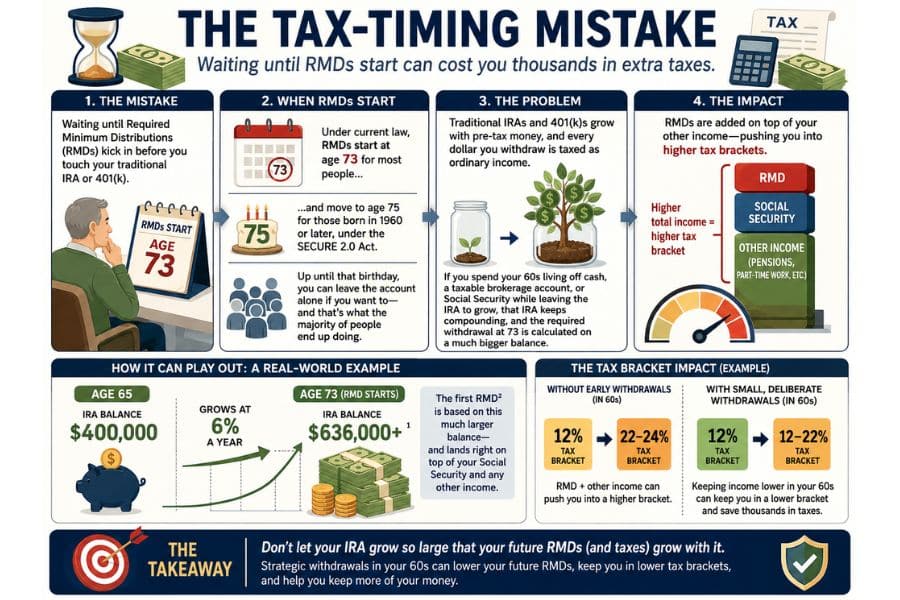
The tax-timing mistake comes down to waiting until Required Minimum Distributions kick in before you touch your traditional IRA or 401(k).
Under current law, RMDs start at age 73 for most people (and move to 75 for those born in 1960 or later, under the SECURE 2.0 Act).
Up until that birthday, you can leave the account alone if you want to, and that’s what the majority of people end up doing.
The problem is that traditional IRAs and 401(k)s grow with pre-tax money, and every dollar you eventually withdraw is taxed as ordinary income. If you spend your 60s living off cash, a taxable brokerage account, or Social Security while leaving the IRA to grow, that IRA keeps compounding, and the required withdrawal at 73 is calculated on a much bigger balance.
A $400,000 IRA at 65 that grows at 6 percent a year is well over $600,000 by 73, and the first RMD lands right on top of your Social Security and any other income you have.
Stack that up, and you can find yourself pushed from the 12 percent bracket into the 22 or 24 percent bracket in a single year, paying more tax per dollar than you would have if you’d taken small, deliberate withdrawals in your 60s.
The tax code rewards people who think about the withdrawal order and calendar years, and penalizes those who don’t.
Your 60s Are the Tax Planning Window Almost Nobody Uses
The years between when you stop working full-time and when RMDs begin are often called the retirement tax planning window, and for good reason. Your earned income has dropped or disappeared, you may not have claimed Social Security yet, and you’re not being forced to pull from the IRA.
Your taxable income is, for many people, the lowest it will ever be again. That means your marginal tax bracket is also low.
You can convert chunks of the traditional IRA into a Roth IRA, paying tax now at a bracket you can see and plan for, so that money grows tax-free forever and never triggers an RMD.
You can realize long-term capital gains from a brokerage account at the 0 percent federal rate, which applies for 2026 to married-filing-jointly couples with taxable income up to $96,700 and single filers up to $48,350.
You can pull just enough from the IRA each year to fill up the 12 percent bracket without spilling into the next one.
Do none of that, and the window closes on its own. Once Social Security starts and RMDs land, your taxable income jumps, your bracket climbs, and the cheap conversion years are gone.
The Social Security Tax Torpedo Most People Never See Coming
Here’s where it gets expensive, and where I think the tax code is at its most confusing. Social Security benefits are taxable, but only sort of.
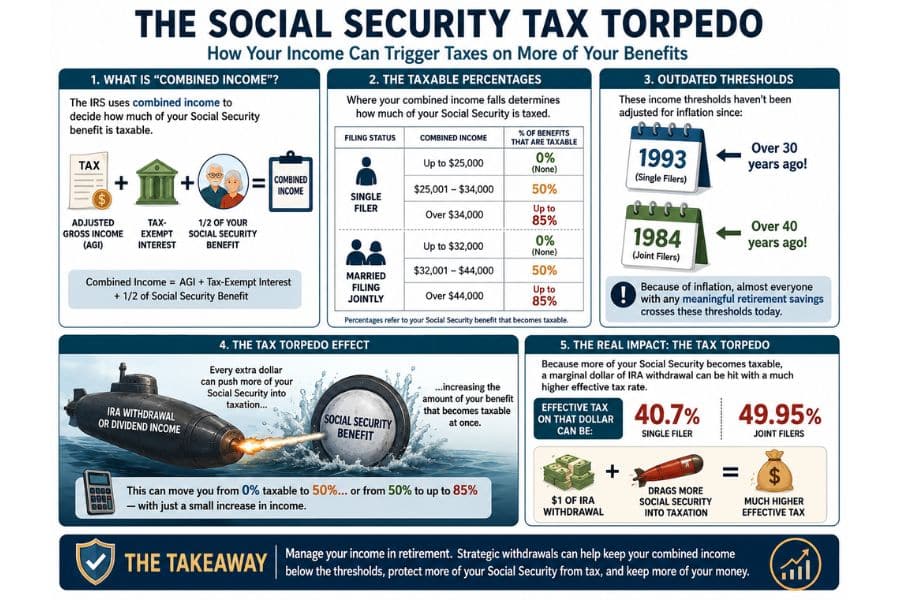
The IRS uses something called combined income, which is your adjusted gross income plus any tax-exempt interest plus half of your Social Security benefit. If that number stays under $25,000 for a single filer or $32,000 for a couple filing jointly, none of your Social Security is taxed.
Above those numbers, 50 percent of the benefit becomes taxable. Above $34,000 single or $44,000 joint, up to 85 percent of the benefit becomes taxable.
Those thresholds haven’t been adjusted for inflation since 1993 and 1984, respectively. Which means almost everyone with any meaningful retirement savings crosses those thresholds now, and every extra dollar of IRA withdrawal or dividend income can drag more of the Social Security benefit into the taxable pile.
Financial planners call this the tax torpedo, because a marginal dollar of IRA withdrawal can effectively be taxed at 40.7 or 49.95 percent once you factor in the extra Social Security it drags into taxation.
It looks and feels like you’re in the 22 percent bracket, but your actual marginal rate is a lot higher. The way to defuse it is to do Roth conversions before you claim Social Security, so that the IRA is smaller when the benefit starts, and later withdrawals from the Roth don’t count toward combined income at all.
IRMAA, the Medicare Surcharge That Arrives Two Years Late
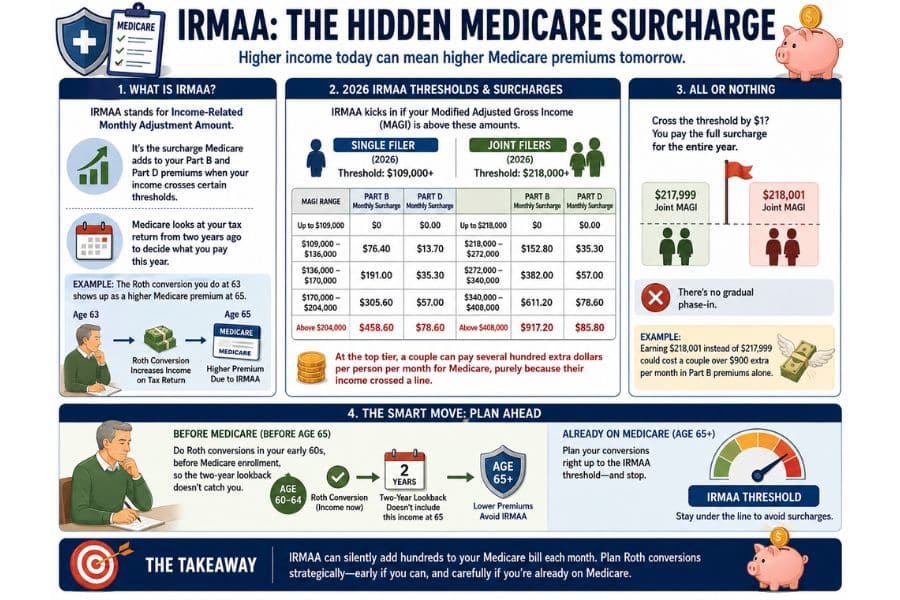
IRMAA stands for Income-Related Monthly Adjustment Amount, and it’s the surcharge Medicare adds to your Part B and Part D premiums when your income crosses certain thresholds. Medicare looks at your tax return from two years ago to decide what you pay this year. So the Roth conversion you do at 63 shows up as a higher Medicare premium at 65.
For 2026, IRMAA kicks in for single filers with modified adjusted gross income above $109,000 and joint filers above $218,000, and the surcharges climb in tiers from there. At the top tier, a couple can pay several hundred extra dollars per person per month for Medicare, purely because their income crossed a line. Cross the threshold by $1, and you pay the full surcharge for the year. There’s no gradual phase-in.
The practical move is to do Roth conversions in your early 60s, before Medicare enrollment at 65, so the two-year lookback doesn’t catch you. If you’re already on Medicare, you plan your conversions right up to the IRMAA threshold and stop.
The Withdrawal Order That Usually Wins
If you have a mix of account types, and most people who save seriously do, the order you pull from them matters as much as how much you pull. The old rule of thumb was taxable accounts first, then tax-deferred accounts, then Roth accounts last.
That order was fine when tax brackets were higher, and RMDs started at 70 and a half, but it can backfire now because it lets the traditional IRA grow untouched for a decade, guaranteeing a big RMD later.
A smarter pattern for a lot of retirees looks like this. In your 60s, take enough from the traditional IRA each year to fill the 12 percent bracket, use taxable account money to cover any shortfall in living expenses, and do Roth conversions on top up to whatever bracket you can (often the top of the 22 or 24 percent bracket, depending on your situation).
Delay Social Security to 70 if your health and cash flow allow it, because the benefit grows about 8 percent a year between full retirement age and 70, and a bigger benefit is more valuable when you’re older.
The result is that by the time RMDs start, the traditional IRA is smaller, so the RMD is smaller, so your taxable income is lower, so more of your Social Security escapes taxation, so your Medicare premium stays in a lower IRMAA tier, so your effective tax rate over the whole of retirement drops.
Every one of those dominoes is a real dollar. Run the numbers over 30 years, and the difference between the default schedule and a thought-through schedule is often six figures.
A few practical things worth doing this year, whether you’re 5 years out like me or already in the window:
- Pull your most recent tax return and figure out where you sit inside your current bracket. The top of the 12 percent bracket for 2026 is $48,475 taxable income for singles and $96,950 for married filing jointly.
- Ask your IRA custodian for a cost estimate for a Roth conversion. Fidelity, Vanguard, and Schwab all have tools that let you model this without committing to anything.
- If you’re within 2 years of Medicare enrollment, look up the current IRMAA thresholds on the Medicare.gov site and pencil your projected income against them before you convert anything.
- If charitable giving is part of your life and you’re over 70 and a half, look at Qualified Charitable Distributions. You can send up to $108,000 directly from your IRA to a qualified charity in 2025, and it counts toward your RMD without hitting your taxable income. It’s one of the more elegant corners of the tax code, and hardly anybody uses it.
- Talk to a fee-only fiduciary about a multi-year tax projection, not just this year’s return. A good one will model your income year by year to 90 and show you where the cliffs are. Expect to pay for it. It’s worth what you pay.
Disclaimer: The content in this article is for informational purposes only and is not intended as financial, investment, or tax advice. Always consult a qualified financial advisor or tax professional before making decisions about your money, investments, or retirement planning.
Disclaimer: This article is for general information only and is not professional advice. It may contain affiliate links. Please see our full Editorial Policy for details.

Kylie Lang is a nationally syndicated travel journalist with bylines on the Associated Press Wire & more, a lifestyle writer, and the founder and editor of Your Lifestyle Library (yourlifestylelibrary.com). She holds a BA (Honours) in History from the University of Kent and is a member of the British Guild of Travel Writers.