
Once you turn 50, you slowly but surely start to notice a few changes. From how well you can get up from the floor to whether or not you can still stand on one leg without toppling over.
I work with many middle-aged people on flexibility and fitness and often get asked about yoga vs. Pilates for people over 50. And my answer is always the same: it comes down to your goal.
Yoga wins for flexibility, calmer breathing, and balance you carry through daily life, while Pilates wins for core strength, posture, and steadying yourself on your feet.
Most people at this stage in life do best with a bit of both. If you can only pick one, pick the one that fixes your biggest complaint, whether that’s feeling stiff or feeling weak.
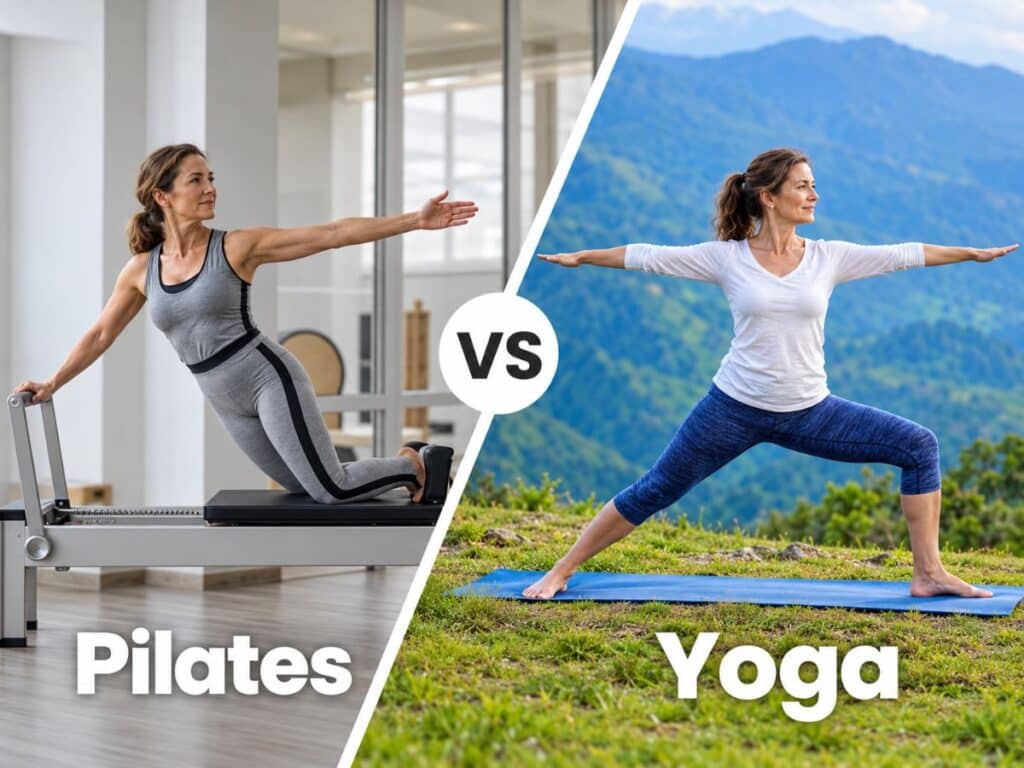
Yoga vs Pilates After 50
If your biggest complaint right now is stiffness, waking up feeling like the Tin Man and taking the first ten minutes of the morning to loosen up, yoga is going to help.
The slow stretching, long holds, and breathing that come with it are what you need, and most people leave class feeling about an inch taller and noticeably less wound up.
If your biggest complaint is weakness, feeling wobbly on your feet, struggling to get up from a low chair, or noticing your posture has crept forward and your shoulders have rounded, Pilates will do more for you.
It drills the muscles that hold you upright and steady, and those are the ones that weaken in our 50s and 60s if nothing is asking them to work.
Both are low-impact, both are kind to aging joints, and both can be done at any fitness level with the right teacher.
Top Tip: Write down the one thing you most want to be able to do in six months, whether that’s touch your toes, get off the floor without a hand down, or walk the dog without your lower back grumbling. Then choose yoga or Pilates and track your progress.
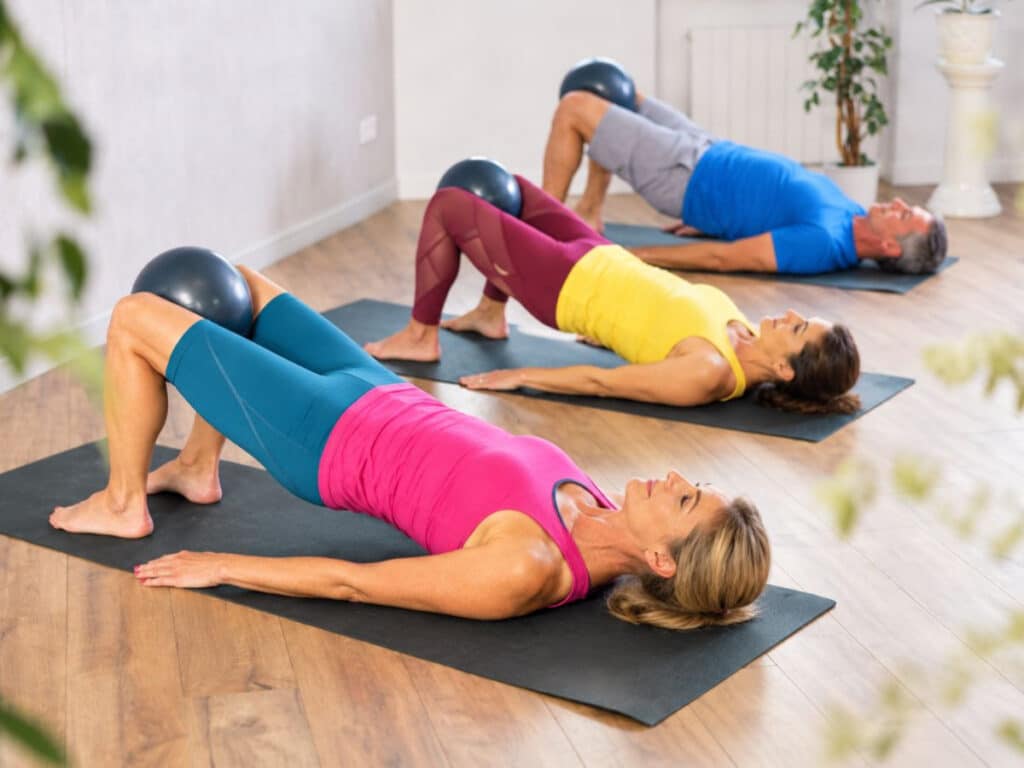
What’s the Difference Between Yoga and Pilates?
Yoga originated in India as a spiritual and physical practice and is thousands of years old.
In a modern class, you’ll move through poses that stretch and lengthen your whole body, hold them while you breathe deeply.
Pilates was developed fairly recently in the 20th century by Joseph Pilates, originally as rehabilitation for injured dancers and bedridden patients.
A Pilates class is more about precise, repeated movements focused on the deep core, the muscles around your middle that support your spine and pelvis. The breathing is sharper and powers the movement rather than calming the mind.
Yoga needs a mat, maybe a couple of foam blocks, and that’s it. Pilates mat classes are similar, but studio Pilates often adds resistance bands, small weighted balls, or a big spring-loaded contraption called a reformer, which is why reformer classes cost a fair bit more.
Found this useful? Get more like it in your inbox as a Lifestyle Library Insider.
Which Is Better for Back Pain and Posture After 50?
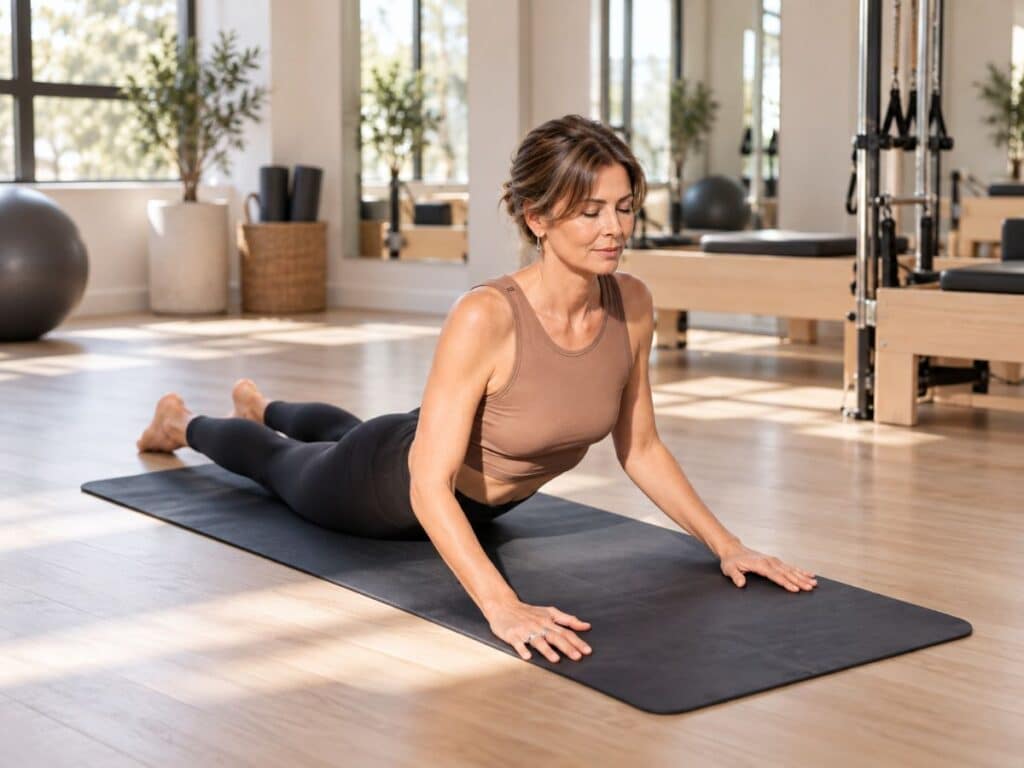
If you suffer from back pain, Pilates is going to be the better option. The whole system is built around the deep core muscles that wrap your middle and support your spine, and when those switch back on, your lower back stops doing work it was never designed for.
My mom suffers from back pain, and we’ve worked quite a few Pilates moves into her home workouts, and it’s made a difference. She’s noticeably stronger than before she started.
Yoga still has a role here, and you shouldn’t rule it out. Gentle stretching eases the stiffness in the hips, hamstrings, and shoulders that often feeds into back pain, and the breathing side helps with the tension that goes with chronic discomfort.
If your back pain is more about tightness than weakness, a gentle yoga class might unlock it. If it’s about not feeling supported through your middle, Pilates wins.
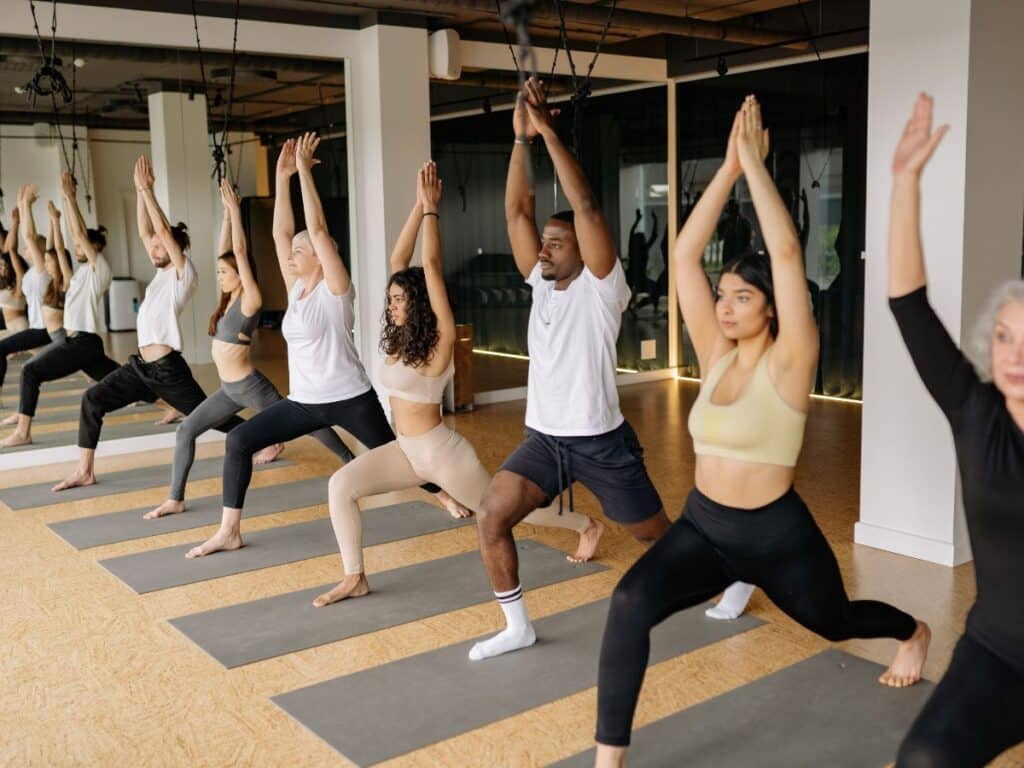
Which Is Better for Balance and Preventing Falls?
Both yoga and Pilates train balance, but Pilates is the better option for functional balance in older adults.
A meta-analysis in Physiotherapy found Pilates produced moderate improvements in balance and a large reduction in fall risk in people over 60.
Originally, the studies on yoga showed improvements in balance, but in 2025, the SAGE trial found a higher fall rate in the yoga group than in the control group.
Nobody is saying don’t do yoga, but it’s a reminder that yoga alone isn’t a complete fall-prevention plan, and some poses are riskier than others for people with balance issues.
Which Is Easier on the Joints and for Beginners?
Both yoga and Pilates are gentle enough for sore knees, dodgy hips, and the general wear and tear that comes with having been on this planet for 50-plus years.
There’s no jumping or pounding, and most of the work is done lying down, sitting, or in controlled standing positions.
Either one can be modified with chair versions or seated work if getting down to the floor is a problem, and most teachers will offer alternatives without you having to ask.
The real safety question is less about which discipline and more about who’s teaching it. A good instructor who notices what your body is doing and offers modifications is worth the money.
Tell them what you’ve got going on, whether that’s a dodgy knee, a shoulder that doesn’t like going overhead, or arthritis in the wrists, and let them guide you around it. A class marked ‘gentle’, ‘beginner’, or ’50+’ is a sensible starting point for either one.
Top Tip: Try one class before you buy a pass. Most studios or gyms will let you drop in once to see if the teacher and the pace suit you.
Can You Do Both Yoga and Pilates?
You can absolutely do both, and if your schedule allows it, that combination covers more than either on its own. Pilates builds strength and posture, yoga gives you mobility and mental quieting, and together they fill in each other’s gaps.
A sensible split for someone starting out is one Pilates class and one yoga class a week, with a walk or two on the other days. Most people start noticing real changes after about six to eight weeks with either twice a week.
Muscle loss after 50 is real, and lifting something heavier than you want to is the main thing that slows it down. Pilates builds core and postural strength, but it won’t build muscle in your legs the way a few sets of weighted squats will.
If you can add one short strength session a week on top of your yoga or Pilates, you’re doing more for your long-term independence than almost anything else.
Frequently Asked Questions
Is yoga or Pilates better for someone over 50?
Yoga and Pilates are both good for people over 50, but they do different jobs. Yoga is more about flexibility, calmer breathing, and stress relief, while Pilates builds core strength, better posture, and steadier balance.
Which is better for back pain, yoga or Pilates?
Pilates is better for back pain because it strengthens the deep core and the small muscles that support your spine, which can ease strain and improve posture.
Does Pilates or yoga help prevent falls in older adults?
Pilates and yoga both improve balance in older adults, and the evidence for Pilates is slightly stronger on functional balance and lower fall risk. Neither is a complete fall-prevention plan on its own, so you still want strength work and regular walking in the mix.
Which is harder, yoga or Pilates?
Pilates is harder than yoga mainly because you feel it in your core, deep abdominals, and back muscles, so it feels like you’re working harder. Yoga, on the other hand, is more demanding when it comes to flexibility and holding poses.
Can a beginner over 60 start yoga or Pilates?
A beginner over 60 can absolutely start yoga or Pilates, since both are low-impact and adapt well to older bodies, including chair and seated versions. The safest route is a beginner or 50-plus class with an experienced instructor who offers modifications.
How often should you do yoga or Pilates after 50 to see results?
To see results from yoga or Pilates after 50, aim for two to three sessions a week, and you’ll usually notice changes in flexibility, balance, and core strength within a month or two.
About this article: Our health articles are based on published studies and advice from experts such as physiotherapists and dietitians, and the sources are linked in the article.
Disclaimer: The content in this article is for informational purposes only and is not intended to replace professional medical advice, diagnosis, or treatment. Always consult your doctor, physical therapist, or healthcare provider before starting a new exercise program, particularly if you have existing joint, cardiovascular, or balance conditions. This article may contain affiliate links.
Become a Lifestyle Library Insider
Health tips, money know-how, travel deals and garden ideas for life after 50, straight to your inbox.

Summer Williams is a lifestyle writer and social media manager and a writer and editor of Your Lifestyle Library (yourlifestylelibrary.com). She holds a BA (Honours) in Journalism from Sheffield Hallam University. She is also a qualified fitness instructor, holding the NCFE Level 2 Certificate in Fitness Instructing. She also creates content under her brand Summer Elizabeth Creative.