
Who wants to live forever? A great song from the fabulous band Queen, and although I don’t want to live forever, I wouldn’t mind knowing how long I might live. Or would I? I don’t know, that’s a debate for another time.
What I would like to know, though, is if I’m doing ok. A sign or a clue that my number isn’t eminently up. Well, it turns out, there are clues, and one of those clues can be found on your staircase.
According to a major study, how fast you climb stairs is a predictor of how long you’ll live. The findings come from a European meta-analysis that combined data from nine studies across multiple countries, tracking more than 480,000 participants over more than a decade.
The results were presented at Preventive Cardiology 2024 by Dr. Sophie Paddock from the University of East Anglia and Norfolk and Norwich University Hospital Foundation Trust.

What the Researchers Actually Found
People who regularly climbed stairs had a 24% lower risk of dying from any cause compared to those who avoided them. More specifically, they had a 39% lower chance of dying from cardiovascular disease.
These are pretty big percentages, and that’s a significant difference in life expectancy connected to one of the most basic physical activities humans do.
The reduced risk didn’t stop there. Regular stair climbers also had lower rates of heart attack, heart failure, and fatal stroke.
Here’s the interesting bit: it wasn’t just healthy people who saw these benefits. People with existing heart conditions also showed improvements. This wasn’t a study just about already-fit people getting fitter, but about everyday movement making a measurable difference across the board.

Why Stairs and Not Something Else?
Why is stair climbing such a powerful health marker?
The answer lies in what your body actually has to do when you climb. Unlike walking on a flat surface, stairs force you to push your entire body weight upward against gravity. That means your heart has to work harder, your lungs pull in more oxygen, and the large muscles in your legs, particularly your glutes, hamstrings, and calves, all fire up at the same time.
That combination of cardio and resistance in a single movement is rare. Most exercises lean heavily toward one or the other, but stairs do both.
Over time, that repeated effort makes your cardiovascular system more efficient. Your heart pumps more effectively, your arteries stay in better shape, and your blood pressure tends to drop. These are exactly the conditions that reduce your risk of the diseases most likely to cut life short.
Your legs benefit too. Strong leg muscles are consistently linked to better heart health and lower mortality in research. Climbing stairs builds that strength without you having to think about it.
So What Does “Fast Enough” Actually Mean?
The researchers found that the benefits were associated with climbing the stairs briskly rather than slowly. So whilst it isn’t about racing up the stairs at top speed, you should be going at a pace that raises your heart rate and leaves you knowing you’ve just climbed a set of stairs.
The reason speed matters is that it reflects your underlying cardiovascular fitness. A person with a strong, efficient heart can climb stairs quickly and recover fast. Someone whose fitness has declined will find the same flight noticeably harder.
Have you ever seen the movie? As Good As It Gets with Diane Keaton and Jack Nicholson? He has a heart attack, and the doctor, played by Keanu Reeves, says he can go home once he can climb a flight of stairs at a steady pace.
And that’s exactly what he does. He doesn’t run up them but is out of breath when he reaches the top.

How Many Stairs Do You Need?
The research points to around five to six flights per day, which works out to roughly 50 to 60 steps, as a meaningful target.
That sounds like a lot until you break it down. Two flights in the morning. Two at lunchtime. Two in the evening. Over the course of a day, most people can find those opportunities without any real disruption to their routine.
When you start to consciously think about it, it’s pretty easy. Skip the elevator at the doctor’s office, take the stairs at the parking garage, use the upstairs bathroom instead of the one on the ground floor, they’re all ways to get your flights in each day.
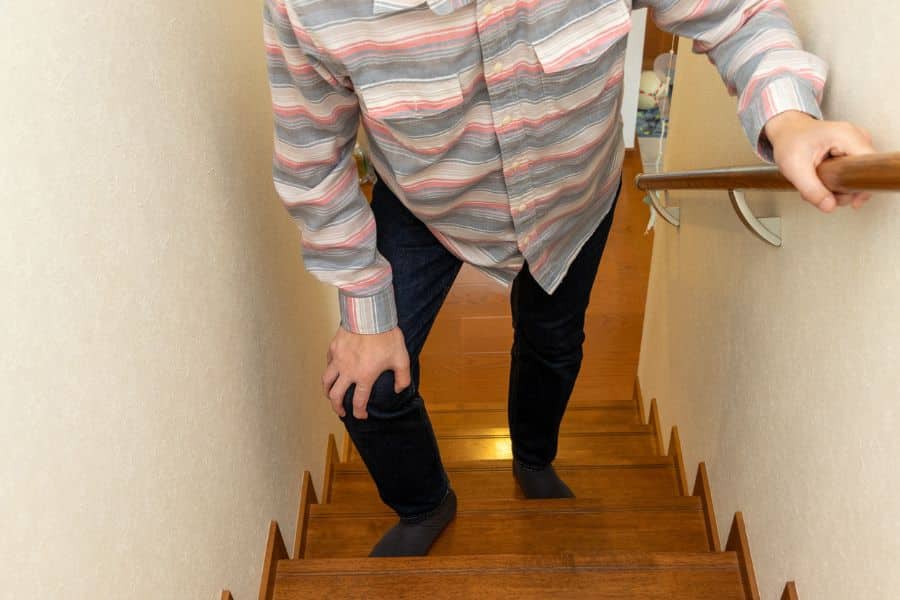
What If Stairs Feel Hard Right Now?
If climbing a single flight leaves you winded, this article is still for you, and possibly more relevant than ever.
Getting out of breath easily on stairs tells you that your cardiovascular fitness has room to grow. That’s not a reason to feel bad, more a reason to start where you are.
Begin with one or two flights a day and build from there. One extra flight per week is enough to make steady progress without putting stress on your joints. If your knees are a concern, focus on placing your whole foot on each step, not just the ball of your foot, and use the handrail on the way down, which places more impact on the joints than going up does.
Don’t go at it all at once; you simply want to gradually shift your cardiovascular fitness in a direction that your future self will thank you for. And remember to check in with yourself as to your progress.
Are stairs getting easier than they used to be? That’s a sign your heart is getting stronger. Are you still breathless at the top after months of regular climbing? That might be worth a conversation with your doctor.
The health and wellness content on Your Lifestyle Library is for informational purposes only and should not replace professional medical advice. Always consult with your healthcare provider before making any changes to your exercise routine.