
It has to be said, I’m not a fan of yoga. I’ve tried to like it, but I find myself constantly watching the clock and wondering when it will all be over. My favorite part was always the end, when you got to spend ten minutes lying quietly, listening to soothing words and music.
It’s a shame because I love the idea of it, but the doing, unfortunately, bores me senseless. However, I’m not adverse to exercise, far from it. I powerwalk regularly with my border collie and do line dancing once a week.
The problem is, I know yoga is good for your joints, and as I get older, I’m now 54, I’m always looking for joint strengthening exercises to help my body. So, if, like me, yoga isn’t your thing, then I’ve found some great exercises that are just as good, if not better. And they’re physical therapist-approved.

7 Joint Strengthening Exercises For Those Who Aren’t Fans of Yoga
Yoga isn’t the only way to protect your joints. Physical therapists routinely recommend alternatives that build joint-supporting muscles more efficiently, with less risk of strain from awkward positions or overextension.
If your joints ache or feel stiff, or if you’re just looking for ways to keep moving without making things worse, these 7 low-impact exercises do the job.
No. 1 Cycling

Living in rural France like I do, having a push bike is mandatory. I have a gorgeous powder blue bike with a lovely wicker basket for my trips to the boulangerie. But it’s not all about baguettes and croissants. Cycling keeps your body weight supported on the seat, so your knees and hips do the work without bearing the full load. That’s exactly what you want when joints are tender or recovering.
It builds real strength in the quadriceps, the large muscles that run along the front of your thighs and act as shock absorbers for your knee joints. Weak quads are one of the most common reasons knees hurt. Stronger quads mean better-supported knees.
If outdoor cycling isn’t practical, a stationary bike works just as well for joint benefits. Recumbent bikes, which have a reclined seat and back support, are worth considering if you have any lower back concerns alongside joint issues.
Your knee should have a slight bend at the bottom of each pedal stroke, not a full lockout. If your knee is straightening completely with each rotation, the saddle needs to come up. A small adjustment makes a big difference in how your knee tracks through the movement.
No. 2 Walking

For joint health, walking is hands down one of the most effective things you can do consistently. It’s good for the mind, body, and soul. I take my collie for a walk every day, and I try to powerwalk with her for some of it to get my heart rate up. I always feel so much better once I’ve done it.
Regular walking improves joint mobility, reduces stiffness, and stimulates the production of synovial fluid, the natural lubricant inside your joints that keeps things moving smoothly. The more you move, the more your joints are fed.
Grass, dirt trails, and running tracks absorb impact far better than a sidewalk or concrete. That small switch can make a noticeable difference in how your knees and hips feel afterward.
It’s also great for weight management. Every pound you lose reduces the pressure on your knee joints by roughly four pounds. A 10-pound loss can take 40 pounds of pressure off your knees with every step.
Start with 20 to 30 minutes a day and build from there.
No. 3 Swimming

The buoyancy water provides reduces the load on your joints by up to 90%, which is why swimming and water aerobics are so widely recommended after joint injuries or surgery. Luckily, we have a beautiful lake near us, and in the summer months when it’s stifling hot, I often go for a morning swim. It takes your breath away, but the natural beauty does wonders for your mood and helps your joints.
Water creates natural resistance in every direction you move, so you’re working your muscles hard while your joints are barely stressed at all.
Swimming engages your whole body. Freestyle and backstroke work the shoulders, core, and legs together in one continuous movement.
If swimming laps isn’t your thing, water aerobics classes offer structure, variety, and a social element that can be fun. Many pools offer dedicated classes for people with arthritis or mobility issues, taught by instructors who understand exactly what you need.
A heated pool also helps relax tight muscles and improve circulation to damaged tissues, which speeds up recovery between sessions.
No. 4 Resistance Bands

Resistance bands have helped my husband no end, especially when he injured his shoulder playing football. Physical therapists use them constantly in joint rehabilitation programs for a good reason: they provide resistance through the full range of motion, which builds the functional strength your joints actually need day to day.
Unlike free weights that rely on gravity pulling straight down, bands create tension in multiple directions. That means the muscles surrounding your joints work more evenly, leading to better overall stability.
They’re also forgiving. You control the resistance entirely by choosing the band thickness or how much you stretch it. If something doesn’t feel right, you ease off. There’s no momentum, no heavy weight to control, and no awkward machine to figure out.
Exercises like seated rows, lateral raises, and banded leg presses are straightforward to learn and highly effective for supporting joint health. My daughter did all these exercises as part of her off-ice training when she used to compete in figure skating. As a competitive skater, strength and conditioning were as important as the work you did on the ice.
The bands are also cheap, portable, and take up no space. For anyone managing joint issues at home, they’re one of the most practical investments you can make.
No. 5 Elliptical Machine
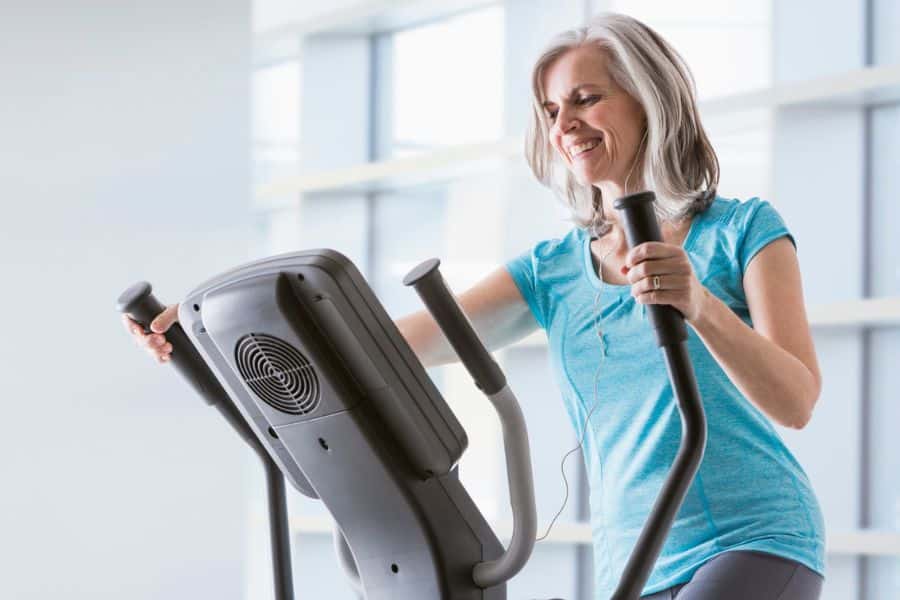
Elliptical machines mimic the movement pattern of running without any of the impact. Your feet stay on the pedals throughout the entire stride, which eliminates the landing force that rattles through your joints with every running step.
For people who can no longer run comfortably, or who never could, the elliptical gives you the cardiovascular workout and lower-body muscle engagement without the impact on your joints. I’m lucky as we turned one of our old barns into a mini gym and I have an elliptical, which I love, especially when the weather is bad, and I can’t go out walking.
The quadriceps, hamstrings, glutes, and core all work during elliptical training, which means you’re building the muscle groups that matter most for joint support. Most machines let you adjust resistance and incline, so you can increase the challenge gradually as your fitness improves.
Many models also have moving handlebars that bring your upper body into the movement, turning it into a full-body workout without adding any joint stress.
No. 6 Rowing

Rowing hits almost every major muscle group in a single, continuous movement. As I live in the Charente, in southwest France, we’re only a few miles from the river, so we invested in kayaks. Oh my goodness, it’s a workout and a half. Your legs drive the push, your core transfers the power, and your arms and back pull it through. It’s one of the most efficient full-body exercises available.
The joint-friendly part: you’re seated throughout. Your ankles, knees, and hips aren’t bearing your body weight. The movement is smooth and rhythmic, with no sudden jolts or lateral stress on the joints.
That pulling motion across the upper back is particularly useful for anyone who spends a lot of time sitting. It strengthens the muscles that tend to weaken and lengthen when you’re desk-bound, which in turn reduces the strain on your neck and shoulders.
Rowing machines are available in most gyms, and the technique is straightforward once you know the sequence: legs, lean, arms on the drive out, and reverse that on the way back in. Get the form right first before adding resistance.
The rhythmic, repetitive nature of rowing also has a meditative quality that many people find surprisingly enjoyable. I can’t say I experienced that with kayaking, but I guess I’m still trying to get the hang of it.
No. 7 Tai Chi
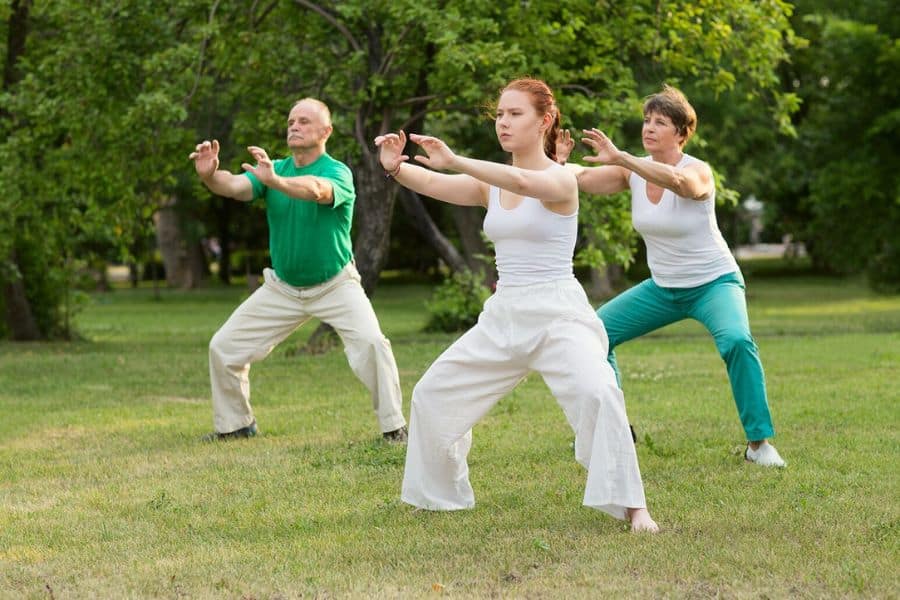
Every time I hear “Tai Chi” mentioned, I think of the first scene in the movie Calendar Girls. They were all on a hill in the north of England doing Tai Chi, and it makes me giggle to think of it as they were the most unlikely looking ladies to be doing this.
The slow, flowing movements of Tai Chi require constant balance and coordination. Your stabilizing muscles are working continuously to keep you controlled through each transition. Over time, that builds meaningful strength and dramatically improves proprioception, your body’s awareness of its own position in space.
Better proprioception means better movement control, which means less risk of the awkward stumbles and missteps that put sudden, damaging stress on joints.
Research has consistently shown that regular Tai Chi practice reduces the risk of falls in older adults, which is one of the most significant threats to joint and bone health as you get older.
It also helps circulate synovial fluid through the joints, reduces stiffness, and has been shown to ease symptoms of rheumatoid arthritis. Many practitioners report better sleep quality, too, which supports the body’s natural repair processes overnight.
Many communities offer classes specifically designed for people with joint concerns, and the group setting tends to keep people consistent in a way that solo workouts sometimes don’t.
Disclaimer: This article is for informational purposes only and does not constitute medical advice. If you have an existing joint condition or injury, consult your healthcare provider before starting a new exercise routine.