
I remember when I was a child, my mom was always telling me to “Sit up straight” or “Shoulders Back.” It used to get on my nerves, but as I’ve grown older, I now understand why she was so insistent.
Posture is so important and can cause more issues than we realize. And not just the hunchback my mom told me I’d get if I didn’t sit with my shoulders back.
It seems to be worse now than when I was growing up, as we didn’t sit at our computers all day or spend countless hours hunched over our phones. Most of us know bad posture is, well, bad. But how many of us realize it could actually be cutting our lives short?

8 Posture Habits Actively Reducing Your Lifespan
Researchers have been connecting poor posture to premature death for years. Good job, my mom didn’t know about this; otherwise, it really would have been all doom and gloom, and a hunchback would have only been the half of it.
Luckily, most of this damage is reversible. Your body is remarkably good at bouncing back when you give it the right signals.
1. Screen Neck

You probably already know the feeling. That dull ache at the base of your skull after a long day at your desk or an hour of scrolling. That’s your cervical spine telling you something is wrong.
When your head drifts forward of your shoulders, which happens the moment you lean toward a screen, the weight your neck has to support increases dramatically.
In neutral position, your head weighs around 10 to 12 pounds. Tilt it forward by just two inches, and that figure climbs to 27 pounds. At three inches forward, you’re dealing with the equivalent of 40 pounds. Your neck muscles were never designed for that kind of load.
The long-term consequences go well beyond neck pain. Forward head posture compresses the cervical spine, interfering with the nerves that control your upper body and restricting the space your lungs need to fully expand. Shallow breathing becomes the new normal, and your heart has to work harder to compensate.
The Fix
Chin tucks are the single most effective exercise for retraining your neck. Sit or stand upright, then gently draw your chin straight back, like you’re trying to make a double chin. Hold for 5 seconds, then repeat 10 times. Do this several times a day.
Pair this with a proper workstation setup. Your screen should be at eye level so your head doesn’t have to tip forward or downward to see it.
2. The Slouch
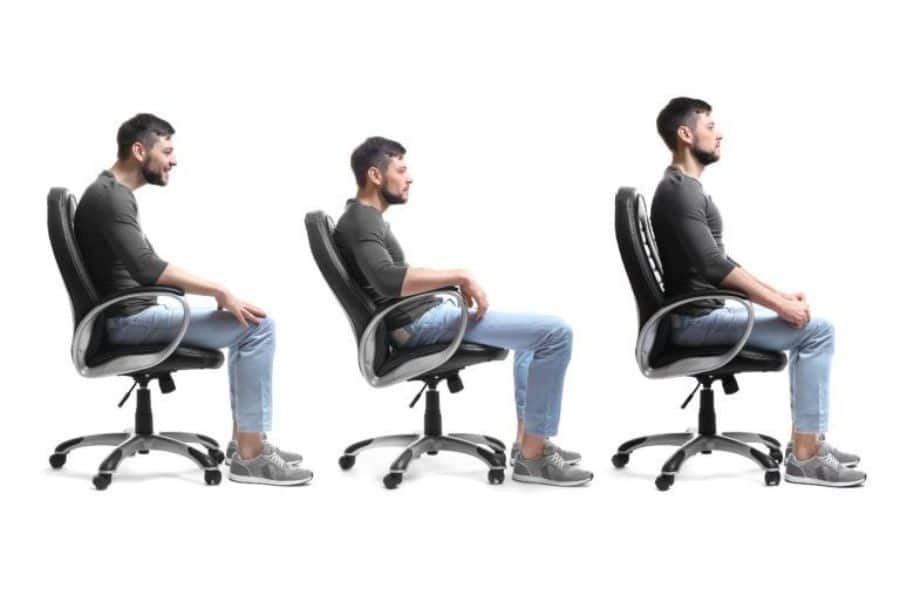
When you slouch, the pressure on your spinal discs increases significantly compared to standing. Over time, this accelerates disc degeneration and creates inflammatory responses throughout your spine.
Those discs are supposed to act as shock absorbers between your vertebrae. When they compress and dry out prematurely, the whole system suffers.
There’s also a direct effect on your mood and energy levels. Slouched posture has been linked to reduced serotonin production and increased feelings of fatigue. So if you’ve ever noticed your energy drops in the afternoon when you’re sitting at your desk, your posture may be partly to blame.
The Fix
The fix starts with your chair. Lumbar support matters. If your chair doesn’t have it, a rolled towel placed at your lower back will do the job. Your feet should be flat on the floor, your knees roughly level with your hips, and your ears stacked over your shoulders.
Set a timer every 30 minutes to stand, move, and reset your posture. Your discs decompress and rehydrate when you move, which they can’t do when you’re in the same position for hours.
I invested in a sit and stand desk, and I try to stand up and work every couple of hours, so I’m not spending my entire time sitting. I have a special mat to stand on, so it’s comfortable, and I’ve found it works wonders. This is the one I have >>>
3. Rounded Shoulders
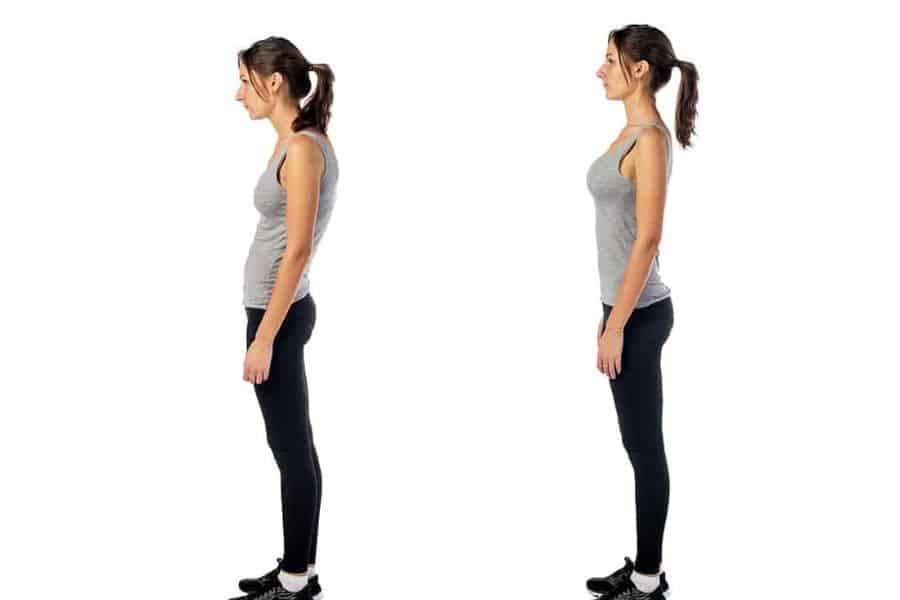
This was one of the things Mom was always pulling me up on. If you spend time at a keyboard, drive regularly, or use your phone frequently, there’s a good chance your shoulders have gradually migrated forward.
The problem runs deeper than appearance. When your shoulder blades drift forward and downward, they compress the brachial plexus, the network of nerves running from your neck and shoulder down into your arm. This is a significant contributor to the neck, shoulder, and arm pain that so many women in midlife experience and write off as “tension.”
The muscles most affected are the serratus anterior and the upper trapezius. The serratus anterior, which runs along the side of your ribcage and is responsible for holding your shoulder blade flat against your back, tends to weaken. The upper trapezius overworks to compensate. The result is that familiar knot of tension at the top of your shoulders that no amount of massage seems to fix permanently.
The Fix
Pull your shoulder blades back and down, as if you’re trying to tuck them into your back pockets. Hold for 3 to 5 seconds, then release. Do this 15 times. It sounds almost too simple, but done consistently every day, it genuinely retrains the muscles that pull your posture back into alignment.
Doorway chest stretches also help by releasing the pectoral muscles that have tightened and pulled your shoulders forward in the first place.
4. The Phone Scroll Hunch

Studies have found that just 30 minutes of scrolling in a slumped position creates measurable changes in spinal curvature in the thoracolumbar region, the junction between your mid and lower back.
The concern is that, with repeated exposure, these temporary changes become structural. What your spine does occasionally eventually becomes what it does permanently.
The average person now spends several hours a day on their phone. Do the math.
The Fix
You don’t need to stop using your phone; you just need to raise it. Holding your device at eye level rather than looking down changes everything about the load on your cervical spine. It feels awkward at first because we’re so conditioned to look down at screens. Stick with it.
When you do need to look down, lead with your eyes first, then tilt your head slightly. Avoid the full neck crane. And set a 20-minute timer if you know you’re prone to long scroll sessions. Even a brief reset of your neck position makes a difference.
5. Never Stretching

Research has identified flexibility as a longevity biomarker. One study found that women with greater flexibility had a significantly lower risk of premature death compared to those with limited mobility. The connection lies in systemic inflammation. Stiff joints and tight connective tissue are associated with arterial stiffness, which directly increases cardiovascular risk.
Think of it this way. Your blood vessels and your muscles respond to similar signals. When one system loses elasticity, the other tends to follow.
The Fix
Regular yoga, Pilates, or tai chi all work well. Even 15 to 20 minutes of focused mobility work daily is enough to shift inflammation markers over time.
Focus on the major joint complexes: hips, thoracic spine, shoulders, and ankles. These are the areas most likely to stiffen with age and most directly connected to postural decline.
6. A Weak Core

Your core is what keeps your spine safe every single time you move. When your abdominal and back muscles are weak, your lumbar discs absorb forces they’re not designed to handle.
Every time you twist, lift, or even just reach for something, your spine takes on a load that a strong core would distribute across the muscular system instead. This accelerates disc degeneration and creates the kind of chronic back pain that becomes harder to address as the years go on.
Beyond the structural protection, resistance training that builds core strength also improves bone density, boosts metabolism, and supports neural communication between your muscles and brain. These are all factors that compound into significantly better health outcomes as you age.
The Fix
Planks, dead bugs, bird dogs, and glute bridges are some of the most effective core exercises available, and you can do all of them on a mat at home. The keyword is consistency. A 10-minute core session four or five days a week will do far more for you than an occasional intense workout.
Start with whatever level you can hold with good form and build from there.
7. Pelvic Tilt
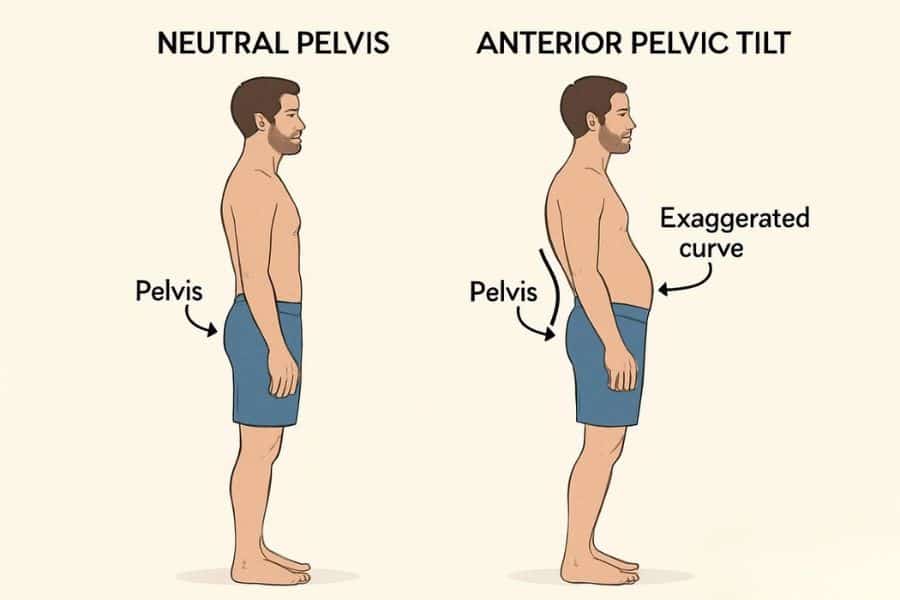
Anterior pelvic tilt, in which your pelvis tilts forward and your lower back arches excessively, is a common contributor to chronic back pain.
Sitting for long periods shortens the hip flexors, the muscles connecting your pelvis to your thighs. When those muscles stay shortened day after day, they pull the front of the pelvis downward. That forward tilt forces every vertebra above it to compensate, creating a chain reaction of stress up through the lumbar and thoracic spine.
Research has found a statistically significant relationship between anterior pelvic tilt and lower back pain, and 3D gait analysis has shown that a larger anterior pelvic tilt during movement directly worsens low back pain. The disc compression it creates builds up over time, which is why chronic low back pain so rarely has an obvious single cause.
The Fix
You need to stretch tight areas and strengthen weak areas. Hip flexor stretches, like a low lunge or a kneeling stretch, address the pull at the front. Glute-strengthening exercises, such as bridges and squats, in particular, build support at the back. Together, they bring your pelvis back to a neutral position.
If you’re not sure whether this applies to you, stand side-on in front of a mirror. If your lower back has a pronounced inward curve and your stomach appears to tip forward even when you’re standing up straight, anterior pelvic tilt is likely a factor.
8. Poor Balance
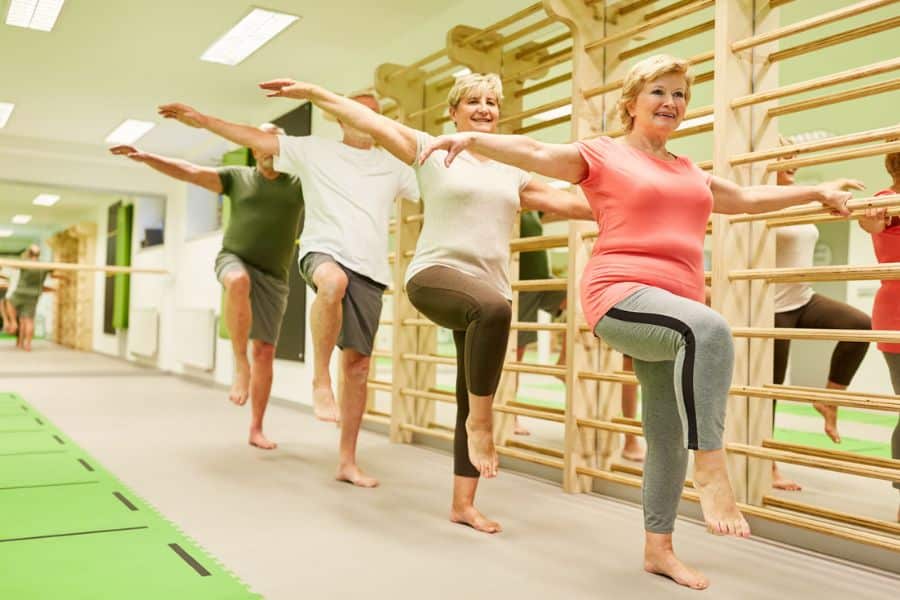
Balance might seem like a concern for much later in life. But the neuromuscular systems that keep you stable begin declining earlier than most people realize, and by the time balance becomes noticeably poor, a significant amount of that capacity has already been lost.
Poor balance is an early indicator of declining coordination between your brain, inner ear, and musculoskeletal system. Falls are one of the leading causes of serious injury and loss of independence in older adults, and they rarely happen out of nowhere. They tend to follow years of gradual, unnoticed decline.
The Fix
Single-leg stands are the most accessible starting point. Stand on one leg for 30 seconds, then switch. Once that feels manageable, progress to doing it with your eyes closed, which removes the visual crutch and forces your proprioceptive system to work harder.
Resistance training supports this, too. Strong leg muscles and a stable core give your balance system the physical foundation it needs. Even adding balance challenges to your existing routine, reaching overhead while standing on one leg, stepping sideways, or walking heel to toe in a straight line, can make a meaningful difference over time.
Your nervous system responds to the demands you place on it. Challenge your balance regularly, and it will adapt accordingly.
Disclaimer: This article is for informational purposes only and is not intended as medical advice. Always consult your healthcare provider before making changes to your exercise routine, particularly if you have an existing injury, medical condition, or mobility concerns.