
Walking the cobbled streets of Europe’s historic towns, you rarely think about what lies beneath your feet. But hidden below ancient plazas and medieval houses, entire worlds hide in plain sight. They’re underground cities carved by human hands over centuries, each one holding stories of survival, ingenuity, and secrets whispered through stone corridors.
From bunkers built for Cold War catastrophe to medieval refuges where families fled from invading armies, Europe’s underground cities reveal a fascinating history.
Some were rediscovered by accident when someone knocked down the wrong wall. Others sheltered thousands during World Wars. And a few still guard mysteries that archaeologists are only beginning to unravel.

9 Underground Cities in Europe To Explore
These nine underground cities prove that Europe’s most fascinating history isn’t always on the surface. Each one tells a different story.
Naours, France

You’d never know it when you first see it, but beneath the quiet village of Naours in northern France lies a subterranean city that once housed 3,000 people in 300 rooms spread across 28 galleries. The Romans started digging these limestone quarries in the 3rd century, but it wasn’t until medieval times that locals transformed the caves into a refuge.
By the 17th century, during the brutal Thirty Years’ War, entire families moved underground with their livestock, setting up chapels, bakeries, and town squares carved from rock. Eventually, the underground city was abandoned and forgotten until 188,7 when a local priest stumbled upon the entrance while exploring the area.
Australian, British, French, and American troops left over 3,000 pieces of graffiti on the walls between 1916 and 1918. Some carved their names and battalion numbers. Others scratched messages to loved ones they’d never see again. One soldier left his full address in Melbourne, not knowing he’d be killed in October 1917 while serving with the 4th Australian Field Artillery Brigade on the Western Front.
The Nazis also used it as a headquarters during World War II. Today, you can tour this underground marvel yourself, descending 33 meters below the streets of modern Naours to walk corridors where history left its mark in stone and soot.
Edinburgh Vaults, Scotland
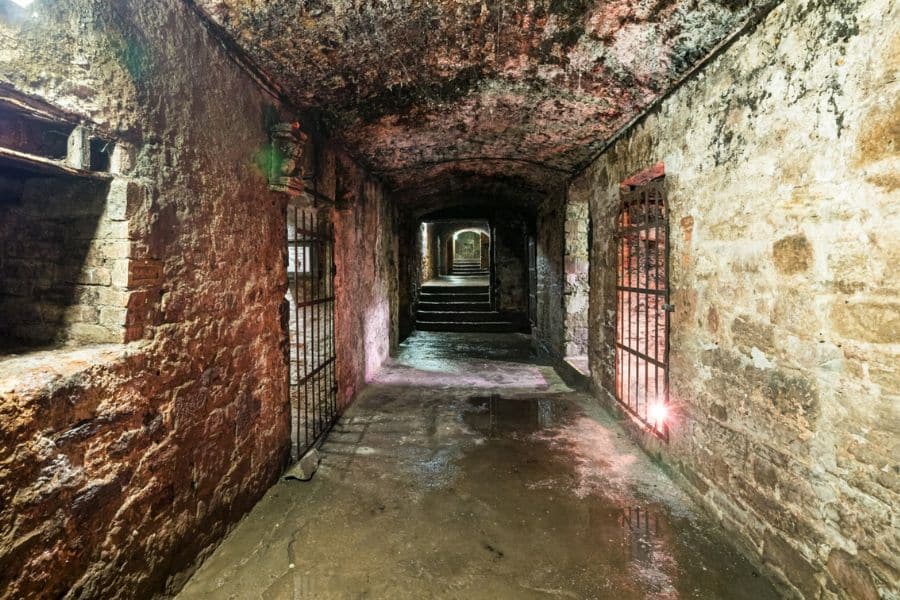
In 1788, Edinburgh completed its South Bridge, a 19-arch viaduct that connected the Old Town to the University. But the city needed every inch of space, so they enclosed 18 of the arches behind tenement buildings and added floors inside, creating 120 vaulted chambers beneath street level.
For about 30 years, the vaults thrived as storage spaces, workshops for cobblers and blacksmiths, and taverns serving ale to merchants above. Then the bridge started flooding. Poor construction meant water poured in, making the vaults damp, dark, and utterly miserable. The businesses left, and Edinburgh’s poorest citizens moved in.
By the 1820s, the vaults had become Edinburgh’s most wretched slum. Families of ten crammed into single rooms with no sunlight, no running water, no sanitation. Prostitution, illegal whisky distilleries, and gambling dens operated in the shadows. Rumors swirled that body snatchers Burke and Hare used the vaults to store corpses before selling them to medical schools, though no proof exists.
By 1860, even the desperately poor had abandoned the vaults, which were sealed with rubble for security. They remained hidden until 1985, when excavations revealed the network once more. Today, you can tour the Blair Street Underground Vaults with candlelight tours that bring the dark history to life, though some visitors swear the ghosts of the vaults’ tragic past still linger in the stone chambers.
Naples Underground (Napoli Sotterranea), Italy

Forty meters below Naples’ chaotic streets spreads a labyrinth of tunnels, cisterns, and chambers carved from volcanic tufa stone over 2,400 years. The Greeks started it in the 4th century BC, quarrying stone to build their temples above. The Romans turned it into an ingenious aqueduct system, creating underground reservoirs that supplied fresh water through 2,000 wells scattered across the city.
For centuries, workers called pozzari would descend into the tunnels to maintain the water supply, giving rise to legends about the munaciello, mysterious hooded figures who appeared in homes through private wells, sometimes bearing gifts, sometimes stealing them.
By the 20th century, the city stopped using the aqueduct, and the tunnels were abandoned until World War II, when they became emergency bomb shelters. During the devastating Allied air raids, thousands of Neapolitans spent months underground. You can still see furniture, graffiti, and objects they left behind.
The archaeological crypt also houses remains of a Greco-Roman theater and Emperor Nero’s dressing room. Since the 1980s, volunteers have worked tirelessly to excavate and restore sections of this underground city, opening it to tours through narrow passages lit only by candlelight. The tour lasts about 90 minutes, and you’ll descend 136 steps into a world that’s simultaneously an ancient quarry, a medieval waterworks, and a WWII refuge.
Burlington Bunker, England

Hidden 100 feet beneath the sleepy Wiltshire town of Corsham lies Britain’s most closely guarded Cold War secret. Burlington Bunker, also known as Turnstile or Site 3, is a 35-acre underground city built in the late 1950s to house the British government in the event of nuclear war. The location made perfect sense because Corsham already had extensive limestone quarries that could be converted into a bombproof, radiationproof, poison-gasproof shelter.
Over a mile long with 60 miles of internal roads, Burlington was designed to accommodate 4,000 government personnel, including the Prime Minister, the Cabinet, military chiefs, and civil servants who would run the country for three months in complete isolation from a devastated world above.
The bunker had everything needed to sustain life underground: its own power station, water purification system, hospitals, kitchens, laundries, a massive telephone exchange, and even a television studio for broadcasting to survivors.
A secret railway line connected it to the main London to Bristol line, so the Royal Family could escape by train. The facility featured an underground lake for drinking water and was climate-controlled at a constant temperature. But Burlington became obsolete almost as soon as it was completed.
The Cuban Missile Crisis in 1962 proved that nuclear missiles could strike with only four minutes’ warning, far too little time to evacuate government ministers to Wiltshire. The bunker was decommissioned in 2004, its fuel drained and supplies removed. Today, it’s not open to the public, though parts have been sold off as secure data storage, and the government still controls certain sections.
Pilsen Historical Underground, Czech Republic

Starting in the late 13th century, the citizens of Pilsen, Czech Republic, began digging beneath their medieval city, eventually creating one of Central Europe’s most extensive underground networks. Stretching nearly 20 kilometers across three levels, these hand-carved tunnels and cellars served multiple purposes over the course of 700 years.
Merchants used them to store food and beer at constant cool temperatures, perfect for fermentation. The underground also contained 360 wells that supplied the entire city with fresh water through a sophisticated 16th-century waterworks system still visible today. During sieges and wars, residents would retreat underground where they could survive for weeks, hidden from invading armies.
Today, you can tour about 800 meters of the underground on a route that winds 5 to 7 meters below the historic city center. You’ll see authentic sections carved by hand from sandstone, explore the preserved waterworks with its faithful replica of a 7-meter oak water wheel, and view artifacts recovered from the wells that reveal medieval daily life.
The temperature stays around 12 degrees Celsius year-round, so bring warm clothing even in summer. One unique touch: if you’re over 18, your tour ticket includes a pivenka, a voucher for a 0.3-liter glass of Pilsner Urquell beer to enjoy at selected restaurants afterward. The underground opens daily, with tours departing from the Brewery Museum, and you’ll need to wear safety helmets throughout the tour.
Wieliczka Salt Mine, Poland

Just outside Kraków lies one of the world’s oldest salt mines, a subterranean marvel that produced table salt continuously for over 700 years until 1996. The Wieliczka Salt Mine dates back to the 13th century, when the discovery of rock salt deposits transformed the region’s economy. Polish kings grew wealthy from the salt trade, funding universities and building grand projects with the profits from the mines.
The mine eventually grew to nine levels, reaching 327 meters in depth, with 245 kilometers of galleries and chambers carved entirely from salt. But what makes Wieliczka extraordinary isn’t just its industrial history but the fact that miners transformed sections into an underground city complete with chapels, sculptures, and even chandeliers, all carved from rock salt.
The crown jewel is St. Kinga’s Chapel, located 101 meters underground. Three miners spent 67 years carving this enormous hall entirely from salt, including chandeliers made of salt crystals, religious sculptures, and a representation of Leonardo da Vinci’s Last Supper. The mine’s artistry continued through generations, with miners creating over 40 chapels and countless sculptures during breaks from extracting salt.
During World War II, the Nazis forced Jewish prisoners to work in an underground armament factory here. Today, nearly 2 million tourists visit each year, descending hundreds of steps to walk the same passages miners have used for centuries. The mine is a UNESCO World Heritage Site, and you can choose from several tour routes, including the traditional tourist route or a more adventurous miners’ route where you wear protective gear and explore less developed sections.
Setenil de las Bodegas, Spain
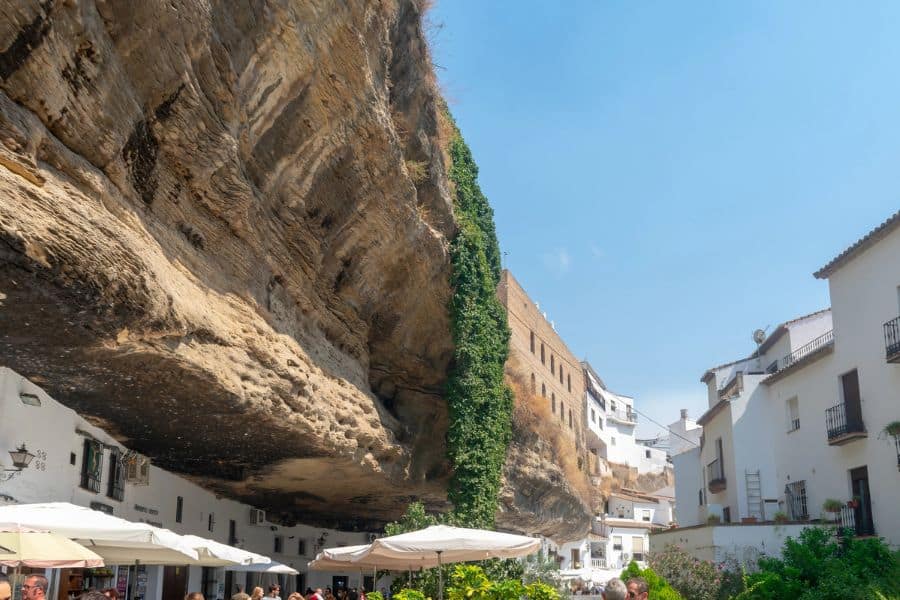
In the mountains of Andalusia, about 30 minutes from Ronda, sits one of Spain’s most unusual white villages. Setenil de las Bodegas looks like something from a fantasy film because around 3,000 people literally live under massive rock overhangs. The town wasn’t exactly built underground; residents simply constructed front walls beneath natural cave formations created by the Guadalporcún River carving through the canyon over millennia.
The result is houses where rock forms the ceiling and back walls while whitewashed facades face the street. The most famous streets are Calle Cuevas del Sol (Caves of the Sun) and Calle Cuevas de la Sombra (Caves of the Shade), where entire blocks sit beneath enormous slabs of overhanging stone.
The Moors founded the town in the 12th century, taking advantage of the natural caves that remained cool in scorching summers and warm in cold winters, ideal for storing wine, olives, and almonds. The town’s name reveals its contested history: Setenil comes from the Latin “septem nihil,” meaning “seven times nothing,” referring to the six failed attempts by Catholic forces to recapture it from Moorish defenders before finally succeeding on the seventh siege in 1484.
Today, you can wander the steep, narrow streets, peek inside cave restaurants and bars where rock forms the interior walls, and climb up to the ruins of the 12th-century Moorish castle for panoramic views. The Roman bridge still spans the river, and locals still live in homes where rock provides natural insulation, just as people have done here for over 5,000 years.
Derinkuyu, Turkey
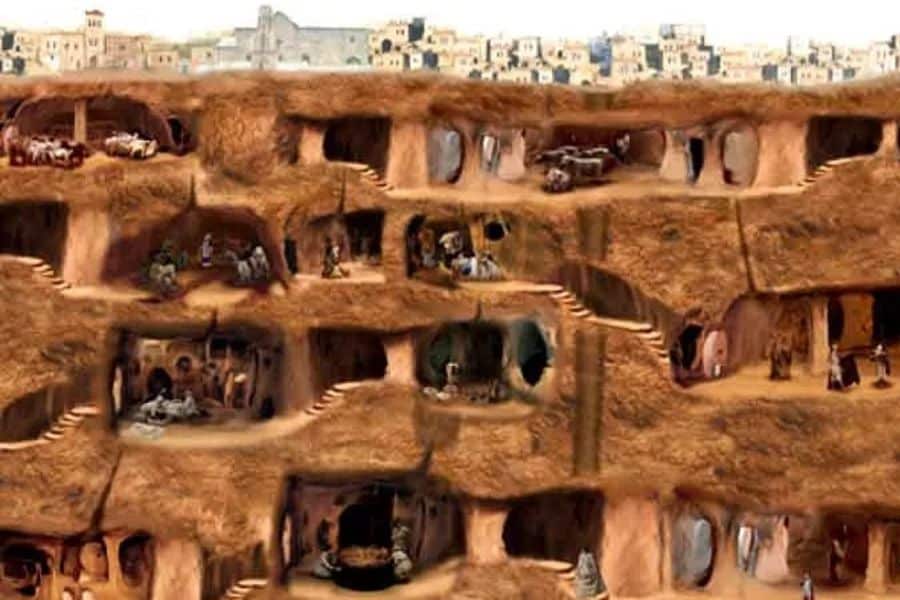
In 1963, a man in the Turkish town of Derinkuyu was renovating his basement when he knocked down a wall and discovered a mysterious room behind it. Further excavation revealed a secret that had been hidden for centuries: an entire underground city extending 85 meters deep, capable of sheltering 20,000 people along with their livestock and food supplies.
Derinkuyu is now recognized as the largest excavated underground city in Turkey and one of the most impressive feats of ancient engineering in Cappadocia. The soft volcanic tufa stone made it relatively easy to carve, and the city eventually grew to 18 levels with hundreds of kilometers of tunnels connecting rooms, stables, wine presses, chapels, and even a religious school.
The city’s origins remain debated, but it likely began with the Phrygians in the 8th century BC and was expanded by Christians during Byzantine times as a means of protection against Arab invasions between 780 and 1180 AD. The design was brilliant for defense: each level could be sealed off with massive rolling stone doors that could only be opened from the inside, narrow passages forced invaders to enter single file, and ventilation shafts provided fresh air while doubling as wells protected from poisoning.
The city was repeatedly used throughout history as a refuge from Mongolian raiders in the 14th century and later from Ottoman persecution. Even in 1909, when massacres threatened Christians in Adana, locals fled to Derinkuyu for safety. The underground city was finally abandoned in 1923 during the population exchange between Greece and Turkey. Today, about half the city is open to visitors who can explore its labyrinth of passages, though claustrophobic travelers should note that some tunnels are quite narrow.
Luxembourg’s Casemates
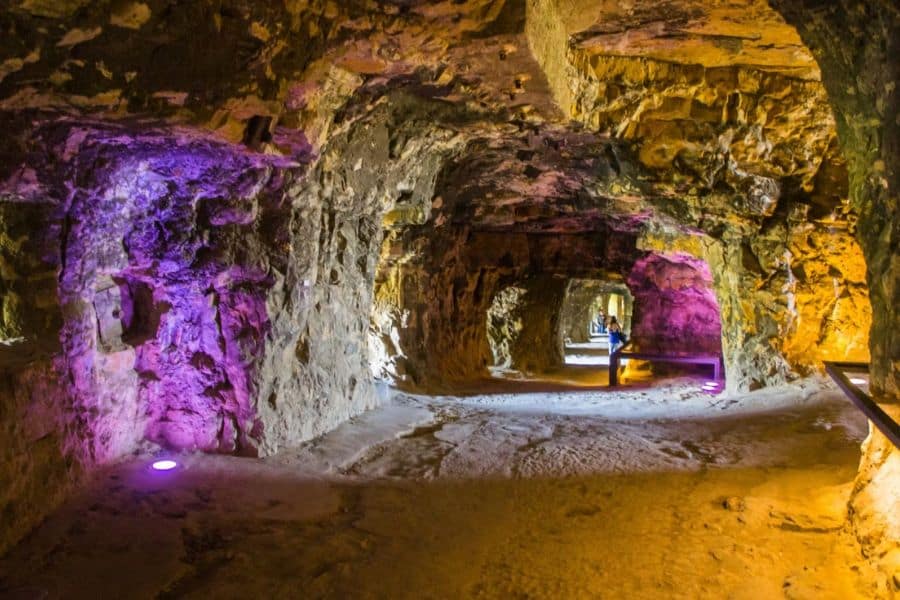
The tiny nation of Luxembourg was once called the Gibraltar of the North because of its impregnable fortress, and the key to its defense lay underground. Starting in 1644, Spanish occupiers began carving defensive tunnels called casemates into the sandstone cliffs beneath Luxembourg City.
Over the next two centuries, Austrian and French military engineers expanded the network until 23 kilometers of galleries honeycomb the rock, reaching depths of 40 meters and spanning multiple levels. These weren’t just escape tunnels but a complete underground military infrastructure capable of housing thousands of soldiers with their horses, storing artillery and weapons, and operating workshops, kitchens, bakeries, and even slaughterhouses entirely below ground.
The casemates played crucial roles in Luxembourg’s defense for centuries, but their most important service came during the World Wars when they sheltered up to 35,000 civilians during air raids. After Luxembourg’s fortress was dismantled following the 1867 Treaty of London, many entrances were sealed, and the casemates were largely forgotten until they opened to tourists in 1933. -Today you can visit two main sections: the Bock Casemates, where you can explore freely at your own pace, and the Pétrusse Casemates, accessible only through guided tours featuring dramatic light and sound installations that bring the history to life. The fortifications and old town earned UNESCO World Heritage status in 1994.
Walking these tunnels, you pass gun emplacements, see the 47 meter deep castle well where legend says the mermaid Melusina once lived, and stand in chambers where an 82-year-old Habsburg field marshal commanded troops during an eight-month siege in 1794.
Disclaimer: This article is for general information only and is not professional advice. It may contain affiliate links. Please see our full Editorial Policy for details.

Kylie Lang is a nationally syndicated travel journalist with bylines on the Associated Press Wire & more, a lifestyle writer, and the founder and editor of Your Lifestyle Library (yourlifestylelibrary.com). She holds a BA (Honours) in History from the University of Kent and is a member of the British Guild of Travel Writers.