
When I go away, I want to avoid the hordes of tourists and crowds and find the undiscovered hidden gems. It’s always far more fun to get off the beaten track and see the real life behind a place, and hear the stories that made it what it is. I love imagining what life must have been like centuries ago and what the streets and houses would have looked like then.
When you allow yourself to wander off path, it’s amazing what you find. Go beyond the guidebook, and you’ll find places you never knew existed, and these are where you make the real discoveries. They’re places where history comes alive, making you hungry for more.
I’m pretty sure that the list of places I’ve gathered for you are ones you’ll never have heard of. But by the time you’ve finished reading about them, these historic villages in Europe will be top of your travel bucket list.
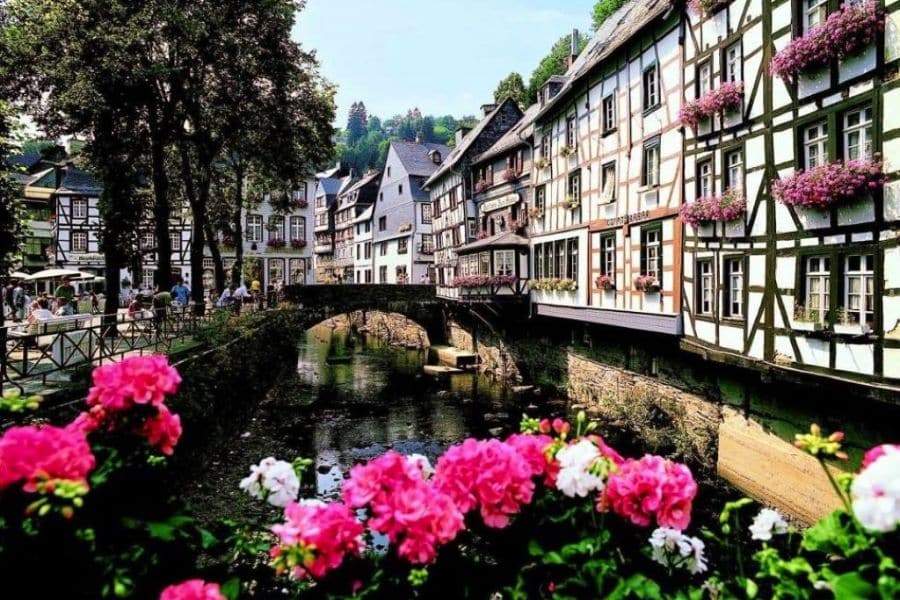
9 Historic Villages in Europe You’ll Never Have Heard Of
Get ready to pack your bags because these nine villages are the real deal. The history oozes through the buildings of these beautiful, well-preserved places, and you’d be forgiven for thinking you’d stumbled onto the set of a historic movie.
Mousehole, Cornwall, England

On July 23, 1595, four Spanish galleys slipped into Mount’s Bay at dawn and landed 400 armed soldiers on the shore just west of a small Cornish fishing village. Within hours, virtually every house in Mousehole had been burned to the ground. The village’s most prominent resident, Squire Jenkyn Keigwin, died from a cannonball while defending his home, the only building in the whole village that the Spanish failed to destroy.
His house still stands today on the harborside, with a plaque outside that reads exactly what happened and when. The Spanish went on to burn Newlyn, Paul church, and bombard Penzance, and then sailed away. It was the only successful major Spanish landing on English soil during the entire Anglo-Spanish War.
Mousehole rebuilt itself into the fishing village you see now, a crescent of granite houses tumbling down to a near-circular harbor where the entrance can still be sealed with wooden beams against winter storms. Smugglers used the sea caves along this coast to stash brandy and tobacco, and in the 18th century, Cornwall accounted for a staggering proportion of all illicit goods entering Britain.
Dylan Thomas spent his honeymoon here in 1938 and called it the loveliest village in England. The last known native speaker of the Cornish language, Dolly Pentreath, was a regular at the Keigwin Arms, reportedly happy to say a few words in Cornish if you crossed her palm with silver, but considerably more eloquent for free if you annoyed her. The village is also the birthplace of Stargazy Pie, the extraordinary Cornish dish served every December 23rd, where fish heads poke through the pastry crust, celebrating the day fisherman Tom Bawcock braved a winter storm to save the village from starvation.
Things To See Nearby:
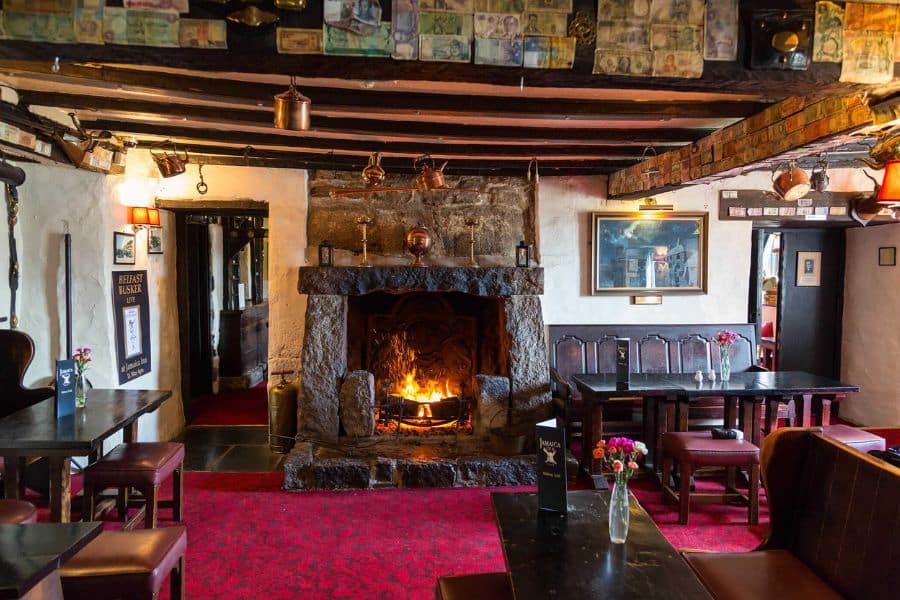
- Jamaica Inn sits on the wild expanse of Bodmin Moor, a 1750 coaching inn so remote and atmospheric that when Daphne du Maurier got lost in the fog on horseback one night in 1930, she stayed for several days listening to smuggling stories and ghost tales from the innkeeper. The result was her 1936 novel of the same name, later turned into a film by Alfred Hitchcock.
- St Michael’s Mount is a tidal island about four miles from Mousehole, connected to the mainland by a causeway that disappears at high tide, topped by a medieval castle and priory that has been continuously occupied since at least the 12th century.
- Tintagel Castle on Cornwall’s north coast is the legendary birthplace of King Arthur, a dramatically ruined 13th-century fortress clinging to a headland above the Atlantic with a 300-foot bridge connecting it to the mainland.
Where to stay in Mousehole >>>
Kilmallock, County Limerick, Ireland

Kilmallock was once the second most powerful town in Munster, a fortified stronghold of the FitzGerald Earls of Desmond who controlled much of southern Ireland from behind its stone walls. Today, over 1,100 meters of those medieval walls still stand, along with a 13th-century Dominican Priory, a collegiate church, and a 15th-century tower house straddling the main street.
In August 1579, two Franciscan priests, Bishop Patrick O’Hely and Friar Conn O’Rourke, had sailed secretly from Brittany to Kerry, disguised as sailors, carrying messages between the Pope and Irish rebels resisting English rule. They sought shelter at the castle of the Earl of Desmond, who was conveniently absent. His countess welcomed them warmly, then quietly reported them to the English authorities.
They were taken to Kilmallock, questioned by the brutal Lord President of Munster, Sir William Drury, tortured when they refused to name their contacts, and hanged outside the town gates without trial. Their bodies were left on the gallows for fourteen days. Both men were beatified by Pope John Paul II in 1992, and a stained glass window inside the church of Saints Peter and Paul marks exactly where this happened.
Things To See Nearby:
- Lough Gur is a horseshoe-shaped lake about 15 minutes from Kilmallock that contains one of the most significant concentrations of prehistoric monuments in Ireland, including the country’s largest stone circle, built around 2,500 BC and still standing in extraordinary condition. The lakeside heritage center tells the story of 5,000 years of continuous human settlement around its shores.
- Adare is a picture-perfect estate village about 25 minutes north, built by the Earls of Dunraven in the 19th century and home to three medieval monasteries and a Norman castle.
- The Rock of Cashel is roughly 40 minutes east, a dramatic cluster of medieval buildings perched on a limestone outcrop rising sharply from the Tipperary plain. It served as the seat of the Kings of Munster for centuries and is where St Patrick is said to have baptized the High King of Munster in 450 AD.
Where to stay in Kilmallock >>>
Culross, Fife, Scotland

If you’ve watched Outlander, you’ve already seen Culross. This perfectly preserved 16th and 17th-century town on the northern shore of the Firth of Forth doubled as the fictional village of Cranesmuir in the series, and the production team chose it for a very good reason.
The white-harled houses with red-tiled roofs climbing steep cobbled streets look exactly as they did when Culross was one of the most important trading towns in Scotland, exporting coal and salt across northern Europe.
The man who built that prosperity was Sir George Bruce, who in 1575 pioneered underwater coal-mining techniques and constructed the world’s first artificial island to load coal directly onto ships. The operation was so astonishing that King James VI came to see it and was convinced he’d been taken prisoner when he emerged from the mine onto the island surrounded by water. The palace Bruce built with his profits still stands, and you can walk straight into it.
Things To See Nearby:
- Dunfermline Abbey and Palace sit at the heart of Scotland’s ancient capital, where Robert the Bruce is buried beneath the nave. The ruins of the royal palace where King Charles I was born in 1600 stand right next to the abbey.
- Stirling Castle commands the landscape from a volcanic rock above the city and was for centuries the preferred residence of Scottish monarchs, including Mary Queen of Scots, who was crowned here as an infant in 1543. The restored Great Hall and Royal Palace interiors are among the finest examples of Renaissance architecture anywhere in Scotland.
- Loch Leven Castle sits on a small island in Loch Leven in Kinross-shire and is where Mary Queen of Scots was imprisoned in 1567 and forced to abdicate her throne. You reach it by a short ferry crossing.
Where to stay in Culross >>>
Mennetou-sur-Cher, Loire Valley, France
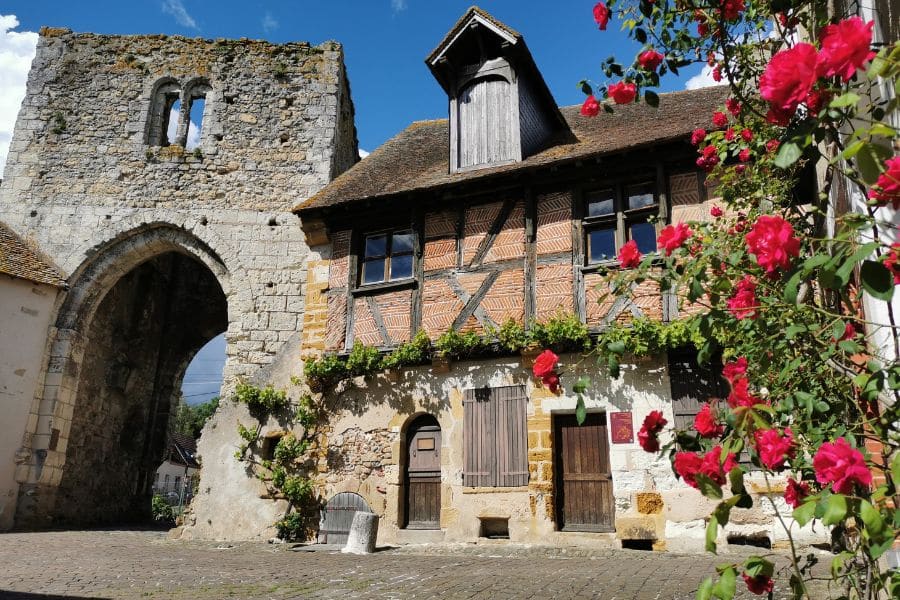
About two hours from Paris, between Tours and Orleans, Mennetou-sur-Cher is a medieval village with its original ramparts still completely encircling it. Three circular defensive towers still stand at full height, and the cobblestoned main street runs exactly as it was laid out when this was a fortified crossing point on the Cher River.
The village survived the Hundred Years’ War, the Black Death, and eight centuries of French history without losing its bones. Local guides lead torchlight tours through the streets at night, and walking the rampart walk in daylight gives you open views across the valley that explain exactly why medieval engineers chose this spot.
Things To See Nearby:
- The Chateau de Chambord is the grandest of all Loire Valley castles, built as a hunting lodge for Francis I from 1519 onwards with 440 rooms, 84 staircases, and a double-helix staircase that Leonardo da Vinci is said to have helped design.
- Amboise is a small riverside town where Leonardo da Vinci spent the last three years of his life at the invitation of Francis I, and his tomb is in the chapel of the royal chateau above the town. The Clos Luce manor, where he lived and worked, is now a museum with scale models of his inventions built from his original drawings.
- The Chateau de Chenonceau, known as the Ladies’ Chateau, spans the River Cher on a series of elegant arches and is one of the most beautiful buildings in France, shaped largely by the women who owned and loved it. Catherine de Medici and Diane de Poitiers both left their mark on the gardens and interiors, and during World War II, the bridge became a crossing point between occupied and free France.
Where to stay in Mennetou-sur-Cher >>>
Monschau, North Rhine-Westphalia, Germany
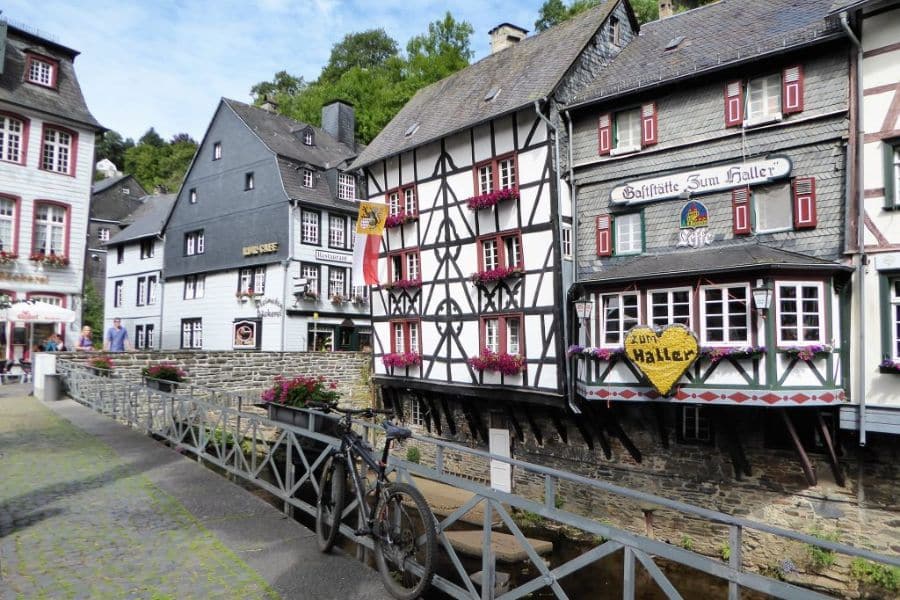
Monschau sits in a narrow valley in the Eifel region near the Belgian border, and its medieval street plan has barely shifted since the 17th century. The town grew wealthy on the wool trade, producing fine cloth that was exported across Europe, and the merchants spent their money building the half-timbered houses that still line every lane today.
More than 330 of those buildings are listed as historic monuments, which gives you some sense of how intact this place actually is. The most impressive survivor is the Red House, built in 1768 by the Scheibler cloth-making dynasty, an eight-storey mansion so grand that four of its floors are now a museum.
In December 1944, Monschau sat at the northernmost tip of the Battle of the Bulge, Hitler’s last major offensive on the Western Front. The German plan required capturing this town to use the road network for the push into Belgium. American troops held it. The battle raged all around, but Monschau itself survived without the destruction that leveled so many other towns in the region.
Things To See Nearby:
- The High Fens nature reserve spreads across the Belgian border from Monschau and is one of the largest moorland plateaus in Western Europe, a vast, wild expanse of bog and heathland. Wooden boardwalks allow you to walk deep into the landscape, and the silence up there is complete.
- Aachen, about 35 kilometers northeast, was the capital of Charlemagne’s empire in the 8th century and the political center of much of Western Europe. His cathedral still stands at the heart of the city and is a UNESCO World Heritage site, housing the golden shrine where his bones are kept and the marble throne where 30 Holy Roman Emperors were crowned between 936 and 1531.
- Burg Eltz is a castle about an hour east that has been owned by the same family continuously since the 12th century, one of only a handful of medieval castles in Germany that was never destroyed.
Where to stay in Monschau >>>
Durbuy, Ardennes, Belgium
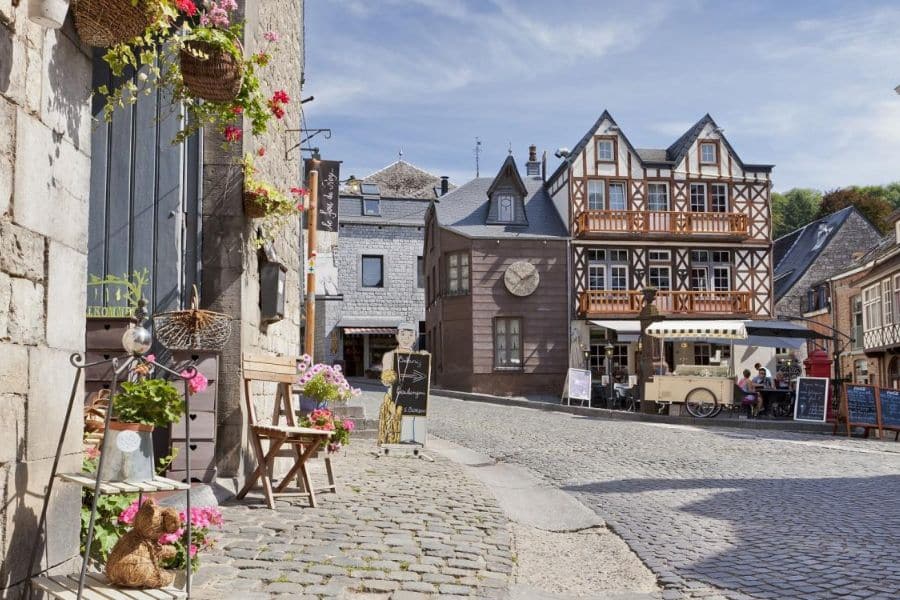
In 1331, John, Count of Luxembourg and King of Bohemia, granted city status to a settlement of a few hundred people on the Ourthe River in the Belgian Ardennes. That decision has never been reversed. Durbuy today has fewer than 400 residents in its historic center and is technically still a city, which gives it a claim to being the smallest city in the world.
Just outside the town at Weris sits one of the most extensive Neolithic stone alignments in northern Europe, dolmens and standing stones dating back more than 5,000 years, older than the pyramids. Most visitors to the region never find it. Back in town, the Topiary Park contains over 250 sculptures made entirely from boxwood plants, some more than 120 years old, and includes a life-size sculpted Pamela Anderson sunbathing, strange but true.
Things To See Nearby:
- The megalithic site at Weris is just ten minutes from Durbuy. These stones were placed here over 5,000 years ago, and their exact purpose is still debated, with theories ranging from astronomical calendars to sacred ceremonial routes through the landscape.
- Liege sits about an hour north and is one of Belgium’s most underrated cities, a former Prince-Bishopric with a complex medieval history and an old town that runs along the Meuse River. The Sunday market at La Batte is the longest street market in Belgium and has been running for centuries.
- The Ardennes forest itself, which surrounds Durbuy on all sides, was the setting for some of the most intense fighting of World War II, and the town of Bastogne, about 40 minutes south, has a remarkable museum and American memorial dedicated to the Battle of the Bulge. The Mardasson Memorial is one of the most moving American war memorials in Europe.
Where to stay in Durbuy >>>
Kazimierz Dolny, Vistula River, Poland
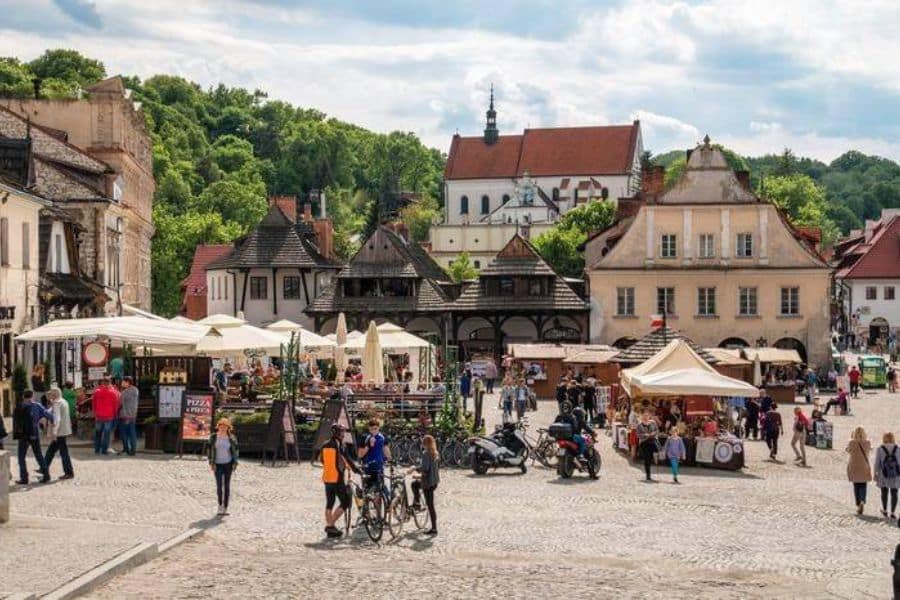
In the 16th and 17th centuries, Kazimierz Dolny was one of the wealthiest grain-trading towns in Europe, situated on the Vistula River, two hours south of Warsaw, and controlling the flow of Polish grain westward toward the Baltic ports and on to the rest of Europe.
The money that passed through here built a Renaissance market square that still stands almost entirely intact, along with a 14th-century castle on the hill above the town and a cylindrical watchtower whose walls at the base are four meters thick.
By the late 19th century, artists started arriving. They came for the light on the river, the loess gorges cutting through the hills, and the medieval bones of a town that modernity had somehow passed by. They kept coming, and Kazimierz Dolny became one of Poland’s most significant artists’ colonies, a tradition that continues today with galleries throughout the old town.
Things To See Nearby:
- Lublin is about an hour east and contains one of the best-preserved old Jewish quarters in Poland, a city that was historically known as the Jerusalem of the Kingdom of Poland before the Holocaust. The old town with its medieval gate tower and Renaissance architecture is largely intact, and the State Museum at Majdanek on the city’s outskirts is one of the most sobering and important Holocaust sites in Europe.
- The Korzeniowy Dol gorge, a 15-minute walk from the Kazimierz Dolny market square, cuts through the loess landscape in a series of deep, narrow ravines.
- Pulawy, about 15 kilometers along the Vistula, contains one of Poland’s earliest landscape parks, established in the early 19th century around the palace of the Czartoryski family. The park was created in the English romantic style and includes two small temples built specifically to house Polish national relics during the Partitions, when preserving Polish heritage was an act of cultural resistance.
Where to stay in Kazimierz Dolny >>>
Sighisoara, Transylvania, Romania
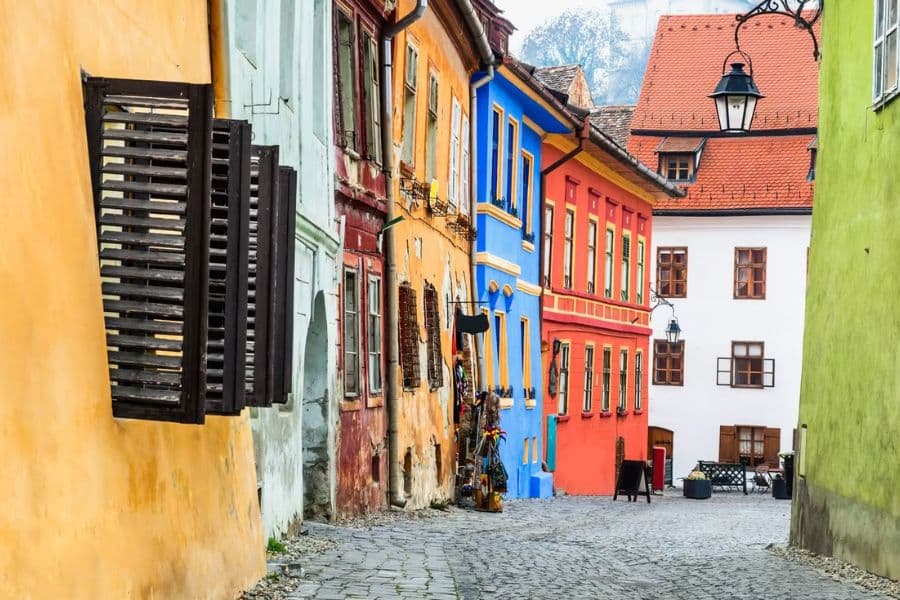
In 1431, a boy was born in a yellow house on a cobblestoned street in a fortified Saxon citadel in Transylvania. His father was Vlad II of the House of Draculea, a name derived from the Order of the Dragon to which he belonged. The son would become Vlad III, ruler of Wallachia, and the historical figure behind Bram Stoker’s Dracula.
The house still stands on the main street of Sighisoara’s medieval citadel, and you can eat lunch in it today. The 14th-century Clock Tower looms over the same street, and the entire citadel is a UNESCO World Heritage site, the best-preserved inhabited medieval fortress in Europe.
Beyond the Dracula connection are the pastel houses painted in ochre, blue, and terracotta, the nine surviving towers, the covered wooden staircase of 175 steps climbing to the hilltop church built in 1345, and the cobblestoned lanes so steep in places that you have to hold the walls.
The Saxons were invited to settle Transylvania by the Hungarian kings as a buffer against Ottoman expansion, and they built their towns as fortresses first and everything else second.
Things To See Nearby:
- Bran Castle, about two hours west of Brasov, is the castle most associated with the Dracula legend, a 14th-century fortress perched on a rocky bluff that Bram Stoker never actually visited but whose description closely matched his imagination enough to make it permanent.
- Brasov is a 90-minute drive from Sighisoara and is the best base for exploring this part of Romania, a beautifully preserved medieval Saxon city with a Gothic church so large it’s simply called the Black Church, and a central square ringed with Baroque facades that was once the main marketplace for the entire region.
- The Viscri fortified church, about 45 minutes from Sighisoara, is a 12th-century Saxon church surrounded by a defensive wall built by the villagers after repeated attacks over the centuries.
Where to stay in Sighisoara >>>
Koprivshtitsa, Sredna Gora Mountains, Bulgaria

On April 20, 1876, a man named Todor Kableshkov stood at the Kalachev Bridge in the center of Koprivshtitsa and fired the first shot of the April Uprising against 500 years of Ottoman rule. The rebellion was crushed within weeks, but the uprising and the brutal Ottoman response to it drew the attention of European powers and set in motion the chain of events that led to Bulgarian independence two years later.
Koprivshtitsa sits 110 kilometers from Sofia in the Sredna Gora mountains and contains the finest collection of Bulgarian National Revival architecture in the country, with brightly painted wooden houses featuring carved ceilings and overhanging upper floors that define 19th-century Bulgarian identity.
Six of the revolutionary leaders’ houses are open as museums. The National Folklore Festival is held here every five years, drawing musicians and dancers from across Bulgaria.
Things To See Nearby:
- Sofia is 110 kilometers west and makes a natural base for the trip, a city that layers Roman, Byzantine, Ottoman, and Soviet history across one another in a way that takes time to read but rewards the effort. The Alexander Nevsky Cathedral, built in the early 20th century to honor the Russian soldiers who died helping liberate Bulgaria, is one of the largest Orthodox cathedrals in the world, and its gold domes are visible from much of the city.
- The Rila Monastery, about two hours southwest of Sofia, is Bulgaria’s most important Orthodox monastery, founded in the 10th century by a hermit monk named John of Rila and rebuilt over the following centuries into a fortress-like complex of striped archways and painted frescoes.
- The Valley of Roses lies between Koprivshtitsa and Plovdiv and is the source of roughly 85 percent of the world’s rose oil used in perfume production. In late May and early June, the fields are in full bloom, and the rose harvest festival draws visitors from across Bulgaria.
Where to stay in Koprivshtitsa >>>
Disclaimer: This article is for general information only and is not professional advice. It may contain affiliate links. Please see our full Editorial Policy for details.

Kylie Lang is a nationally syndicated travel journalist with bylines on the Associated Press Wire & more, a lifestyle writer, and the founder and editor of Your Lifestyle Library (yourlifestylelibrary.com). She holds a BA (Honours) in History from the University of Kent and is a member of the British Guild of Travel Writers.