
As a writer myself, I always get a little thrill when I find myself somewhere a famous writer has spent time. At the New Year, I stayed at the Hotel Monte Cristo in Paris, and although no famous writers have stayed there, all the rooms are inspired by Alexandre Dumas’s legendary novel, The Count of Monte Cristo.
There’s something almost magical about sleeping in the same room where literary legends once stayed. They’re places where some of the world’s greatest novels were actually written, where authors escaped to find inspiration or to meet impossible deadlines. And there are plenty of hotels to choose from in Europe.
Walking through their hallways, you can almost imagine Hemingway at the bar or picture an author hunched over a typewriter racing to finish a manuscript. Some of these hotels have preserved the very rooms where famous books were completed, while others simply wear their literary history with pride.
9 Historic European Hotels Where Famous Writers Lived
Each of these stunning hotels has a story to tell, and staying in one of them feels like stepping into the pages of literary history.
L’Hotel, Paris, France
Oscar Wilde arrived in Paris in 1897, fresh out of Reading Gaol and with his reputation in tatters. The flamboyant Irish writer who had once been the toast of London society was now broke, disgraced, and desperate for somewhere to lay his head. He found it at the Hotel d’Alsace on the Left Bank, a dingy establishment that was about as far from glamorous as you could get.
Built in 1828 on the site of Queen Margot’s 17th-century Pavilion of Love, the hotel had seen better days by the time Wilde checked in. He wrote to his publisher complaining that the place was “so filthy, so utterly depressing, so hopeless.” But with nowhere else to go and no money to pay for anything better, Wilde made Room 16 his home for the final years of his life.

On November 30, 1900, Oscar Wilde died in that room at the age of 46. Legend has it that his final words were “I am dying beyond my means.” He also famously quipped about the hideous wallpaper: “My wallpaper and I are fighting a duel to the death. One or the other of us has to go.”
Fast forward to the 1960s, and the hotel had undergone a complete transformation. Renamed L’Hotel in 1963 and renovated in 1967, it became the place to be seen in Paris. Salvador Dali, Frank Sinatra, Elizabeth Taylor, and Jim Morrison all passed through its doors. Even Argentine writer Jorge Luis Borges checked in specifically because Wilde had died there. Borges had translated Wilde’s “The Happy Prince” into Spanish as a nine-year-old and remained a devoted fan his entire life.
Today, L’Hotel is a 20-room five-star boutique property with interiors by designer Jacques Garcia. The Oscar Wilde Suite features period furniture and a large balcony, though it’s unlikely Wilde himself stayed in anything quite so grand. His final hotel bill, framed and displayed in the suite, shows he owed 2,643 gold francs, plus the cost of 42 candles, 11 bottles of milk, and three bottles of lemonade.
Check rates and availability at L’Hotel >>>
Ballynahinch Castle, County Galway, Ireland
Tucked into 450 acres of wild Connemara countryside at the foot of the Twelve Bens mountains, Ballynahinch Castle has a history that reads like an Irish epic. The original castle was built in 1546 by Donal O’Flaherty, whose wife was none other than the legendary pirate queen Grace O’Malley. After Donal’s death, Grace took over the O’Flaherty clan and ruled with an iron fist.
The present building dates to 1754, when the Martin family built it as an inn. It later became the home of Richard Martin, known as “Humanity Dick” for founding the RSPCA in 1822. But perhaps the most colorful owner was the Maharaja of Nawanagar, a famous Indian cricketer known as Ranji, who bought the estate in 1924.

Ranji arrived each summer by private train, accompanied by an entourage of servants and friends. Locals would place firecrackers on the tracks to welcome him, and he’d throw lavish birthday parties where he served guests himself. He built 72 stone fishing piers along the riverbank that are still in use today.
The castle’s literary connections run deep. Nobel Prize winner Seamus Heaney was so taken with the place that he wrote a poem called “Ballynahinch Lake” in the 1990s, which was privately printed in an edition of 500 copies for the hotel’s millennium celebration.
Irish novelist Edna O’Brien researched her 2002 true-crime novel “In the Forest” by having someone bring her into the estate woods and legally fire a shotgun so she could capture the sound accurately. Poet Peter Fallon published “Ballynahinch Postcards” in 2007 after staying here. Margaret Atwood and Michael Longley have also been regular guests.
The bar still displays photos of these literary luminaries alongside artwork they’ve created during their stays, and the Fisherman’s Pub remains exactly the kind of wood-paneled retreat where writers love to hole up with a whiskey and their notebooks.
Check rates and availability for Ballnahinch Castle >>>
The Balmoral, Edinburgh, Scotland
In August 2006, J.K. Rowling had a problem. She was under enormous pressure to finish the final Harry Potter book, but her Edinburgh home was chaos. With a baby, a toddler, a teenager, a husband, and a dog all demanding her attention, she couldn’t concentrate. So she did what any sensible writer would do. She checked into a hotel.
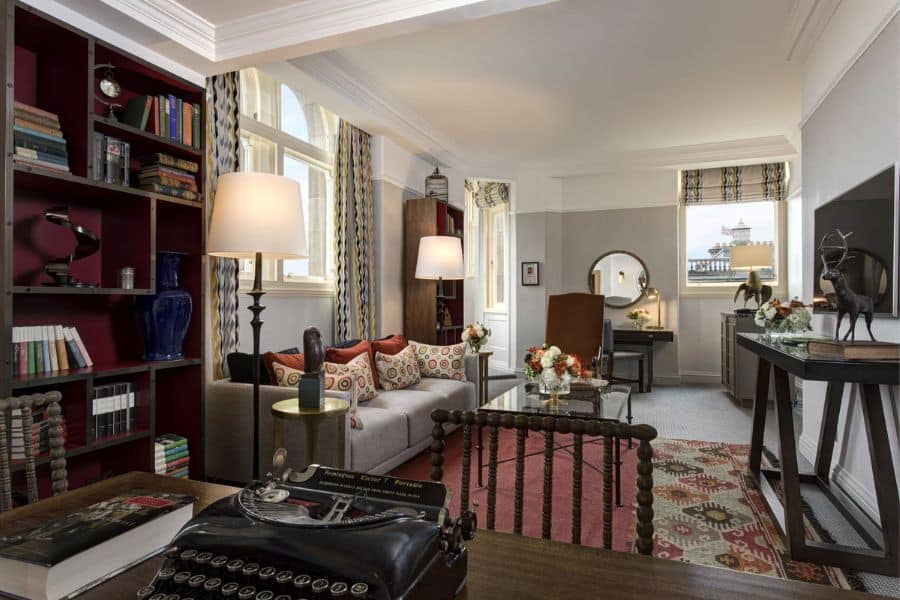
Room 552 at The Balmoral became Rowling’s sanctuary for the next six months. Built in 1902 as the North British Station Hotel, The Balmoral sits at the top of Princes Street with its iconic clock tower (set three minutes fast to help travelers catch their trains at Waverley Station). Rowling requested a room with a view overlooking Edinburgh Castle and Calton Hill, and she got exactly what she needed: peace, quiet, and no distractions.
For nearly half a year, she worked deep into the nights, tying together an 880,000-word, 700-character series that had captivated hundreds of millions of readers. On January 11, 2007, she wrote the final words of “Harry Potter and the Deathly Hallows.” To commemorate the moment, she grabbed a pen and wrote on the back of a marble bust of Hermes: “J.K. Rowling finished writing Harry Potter and the Deathly Hallows in this room.”
Room 552 is now the J.K. Rowling Suite, complete with a purple door, an owl door knocker, woodland-themed wallpaper featuring bare trees, and a statuette of a stag (either Harry’s Patronus or his father’s Animagus form, depending on how you interpret it).
The marble bust Rowling signed is displayed in a glass case, though the signature has started to fade over the years. The suite costs around £1,000 per night, and Harry Potter fans from around the world make pilgrimages to stay in the room where their beloved series came to an end.
Check rates and availability for The Balmoral in Edinburgh >>>
Hotel d’Angleterre, Copenhagen, Denmark
Hans Christian Andersen was terrified of fire. Given that Copenhagen had a rather unfortunate habit of burning down in the 19th century, this fear wasn’t entirely irrational. So when the author of “The Little Mermaid” stayed at Hotel d’Angleterre between 1860 and 1871, he always, always requested a ground-floor room.
Founded in 1755 by Jean Marchal, a French hairdresser-turned-valet, and his wife Maria Coppy, a genius cook, the hotel has survived for 270 years despite that devastating fire in 1795 that burned the original building to the ground. After relocating to its current spot on Kongens Nytorv (the King’s New Square), the hotel was completely refurbished between 1872 and 1875 by the architects who also designed the Tivoli Gardens and the Royal Danish Theatre.

Andersen became so regular that he never missed a Christmas at the hotel. It was here, in his ground-floor suite, that he wrote “What The Old Man Does is Always Right.” The hotel even hosted the celebration of the 50th anniversary of his arrival in Copenhagen in 1869, with his suite decorated in flowers for the occasion.
The hotel claims another significant moment in Danish history. The first draft of the Danish Constitution was presented at d’Angleterre in 1849. And in 1966, Alfred Hitchcock filmed scenes from his spy thriller “Torn Curtain” here, with Paul Newman staying at the hotel in the movie. Hitchcock even made one of his signature cameos in the foyer, calming a crying baby.
Today, the hotel is nicknamed “The White Lady” for its stunning white facade. The Hans Christian Andersen Suite pays tribute to its most famous literary guest, and you can still take afternoon tea in the elegant surroundings where Danish history and fairy tales collide.
Fairmont Le Montreux Palace, Switzerland
Vladimir Nabokov was a man of particular habits. He wrote standing up on index cards, and collected butterflies with obsessive precision. And after the success of “Lolita” made him wealthy, he and his wife Véra decided they’d had enough of moving around. In 1961, they checked into the Swan Suite at the Montreux Palace Hotel on Lake Geneva and stayed for 17 years.
The hotel opened in 1906 on the shores of Lake Geneva, designed by architect Eugène Jost as a Belle Époque masterpiece. By the time the Nabokovs arrived, it had already hosted its share of famous guests and even served as the venue for the signing of the Montreux Convention in 1936. This international treaty still governs access to the Black Sea.

Nabokov initially lived on the third floor, where he could hear actor Peter Ustinov’s footsteps overhead as he worked. After a year, he and Véra moved to the top floor, the sixth level, which offered spectacular views of the lake and the Alps with no overhead neighbors. From his window, Nabokov could watch the lake and mountains, and when inspiration struck, he’d venture out with a butterfly net to hunt specimens in the hills above Montreux.
It was here that Nabokov wrote “Pale Fire,” “Ada,” and “Look at the Harlequins!” His daily routine involved shuffling his index cards (which he kept under his pillow for nocturnal reference) and crafting the intricate, playful prose that made him one of the 20th century’s greatest novelists. His wife Véra sometimes woke to “furtive noises” as the insomniac writer worked through the night.
Butterflies and literature were his twin obsessions. Nabokov once said, “It is not improbable that had there been no revolution in Russia, I would have devoted myself entirely to lepidopterology and never written any novels at all.” Butterflies appear more than 500 times in his literary works. When he died on July 2, 1977, he left behind not only his novels but an enormous butterfly collection, now housed in the Cantonal Museum of Zoology in Lausanne.
The hotel has a junior suite named after him, and you can still walk the same paths around Lake Geneva where Nabokov hunted butterflies and dreamed up his most complex narratives.
Check rates and availability for Fairmont Le Montreux >>>
The Langham, London, England
On the evening of August 30, 1889, three men sat down to dinner at The Langham hotel in London. The host was J.M. Stoddart, managing editor of Lippincott’s Monthly Magazine. His guests were two relatively unknown writers: 35-year-old Oscar Wilde and 30-year-old Arthur Conan Doyle. By the end of the night, literary history had been made.
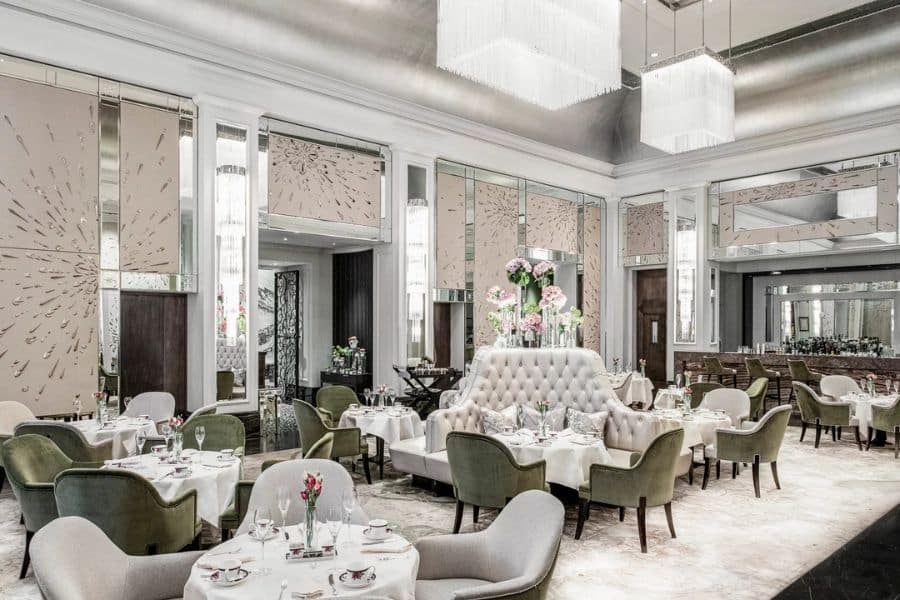
The Langham had opened in 1865 as Europe’s first “Grand Hotel,” a seven-story Victorian masterpiece with revolutionary innovations for the time: the first hydraulic lifts in England, air conditioning, hot and cold running water, and a water closet in every room. The Prince of Wales himself performed the opening ceremony, and the hotel immediately became the place where London’s elite gathered.
Stoddart wanted to commission original fiction for his magazine, and he’d invited Wilde and Doyle (he’d also invited 24-year-old Rudyard Kipling, who couldn’t attend) to see what he could persuade them to write. Conan Doyle later called it “a golden evening.” By the time the wine and conversation had flowed, both men had agreed to write novels for Lippincott’s. Wilde produced “The Picture of Dorian Gray.” Doyle wrote “The Sign of Four,” the second Sherlock Holmes mystery.
The dinner had such an impact on Conan Doyle that he set two Sherlock Holmes stories at The Langham. In “A Scandal in Bohemia,” the King of Bohemia tells Holmes he can be found “at The Langham, under the name of the Count Von Kramm.” The hotel appears again in “The Sign of Four.”
In 2010, a green plaque was unveiled at The Langham commemorating that August evening, often called “the most important meeting in literary history.” It certainly ranks among the most productive dinner parties ever held.
The hotel survived two World Wars (though the West Wing was destroyed by Luftwaffe bombing), a period as BBC offices (they tried to demolish it in 1980 but English Heritage stopped them), and numerous renovations. Today, it’s a five-star hotel where you can take afternoon tea in the Palm Court and imagine Wilde and Doyle raising their glasses to literary success.
Check rates and availability for The Langham >>>
Hotel Sacher, Vienna, Austria
In 1948, British writer Graham Greene was in Vienna researching a story. The city was divided into four zones controlled by the Allied powers, and Greene was staying at the Hotel Sacher, which had miraculously survived World War II when nearly every building around it had been shattered by bombs.
One day, Greene had lunch at the Sacher with a man who would later become infamous: Kim Philby, a British intelligence officer who was secretly spying for the Soviet Union. During that lunch, Philby told Greene stories about the black market, the tensions between the Allied powers, and life in occupied Vienna. Greene listened carefully. That meeting became the inspiration for “The Third Man,” one of the greatest British films ever made.
The Hotel Sacher had opened in 1876, built by Eduard Sacher, son of the man who created the famous Sachertorte in 1832. But it was Eduard’s widow, Anna Sacher, who made the hotel legendary. After Eduard died in 1892, Anna took over management and ran the place until 1930. She was never seen without her French Bulldogs and a cigar, and she turned the Sacher into one of the finest hotels in the world.
The hotel attracted everyone from Somerset Maugham and Charlie Chaplin to Noël Coward. Orson Welles, who starred in the film adaptation of “The Third Man, became so regular that he practically lived at the Sacher. Welles later said he’d been offered either a salary or a percentage of the profits for playing Harry Lime. He chose the salary. The film became the most successful of the immediate post-World War II era. He regretted that decision for the rest of his life.
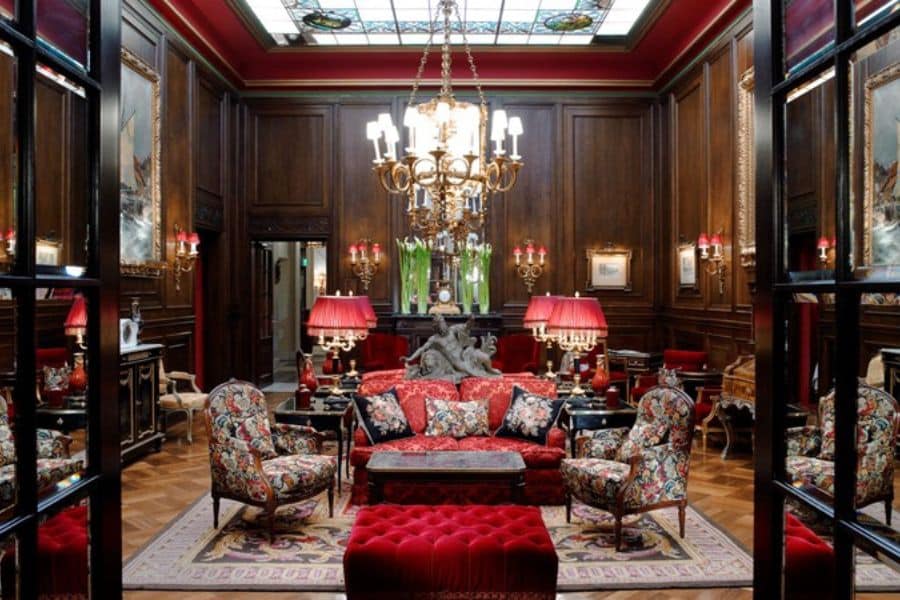
The hotel has preserved its old-world grandeur. The Rote Bar still serves fine Austrian cuisine in a space that was once a horse stable for Russian troops during the city’s liberation in 1945. Anna Sacher’s tradition of having VIP guests sign tablecloths continues to this day. Four tablecloths, densely covered with signatures, are carefully treasured in the hotel.
And yes, the Original Sachertorte, handmade according to Franz Sacher’s secret 1832 recipe, is still served in the café. It’s been called the world’s most famous chocolate cake, and it’s 50 years older than the hotel itself.
Check rates and availability at Hotel Sacher >>>
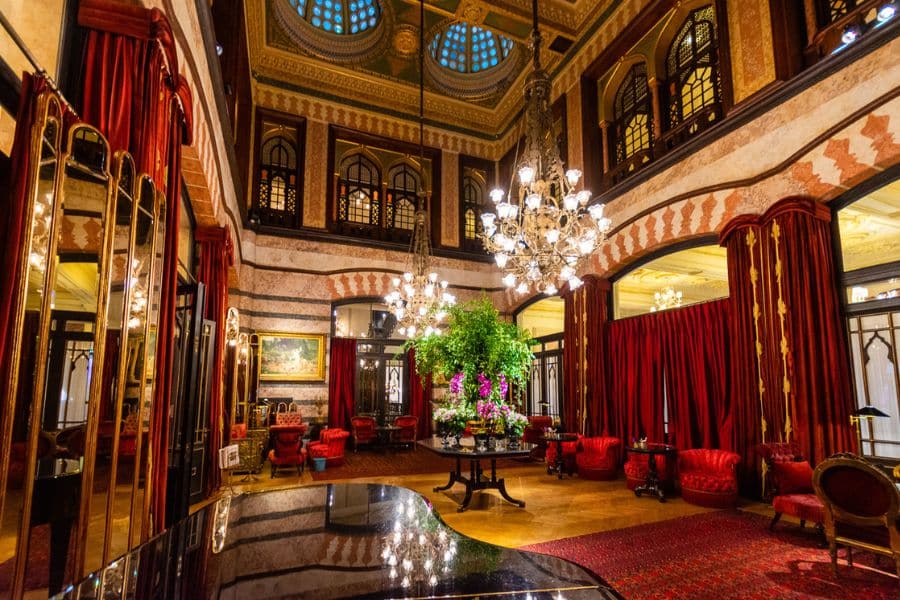
Pera Palace Hotel, Istanbul, Turkey
When the Orient Express rolled into Istanbul in the late 1800s, passengers needed somewhere suitably grand to stay. In 1892, the Pera Palace Hotel was built in the Beyoğlu district, specifically designed for Orient Express travelers. It was the first hotel in Istanbul to have electricity and hot running water, innovations that seem mundane now but were absolutely cutting-edge then.
Agatha Christie stayed here multiple times in the 1920s and 1930s, and during one of those visits, she wrote “Murder on the Orient Express.” Room 411, where she stayed, is now the Agatha Christie Room, preserved as a tribute to the Queen of Crime. The hotel’s Orient Bar and Belle Époque architecture provided the perfect atmospheric backdrop for Christie to dream up her most famous mystery.

Ernest Hemingway also loved the Pera Palace. He stayed in what’s now called the Ernest Hemingway Suite and spent many evenings at the Orient Bar (no surprise there). In his short story “The Snows of Kilimanjaro,” the protagonist stays at the hotel while serving in the military. The suite retains the Grand Canal views and period details that Hemingway would have seen.
The hotel served as a cultural bridge between East and West, hosting everyone from Mustafa Kemal Atatürk (founder of modern Turkey, who stayed in Room 101) to European royalty and artists. Its guest book reads like a who’s who of early 20th-century glamour: Alfred Hitchcock, Ernest Hemingway, Agatha Christie, Greta Garbo, and countless others.
During World War II, Istanbul was neutral, and the Pera Palace became a hotbed of international intrigue, with spies from various countries all staying under the same roof. The hotel’s discreet staff kept their secrets, and the stories of those war years remain largely untold.
Today, the Pera Palace has been beautifully restored, with the Agatha Christie Room and Ernest Hemingway Suite available for guests who want to sleep where literary legends once dreamed up their masterpieces.
Check rates and availability at Pera Palace Hotel >>>
Hôtel du Cap-Eden-Roc, French Riviera, France
In 1869, Hippolyte de Villemessant, founder of the French newspaper Le Figaro, had an idea. He’d build a retreat on the French Riviera where anxious, burned-out writers and artists could escape Paris and find inspiration. He called it Villa Soleil, and it opened on Cap d’Antibes, surrounded by pine forests and overlooking the Mediterranean.
In 1889, Italian hotelier Antoine Sella bought the property and opened it as the Grand Hôtel du Cap. But there was one problem. Nobody came in the summer. The Riviera was strictly a winter destination for the wealthy, who fled north before the heat arrived in June.
That all changed in 1923 when Gerald and Sara Murphy, a wealthy young American couple, decided to rent the entire hotel for the summer. It was unprecedented. The Murphys brought their friends, artists and writers of the Lost Generation: F. Scott Fitzgerald, Ernest Hemingway, Dorothy Parker, Pablo Picasso, Cole Porter, and Jean Cocteau. They threw parties, sunbathed (a radical new concept), cleared the beach of rocks and seaweed, and basically invented the summer Riviera season.
Fitzgerald fell in love with the place. He and his wife Zelda returned for two seasons, and the hotel became the inspiration for “Tender is the Night.” In the novel’s opening lines, Fitzgerald describes it perfectly: “On the pleasant shore of the French Riviera, about halfway between Marseille and the Italian border, stands a large, proud, rose-colored hotel. Deferential palms cool its flushed facade, and before it stretches a short, dazzling beach.”
Hemingway lingered for long vacations. Marc Chagall sketched in the beachside cabanas. The Duke and Duchess of Windsor were such loyal guests that owner André Sella would personally welcome them at the Antibes train station whenever they visited.
The Eden Roc pavilion was built in 1914, 400 yards from the main hotel, and became the spot for the most glamorous lunches and parties on the Riviera. The Kennedy family summered here in 1938, when JFK was just 21. Elizabeth Taylor brought all of her husbands here at various points.
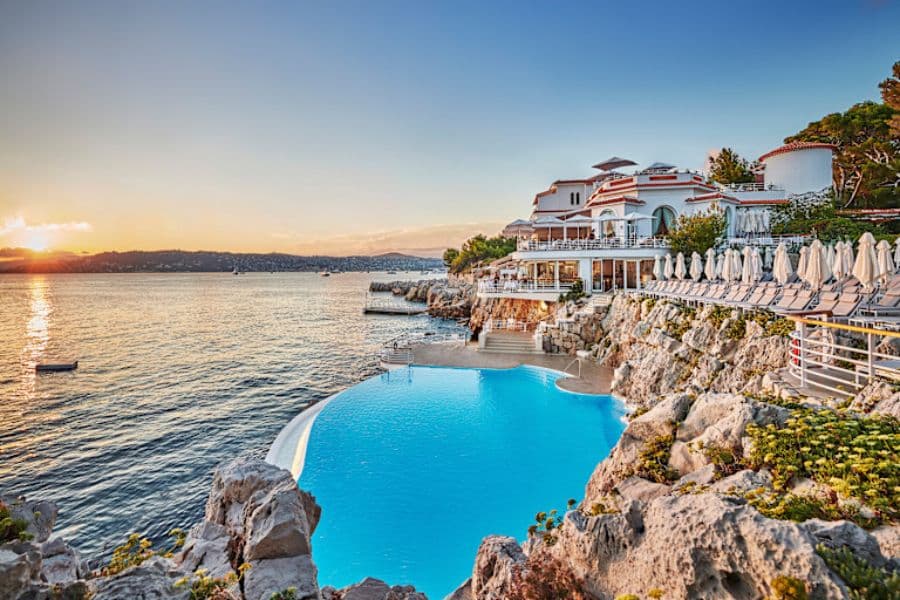
Today, the Hôtel du Cap-Eden-Roc sits on 22 acres of coastline with 117 suites, Michelin-starred dining, and an infinity pool that’s been photographed more times than practically any other pool in the world. It’s still the place where celebrities escape during the Cannes Film Festival, and it still embodies the glamour that Fitzgerald captured so perfectly almost a century ago.
Disclaimer: This article is for general information only and is not professional advice. It may contain affiliate links. Please see our full Editorial Policy for details.

Kylie Lang is a nationally syndicated travel journalist with bylines on the Associated Press Wire & more, a lifestyle writer, and the founder and editor of Your Lifestyle Library (yourlifestylelibrary.com). She holds a BA (Honours) in History from the University of Kent and is a member of the British Guild of Travel Writers.