
The first proper garden I ever had to myself was a concrete rectangle about the size of a postage stamp, behind a rental in a row of identical little terraced houses in a particularly grotty part of the East End of London.
I remember standing at the back door with a cup of tea on a Saturday morning, looking at it, and thinking, well, that’s not much to work with, but I want to make it look pretty while I’m here. I didn’t want to spend hours on it and wanted stuff I could take with me when I moved on, since I was only renting.
What I learned over that summer is that a tiny plot can feel surprisingly generous if you stop trying to cram a big garden into it. It’s all about fooling the eye and making every inch count. I pulled on my event design skills and used a few tricks I’d learned from designing creative, temporary interiors.
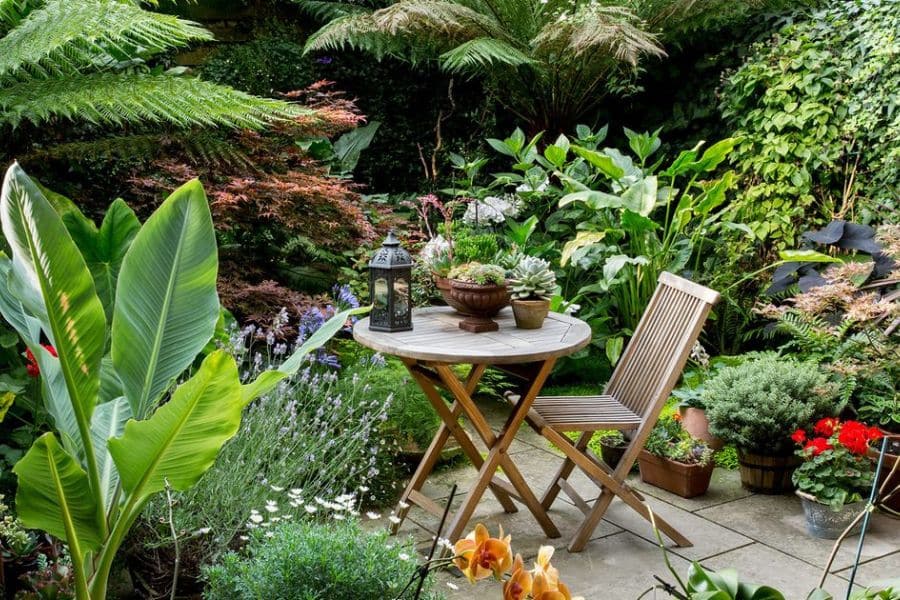
7 Tricks That Turn Your Tiny Garden Into a Beautiful Oasis
My first business, many years ago, was an event planning and design business, and I learned so much about transforming spaces. When you’re faced with an ugly ballroom, and your job is to make it look beautiful for, let’s say, 5 hours during a dinner event, you’re somewhat limited.
You can’t take up carpets, paint walls, or do anything structural. However, you can still turn a room into something spectacular for one night and then put it back the way it was.
A garden, especially one that comes with a rented property, isn’t really any different. You’ve just swapped the inside for the outside, but the same design rules apply.
Stop Looking at the Floor and Start Looking Up

The single biggest shift in a small yard is going vertical. When all your plants are sitting at ground level in pots, your eye takes the whole space in at once and goes, right, that’s it then.
The moment you start putting things at different heights, the eye has to travel, and travel reads as size.
I used this principle when I nailed a length of trellis to a horrible bit of fence I couldn’t replace because it wasn’t my responsibility as a tenant. Instead, I trained a clematis up it, stuck a couple of hanging planters on either side with trailing nasturtiums, and within a season the fence had gone from eyesore to feature.
The plot wasn’t any bigger, but it felt bigger because there was something to look at above waist height. A few easy ways to get layers going without much effort:
- Wall planters or pocket planters on a sunny fence. I’ve grown strawberries, lettuce, and herbs in mine, and it’s the only place the slugs can’t reach them. Small win, big morale boost.
- A simple obelisk or tripod of bamboo canes in a pot, with sweet peas or beans climbing up. Instant height for about $8.
- Hanging baskets at different drop lengths. Two at the same height look like a pair of earrings. Three at staggered heights look like a garden.
- A tall, narrow shrub or small tree in a pot at the back corner. Anchor the eye high, and the whole space stretches up to meet it.
Pick Three Colors and Stick to Them

The eye can’t cope with multiple colors. It’s why all events have a color scheme, and your garden needs one too, otherwise the whole thing starts to look like a mishmash of nothing in particular. It makes everything look too busy, which then makes everything look smaller.
A small space reads as bigger when the colors are repeated and limited. Pick three, or four tops if you really can’t decide.
The trick is to repeat those same colors in different plants around the yard. White cosmos at the back, white alyssum tumbling out of a pot at the front, a white-flowered geranium in a hanging basket.
Your eye joins the dots and reads the whole plot as a single composition rather than a collection of unrelated bits.
Use Mirrors and Reflective Surfaces to Cheat

It’s the oldest trick in the book when faced with small spaces. If you have a tiny living room, pop a mirror over the mantlepiece, and it immediately makes the room feel more spacious. An outdoor mirror on a fence or wall works the same way and really does double what you see.
It doesn’t need to be expensive; in fact, I’d advise against it, since it’ll be exposed to the elements. You can easily pick something up at a yard sale for pennies. Screw it to the fence behind a pot of ferns, and the effect will be immediate.
A few things I’ve learned about mirrors and gardens:
- Don’t hang a mirror where it’ll reflect the sun straight at your seating spot, because you’ll cook.
- Angle it slightly downward so it reflects plants and ground rather than sky
- Tuck it partly behind foliage so it feels like a window into another bit of garden rather than, you know, a mirror nailed to a fence.
Reflective surfaces, in general, help to expand your space. A glazed pot in a pale color, a galvanized metal trough, a glass tabletop, even a little water feature, anything that bounces light around makes a small space feel airier.
Create a Hidden Corner You Can’t See From the Door

Bear with me here because I realize this sounds counterintuitive in a tiny yard. Why would you hide any of it? But the moment you can’t see the whole garden from one spot, your brain assumes there’s more of it.
In my tiny, postage-stamp garden, I remember putting a tall planter with a bamboo screen about two-thirds of the way down. Behind it: a little bench, a pot of mint, and a string of fairy lights. You didn’t know it was there until you walked around the planter.
The effect is the same one you get in a well-designed big garden, where you can’t see everything at once and you feel like you’re discovering it as you go. In a small plot, you only need the smallest suggestion of a hidden corner. A trellis with a climber on it, a tall grass-like miscanthus in a pot, or a folding screen at an angle.
What goes behind the screen matters less than the fact that something is back there. It becomes the spot you go to when you want five minutes to yourself, and it makes the whole yard feel like it has more than one room.
Go Big With One Plant Instead of Small With Twenty

The instinct in a small space is to buy small plants because, well, small space. But tiny pots dotted around look a bit lost. What changes everything is one generous, properly sized thing. A big leafy hosta in a wide pot, maybe a fig tree in a half-barrel, or a single enormous pot of dahlias.
The scale of one bold plant tricks the eye into reading the whole space as more substantial, because your brain uses the biggest thing as the reference point.
Repeat the Same Pot, the Same Plant, the Same Anything

Repetition is the cheat code of small garden design. Three matching pots in a row along a wall look deliberate and calm, as if you couldn’t decide. The yard reads as designed rather than collected, and designed reads as bigger because your eye isn’t snagging on a hundred different things.
You can repeat almost anything. Three terracotta pots of lavender, a run of identical galvanized buckets with herbs in them, or the same trailing plant in every hanging basket.
Lay the Floor Diagonally and Make the Edges Disappear

If you’ve got any control over the actual floor of your small yard, paving or decking, or even just the direction your stepping stones run, lay them diagonally instead of square to the fence. The longest line in any rectangle is the diagonal, and your eye follows it, which makes the space feel longer than it is.
The other half of this trick is making the edges of the yard disappear. Hard boundaries, a sharp fence line, a clear edge between patio and border, tell your eye exactly where the space ends. Soften those edges with plants that flop over them.
Let alyssum spill onto the paving, allow a hardy geranium to tumble over a low wall. Plant something tall and feathery right up against the fence so you can’t quite tell where the fence stops, and the plants start.
I do this mostly with grasses because they’re forgiving and move in the breeze, which adds another layer of distraction from the fact that the boundary is right there. A clump of stipa or a tall miscanthus in a back corner, and suddenly your eye can’t find the edge of the yard.
Whatever’s on the other side of the fence becomes part of your view, which is sometimes a neighbor’s apple tree and sometimes a satellite dish, but you take what you can get.
Disclaimer: This article is for general information only and is not professional advice. It may contain affiliate links. Please see our full Editorial Policy for details.
Kylie Lang is a nationally syndicated travel journalist with bylines on the Associated Press Wire & more, a lifestyle writer, and the founder and editor of Your Lifestyle Library (yourlifestylelibrary.com). She holds a BA (Honours) in History from the University of Kent and is a member of the British Guild of Travel Writers.