
As a figure skater, balance is one of the most important parts of skating. If you have no balance, you’ll end up on your bottom. I skated competitively as a kid, so trust me, I spent plenty of time picking myself up off the ice.
What I learned from all that is that balance behaves a lot like a muscle. Practice and it gets better, but left alone without being worked, it fades.
These days I do fitness work with older people. We work a lot on strength, conditioning, and balance. Naturally, walking forms a big part of the cardio side of things, but as good as it is, it doesn’t help with balance.
You’ll find your lack of balance sneaks up on you without realizing it. You spin around too fast when someone calls your name, or lifting one leg makes you wobble. It’s the little things that turn into bigger things as you get older.

Why Walking Doesn’t Help With Balance
The CDC says more than 1 in 4 people over 65 have a fall each year. Of those, about 37% are hurt badly enough to need treatment or spend at least a day laid up.
Now for the better news. The big research review behind the World Health Organization’s activity guidelines found that balance and functional exercises cut falls by 24%. Do 3 hours or more a week, and that went up to around 42%. Walking programs on their own? There wasn’t enough evidence for the researchers to say either way.
So keep walking; it’s brilliant for your heart and your walking speed. Just don’t rely on it to look after your balance, either.
The 10-Second Test
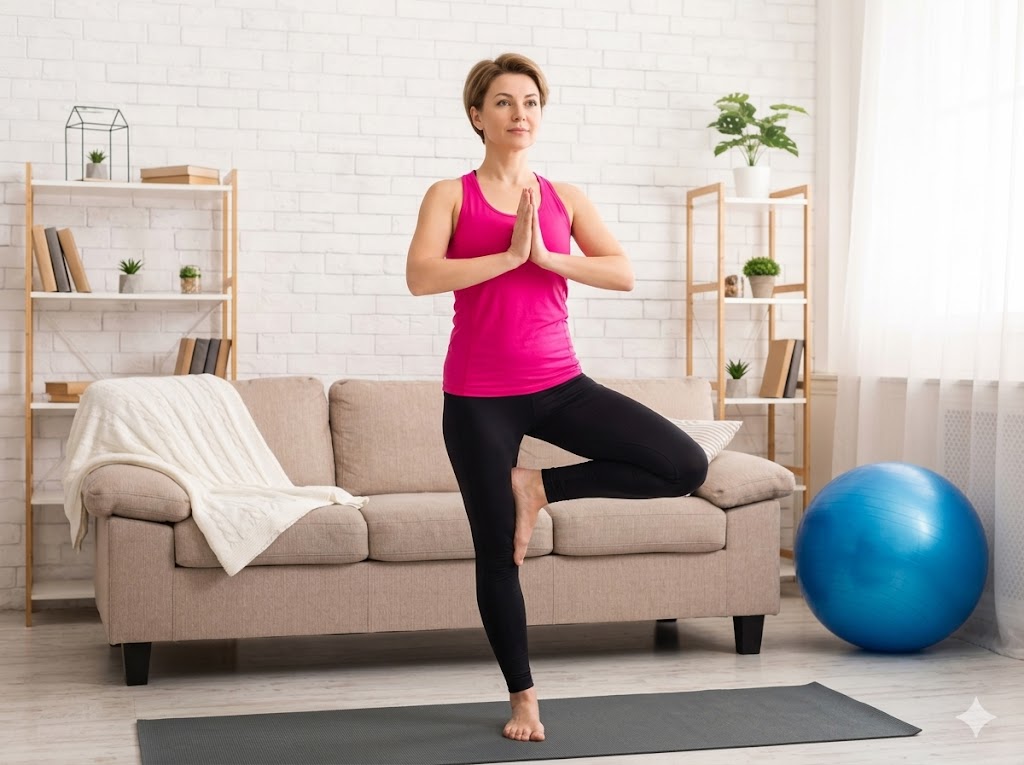
The best test is to try balancing on one foot for 10 seconds without holding on to anything. That’s what researchers asked 1,702 people aged 51 to 75 to do in a study published in the British Journal of Sports Medicine. Roughly 1 in 5 couldn’t. In the 71 to 75 age group, more than half couldn’t.
They followed them for another 7 years. The ones who’d failed were 84% more likely to die from any cause in that time, even after allowing for their age and health. The study can only show a link, and it doesn’t prove wobbly balance was to blame. I’d still take the 10-second balance test seriously.
Doctors in the US use something similar: the CDC’s 4-stage balance test. It’s 4 positions held for 10 seconds each: feet together, one foot half in front of the other, heel-to-toe, then one foot. A few of them turn up in the moves below.

7 Standing Exercises To Improve Your Balance
Stand next to a kitchen counter or hold onto a sturdy chair that won’t slip, and put on proper shoes on. Socks and slippers on a hard floor are asking for trouble. Remove any rugs out of the way too, and if you’re a bit unsteady, get someone to hang around the first few times.
Go through the moves in order, because they get harder as you go. The whole thing takes 10 to 15 minutes, and most days of the week are ideal.
Pair it with a few chair exercises and leg exercises, and you’ll be working on your strength and balance too.
1. Weight Shifts
This move is a good starting point because every time you take a step, your weight moves from one foot to the other, and this gets your hips and ankles used to doing that smoothly. It helps when you turn around in the kitchen or step to the side to let someone pass.
How to do it:
- Stand facing the counter with your feet hip-width apart and your fingertips resting on top.
- Slowly move your weight over to your right foot. Your left heel can lift a little.
- Hold it there for 5 seconds.
- Come back to the middle, then do the same on your left side.
Watch out: Move from your hips and keep your top half upright. If your shoulders start leaning over, your hips aren’t doing the work.
Make it harder: Lift your other foot right off the floor while you hold, or let go of the counter.
| ⚖️ Weight shifts at a glance | |
| 💪 Works | Hips, ankles and the muscles that keep you upright |
| 🔁 Reps | 10 to each side, holding 5 seconds |
| ✅ Helps with | Turning, stepping sideways and walking |
| ⬆️ Make it harder | Lift the other foot, or let go of the counter |
Found this useful? Get more like it in your inbox as a Lifestyle Library Insider.
2. Heel Raises
Your calves and ankles are working away all the time to keep you upright, and they’re what save you when the sidewalk is uneven. Heel raises make them stronger, and you can do them while you wait for the coffee to brew.
How to do it:
- Stand facing the counter with your feet hip-width apart and your hands resting on top.
- Slowly come up onto the balls of your feet, as high as feels comfortable.
- Hold for a second.
- Lower your heels back down slowly.
Watch out: Keep your weight over your big toes. If you roll out onto your little toes, it’s easy to go over on your ankle.
Make it harder: Hold on with one hand, then just your fingertips. When that’s easy, try one foot at a time.
| 🦶 Heel raises at a glance | |
| 💪 Works | Calves and ankles |
| 🔁 Reps | 10 to 15, slow on the way down |
| ✅ Helps with | Uneven ground, curbs and stairs |
| ⬆️ Make it harder | Fingertips only, or one foot at a time |
3. Side Leg Raises
The muscles on the outside of your hips keep you steady every time you lift a foot off the ground. If they get weak, you start to waddle a bit when you walk, and you’re more likely to topple sideways.
How to do it:
- Stand side-on to the counter, or behind a sturdy chair, and hold on.
- Stand up tall with your feet slightly apart and your toes pointing forward.
- Slowly lift one leg out to the side, keeping it straight. Only go as far as you can without leaning.
- Hold for a second, then lower it slowly.
- Do all your reps on one leg, then swap.
Watch out: Keep your toes pointing forward. If they turn up to the ceiling, a different muscle takes over, and you lose some of the benefit.
Easier version: Only lift your leg a few inches. Staying upright is more important than how high it goes.
| 🦵 Side leg raises at a glance | |
| 💪 Works | The outside of your hips and your bottom |
| 🔁 Reps | 10 to 15 on each leg |
| ✅ Helps with | Walking steadily and not tipping sideways |
| ⬇️ Easier version | Lift your leg just a few inches |
4. Standing March
When you walk, you’re on one leg for a split second with every step. Marching on the spot lets you practice that slowly, and it works the muscles at the front of your hips that lift your feet. Those are the ones that stop you from catching your toe on the edge of a rug.
How to do it:
- Stand tall next to the counter with one hand on it.
- Lift your right knee up in front of you, as high as is comfortable.
- Lower it slowly, then lift your left knee.
- Keep going, nice and slow, swapping legs each time.
Watch out: Don’t rush it. If you march fast, momentum does the work for you, and your balance gets off lightly.
Make it harder: Hold each knee up for 2 or 3 seconds, or let go of the counter and cross your arms over your chest.
| 🚶 Standing march at a glance | |
| 💪 Works | Front of your hips, thighs and core |
| 🔁 Reps | 10 to 20 marches in total |
| ✅ Helps with | Lifting your feet so you don’t trip |
| ⬆️ Make it harder | Hold each knee up, or cross your arms |
5. Heel-to-Toe Stand
Standing with one foot right in front of the other gives you a really narrow base, so your body has to work hard to stop you swaying. It’s also one of the positions in the CDC test, and if you can’t hold it for 10 seconds, your risk of falling is higher.
How to do it:
- Stand next to the counter, holding on with one hand.
- Put one foot right in front of the other, so your front heel touches the toes of your back foot.
- Look straight ahead at something that isn’t moving, like a cupboard handle.
- Hold for 10 seconds. Over time, work up to 30.
- Swap feet and do it again.
Watch out: If you can’t get your feet in a line, put your front foot a little to the side to start with.
Make it harder: Let go of the counter, or slowly turn your head from side to side while you hold.
| 👣 Heel-to-toe stand at a glance | |
| 💪 Works | Ankles, hips and core |
| ⏱️ Hold | 10 seconds, working up to 30, each way |
| ✅ Helps with | Narrow paths, crowds and tight spaces |
| ⬇️ Easier version | Front foot slightly to the side |
6. Single-Leg Stand
This is the hardest one, and it’s the one I’d really like you to keep at. You’re on one leg every time you go up a step, get in the car, or put your pants on, so it makes sense to get good at it.
How to do it:
- Stand next to the counter with your feet hip-width apart, holding on with one hand.
- Put your weight onto your left foot.
- Bend your right knee and lift that foot a few inches off the floor.
- Hold for 10 seconds, working up to 30, then put it down.
- Swap legs.
Watch out: Keep a little bend in the knee you’re standing on, and try to keep your hips level.
Make it harder: Hold on with one finger, then let go completely. Once that’s easy, try closing your eyes, but only with the counter right next to you.
| 🦩 Single-leg stand at a glance | |
| 💪 Works | Hips, ankles, feet and core |
| ⏱️ Hold | 10 seconds, working up to 30, on each leg |
| ✅ Helps with | Stairs, the car and getting dressed |
| ⬆️ Make it harder | Let go of the counter, then close your eyes |
7. Heel-to-Toe Walk
The last move puts it all together. It’s the heel-to-toe stand, but walking, so you have to find your balance again with every step. It’s harder than it looks.
How to do it:
- Stand at one end of the counter or along a hallway wall, close enough to touch it.
- Put your right foot in front of your left, so your right heel touches your left toes.
- Do the same with your left foot.
- Look at a spot straight ahead and take 10 to 20 steps.
- Turn around carefully and walk back.
Watch out: Look ahead, not at your feet. Looking down tips your body forward and makes it harder to stay steady.
Easier version: Leave a small gap between your heel and toes, and keep one hand on the counter as you go.
| 🚶♀️ Heel-to-toe walk at a glance | |
| 💪 Works | Your whole balance system on the move |
| 🔁 Reps | 10 to 20 steps, there and back |
| ✅ Helps with | Walking steadily and recovering from a stumble |
| ⬇️ Easier version | A small gap between heel and toe |
About this article: Our health articles are based on published studies and advice from experts such as physiotherapists and dietitians, and the sources are linked in the article.
Disclaimer: The content in this article is for informational purposes only and is not intended to replace professional medical advice, diagnosis, or treatment. Always consult your doctor, physical therapist, or healthcare provider before starting a new exercise program, particularly if you have existing joint, cardiovascular, or balance conditions. This article may contain affiliate links.
Become a Lifestyle Library Insider
Health tips, money know-how, travel deals and garden ideas for life after 50, straight to your inbox.

Summer Williams is a lifestyle writer and social media manager and a writer and editor of Your Lifestyle Library (yourlifestylelibrary.com). She holds a BA (Honours) in Journalism from Sheffield Hallam University. She is also a qualified fitness instructor, holding the NCFE Level 2 Certificate in Fitness Instructing. She also creates content under her brand Summer Elizabeth Creative.