
The one oatmeal topping dietitians point to for brain, heart, and gut health is ground flaxseed, 1 to 2 tablespoons stirred in once the oats are off the heat.
It’s cheap, it keeps for months in the freezer, and it does more for your heart, gut, and brain than almost anything else you could sprinkle on a bowl of oats, which is handy now that the mornings have turned, and most of us would rather have something warm in a bowl than a smoothie on the way out the door.
It’s exactly what my daughter had every morning while training as an elite figure skater, and it may look like you’re putting sawdust on your breakfast, but you won’t taste it under the berries and milk

Why Flaxseed on Oatmeal Is Good for Your Heart
Flaxseeds are one of the richest plant sources of alpha-linolenic acid (ALA), an omega-3 fatty acid your body can’t make on its own.
The soluble fiber in flax works alongside the beta-glucan already in your oats, and together they have a bigger effect on LDL cholesterol than either one on its own. Katherine Zeratsky, RDN, LD, a dietitian at the Mayo Clinic, says the fiber in flax “can be beneficial in helping reduce our overall cholesterol level.”
Aim for 1 to 2 tablespoons a day. Build up slowly if you’ve not eaten much fiber lately, and drink water with it, because fiber without fluid can cause problems.
Why Flaxseed Is Good for Your Gut
Oats and flaxseed are a fiber one-two. Oats bring beta-glucan, a soluble fiber that feeds the bacteria in your large intestine; flax brings a mix of soluble and insoluble fiber plus mucilage, the gel-like substance that gives soaked flax its slightly slimy texture.
“Flaxseed is an excellent source of soluble fiber, which forms a gel,” says Julia Zumpano, RD, LD, a registered dietitian at Cleveland Clinic. That gel slows down digestion, so a bowl of flax-topped oats keeps you full for longer.
Gut bacteria eat those fibers and, in return, produce short-chain fatty acids like butyrate that help keep the lining of your gut in good shape.
Why Flaxseed Is Good for Your Brain
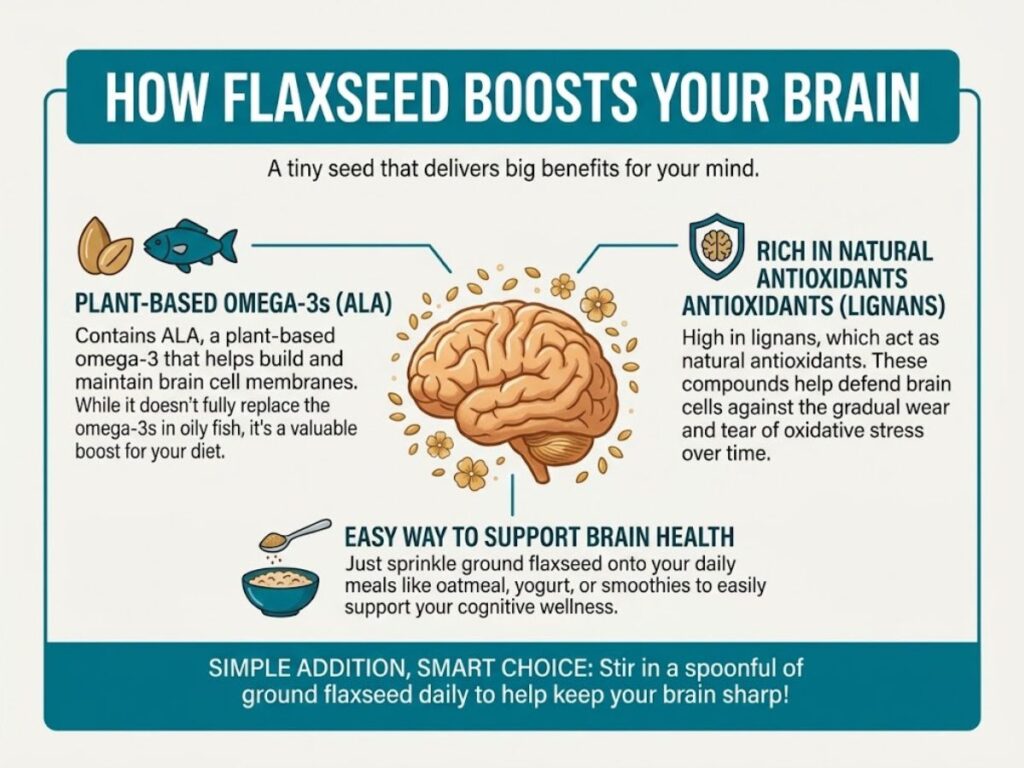
The ALA in flaxseed is in the same family as the omega-3 fatty acids you get in oily fish. Linda Van Horn, PhD, RD, a professor of preventive medicine at Northwestern University, told American Heart Association News that the ALA in flax can “convert to omega-3 fatty acids typically found in fish.” But the plant form converts to the long-chain omega-3s (EPA and DHA) at a much lower rate.
It’s not a replacement for salmon or sardines if those are already in your diet, but it can still contribute if they aren’t, and the brain uses omega-3s to build and maintain the fatty membranes of its cells.
Flax also contains lignans, plant compounds with antioxidant activity. “Flaxseed contains a high percentage of lignans,” says Alison Massey, MS, RD, a clinical dietitian and diabetes educator at Mercy Medical Center in Baltimore, speaking to Today’s Dietitian. Oxidative stress chips away at brain cells over the years, and foods that help the body manage it are worth having on hand.
Found this useful? Get more like it in your inbox as a Lifestyle Library Insider.
How Much Ground Flaxseed to Add to Oatmeal, and How Often
One to 2 tablespoons stirred into a bowl of cooked oats, once a day, is the sweet spot.
Start with 1 teaspoon if you’ve not eaten flax before, and work up over a week or two. Drink a full glass of water with breakfast.
Top Tip: Buy ground flaxseed in a vacuum-sealed bag or small container, and keep it in the fridge or freezer as soon as you open it. Flax oils go rancid faster than almost any other seed, and rancid flax tastes bitter and loses most of its benefits.
A bag in the freezer stays good for months; the same bag in a warm cupboard will be off within a few weeks.

Whole vs Ground Flaxseed, and What You Get Per Tablespoon
Ground flaxseed is the form you want on your oatmeal, because whole seeds have a shell tough enough to pass straight through you without giving up what’s inside. Kendra Haire, a registered dietitian nutritionist, puts it plainly: “It is best to use ground flaxseeds, as this allows more of their nutrients to be digested and available to the body.”
| Whole flaxseed | Ground flaxseed | |
|---|---|---|
| Digestibility | Shell passes through intact | Nutrients fully absorbed |
| Best use on oatmeal | Not recommended | Stir in after cooking |
| Shelf life once opened | Months in a cool cupboard | Weeks in the cupboard, months in the fridge or freezer |
| Prep | Grind in a coffee grinder before use | Ready to use straight from the bag |
One tablespoon of ground flaxseed (about 7 grams) gives you roughly 37 calories, 2 grams of fiber (about a third of it soluble), 3 grams of fat including 1.6 grams of ALA omega-3, and 1.3 grams of protein, along with a useful dose of lignans, manganese, magnesium, and thiamin.
Two tablespoons, the top end of what dietitians suggest for a daily bowl, puts you at around 4 grams of fiber and 3.2 grams of ALA before you’ve eaten anything else.
Simple Ways to Use Ground Flaxseed in Oatmeal
Stir the flax in after your oats are off the heat, not before. Cooking it isn’t dangerous, but prolonged heat can damage some omega-3s, and it offers no benefit.
If you don’t want to grind your own, a bag of pre-ground flaxseed from the grocery store is fine. If you’d rather grind it fresh, a cheap coffee grinder does the job. Grind a small jar’s worth at a time and keep it in the fridge.
Recipe Card: Ground Flaxseed Oatmeal
- Yield: 1 serving
- Prep time: 5 minutes
- Cook time: 5 minutes
- Additional time: None
Ingredients
- 1/2 cup dry rolled oats
- 1 tablespoon ground flaxseed
- 1 handful of berries
- a few chopped nuts
- 1 splash milk
Instructions
- Cook the 1/2 cup of dry rolled oats according to the package directions.
- Take the oats off the heat before adding the flax, since prolonged heat can damage some of the omega-3s.
- Stir the 1 tablespoon of ground flaxseed into the cooked oats.
- Top the bowl with a handful of berries and a few chopped nuts.
- Finish with a splash of milk and serve.
Frequently Asked Questions
Can You Eat Flaxseed on Oatmeal Every Day?
Yes. Dietitians suggest 1 to 2 tablespoons of ground flax a day, and my daughter ate it this way every morning for years when she was skating. If you don’t eat much fiber at the moment, start with a teaspoon and add a bit more each week. Have a big glass of water with your bowl, too. If you take blood thinners or thyroid medication, or you’re pregnant, ask your doctor before you make it a daily thing.
Should You Use Whole or Ground Flaxseed on Oatmeal?
Use ground flaxseed on oatmeal, not whole. Whole flaxseeds have a hard shell that passes straight through you without releasing much of what’s inside. Grinding them lets your body absorb the fiber, omega-3s, and lignans. “Eating ground flax seeds gives you more benefits than whole seeds,” says Victoria Taylor, a registered dietitian at the British Heart Foundation.
When Should You Add Flaxseed to Oatmeal, Before or After Cooking?
Add flaxseed to oatmeal after cooking, not before. The oats retain enough heat to warm the flax through once they’re off the stove, and prolonged cooking can damage some omega-3 fatty acids. Stir in 1 to 2 tablespoons once the oatmeal is in the bowl.
How Should You Store Ground Flaxseed So It Doesn’t Go Rancid?
Store ground flaxseed in the fridge or freezer in a sealed container as soon as you open the bag. Flax oils go rancid faster than almost any other seed, and warm cupboard storage can make it bitter within a few weeks. In the freezer, a bag stays good for several months.
About this article: Our health articles are based on published studies and advice from experts such as physiotherapists and dietitians, and the sources are linked in the article.
Disclaimer: The content in this article is for informational purposes only and is not intended to replace professional medical or nutritional advice. Always consult your doctor or a registered dietitian before making significant changes to your diet, particularly if you have a health condition, a food allergy, or take medication. This article may contain affiliate links.
Become a Lifestyle Library Insider
Health tips, money know-how, travel deals and garden ideas for life after 50, straight to your inbox.

Kylie Lang is a nationally syndicated travel journalist with bylines on the Associated Press Wire & more, a lifestyle writer, and the founder and editor of Your Lifestyle Library (yourlifestylelibrary.com). She holds a BA (Honours) in History from the University of Kent and is a member of the British Guild of Travel Writers.