
I took this test a few weeks ago to discover my biological age and was more than a little disgruntled at my results, though I shouldn’t have been, really, because all the signs were there. The problem is, you reach a certain age, and things stop working the way they used to.
It takes you a second to get your balance if you get up too quickly, things ache that didn’t before, and getting up off the floor from a sitting position is nigh on impossible without looking decidedly ungainly. I even have a bloody garden kneeler for weeding! Seriously, I’ve turned into my mother overnight.
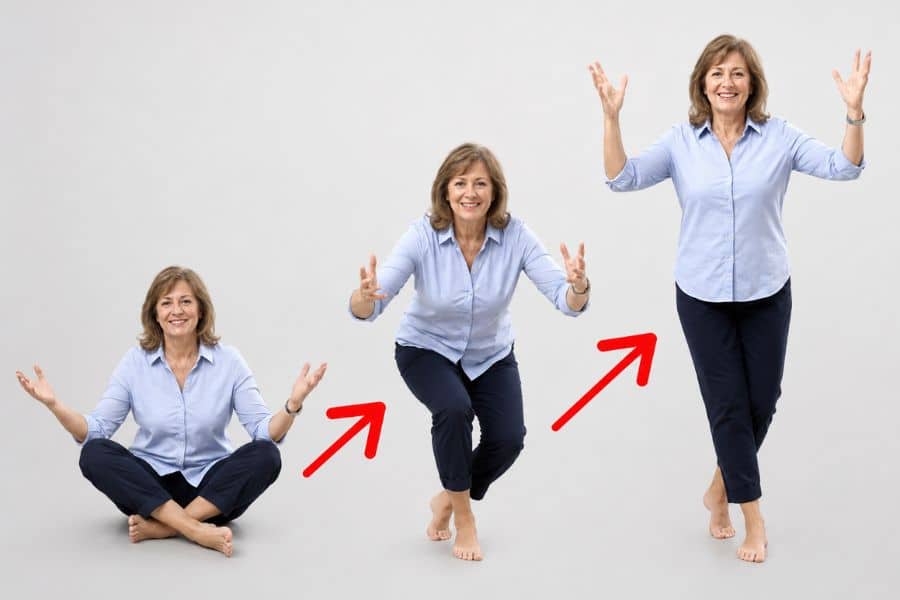
Anyway, I digress. The test is called the sitting-rising test, and the basic idea is simple enough. You lower yourself from standing all the way down to sitting on the floor, and then you get back up again, and you try to do both with as little help from your hands, knees, and forearms as possible. That’s it.
What’s the point? Well, the way your body handles getting up and down off the floor tells you quite a bit about your long-term health. If you ever wondered what your true biological age is, then this is the test to take.

What Is the Sitting-Rising Test?
The sitting-rising test was developed back in the 1990s by Brazilian sports medicine doctor Dr. Claudio Gil Araujo. It measures several things at once, things that tend to decline with age and that most of us don’t think to test until something goes wrong. Sounds rather familiar, doesn’t it?
In order to get a good score, your body needs to pull together leg and core strength, hip flexibility, balance, and what researchers call neuromuscular coordination, which is basically how efficiently your nervous system and your muscles are talking to each other.
Those are four different systems working in harmony, and the test immediately exposes any weak link in the chain.
A study followed 4,282 adults aged 46 to 75 over a median of 12 years and found a pattern. People who scored a perfect 10 had a death rate of 3.7% over that period. Those who scored an 8 saw that figure triple to 11.1%. Those in the lowest scoring group, 0 to 4, had a death rate of 42.1% and a risk of cardiovascular death six times higher than the top scorers.
And those figures accounted for age, sex, body weight, and existing health conditions.
That’s why the test is described as a biomarker of aging rather than just a fitness test. It’s measuring how well your body’s systems are aging together.
How To Take the Test
Find a clear, flat, non-slip space. Remove your shoes. Starting from standing, cross your legs and lower yourself all the way down to sitting on the floor, then rise back up to standing. Do both movements using as little help as possible.
You start with a score of 10, five points for sitting down and five for getting back up. Each time you use a hand, knee, forearm, or side of leg for support, you lose one point. Half a point comes off for wobbling or loss of balance at any point. A hand on your knee counts as a full-point deduction. Crossing your legs is allowed and costs you nothing. Thank God there is one thing that won’t deduct points.
A perfect 10 means down and back up, smooth and steady, with nothing touching the floor except your feet. If your score doesn’t end up being lower than you thought it would be, I’ll be surprised. Less than 8% of adults over 55 achieve a perfect 10, so if yours was lower than you hoped, you’re in very large company.
What Your Score Tells You
A score of 8 or above is considered a good result and is associated with a low mortality risk in the research. Below 8, and the risk profile starts to shift, so that’s the number worth aiming for if you’re currently sitting under it.
If your score was low, it helps to think about where exactly things went wrong rather than just feeling disheartened and beating yourself up over it. Were your hips feeling tight or restricted as you tried to lower yourself? Was it your leg strength, finding your muscles couldn’t quite control the descent, or push you back up without help? Was it balance, a wobble, or a lurch at any point? Or was it simply that the movement felt unfamiliar, because your body hasn’t been asked to do it in years?
How To Improve Your Score
In all honesty, the best thing you can do to improve your score is to simply spend more time on the floor. Not necessarily exercising on the floor, just being down there. Stretching, reading, whatever. Every time you lower yourself down and get back up, you’re practicing the movement pattern and reminding your body that it knows how to do this.
Beyond that, there are specific things worth targeting depending on where your score fell apart.
Hip flexibility
Tight hips are one of the most common culprits, particularly for people who sit for long periods during the day. A simple hamstring stretch, lying on your back with a towel or strap looped around one foot and gently drawing the leg toward you, held for 30 seconds each side, is a Harvard-recommended starting point that directly addresses one of the main flexibility limiters in the test.
Leg strength
Stationary lunges are particularly useful here because they build leg strength and balance simultaneously. Standing with one foot ahead of the other, you lower your torso straight down until the front thigh is roughly parallel to the floor, then return. Five to ten reps each side, two to three sets. A counter or wall nearby for balance support is completely fine to start with.
Core strength
Who doesn’t need to strengthen their core? I know I do, and a basic plank, held for as long as you can maintain good form, builds the stability that controls both the descent and the ascent in the test. Even 20 or 30 seconds repeated a few times through the day adds up more than you’d think.
Balance
My daughter was a competitive figure skater, and so I started skating years ago as a form of exercise, as I spent so much time at the rink. Balance was a massive part of being able to skate, and there was one move called the spiral that I had perfected but now can’t see to do even stationary.
A spiral is basically where you stand on one leg with your other leg stretched out behind you. It looks lovely, and you go in a spiral motion around the rink.
All that to say, standing on one leg is a helpful thing to do in order to get your score higher. Do it while you’re cleaning your teeth or waiting for the coffee machine to do its thing. Once that starts to feel easy, try it with your eyes closed. You’ll be amazed how that ups the ante.
The Movement Pattern Itself
Sometimes the issue is less about strength or flexibility and more about the fact that your nervous system simply hasn’t been asked to do this movement in a long time. Practicing the sit-to-floor-and-back movement regularly, slowly, and with control, teaches your body what’s being asked of it.
Yoga and tai chi are both great for helping with improving your flexibility, balance, and body awareness, which the test draws on. So don’t panic, all is not lost, and, like most things, practice makes perfect.
Disclaimer: This article is for general informational purposes only and is not a substitute for professional medical advice. If you have any existing joint problems, balance issues, arthritis, or recent injuries, consult your doctor or a physical therapist before attempting the sitting-rising test or beginning any new exercise routine.