
You know the feeling. You went to bed at a reasonable hour, drifted off within minutes, and then some invisible switch flips at 3:14 AM, and you’re wide awake, staring at the ceiling, doing the mental math on how many hours you’ve got left before the alarm goes.
I’m in my 50s, and I can tell you this has become my most reliable overnight routine. The falling asleep bit is fine; it’s staying asleep that’s causing the problems. It’s so frustrating because I used to be such a good sleeper, getting a good 8 hours a night. Now I’m lucky to get five.
I’ve tried so many things, from spraying my pillow with a sleep mist to lying with my legs up the wall for 10 minutes before going to bed because I’d read on a forum this would help. It didn’t, so I started looking for other alternatives that would help with sleep after 50.

What’s Really Going On With Sleep After 50
Your body has a master clock, and over the decades it starts to lose some of its sharpness. The clean line between daytime alertness and nighttime drowsiness gets a bit blurred, so the signals your body sends about when to be awake and when to be sleepy aren’t as defined as they used to be.
The other thing that changes is the shape of your sleep itself. You spend less time in the deep, slow-wave stages and less time in REM, and more time bobbing around in the lighter stages where you’re much easier to wake up.
So a car door slamming, your partner turning over, a full bladder, a random dream, any of it can pull you back to the surface where in your 30s you’d have slept straight through.
Waking briefly during the night is a normal, ancient pattern. Our ancestors did it. The waking itself isn’t the problem. The problem is what happens next, when you can’t drop back off, and you lie there for 90 minutes cataloging every worry you’ve ever had.
That’s the bit that wrecks the next day, and that’s the bit we can actually do something about.
Fix 1: Get Outside in the Morning

This is the simplest and most powerful thing you can do to help your sleep patterns. Getting your eyes on real outdoor light within about an hour of waking sends a firm signal to your body clock: it’s morning, start the countdown.
Roughly 16 hours later, that countdown ends with a natural melatonin release, and you get sleepy. I’ve started doing this for the last six weeks, which is easy because it’s summer and the weather is fab. How well it will go when winter hits is another matter.
Why does it work? Well, your kitchen ceiling light, for example, is at or below 500 lux. A cloudy morning outside is often 10,000 lux or more, and a sunny one is many multiples of that. Your circadian clock is calibrated to daylight, not to a light fixture.
Stand on the back step, walk to the mailbox, drink your coffee in the yard, put a coat over your pajamas if you have to. 10 to 15 minutes of real outdoor light is the fix, and it works on gray days too.
Fix 2: Let Your Body Cool Down Before Bed

Your core temperature drops slightly as you fall asleep. It’s part of the signal that tells your brain to switch modes. As we get older, the blood vessels that manage that cooling process aren’t quite as responsive, so the drop can be delayed or muted, and you end up lying there feeling warm and alert when you should be drifting off.
The counterintuitive fix is a warm shower or bath about 90 minutes before you want to be asleep. Warming up dilates your blood vessels, so when you step out, your body sheds heat quickly, and your core temperature drops faster than it would otherwise.
The other half of this is your bedroom. Somewhere between 60 and 67 degrees Fahrenheit is the range most sleep specialists point to. That feels cold when you first climb in, and warm enough once you’re under the covers. A stuffy bedroom is one of the main reasons for restless sleep after 50, and it’s an easy one to adjust with a thermostat and a window.
I’m up on the third floor in our house, and with the brutal summer we’ve had this year, it’s been beyond hot, so I caved and installed aircon, and it’s made such a difference.
Fix 3: Sort Out Your Fluids and Your Dinner

Getting up to use the bathroom at 2 AM is one of the biggest reasons sleep gets fragmented after 50. Pelvic floor changes, prostate changes, medications, all of it stacks up, and even one trip can be enough to jolt you into that wide-awake state you can’t escape from.
A useful rule is to front-load your hydration. Most of your fluid intake happens in the morning and afternoon, and you taper things off about 2 hours before bed. You still stay properly hydrated. You just shift the timing so your bladder isn’t full at 3 AM.
Dinner is the other piece of the puzzle. Finishing a heavy meal 3 hours before bed gives your digestion time to settle, so you’re not dealing with low-grade reflux or an elevated heart rate while trying to sleep.
A late, rich dinner with a glass of wine is a recipe for shallow, choppy rest, and I say that as someone who loves a late, rich dinner. I live in France, and mealtimes are long and late with wine. What can I say?
A simple set of rules:
- Hydrate mostly in the morning and early afternoon
- Stop drinking fluids about 2 hours before bed
- Aim to finish dinner 3 hours before you turn in
- Keep evening food on the lighter side if you can
Fix 4: Rethink Caffeine and That Evening Glass of Wine

Caffeine hangs around in your system longer than it used to. Your liver processes it more slowly with age, and the half-life roughly doubles compared with what it was in your 20s, which means the 3 PM coffee you thought was harmless is still very much on board at bedtime.
Even if you fall asleep, it makes your sleep lighter and more restless without you realizing it.
My advice is to say no to coffee after noon and switch to decaf, a herbal tea, or water. It does help; I’ve been doing it for about six weeks now, and I’ve noticed the difference.
A glass of wine in the evening does make you drowsy at first, which is why so many of us reach for it. The trouble comes in the second half of the night, when your liver metabolizes it, and the byproducts act as stimulants.
You wake up at 3 AM with your heart going, and you blame the sleep, when really you’re just meeting the wine on its way out. Treating alcohol as an occasional early-evening thing rather than a nightly wind-down will make all the difference, hard though it may be.
Fix 5: The 20-Minute Rule for the 3 AM Wake-Up
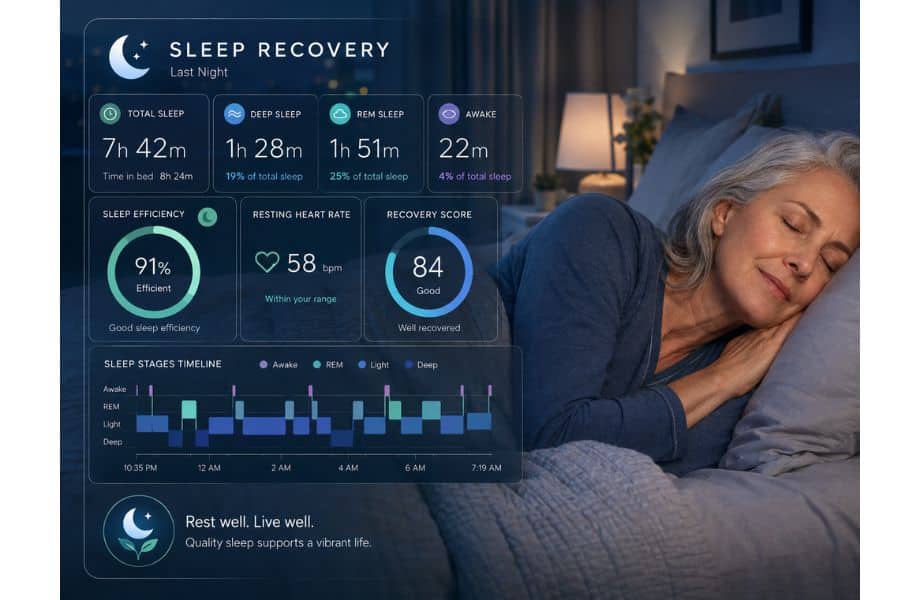
If you’ve been awake for about 20 minutes and you’re not drifting back off, don’t lie there. Get up. I know it sounds counterintuitive, but if your bed becomes the place where you spend hours awake and frustrated, your brain thinks of it as a place of stress rather than sleep.
Get up, go to another room, keep the lights low, and read a physical book. Reading always makes me tired, and I often end up reading the same sentence several times. The biggest thing, though, is to ignore your phone, don’t look at the clock, don’t turn on the television.
When your eyes start to feel heavy, wander back to bed. Some nights it takes 15 minutes, and other nights it takes an hour. Either way, you’re teaching your brain that the bed is for sleeping, and that the 3 AM wake-up is just a short blip.
I now keep a dim bulb in the landing light just outside the bedroom, so I’m not blasting myself with a bright light the minute I get up.
Fix 6: Move Your Body During the Day

There’s a chemical called adenosine that builds up in your brain during your waking hours, and it’s part of what creates the pressure to sleep at night. The more you use your body and brain during the day, the more adenosine accumulates, and the deeper your sleep tends to be.
After 50, and especially after retirement or a shift to more sedentary work, many of us simply aren’t moving enough to build up that pressure, and our sleep becomes shallow as a result.
30 minutes of moderate movement does the trick. A brisk walk, some resistance work, gardening that actually gets you sweating, whatever fits your life.
One caveat: try to finish anything vigorous at least 3 hours before bed. Late-evening workouts can raise your core temperature and rev your nervous system when you’re trying to wind it down. Morning or afternoon movement is where the sleep benefit really shows up.
The Wind-Down Timeline That Actually Works
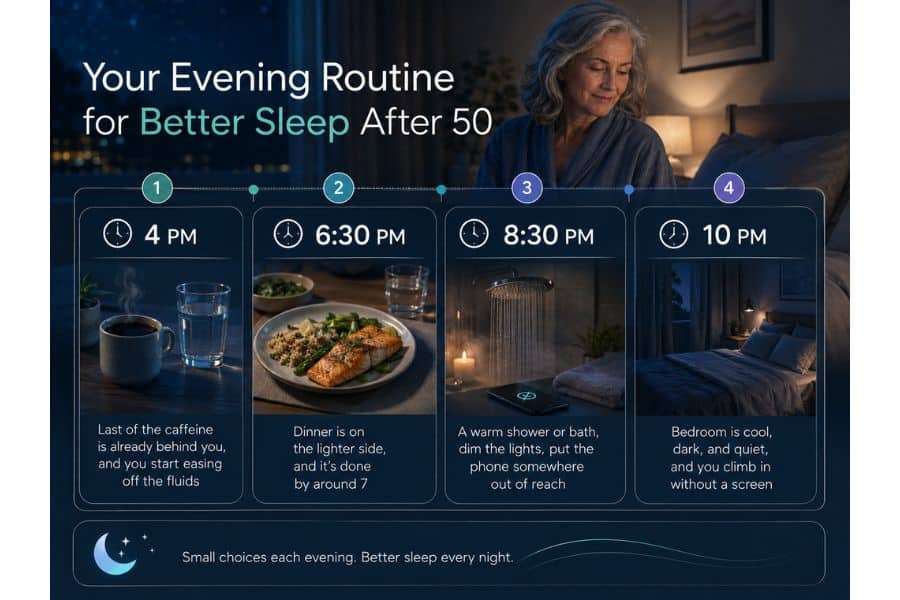
A piece of advice my doctor gave me was to stop trying to make my body switch from awake to asleep in 10 minutes flat. Instead, give it time to get used to the fact you’re going to sleep. Start to gradually slow things down from about 4 PM onward, so that by the time your head hits the pillow, your body is ready for it.
- 4 PM: last of the caffeine is already behind you, and you start easing off the fluids
- 6:30 PM: dinner is on the lighter side, and it’s done by around 7
- 8:30 PM: a warm shower or bath, dim the lights, put the phone somewhere out of reach
- 10 PM: bedroom is cool, dark, and quiet, and you climb in without a screen
The other thing worth knowing is that your morning wake-up time matters more than your bedtime for keeping the whole system stable. A consistent morning anchor pulls everything else into place over time, so if you’re going to pick one thing to hold steady, hold that one steady, and let bedtime drift a little if it needs to.
Disclaimer: The content in this article is for informational purposes only and is not intended to replace professional medical advice, diagnosis, or treatment. Always consult your doctor, physical therapist, or healthcare provider before starting a new exercise program, particularly if you have existing joint, cardiovascular, or balance conditions.

Kylie Lang is a nationally syndicated travel journalist with bylines on the Associated Press Wire & more, a lifestyle writer, and the founder and editor of Your Lifestyle Library (yourlifestylelibrary.com). She holds a BA (Honours) in History from the University of Kent and is a member of the British Guild of Travel Writers.