
I’m sure you’ve noticed how your mood changes when the sun comes out and throws its happy rays over everything. Well, it’s a bit like that when you visit these nine gorgeous places. The colors of the buildings have the same effect.
You can’t help but smile when you see them, and you’d be forgiven for thinking you’d stepped into a painting. Just like in Mary Poppins, when Bert, the chimneysweep takes Mary and the children into his painting, and another world appears before their eyes. It’s absolute magic.
Luckily, there’s no need for magic or Mary Poppins to step into these towns and villages. The colors simply pop and are a feast for the eyes. I have only one word: they’re Supercalifragilisticexpialidocious.

9 of the Most Colorful Places in Europe
If it’s color you’re looking for, you’ll find it in these nine European hotspots. They’re simply breathtaking to look at, and the history and stories behind them are pretty cool, too.
Tirana, Albania
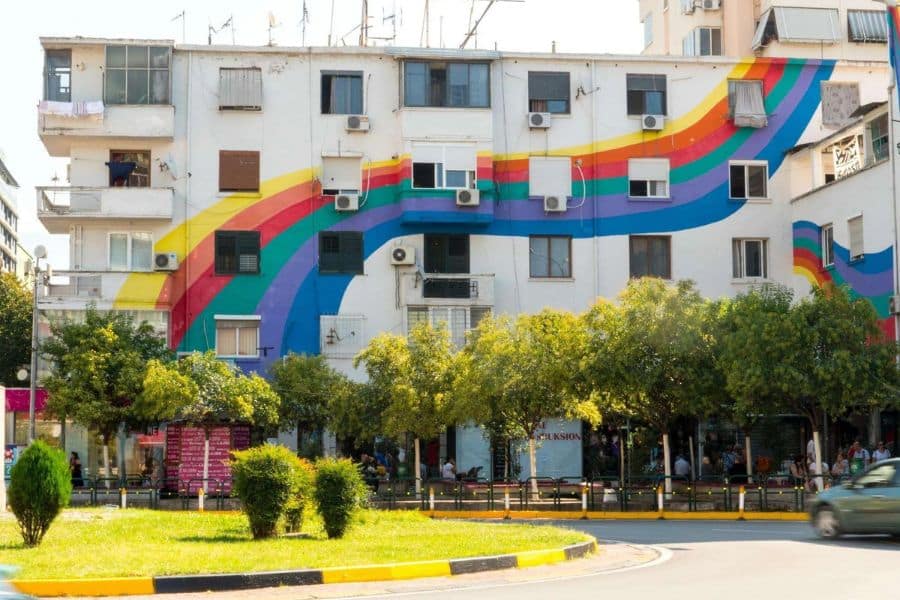
In 2000, artist and mayor Edi Rama began painting Tirana’s gray Soviet-era apartment blocks without the building owners’ permission. He used public funds meant for other projects and covered entire facades in wild stripes, polka dots, and clashing patterns that looked more like modern art installations than government housing.
The Communist dictatorship had fallen a decade earlier, leaving behind hundreds of identical concrete blocks that had turned the city into a sea of depression-inducing gray. Rama figured color was cheaper than demolition. He got death threats from residents who hated seeing their buildings turned into what they called “circus tents.”
But something unexpected happened. Crime dropped in the painted neighborhoods. People started taking care of the streets around the colorful buildings, and shop owners opened businesses in areas they’d previously avoided. The project that began as one man’s controversial vision ultimately changed how the entire city saw itself.
Poznan, Poland

The merchants who built Poznan’s Old Market Square in the 13th century competed to make their houses taller and more ornate than their neighbors. Each facade told you exactly how wealthy and important the owner was. The Renaissance brought Italian architects who added arcaded loggias and elaborate decorative details.
Then World War II destroyed about 90 percent of the historic center. The Communist government, after the war, faced a choice. Rebuild the square exactly as it was, or replace it with modern socialist architecture. They chose reconstruction, using old paintings and photographs to recreate the Renaissance facades down to the smallest detail.
The colors you see today on those tall, narrow townhouses aren’t original to the medieval period. They’re based on what paint researchers found under layers of later additions when they studied the few buildings that survived the bombing. Each owner picked their shade from an approved palette meant to recreate how the square looked in its 16th-century glory days.
Burano, Italy
Burano’s government created a color system in the 16th century that’s still enforced today. If you want to paint your house, you submit a request to the local authority. They consult a register listing the specific colors permitted for your building. You can’t just pick any shade of blue or yellow you like.
The system started because the island’s main industries were fishing and lace-making. Fishermen’s wives needed to supplement their income during slow seasons, so they stayed home making lace while their husbands were at sea.
The story about fishermen painting houses in bright colors so they could be seen through the fog is romantic but probably not true. More likely, the colors were about property boundaries and family identification in a place where many people had the same surnames.
The lace industry made Burano wealthy in the 17th and 18th centuries. Burano lace was so prized that it adorned the clothes of European royalty. That wealth paid for the well-maintained houses you see today. When the lace industry collapsed in the early 1900s due to competition from machine-made lace, the island fell into poverty. The painted houses stayed because nobody could afford to change them.
Stockholm, Sweden

Gamla Stan sits on an island where Stockholm was founded in 1252. The medieval merchants built their houses close together to fit as many buildings as possible onto valuable land near the harbor. The narrow streets weren’t designed for charm. They were the result of cramming commerce into a limited space.
The colors came much later. In the 17th and 18th centuries, wealthy merchants began covering their wooden and stone houses with stucco and painting them in colors that signified their status, as in Poznan. Ochre and rust were derived from iron oxide pigments, which were cheap and readily available in Sweden. The deeper, richer shades of terracotta and gold required more expensive pigments, so only the wealthiest families could afford them.
Swedish law required property owners to maintain the exteriors of their historic buildings in accordance with strict heritage guidelines. That’s why the color palette hasn’t changed much in 300 years. Building owners can’t just decide to paint their house bright pink or electric blue. They have to choose from colors that match the historical period of their building.
Júzcar, Spain

Sony Pictures offered the 221 residents of Júzcar 70,000 euros in 2011 to paint their white Andalusian village Smurf blue for the premiere of their new movie. The deal included repainting everything back to white after the promotion ended. Village residents voted to approve the temporary makeover.
The premiere brought international attention to a place that had never seen tourists. After Sony left and the contract expired, the villagers held another vote. They decided to stay blue. Tourism had increased by 300 percent in just a few months. Buses full of visitors arrived daily in a village that had maybe seen a dozen outsiders per year.
Not everyone was happy about it. Some residents hated living in a blue village and felt like they’d sold out their heritage for tourist money. Others argued that the white villages of Andalusia are themselves relatively recent, painted white for practical reasons like reflecting heat and repelling insects. The debate split the tiny community. But the blue stayed, and so did the tourists.
Notting Hill, London
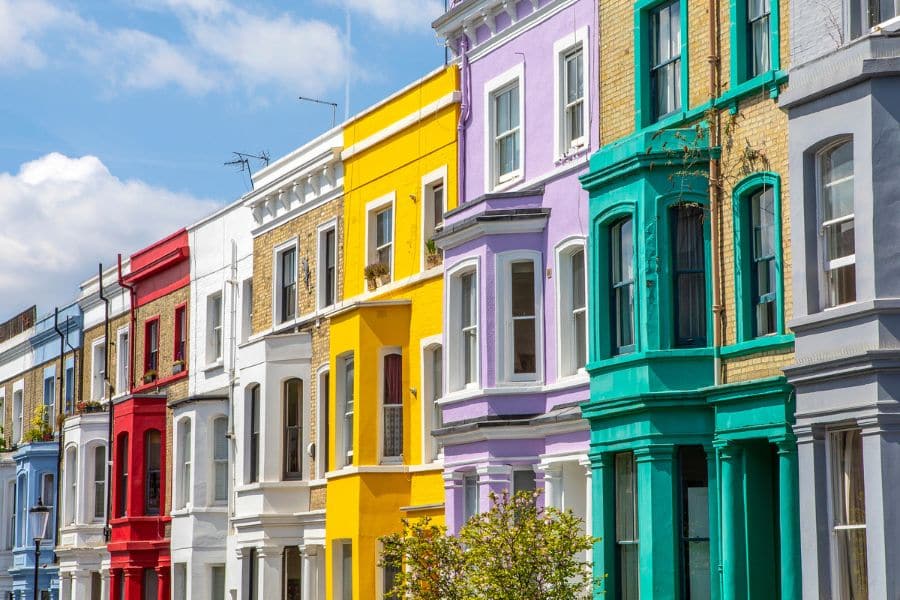
The Victorian houses in Notting Hill were built in the 1840s and 1850s as part of a planned development for wealthy London families. The original buildings were white stucco, uniform, and respectable. Nobody painted them in pastel colors back then. That would have been considered vulgar.
The neighborhood declined sharply after World War II. Large Victorian houses were too expensive for single families to maintain, so landlords divided them into cheap rental units. Notting Hill became one of London’s poorest areas, home to Caribbean immigrants who faced housing discrimination elsewhere in the city. The houses fell into disrepair.
In the 1970s and 1980s, young professionals started buying these run-down houses and renovating them. They painted the exteriors in the pastel colors you see today, inspired by similar houses in places like Charleston and San Francisco. It was part of making the neighborhood fashionable again.
The film “Notting Hill” in 1999, with Julia Roberts and Hugh Grant, cemented the area’s status as expensive and desirable. Now those same colorful houses that represented urban renewal sell for millions of pounds.
Colmar, France

Colmar changed hands between France and Germany five times between 1871 and 1945. Each time, the new rulers left their mark on the city’s architecture and culture. The half-timbered houses date back to the Middle Ages, when Colmar was a prosperous free imperial city in the Holy Roman Empire.
The timber-frame construction method was practical because wood was plentiful in the nearby Vosges Mountains, and it allowed builders to construct upper floors that jutted out over the street below. This gave families more living space without taking up valuable ground-level property. The gaps between timbers were filled with wattle and daub, then later plastered and painted.
Those painted colors have meaning. In medieval times, different colors indicated different trades. Butchers painted their houses red. Bakers used warm yellows. Tanners, who worked with leather and unpleasant smells, were required to live and work near the canals where they could dispose of waste, which is why La Petite Venise became the tanners’ quarter. The color tradition continued even after the guild system disappeared.
Alesund, Norway
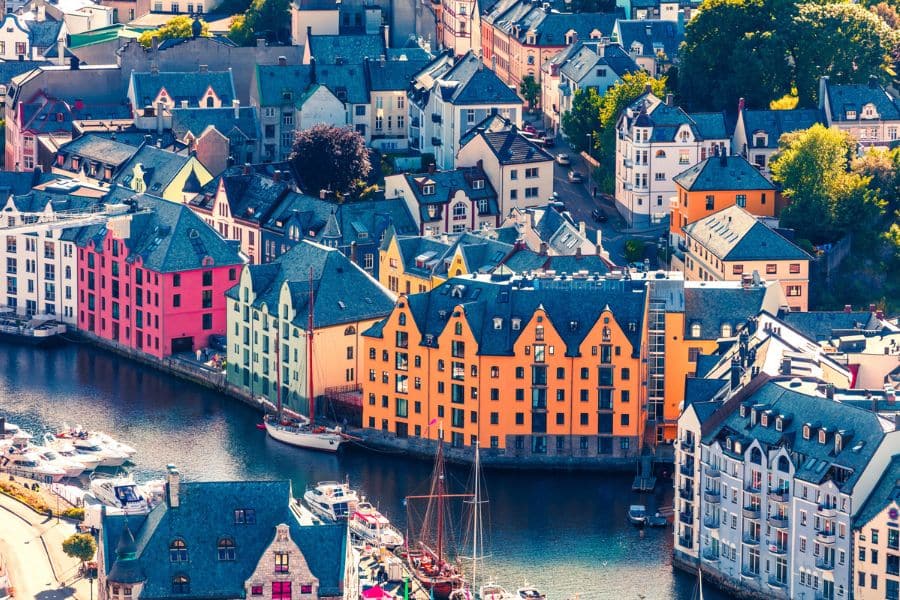
On January 23, 1904, a fire started in a warehouse and spread through Alesund’s wooden buildings. Strong winds turned the blaze into an inferno that destroyed 850 houses and left 10,000 people homeless in the middle of winter. Only one person died in the fire itself, but the aftermath was brutal.
Kaiser Wilhelm II of Germany, who vacationed on Norway’s fjords every summer, sent four ships loaded with construction materials to help rebuild. Norwegian architects saw an opportunity to create something new rather than just replace what burned. They banned wooden construction in the town center and designed an entire city in the Art Nouveau style then sweeping Europe.
Over 320 buildings went up in just three years. Young Norwegian architects who’d trained in Germany brought back the flowing lines and organic decorations of Jugendstil. They adapted the style to local conditions by using materials that could withstand harsh coastal weather. The colors came from traditional Norwegian paint pigments mixed with the softer pastels popular in Art Nouveau design across Europe.
Reykjavik, Iceland
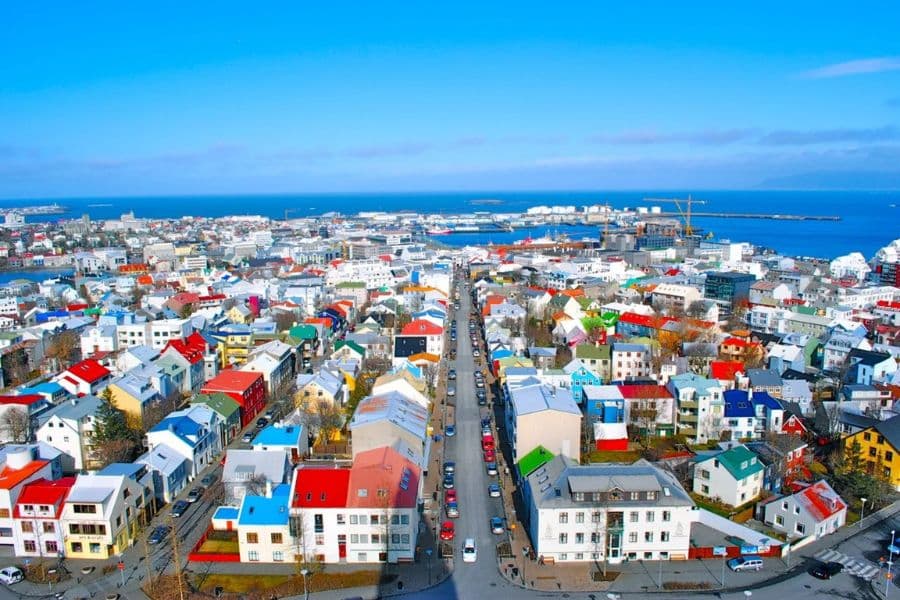
Iceland banned the import of timber in the 18th century to protect what little forest remained on the island. This created a construction problem. Trees don’t grow well in Iceland’s harsh climate, so builders needed an alternative to wood.
Danish merchants brought corrugated iron sheets to Iceland in the late 1800s. The material was cheap, lightweight enough to transport by ship, and could withstand Iceland’s brutal weather. Icelanders began covering their wooden houses with corrugated iron to protect them from wind and rain. Eventually, they built entire houses from it.
The bright paint colors served a practical purpose. Unpainted corrugated iron rusts quickly in Iceland’s wet, salty coastal air. Paint protects the metal and extends the life of buildings. Red paint was cheapest because it was made from iron oxide, the same rust the paint was meant to prevent. Other colors cost more, which is why you can still tell which families had money by looking at their house colors. Blue and green paints required imported pigments that only wealthier families could afford.
The colors you see in these European cities tell stories about wealth, politics, survival, and identity. Paint wasn’t just decoration. It was protection, advertisement, defiance, or regulation, depending on where and when it was applied. Those bright facades that look so pretty in photos represent real decisions made by real people dealing with fires, wars, poverty, and changing governments.
Some of these places deliberately painted themselves into tourist destinations. Others stumbled into fame and had to decide whether to embrace it or resist it. Either way, the paint stayed because enough people decided it was worth keeping.
Disclaimer: This article is for general information only and is not professional advice. It may contain affiliate links. Please see our full Editorial Policy for details.

Kylie Lang is a nationally syndicated travel journalist with bylines on the Associated Press Wire & more, a lifestyle writer, and the founder and editor of Your Lifestyle Library (yourlifestylelibrary.com). She holds a BA (Honours) in History from the University of Kent and is a member of the British Guild of Travel Writers.