
It’s taken a little bit of trial and error to get my hydrangeas to look good and give me beautiful blooms. I’ve made a few mistakes, killed them off completely by being a little too enthusiastic, and now, I finally know what I’m doing. I now know the things to do in March for healthy hydrangea.
What you do to your hydrangeas before spring is in full swing has a direct impact on how they perform for the entire summer. Miss this window, and you could spend all season waiting for flowers that never quite arrive.
The good news? These tasks are simple, and none of them requires a degree in horticulture. I learned these from my French neighbor, Claude, who knows exactly what he’s doing and has years of experience.
First, Know What Type of Hydrangea You Have
Before you touch a single stem, this matters more than anything else.
Some hydrangeas bloom on old wood. That means they set their flower buds the previous year. If you prune them hard in March, you are cutting away this summer’s flowers. Gone. Just like that.
Others bloom on new wood. They produce flower buds on fresh growth each spring, so you can prune them back without any worry.
The old-wood bloomers include Bigleaf hydrangeas (Hydrangea macrophylla, those classic blue and pink mopheads) and Oakleaf hydrangeas. The new-wood bloomers are Smooth hydrangeas (like Annabelle) and Panicle hydrangeas (like Limelight).
Not sure which one you have? Spend a season watching it. Note when it blooms and where the flowers appear. That one observation will save you years of frustration. Also, check out this guide on the various types of hydrangea.
5 Things To Do In March For Healthy Hydrangea
If you want beautiful blooms, these five tips, courtesy of Claude, my French neighbor and farmer, will help you get started. Perfect for newbie gardeners.
Task 1: Check for Winter Damage

March is the time to give your hydrangeas a proper once-over after the cold months.
Look for stems that appear pale, almost bleached. They may feel hollow when you gently squeeze them. Some may have snapped during winter freezes. These stems are dead and won’t produce any leaves or flowers this season.
You can confirm a stem is dead with the scratch test. Use your fingernail or a pocketknife to lightly scratch the stem’s surface. Green underneath means it’s alive. Brown and dry means it’s gone.
Remove any dead stems by cutting them down to ground level. There’s no point in leaving them; clearing them out gives healthy growth room to come through.
Task 2: Prune Correctly Based on Your Variety

This is where most gardeners go wrong.
If you have a Smooth hydrangea (Annabelle) or a Panicle hydrangea (Limelight, Bobo), March is your window to prune. These bloom on new wood. You can cut them back hard, even close to the ground, and they will shoot up fast and flower beautifully by summer. If the idea of cutting them that low makes you nervous, removing one-third of the plant is a safe starting point.
If you have a Bigleaf or Oakleaf hydrangea, put the pruners down. Do not prune in March. These bloom on last year’s growth. The flower buds are already sitting on those stems right now, waiting for warmer weather. Cut them, and you will have a summer of green leaves and absolutely nothing else.
For Bigleaf varieties, the only pruning needed in March is removing any dead stems (identified above) and cutting off last year’s dried flower heads. To deadhead correctly, cut just above the first visible bud below the old flower. That bud is where this year’s bloom will come from.
Task 3: Feed Them the Right Way

Think of March fertilizing as waking your hydrangeas up with a proper breakfast rather than a sugar rush.
A balanced granular fertilizer with equal parts nitrogen, phosphorus, and potassium works well. Look for a 10-10-10 blend. Apply it in early spring as new growth starts to appear, following the package instructions for quantities.
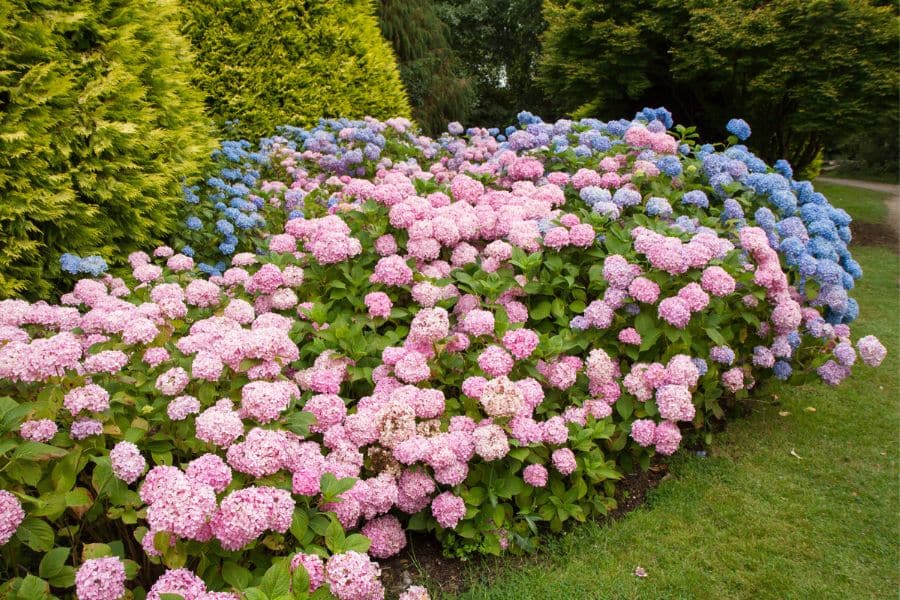
One thing worth knowing: if you want blue or purple blooms on your Bigleaf hydrangeas, your soil needs to be on the acidic side with a pH below 6. Aluminum in acidic soil is what creates those blue tones. In neutral or alkaline soil, the same plant will produce pink flowers. You can add soil acidifiers or aluminum sulfate to shift the pH if you want to influence the color.
Always water your hydrangeas well after applying fertilizer. This moves the nutrients down into the root zone where they are actually needed.
Task 4: Refresh the Mulch

This one takes about twenty minutes and pays off all summer long.
Clear away any old mulch, fallen leaves, and debris from around the base of your plants. Winter mulch can harbor pests and fungal issues if left to sit, so starting fresh is a smart move.
Then apply a new layer of organic mulch, around 2 to 3 inches deep. Keep it a few inches away from the actual stems. Piling mulch against the woody stems creates a damp environment that encourages rot.
Fresh mulch does several things at once. It retains soil moisture, regulates soil temperature as spring warms, and helps suppress weeds around your plants.
If you want to give the soil a boost at the same time, you can mix in a little fresh compost when you refresh the mulch. Your hydrangeas will not complain.
Task 5: Start a Consistent Watering Routine

Hydrangeas have large leaves that lose moisture fast. They are not drought-tolerant plants, and after a dry winter, the soil around your shrubs may be drier than it looks.
In March, if you’re not getting regular rainfall, give your hydrangeas a drink on days when temperatures are well above freezing. You do not need to go overboard, but keeping the roots from drying out as they emerge from dormancy makes a real difference.
Once spring is underway and temperatures rise, aim to water deeply once or twice a week rather than little and often. Deep watering encourages roots to grow downward, resulting in stronger, more resilient plants.
Check the soil about 2 to 3 inches down. If it feels dry at that depth, it’s time to water.
One More Thing Worth Watching
If you live somewhere with unpredictable late frosts, keep an eye on the forecast. A sudden cold snap in late March or early April can damage the new buds that are just starting to emerge, particularly on Bigleaf hydrangeas.
If frost is forecast, a light covering of burlap or a frost cloth overnight can protect those new buds. It only takes a few minutes to put in place and could save your blooms for the entire season.
Get these five tasks done in March, and your hydrangeas will have everything they need to deliver a summer full of big, beautiful blooms that will make you the envy of the neighborhood.

Kylie Lang is a nationally syndicated travel journalist with bylines on the Associated Press Wire & more, a lifestyle writer, and the founder and editor of Your Lifestyle Library (yourlifestylelibrary.com). She holds a BA (Honours) in History from the University of Kent and is a member of the British Guild of Travel Writers.