
Right now, with the weather so blisteringly hot, I’m sorely tempted to give up on the whole garden. The grass has gone the color of straw, the flowers are wilting, and there’s another heatwave rolling in this weekend. I’m fighting a losing battle, and I know it.
So I’ve been daydreaming instead. And what keeps coming to mind is the idea of a little Japanese retreat. A calm, cool corner to sit in with a cup of tea, where nothing needs mowing, and nothing needs saving from the sun. Plus, the ceramic Buddha I’ve had for over 20 years would look wonderful sitting there.
A Japanese-style corner is one of the few gardens that actually thrives on neglect and heat. The classic dry garden, all gravel and stone and a few tough plants, barely needs watering, and they’re not as expensive as you might think. In fact, you can build one in a weekend for under a hundred dollars. Let me show you how.
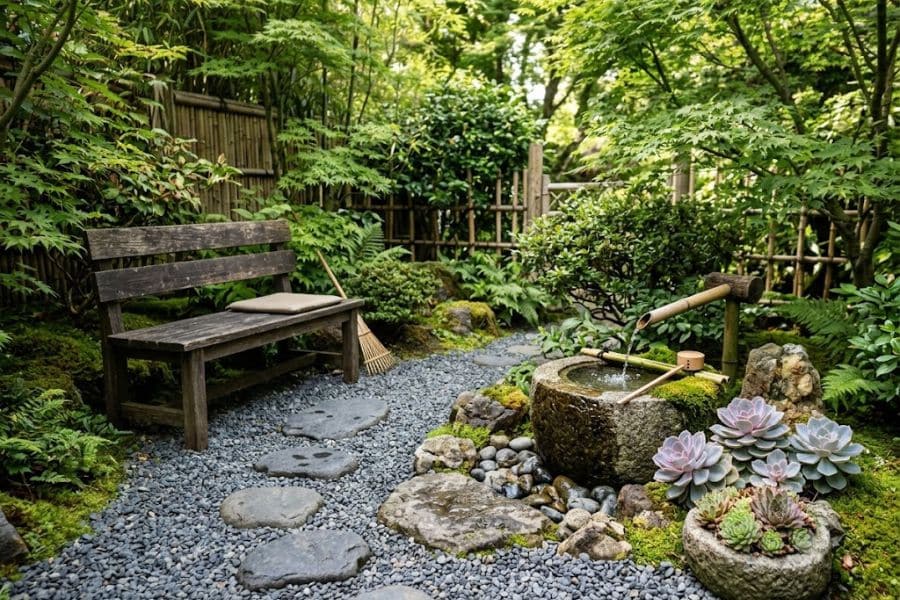
How To Create a Japanese-Style Retreat
This garden style is called karesansui, which translates as “dry mountain water.” Zen monks created these gardens centuries ago as places to sit and think, using raked gravel to suggest rippling water and carefully placed rocks to stand in for mountains and islands.
That’s exactly why it suits a summer like this one. While the rest of your yard is gasping, a gravel corner sits there cool and composed. It’s the anti-lawn, and after the June I’ve had, that sounds like heaven.
The key is to keep it simple and natural, so nothing looks planted in a straight line. And keep it still, meaning muted greens and greys rather than a riot of color.
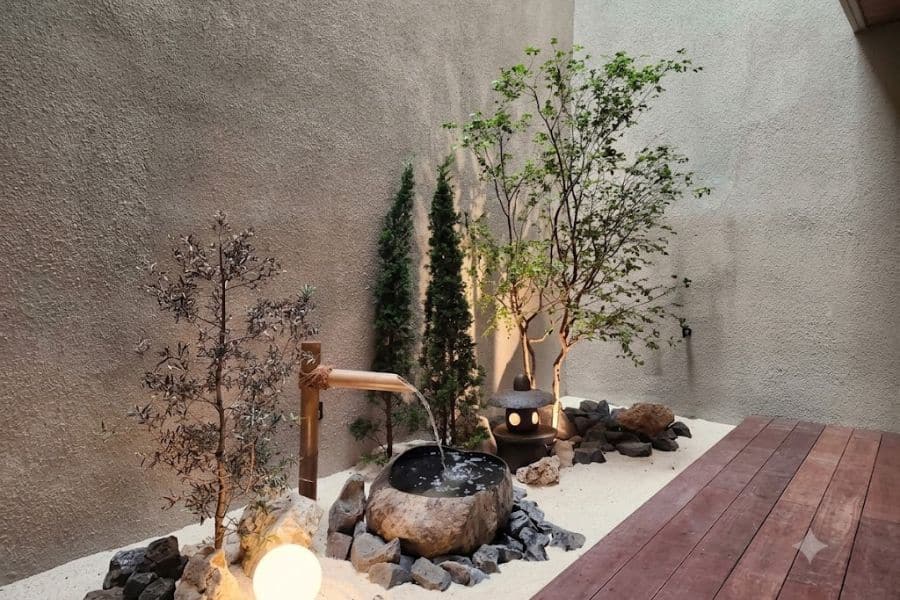
Step One: Choose and Clear Your Corner
Pick a shaded spot so you can happily sit there without frazzling in the heat. You don’t need much, just a patch of two or three square yards is plenty.
Clear it right back to bare soil, dig out the weeds, and rake it level. Do it early in the morning before the sun turns red hot.
Step Two: Lay the Gravel
Gravel is the heart of the whole thing, and it’s where most of your budget goes. Light-coloured gravel or fine pea shingle works beautifully. Dig your cleared patch down about four inches, lay a sheet of weed fabric so you’re not forever pulling up dandelions, then spread the gravel over the top.
A couple of bags will cover a small corner and cost you somewhere around $40. Rake it smooth, and then drag the rake in slow, curved lines around your stones to suggest ripples on water.
Step Three: Add Your Rocks
Rocks are the bones of the garden, standing in for mountains. The trick is to group them in odd numbers, threes or fives, with one larger stone as the star and smaller ones gathered around it like family.
For some reason, even numbers look too staged and curated, whereas odd numbers give it a more natural feel. Depending on what you have lying around, you might not need to buy these. Here in the Charente, where I live, there is an abundance of lovely stone. Plus, my neighbor Simon has loads I can use, and he’s happy for me to help myself, which is great.
Bed each one down so it sits solid and doesn’t wobble underfoot.
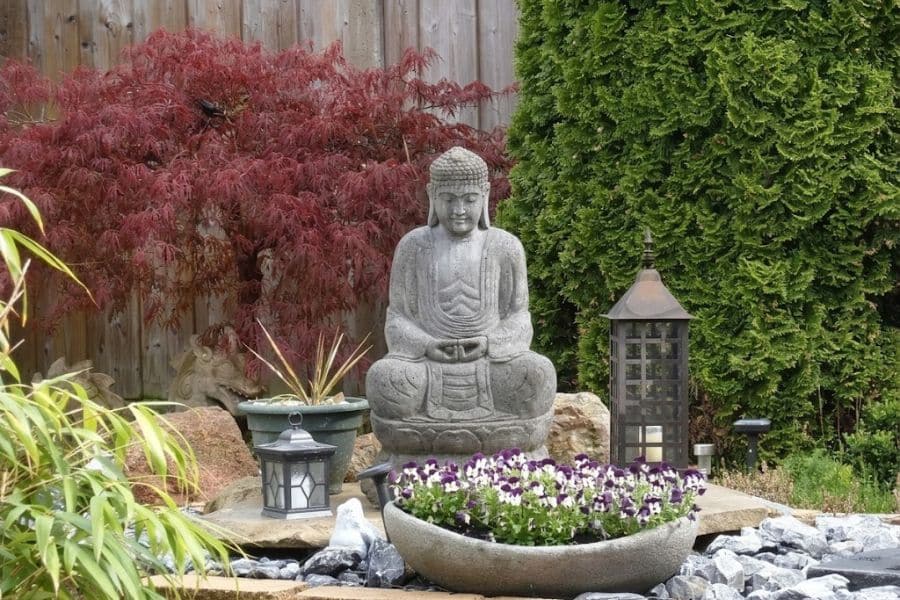
Step Four: Choose One Focal Point
Japanese gardens work by restraint, so you want one object that draws the eye, not ten competing for it. A small stone lantern, a simple water basin, or even a weathered pot on its side can do the job. For me, it’s my Buddha who, for some unknown reason, is called Bernard.
Actually, Bernard is very well traveled as he started life in Australia, came with me to America, then to England, and now he’s happily living the good life in France.
Don’t buy new for any of this if you can help it. Thrift stores, yard sales, and secondhand marketplaces are full of these, and you can usually pick one up for ten or fifteen dollars.
The more weathered and imperfect, the better. That gentle, worn look has a name in Japan, wabi-sabi, the beauty of things that are aged and unshowy.
Step Five: Add a Few Tough, Drought-Proof Plants
Here’s where you resist the urge to fill the space. A Japanese corner wants a light touch, three or four plants at most, chosen for shape and calm rather than color.
Reach for things that shrug off a heatwave. Mondo grass and blue oat grass give you that lovely fountain shape and cope with dry spells once they’re settled.
A dwarf conifer or a small evergreen shrub gives you year-round structure. If you have a shadier nook, a little Japanese maple is glorious, though it wants shelter from the fierce afternoon sun or the leaves scorch.
For more ideas that survive on next to no water, my roundup of hard-to-kill plants for lazy gardeners is full of tough plants that would sit happily in a corner like this. Reckon on around fifteen dollars for a few starter plants.
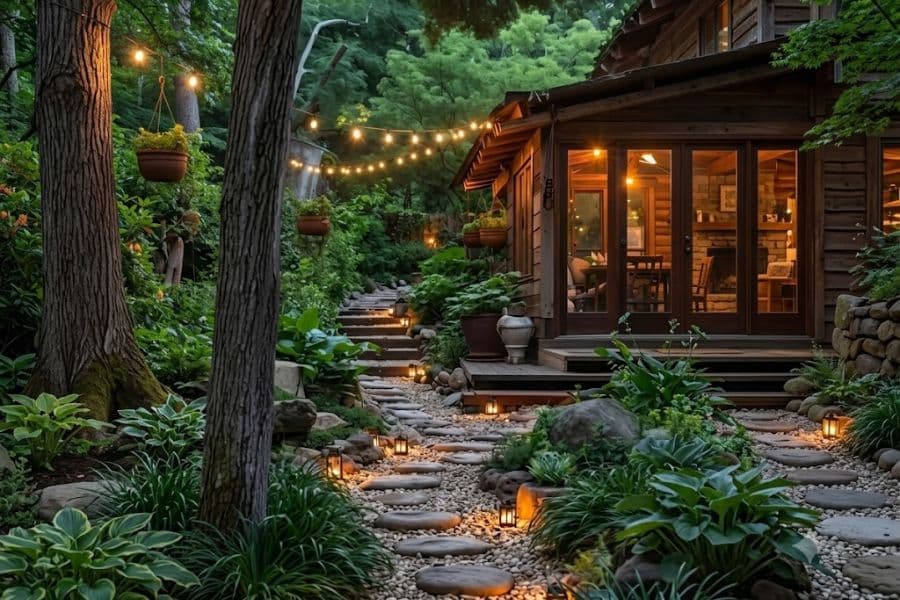
Step Six: Give Yourself Somewhere to Sit
None of this matters if you can’t enjoy it, so find a perch. A simple wooden bench, an old stool, or a flat-topped boulder all work. If you’re overlooked and want a bit of privacy, a roll of bamboo screening fixed to the fence costs about twenty dollars and instantly hides the neighbor’s shed and wraps the corner in a bit of hush.
Add a lantern with a real candle or a cheap solar light if you want to sit out as the evening cools, which in this heat is the only civilized time to be outdoors anyway.
The Budget, Roughly
Here’s how a small corner comes together for under a hundred dollars:
- Gravel: around $40
- Rocks and stepping stones: free to $15 if you scavenge
- A focal lantern or basin, thrifted: around $15
- Bamboo screening: around $20
- A few drought-proof plants: around $15
That brings you to right around the hundred mark, and less if you’re a good scavenger. Spend more only where you want to, on a nicer lantern or a proper bench down the line.
The Real Payoff
What you’re really building is a spot to sit and do nothing. Ten quiet minutes with a cup of tea and no phone does more good than we give it credit for, and pottering in a garden is one of the everyday habits linked to a longer, calmer life.
So while I’ve all but surrendered on the lawn this summer, I’m not giving up on the garden. I’m just changing the plan. One cool, calm corner that gives me somewhere to escape the heat.
Are you tempted to carve out a little retreat of your own? Start with the corner you like least, the one that’s beaten you this summer, and go from there.