
As I’ve gotten older, I’ve found anything to do with working out a lot harder than I used to. But it’s so important to include some movement in my daily routine to maintain muscle strength, flexibility, and fitness. And, as someone who’s had back issues for many years, I’m always cautious with the exercise I do.
I write this as I hauled myself off the floor this morning after a set of crunches, having already done some work on my rower and some strength work. I didn’t exactly feel like a new woman, more like a very old one, and I’m only 55.
But there is light at the end of the fitness tunnel. Japanese core exercises are more about posture, breath, small, controlled movements, and the deep muscles that hold your spine steady when you bend to pick up a bag of groceries.
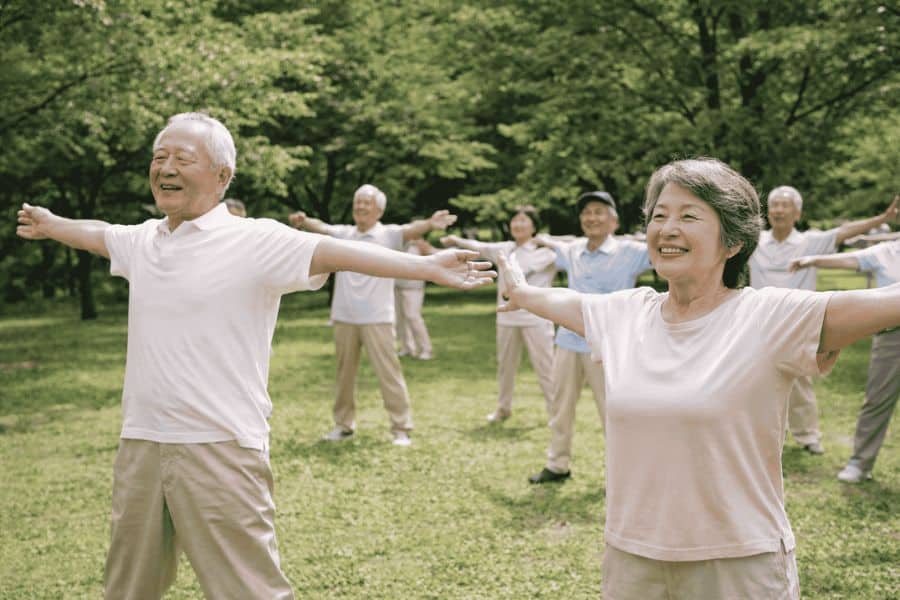
6 Japanese Core Exercises That Protect Your Back
Below are 6 core exercises rooted in Japanese physical culture, from radio calisthenics to hara breathing, which don’t leave you feeling like you want to collapse.
1. Hara Breathing (Deep Belly Breath from the Lower Abdomen)
In Japanese tradition, the hara is the area a few inches below your navel and is considered the center of physical and emotional balance.
Hara breathing trains you to draw breath low into the belly rather than high into the chest, which switches on the transverse abdominis, the deep corset muscle that stabilizes your lumbar spine.
Chest breathers tend to be back pain sufferers, and this is often where the fix starts.
Sit upright on a firm chair or cross-legged on the floor, with your hands resting just below your navel. Inhale slowly through your nose for a count of 4, letting your lower belly push gently into your palms.
Exhale for a count of 6, drawing the belly back toward your spine without collapsing your chest. Aim for 10 rounds, twice a day, and try to do one round before you get out of bed and one before you sleep.
Within a couple of weeks you’ll notice you’re standing taller, your ribs feel less locked up, and the low back tension you carry through the afternoon eases off. This is the foundation that makes every other exercise on this list work harder for you.
2. Seiza Sitting with Spinal Lift
Seiza is the traditional Japanese kneeling posture, sitting back on your heels with a long spine and relaxed shoulders. Held for even a few minutes a day, it teaches your deep core and spinal extensors to hold you up without slumping, which is exactly the pattern most desk-bound backs have lost.
Kneel on a folded blanket or a firm cushion, big toes touching, heels apart, and lower your seat down onto your heels. If your ankles or knees protest, place a rolled towel behind the knees or use a meditation bench.
Lengthen through the crown of your head as though a string is drawing you upward, and let your shoulders drop away from your ears. Rest your hands on your thighs. Hold for 1 minute to start, working up to 5.
Add a spinal lift by inhaling and imagining your ribs floating up away from your pelvis, then exhaling without collapsing back down. This tiny movement builds endurance in the postural muscles that keep your lower back safe when you’re standing at the sink or walking the dog.
3. Radio Taiso Trunk Twist
Radio Taiso is the daily radio-broadcast calisthenics routine that millions of Japanese people, from school kids to workers in their 80s, have done every morning since 1928. One of its most useful moves for the aging back is the standing trunk twist, which builds rotational stability in the obliques without loading the spine.
Stand with your feet shoulder-width apart, knees soft, arms hanging loose. Let your arms swing across your body as you rotate your torso gently to the left, allowing your right heel to peel off the floor and your hips to follow. Then swing back through center and rotate to the right.
The arms are relaxed, not thrown; the power comes from a controlled twist through the middle. Do 20 rotations at an easy pace.
You’re teaching your core to control rotation, which is what protects you when you reach behind for a seatbelt or twist to lift a bag off the passenger seat.
Most back injuries in people over 50 happen during ordinary rotational tasks like this, not during heavy lifting.
4. Makko-ho Forward Fold (Seated Hamstring and Back Stretch)
Makko-ho is a set of 4 stretches developed in Japan in the 1930s to open the body’s energy meridians, and one of them, the seated forward fold, does wonderful things for the posterior chain that supports your lower back.
Tight hamstrings pull the pelvis into a tucked position that flattens the lumbar curve and puts constant strain on the discs.
Sit on the floor with your legs extended straight in front of you, feet flexed, spine long. Inhale and reach your arms up overhead. Exhale and hinge forward from the hips, not the waist, reaching for your shins, ankles, or feet, wherever your hands land without rounding your back.
Keep your neck long. Hold for 5 slow breaths, then roll up one vertebra at a time.
Do this twice, and don’t force the fold. The point is not to touch your toes, but to give the back of your legs and your spinal muscles a long, gentle stretch that undoes some of what sitting all day does to you.
Over a few weeks, the range will improve on its own, and your back will feel considerably less stiff when you get out of bed.
5. Tanden Plank (Low-Belly Hold on Forearms)
This is the Japanese answer to the standard plank. In the West we’re told to squeeze the abs; in the tanden version, you draw your awareness and gentle engagement to the low belly, the same hara area from exercise 1. This recruits the deep stabilizers rather than just the surface abs, making the hold far more spine-friendly.
Start on your forearms and knees, with your elbows directly under your shoulders and your forearms parallel. Draw your lower belly in and up, as though you were zipping up a pair of tight jeans from the pubic bone to the navel.
Then extend your legs back into a full plank, or keep the knees down if that’s kinder to your back today. Hold for 20 seconds, breathing steadily into the low belly, not gasping in the chest.
Build up by 5 seconds a week until you’re holding for a minute. If your lower back starts to sag or your shoulders creep up toward your ears, come down.
A shorter hold done well beats a longer hold done badly, and this exercise done properly will give you more back strength than 100 crunches.
6. Neko No Pose (Cat Cow)
Neko no pose translates loosely as cat pose, and it’s a staple of Japanese somatic movement and physiotherapy. It mobilizes every segment of your spine in flexion and extension, which is exactly the movement your back was designed to do and which most of us do less and less as we age. Stiffness is not a decree; it’s mostly disuse.
Come onto your hands and knees, wrists under shoulders and knees under hips. Inhale and slowly arch your spine, letting your belly drop and your gaze lift, moving one vertebra at a time from the tailbone up to the base of the skull. Exhale and reverse it, tucking your tailbone under, rounding your back toward the ceiling, and dropping your head last. Do this slowly enough that each round takes 2 full breaths.
Aim for 8 to 10 rounds every morning. This is the single best thing you can do for a stiff lower back before you start your day, and it doubles as a check-in: on days when one section of your spine feels stuck, you’ll notice it here first and can go gently. Over months, this exercise keeps the discs hydrated and the small stabilizing muscles between each vertebra doing their job.
Disclaimer: The content in this article is for informational purposes only and is not intended to replace professional medical advice, diagnosis, or treatment. Always consult your doctor, physical therapist, or healthcare provider before starting a new exercise program, particularly if you have existing joint, cardiovascular, or balance conditions.

Kylie Lang is a nationally syndicated travel journalist with bylines on the Associated Press Wire & more, a lifestyle writer, and the founder and editor of Your Lifestyle Library (yourlifestylelibrary.com). She holds a BA (Honours) in History from the University of Kent and is a member of the British Guild of Travel Writers.