
When you’re building your retirement fund, you try to prepare for every eventuality, from replacing a car or helping an adult child with a house deposit to covering a major medical or home expense.
Unfortunately, emergencies never fall into a nice, neat little box, and neither does the way you fund them. It might seem obvious to withdraw from your IRA as that’s where your money is sitting, but that could be the worst move you could possibly make.
Money taken from a traditional IRA generally counts as ordinary taxable income. A larger withdrawal can push more of your Social Security benefits into the taxable column and, in some cases, increase your Medicare premiums as well.
That means a $35,000 withdrawal can have a bigger tax impact than you expect. The real question isn’t simply whether you have enough money, but which account you should take it from, and in what order.
1. Why the Retirement Withdrawal Order Matters
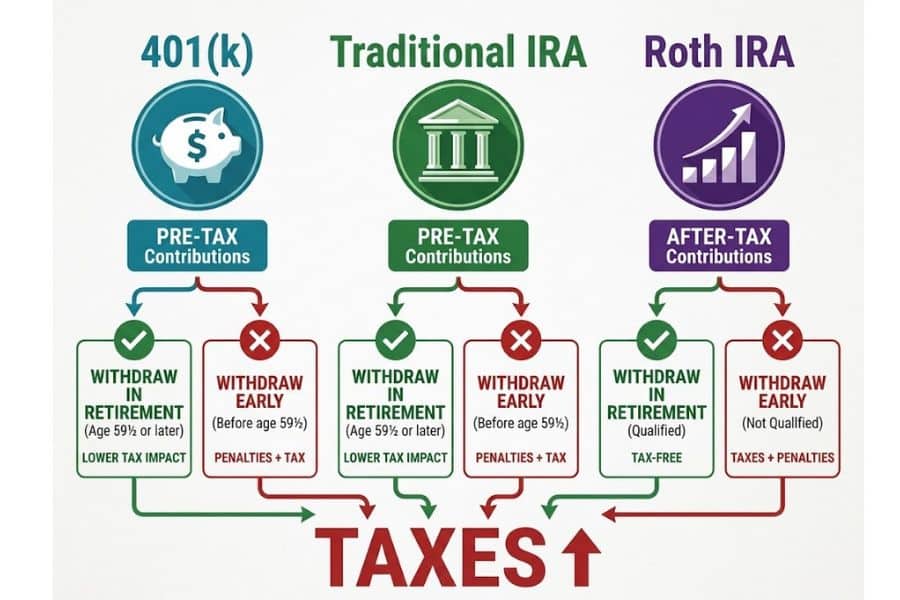
Most people spend decades thinking about how to save for retirement and about ten minutes thinking about how to spend it.
By the time you retire, you’ve probably got money in more than one type of account: a regular brokerage account, a traditional IRA or 401(k), maybe a Roth. Each of those is taxed a completely different way when you touch it.
Pull from the wrong one at the wrong time, and you can push yourself into a higher bracket, trigger extra Medicare premiums, and make more of your Social Security taxable, all in the same year, without meaning to.
Get the order right and your money can last longer, your tax bill can shrink, and you can keep more control over what you owe from year to year. It’s the same amount of money in your accounts either way. It’s just a question of which door you walk it out of first.
Know Your 3 Retirement Tax Buckets

Before any of the strategy makes sense, you need to know which bucket each of your accounts falls into. Most retirees have some mix of all three, and treating them the same way is where the trouble starts.
Taxable Money
This is your regular brokerage account, savings, CDs, anything held in your own name outside of a retirement fund. You’ve already paid tax on the money that went in.
What you owe now is tax on the growth, and the good news is that long-term capital gains and qualified dividends are taxed at lower rates than ordinary income.
In 2026, married couples filing jointly can qualify for the 0% federal long-term capital gains rate as long as their taxable income remains below the $98,900 threshold. That can create a valuable opportunity for retirees to realize investment gains without paying federal capital gains tax.
But there’s an important catch. Ordinary income, IRA withdrawals, and other taxable income can use up that 0% bracket before your capital gains are counted.
Tax-Deferred Money
This is your traditional IRA, traditional 401(k), 403(b), most workplace plans. You got a tax break when you put the money in, the investments grew without being taxed along the way, and now every dollar that comes out is taxed as ordinary income.
That’s the same tax rate as a paycheck, which is usually the highest rate you’ll pay on anything.
Tax-Free Money
Roth IRAs and Roth 401(k)s. You paid tax on the money going in, and if you follow the rules, everything that comes out later, contributions and growth, is tax-free. No tax on withdrawals, no required minimum distributions on Roth IRAs during your lifetime, and the money can pass to your heirs with generous tax treatment. This is the bucket to protect the longest.
3 Tax Triggers That Can Change Your Strategy
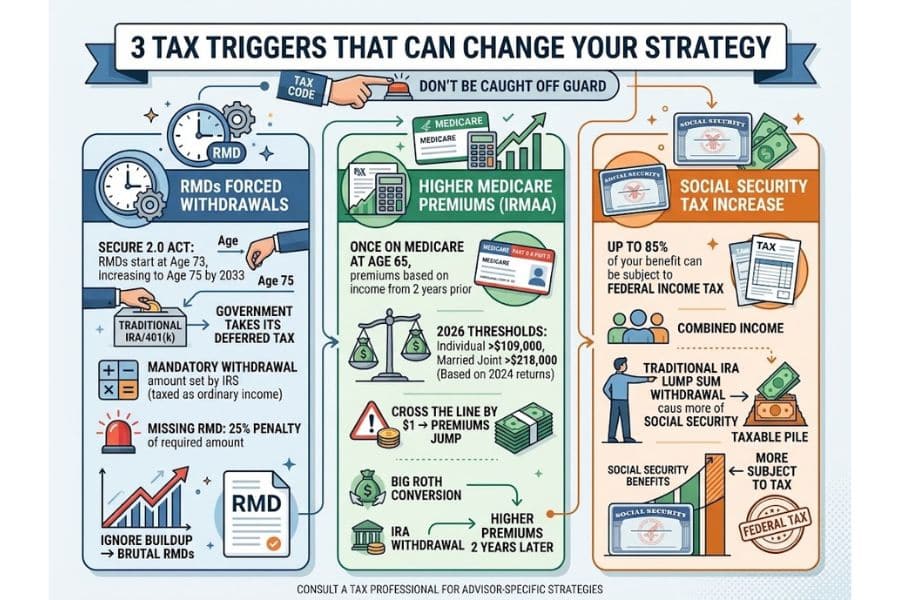
You’d think you could just decide how much you want to spend each year and pull it from wherever you like. Then the tax code taps you on the shoulder.
RMDs Can Force Your Hand
Required minimum distributions are the government’s way of finally collecting the tax it deferred on your traditional IRA or 401(k). Under the SECURE 2.0 Act, RMDs now start at age 73 for most people, with the age increasing to 75 in 2033.
Once they start, the IRS tells you the minimum amount you have to withdraw each year based on your account balance and life expectancy, and it’s taxed as ordinary income whether you need the money or not.
Miss one and the penalty is 25% of what you should have taken. Ignore the buildup in your traditional accounts through your 60s, and RMDs in your 70s can be brutal.
Higher Income Can Raise Medicare Costs
Once you’re on Medicare at 65, your Part B and Part D premiums are based on your income from two years earlier. This is called IRMAA, and in 2026 it can apply when modified adjusted gross income exceeds $109,000 for an individual filer or $218,000 for a married couple filing jointly.
Medicare generally looks back two years when calculating it, so 2026 premiums are typically based on your 2024 tax return.
Cross the line by a single dollar and your monthly premium can jump by hundreds. A big Roth conversion or a chunky IRA withdrawal in one year can look fine on paper and then cost you thousands in Medicare surcharges two years later.
More of Your Social Security Could Be Taxed
Up to 85% of your Social Security benefit can be subject to federal income tax, depending on your “combined income.” Pull a big lump from your traditional IRA, and you can drag more of your Social Security into the taxable pile in the same year.
Most people don’t realize this is even a lever until they see it on the return.
Which Retirement Money Should You Use First?
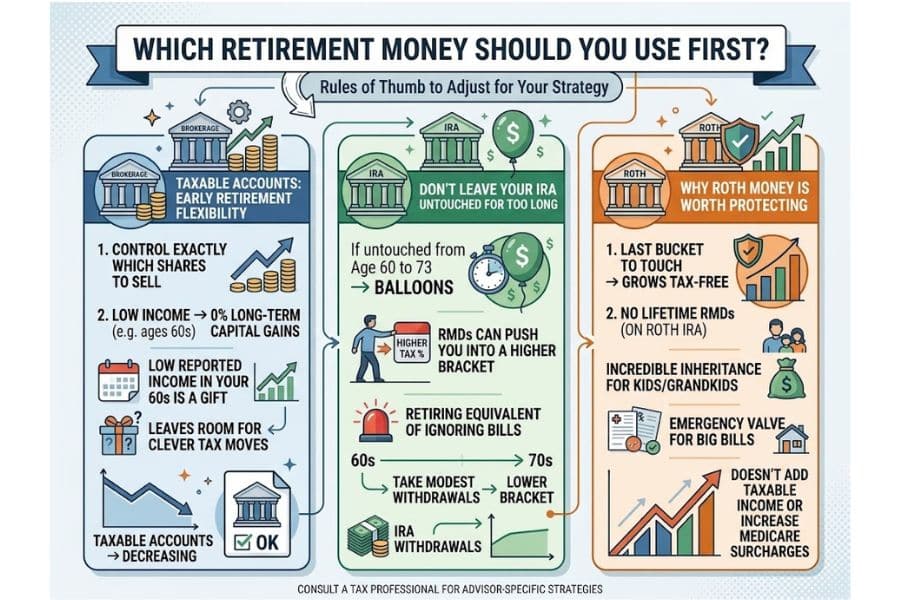
The classic order of operations, taxable first, tax-deferred next, Roth last, is a decent starting point. It lets your tax-deferred and tax-free accounts keep growing, and it uses up the money that’s already been taxed. But like most rules of thumb, it needs a bit of adjusting for individual circumstances.
Taxable Accounts Can Give You Flexibility
Spending from your brokerage account in your early retirement years is often the cleanest move. You control exactly which shares to sell, you can take advantage of the 0% long-term capital gains bracket if your income is low enough, and you keep your reportable income down in years before Social Security and RMDs kick in.
Low reported income in your 60s is a gift. It leaves room to do other clever things with the tax code.
Don’t Leave Your IRA Untouched for Too Long
If you don’t touch your traditional IRA at all from 60 to 73, it can balloon to the point where the RMDs, once they start, push you into a much higher bracket than you were ever in during your working life.
It’s the retirement equivalent of ignoring the credit card bill because it hasn’t hit the max yet. Taking modest IRA withdrawals in your 60s, while you’re in a lower bracket, can flatten out the tax hit over your lifetime.
Why Roth Money Is Worth Protecting
Roth is the last bucket you want to touch, for good reason. It grows tax-free, there are no lifetime RMDs on a Roth IRA, and it’s an incredible thing to leave to your kids or grandkids.
It’s also your emergency valve. If you have a year with unexpected medical bills, or you need a big lump for a house repair, pulling from Roth doesn’t add to your taxable income, doesn’t push up your Medicare premiums, and doesn’t affect your Social Security taxation.
Protecting that flexibility for later in retirement is worth a lot.
Why Your 60s Can Be a Tax Planning Sweet Spot
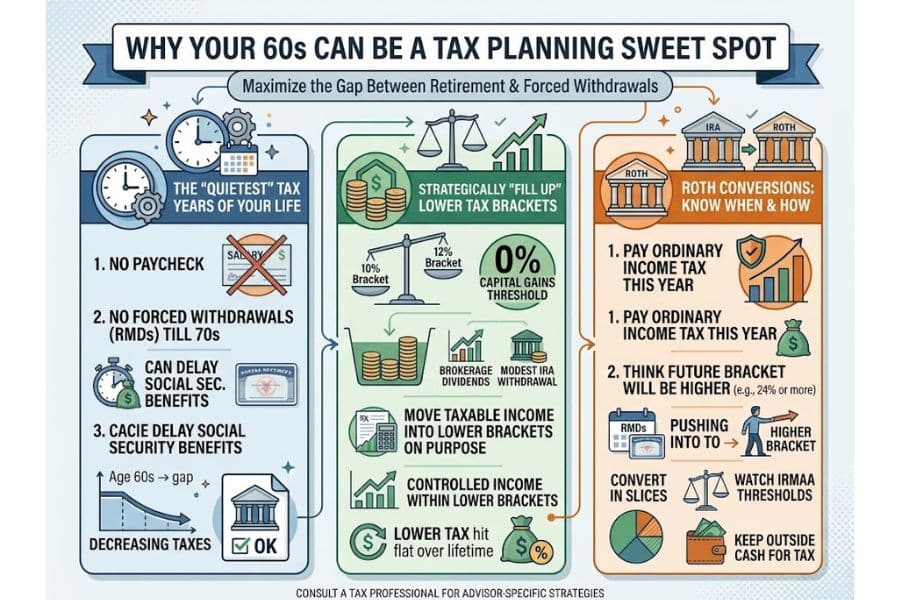
The years between retiring and your first RMD are the quietest tax years of your life. No paycheck, no forced withdrawals, and you can often delay Social Security. That gap is where the real planning happens.
Use Lower Tax Brackets Strategically
If your only income for the year is some brokerage dividends and a modest IRA withdrawal, you might find yourself sitting comfortably in the 12% federal bracket, or below the 0% capital gains threshold.
That’s your chance to “fill up” the lower brackets on purpose. Take enough from the traditional IRA each year to use the 10% and 12% brackets, and you get that money out at a rate you may never see again once RMDs and Social Security both land.
Know When a Roth Conversion Makes Sense
A Roth conversion is where you move money from a traditional IRA into a Roth IRA and pay the ordinary income tax on it that year. It sounds counterintuitive, volunteering for a tax bill. In the right year, it’s one of the best moves you can make.
If you’re in the 12% or 22% bracket now and you think future you, with RMDs and Social Security stacked on top, will be in the 24% or higher bracket, converting a chunk each year in your 60s can save real money over the long haul.
The trick is doing it in slices. Convert enough to fill the current bracket, not a dollar more. Watch the IRMAA thresholds. And keep enough cash outside the IRA to pay the tax bill, because paying it out of the conversion itself defeats a lot of the point.
How the Strategy Works in Real Life
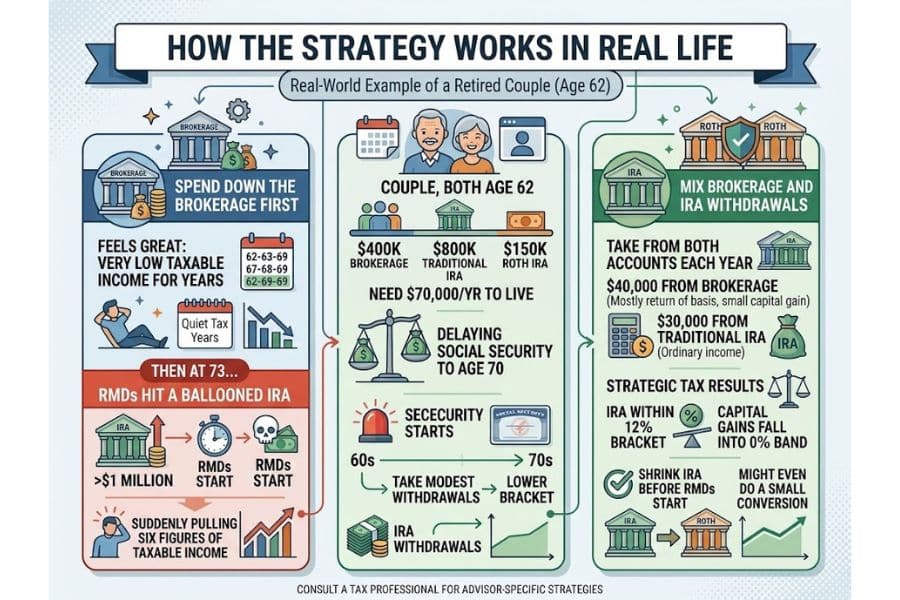
Imagine a couple, both 62 and retired, with $400,000 in a brokerage account, $800,000 in a traditional IRA, and $150,000 in a Roth IRA. They need $70,000 a year to live on, and they’re delaying Social Security to 70.
Option 1 – Live Off the Brokerage Account
They spend down the brokerage first. Very low taxable income for years. Feels great. Then at 73, RMDs hit an IRA that has grown to well over a million, they start Social Security, and suddenly they’re pulling six figures of taxable income a year at the highest brackets they’ve ever paid.
Option 2 – Mix Brokerage and IRA Withdrawals
Instead, each year they take about $40,000 from the brokerage account (mostly a return of basis, with a small capital gain) and $30,000 from the traditional IRA.
The IRA withdrawal is taxed as ordinary income, but their total taxable income is low enough to sit in the 12% bracket, and their capital gains fall into the 0% band. They shrink the IRA before RMDs start, and they might even do a small Roth conversion on top.
Why Mixing Withdrawals Can Reduce Taxes
Blending sources lets you precisely steer your taxable income. You can dial it up to use a low bracket, dial it back to stay under an IRMAA threshold, and keep your Social Security taxation in check. The single-bucket strategies are easier to describe and much more expensive to live through.
Why the Tax Savings Aren’t Guaranteed
Tax law changes. Your investments do their own thing. Your health, your spending, and the timing of Social Security all move the numbers. A strategy that looks perfect at 62 will need tweaking at 65 and again at 70.
What Changes Once RMDs Begin?
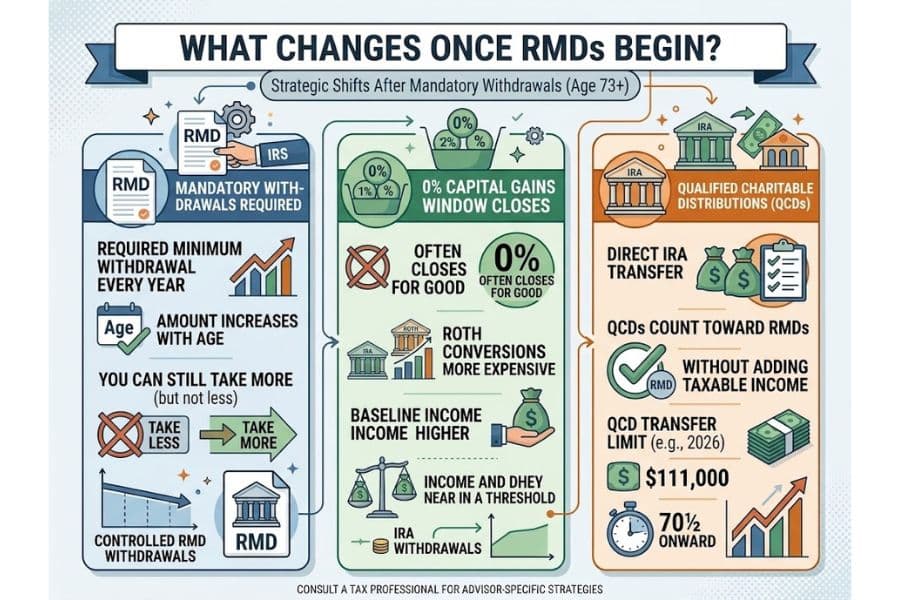
At 73, the game shifts. The IRS now requires a minimum withdrawal from your traditional accounts each year, and that amount increases with age. You can still take more if you need it, but you can’t take less.
Roth conversions get more expensive because your baseline income is higher. The 0% capital gains window often closes for good. At this point, your job is managing the extra income, not creating it.
Qualified charitable distributions become a real tool from 70½ onward. In 2026, you can transfer up to $111,000 directly from an IRA to an eligible charity through a qualified charitable distribution, or QCD. If you’re subject to RMDs, the QCD can count toward your required distribution without the qualifying amount being included in your taxable income.
If you already give to charity, doing it this way instead of writing checks can be far more tax-efficient. Coordinating withdrawals between spouses matters more, too, since one of you may have a larger IRA and a different bracket to work with.
Retirement Withdrawal Mistakes That Can Raise Your Tax Bill
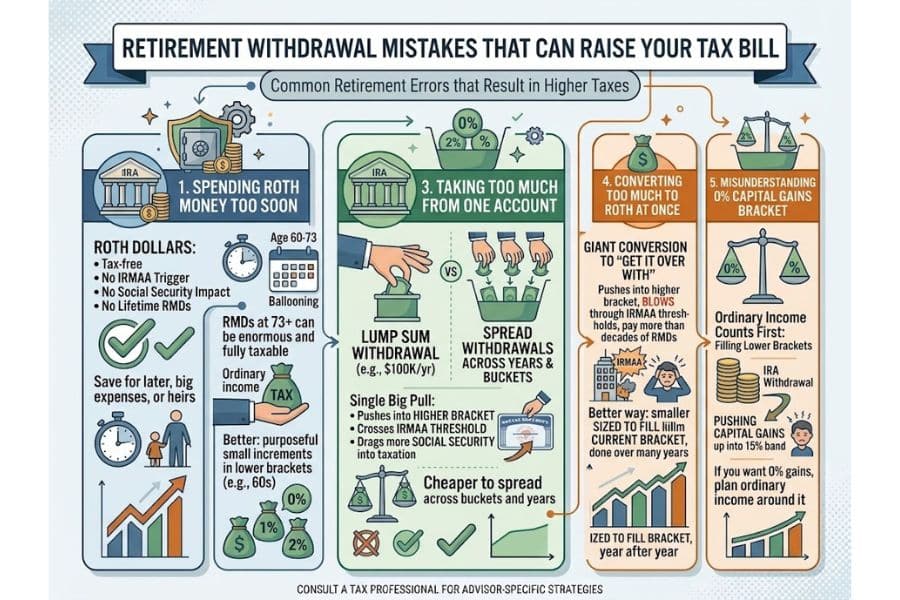
Mistake #1 – Spending Roth Money Too Soon
Roth dollars are the most valuable dollars you own. They’re tax-free forever, they don’t trigger IRMAA, they don’t push your Social Security into the taxable zone, and they have no lifetime RMDs.
Save the Roth for later in retirement, for big one-off expenses, or for your heirs.
Mistake #2 – Leaving Your IRA Untouched for Too Long
The mirror image of the first mistake. If your traditional IRA compounds untouched from 60 to 73, the RMDs when they start can be enormous, and every dollar comes out as ordinary income.
Eating away in small increments at the IRA in your 60s, on purpose, in the lower brackets, is often the single biggest tax saver available to a retiree.
Mistake #3 – Taking Too Much From One Account
A $100,000 withdrawal in one year from your traditional IRA can look identical, on paper, to $50,000 a year for two years. It isn’t.
The lump sum can push you into a higher bracket, cross an IRMAA threshold, and drag more of your Social Security into taxation, all in a single tax return. Spreading withdrawals across years, and across buckets, is almost always cheaper than one big pull.
Mistake #4 – Converting Too Much to Roth at Once
Roth conversions are a great tool with a trigger. Convert a huge chunk in a single year to “get it over with,” and you can push yourself into a much higher bracket than you’d otherwise ever see, blow through the IRMAA thresholds, and pay more in that one tax bill than you would have paid on RMDs over a decade.
The best way is a series of smaller conversions, sized to fill the bracket you’re already in, done year after year through your 60s.
Mistake #5 – Misunderstanding the 0% Capital Gains Bracket
This one is costly. That 0% long-term capital gains rate for married couples with taxable income up to $96,700 sounds like free money, and it is, until you stack an IRA withdrawal on top of your capital gains and realize the ordinary income counts first.
The IRA withdrawal fills up the lower brackets, pushing the capital gains up into the 15% band. You didn’t lose the 0% rate on all of it, but you lost it on the part that got bumped. If you want to harvest gains at 0%, you have to plan the ordinary income around it, not the other way around.