
You open your banking app to check on some payments and see it. A charge you never made for something you’ve never heard of, from a place you’ve never been to. You feel sick, and your heart skips a beat.
It’s happened to me, and I’m certainly not alone, and you wonder how on earth you’ve managed to fall for it. What did you do that gave people access to your money? It’s quite literally the worst feeling in the world.
After it happened to me, I decided to research the latest money scams and set up a foolproof plan to stay one step ahead of the fraudsters for good.
How To Protect Yourself Against the Latest Money Scams
Most of us like to think we’d spot a scam a mile away. But according to the Federal Trade Commission, Americans lost a record $15.9 billion to fraud in 2025. That’s up from $12.5 billion the year before, and a staggering 430% increase since 2020.
The reason scams are so effective now is that scammers have gotten dramatically better at what they do. They use AI tools, fake branding, and spoofed phone numbers to look completely convincing. An email can look like it came from your bank. A phone call can show your bank’s real number on your caller ID. Even the websites look real.
Knowing what’s out there is your best defense.
Why These Scams Are So Hard to Spot
There was a time when a scam email was easy to identify. It came from a random address, the spelling was terrible, and it often opened with something like “Dear Beloved Friend.”
Those days are long gone.
Today’s fraudsters use AI to write flawless, professional emails. They copy real logos and branding. They spoof phone numbers so your caller ID shows the name of your actual bank. Some even use AI-generated voices that sound exactly like real people.
The result is that what lands in your inbox or on your phone can look indistinguishable from the real thing. Which is exactly why the specific scams below are doing so much damage right now.

5 Scams Making the Rounds Right Now
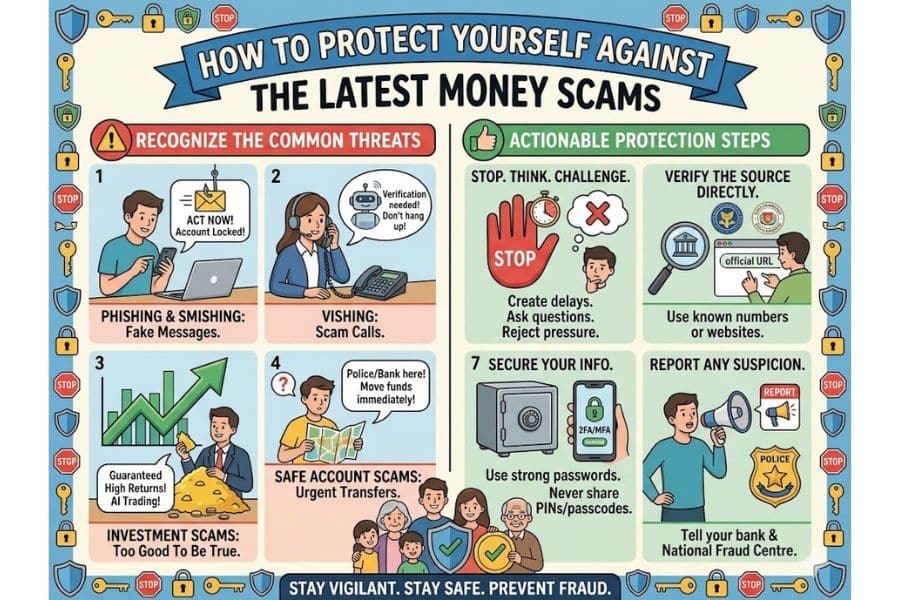
1. The IRS (or Tax Office) Call
You get a call supposedly from the IRS. The person on the other end sounds professional and says you owe back taxes and that if you don’t pay immediately, you’ll face arrest or legal action.
They know your name, your address, or the last four digits of your Social Security number, details scraped from publicly available data that make them sound legitimate.
They’ll push you to pay fast, often asking for payment in gift cards or cryptocurrency. That’s the telltale sign. No government tax agency will ever call you out of the blue demanding immediate payment. The IRS always contacts taxpayers by mail first, and never asks you to pay with a gift card.
Between March 2013 and March 2025, over 16,000 victims reported to the Treasury Inspector General that they had collectively lost more than $114 million to IRS impersonation scams alone. If you get one of these calls, hang up.
2. Your Bank’s “Fraud Department” Calling You
This one nearly happened to me before I realized something was off, but it was a very close call.
You get a call from someone claiming to be from your bank’s fraud team. They tell you there’s been suspicious activity on your account, and they need to verify your identity. They might ask you to confirm your login details or read back a one-time passcode that just arrived by text.
Here’s what’s actually happening. That passcode was triggered by the scammer, who is actively trying to log into your real account in real time. The moment you read it aloud, they’re in.
Bank impersonation scams tripled from 2024 to 2025 and were the leading scam type reported at one major regional bank, accounting for around 17% of all its scam cases.
Fraudsters can spoof your bank’s real phone number so it shows up correctly on caller ID, which makes this one especially convincing.
Your bank will never call you and ask you to read back a security code. If you get a call like this, hang up and call the number on the back of your card.
3. The “Pig Butchering” Investment Scam
I know it sounds bizarre, but the name comes from the idea of fattening a pig before slaughter. Victims are “fattened” with trust and apparent gains before the scammers vanish, leaving them with nothing.
It starts innocuously. A stranger reaches out on social media, a dating app, or sometimes just a “wrong number” text. They’re friendly, engaging, and in no hurry. Over weeks or sometimes months, they build what feels like a real relationship. Then, eventually, they mention that they’ve been making great returns in crypto and would love to show you how.
They direct you to what appears to be a professional investment platform. Your “balance” appears to grow impressively. They encourage you to invest more. Some victims are even allowed to make small withdrawals early on, just to build trust. Then, when you try to access your money, the platform freezes or disappears entirely.
This exact scam happened to one of my friends in France, who is in his 70s. He was absolutely hooked in and was all for getting my husband in on the act, as he was making great money. Sadly, all his accounts were frozen and the money gone, and to date, he hasn’t been able to recover any of it.
Investment fraud was the largest category of financial fraud in 2024, with $5.7 billion in losses, according to the FTC. The FBI’s Operation Level Up identified that 77% of victims of cryptocurrency investment fraud had no idea they were being scammed until agents contacted them directly.
If someone you’ve never met in person is steering you toward a financial opportunity, stop the conversation.
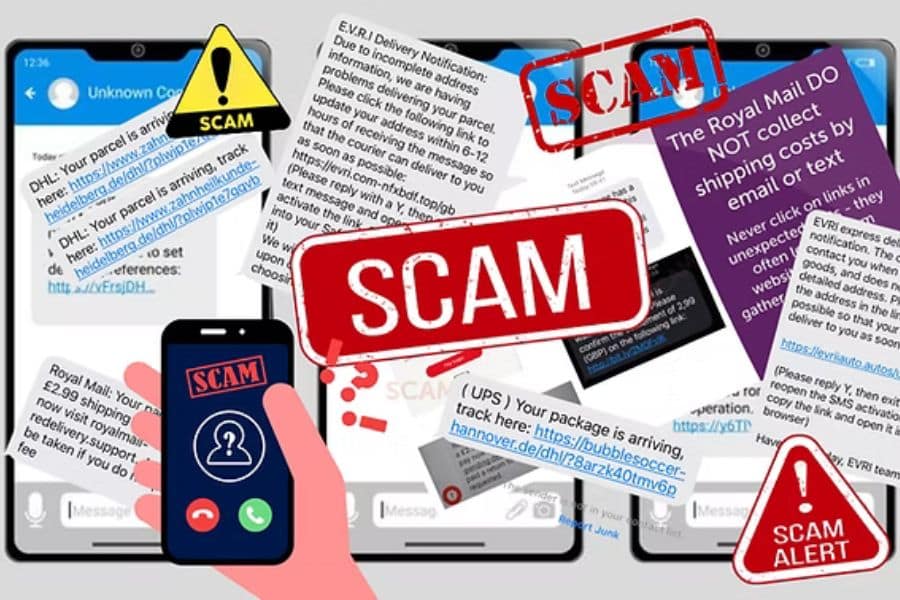
4. The Delivery Company Text
Your phone buzzes. It’s a text from what looks like FedEx, UPS, or USPS. It says there’s a problem with your delivery and you need to click a link to confirm your details or pay a small re-delivery fee, often just a dollar or two.
The link takes you to a fake website that looks almost identical to the real carrier’s site. You enter your name, address, and payment details to sort the “problem.” Those details go straight to the scammer. The small fee is the hook, as it lowers your guard because it’s too minor to be suspicious. But it’s your financial information they’re after, not the dollar.
I’ve had so many of these texts over the last few months that I know what to expect, but I did nearly fall foul of it the first time, as I was expecting a parcel, coincidentally, but then I remembered the French postal system asks you to go into the nearest post office to pay any delivery fees. They never text you, so I didn’t get caught on this occasion.
Always go directly to the carrier’s official website to track a package. Never use a link from a text you weren’t expecting.
5. The Social Security Suspension Scam
You receive a call or voicemail saying your Social Security number has been “suspended” due to suspicious activity or that it’s been linked to a crime. The caller urges you to press a number or call back immediately to resolve the issue before it escalates.
They may ask you to confirm your Social Security number to “verify your identity” or tell you to move your money into a “safe account” until the matter is cleared up.
Scammers will use demands or threats to pressure you into acting immediately, including threats of arrest or deportation, and they won’t let you question or appeal the situation. That pressure is entirely deliberate, as it’s designed to stop you from thinking clearly.
Social Security numbers cannot be suspended. No government agency will ever ask you to move your money to a different account for safekeeping.
What To Look For and the Tricks Scammers Use
Scammers rely on speed and panic. The slower you go, the better your chances of catching it. Here’s what to look for:
- The email address doesn’t match the organization. It might look close at first glance, something like “support@irs-helpdesk.com” instead of an address ending in irs.gov. Always check the domain after the @ symbol, not just the name displayed
- The phone number looks right on the caller ID, but that doesn’t mean it is. Spoofing technology lets fraudsters fake any number they like
- You’re being asked to read back a one-time passcode over the phone. Legitimate banks and institutions will never ask for this
- There’s urgency or a threat attached. “Your account will be closed.” “You will be arrested.” “You have 24 hours.” Legitimate organizations don’t operate this way
- You’re being asked to pay using gift cards, cryptocurrency, or a wire transfer. These are the preferred payment methods of scammers because they’re nearly impossible to trace or reverse
- The link in an email or text doesn’t match the real website. Look for extra words, hyphens, or slight misspellings, like “fedex-delivery-help.com” instead of fedex.com
- The message contains slightly awkward phrasing, odd formatting, or unusual capitalization
- Someone you’ve recently met online is introducing investment opportunities or asking you to keep your conversations private
How To Stay One Step Ahead of the Latest Scams
New variations of old scams appear constantly, and what’s circulating this month may look completely different from what was doing the rounds six months ago. Building a quick monthly habit takes about five minutes and can make a real difference.
Step 1: Bookmark the FTC’s scam alerts page
Go to the FTC’s scam alerts page and bookmark it in your browser. The Federal Trade Commission updates this page regularly with new scam warnings written in plain, easy-to-understand language. Check it once a month.
Step 2: Sign up for free email alerts
While you’re on the FTC site, sign up for their free consumer alerts so the latest warnings come straight to your inbox. AARP’s Fraud Watch Network is another excellent option, especially for scams targeting people over 50. You can sign up here. You don’t have to be an AARP member to use it.
Step 3: Use a free AI tool to search for what’s happening right now
Perplexity is a free tool that searches the web in real time and gives you a clear summary of what it finds.
Use a prompt like this, “What are the most common financial scams targeting Americans this month?” It will pull current results and summarize them in seconds.
Microsoft Copilot works the same way and is completely free. Use the same prompt, and it will search the web and give you an up-to-date answer.
If you prefer ChatGPT, that works too. Just make sure the web search option is turned on before you ask, otherwise it may give you information that’s months out of date. Look for the small globe or search icon near the message box before you type your question.
Step 4: Do a quick Google search once a month
Simply type “latest financial scams” followed by the current month and year into Google. This takes thirty seconds and will surface recent news articles, government warnings, and consumer alerts that are relevant right now.
What To Do If You Think You’re Being Targeted
Stop all contact immediately. Don’t transfer any money and don’t share any further information.
Call your bank directly using the number printed on the back of your card or on your official statement, not any number given to you in a message or by a caller.
Report the scam to the FTC. If it involves cryptocurrency or online fraud, you can also file a report with the FBI’s Internet Crime Complaint Center at ic3.gov.
Tell someone you trust. Scammers often try to create a sense of secrecy or shame around their schemes. Talking about it is one of the most effective things you can do.
Disclaimer: This article is for informational purposes only and does not constitute financial or legal advice. If you believe you have been the victim of financial fraud, contact your financial institution and the relevant authorities immediately.