
Living in France, red meat is always on the menu. As a country, I can never imagine them not eating meat; it’s an integral part of their culture. I love meat, and red meat is my favorite. I can never resist a steak.
But recently, I’ve started questioning some of my food choices, especially as I’m getting older. Now I don’t want to turn into one of those people who cuts out certain foods the minute they read a new study. However, I do like to be informed.
A new study on red meat and diabetes risk has been doing the rounds recently. But it’s not all doom and gloom: red meat itself isn’t the problem. It’s a specific sugar inside it, and the same sugar in another food poses no risk. This piqued my interest.

The Red Meat and Diabetes Link Scientists Couldn’t Explain
This isn’t the first time red meat has had a bad rap when it comes to type 2 diabetes. Back in 2023, a team of researchers at the Harvard T.H. Chan School of Public Health went through the eating habits of 216,695 people. They’d filled in food questionnaires every two to four years, and some of them had been doing it for 36 years.
More than 22,000 of them developed type 2 diabetes. The people eating more red meat had a 62% higher risk than people eating less.
Processed meat came out worst. Every extra daily serving of bacon, ham, sausages, or hot dogs was linked to a 46 percent higher risk. Eating an extra serving of unprocessed red meat, like a steak or a lamb chop, was linked to a 24 percent higher risk.
Walter Willett, the study’s senior author, said: “A limit of about one serving per week of red meat would be reasonable for people wishing to optimize their health and well-being.”
One a week. Try telling that to anyone in France.
What nobody could pin down was why. Was it the saturated fat, the iron, or the salt and preservatives in processed meat? Now French researchers have pointed to something much smaller: sugar.
The Sugar Humans Lost Millions of Years Ago
It’s a sugar called Neu5Gc, and it’s found in the meat of mammals. Beef and lamb are the main sources. Pork has some too, and milk, cheese, and yogurt carry smaller amounts. Chicken and fish have very little.
Most mammals make Neu5Gc themselves. We don’t. Around two to three million years ago, our ancestors lost the gene that makes it. So every bit of Neu5Gc in your body came from something you ate, and your body builds some of it into its own cells.
How Your Immune System Treats It

Your immune system spots that Neu5Gc, decides it doesn’t belong, and makes antibodies against it. Scientists call this reaction xenosialitis.
The theory is that this keeps chronic inflammation low for years. You can’t feel it, but over time it can reduce insulin’s effectiveness and wear down the cells in your pancreas that make it.
Ajit Varki and his team at UC San Diego have studied Neu5Gc for years. In mice bred without the gene, a diet rich in Neu5Gc has been linked to more inflammation and faster-growing cancers, just like us.
Found this useful? Get more like it in your inbox as a Lifestyle Library Insider.
But Does It Happen in Real People?
What nobody knew was whether people who eat more Neu5Gc are more likely to develop type 2 diabetes. If they are, is the sugar causing the problem, or is it simply the red meat?
Nearly 90,000 French Adults and Their Food Diaries
Researchers led by Leopold Fezeu, MD, PhD, at Université Sorbonne Paris Nord looked at 89,953 adults in the long-running NutriNet-Santé study. None had type 2 diabetes or cancer at the start. About 79 percent were women, and their average age was 42.
The team worked out how much Neu5Gc each person ate from three detailed food records and split them into five groups, from lowest to highest. Over a median of 7.2 years, 966 of them developed type 2 diabetes.
So what did they find? The people eating the most Neu5Gc from meat had a 63 percent higher risk of type 2 diabetes than the people eating the least. The second-highest group had a 41 percent higher risk.
“It does not mean that 63% of high consumers will develop diabetes,” Fezeu said.
The top group also wasn’t eating excessive amounts of meat. The men had a median of 97 g of red meat a day, about 3.5 ounces, and the women 73 g, about 2.5 ounces. That’s roughly a small steak most days.
Body weight explained only about 13 percent of the link, so it isn’t simply that meat-eaters were heavier. Fezeu said the findings “support chronic inflammation as a specific mechanism linking red meat consumption with T2D,” partly independent of body fat.
Then the Researchers Looked at Dairy
Next, the team ran the same check on the Neu5Gc people got from dairy. They found no significant link to type 2 diabetes.
“There may be differences between sources, or other components of red meat may contribute,” Fezeu said. One likely reason is the amount. Dairy carries much less Neu5Gc than red meat, and most of us eat it in smaller servings.
It also aligns with the Harvard study, which linked swapping a daily serving of red meat for dairy to a 22 percent lower risk of type 2 diabetes.
Living in France, where the cheese course is part of life, I was very glad to read that.
So, Do You Have to Give Up Steak?
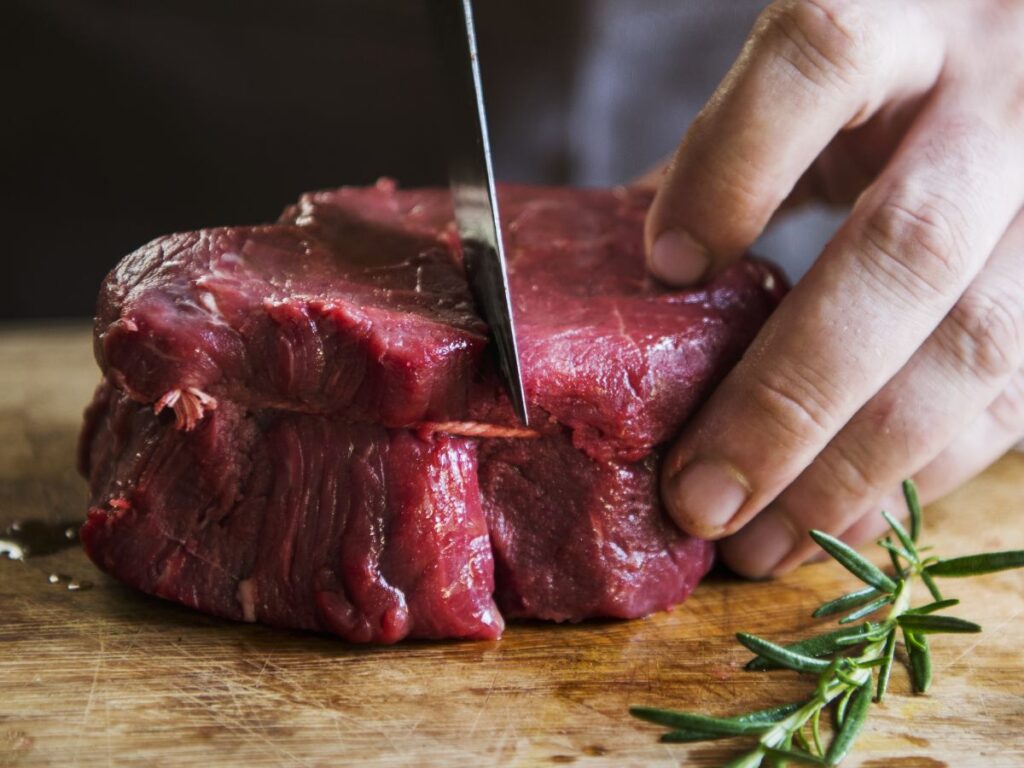
No, you don’t have to give up steak, thank God for that. This study suggests that how much you eat, and how often, matters.
Julia Zumpano, a registered dietitian at the Cleveland Clinic, suggests one to two servings a week, about 6 ounces in total. And she has a simple rule for when you do eat it: “Anytime you eat red meat, it should be the leanest cut you can find, with all the fat removed.”
The Small Print
This is an observational study. In Fezeu’s own words, “it shows an association, not cause and effect.” The results were presented at the European Association for the Study of Diabetes meeting in Milan and haven’t been peer-reviewed yet.
When the researchers adjusted for overall red meat intake, the Neu5Gc link weakened and was no longer statistically significant. “Neu5Gc and red meat are closely linked, since red meat is the main source of Neu5Gc,” Fezeu explained.
Red meat also contains other things, like heme iron, that may play a part. So it’s too early to blame the sugar alone.
The team didn’t measure anyone’s Neu5Gc antibodies, so the inflammation theory is still a theory. “It is a plausible explanation, but it remains a hypothesis,” Fezeu said. The study mostly included women in their early forties, so the findings need confirmation in other groups.
If you already have prediabetes or diabetes, or it runs in your family, don’t make any diet changes before having a conversation with your doctor.
Easy Ways to Eat a Little Less Red Meat
- Choose lean cuts, such as flank, round, sirloin, or tenderloin, and ground beef that’s at least 90 percent lean.
- Trim the fat and grill, roast, or broil your meat instead of frying it.
- Swap a meal or two a week for chicken, fish, beans or lentils. In the Harvard study, swapping a daily serving of red meat for nuts or legumes was linked to a 30 percent lower risk, and plant proteins are one of the swaps the French team wants to test next.
- Make meat the side, not the star, with a smaller portion and a bigger pile of vegetables.
For a steak lover like me, it’s good news, and I’m a happy camper. Red meat can stay on the menu in France and anywhere else. It just doesn’t need to be on it every night.
About this article: Our health articles are based on published studies and advice from experts such as physiotherapists and dietitians, and the sources are linked in the article.
Disclaimer: The content in this article is for informational purposes only and is not intended to replace professional medical or nutritional advice. Always consult your doctor or a registered dietitian before making significant changes to your diet, particularly if you have a health condition, a food allergy, or take medication. This article may contain affiliate links.
Become a Lifestyle Library Insider
Health tips, money know-how, travel deals and garden ideas for life after 50, straight to your inbox.

Kylie Lang is a nationally syndicated travel journalist with bylines on the Associated Press Wire & more, a lifestyle writer, and the founder and editor of Your Lifestyle Library (yourlifestylelibrary.com). She holds a BA (Honours) in History from the University of Kent and is a member of the British Guild of Travel Writers.