
I know none of my plants love water from the faucet. I mean, they’ll take it, of course they will, but they definitely prefer rainwater to anything that comes out of the outdoor garden tap.
Not to mention, in a heatwave we’re not supposed to be using hoses in that way, as there are often hosepipe bans during the hot months of summer
So what do you do if you don’t want everything in your garden to wither and die due to lack of water? Or if you only have one small water butt that stood empty by the first week of summer?
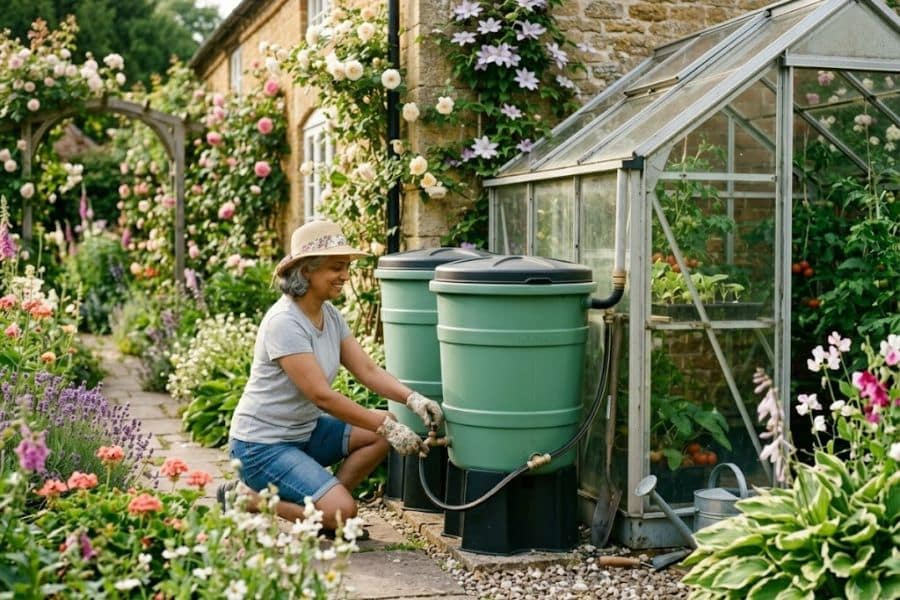
How to Collect and Store Enough Rainwater to Actually Make a Difference
The first thing worth knowing is that even a small roof throws off a ridiculous amount of water in a single storm. A rough rule of thumb: every 1,000 square feet of roof catches about 620 gallons in an inch of rain.
So a modest garden shed with a 100-square-foot roof gives you around 60 gallons per inch of rain, and a typical house roof section feeding one downspout can easily dump 200 or 300 gallons in a good downpour.
Your standard 50-gallon water barrel is full and overflowing before you’ve finished making a cup of tea.
The barrel isn’t the problem. The problem is the number of barrels. The goal isn’t to have one giant tank, but more catchment points, more storage, and a way to move water from where it lands to where you need it. All of which you can build up slowly, one season at a time, without spending a fortune.
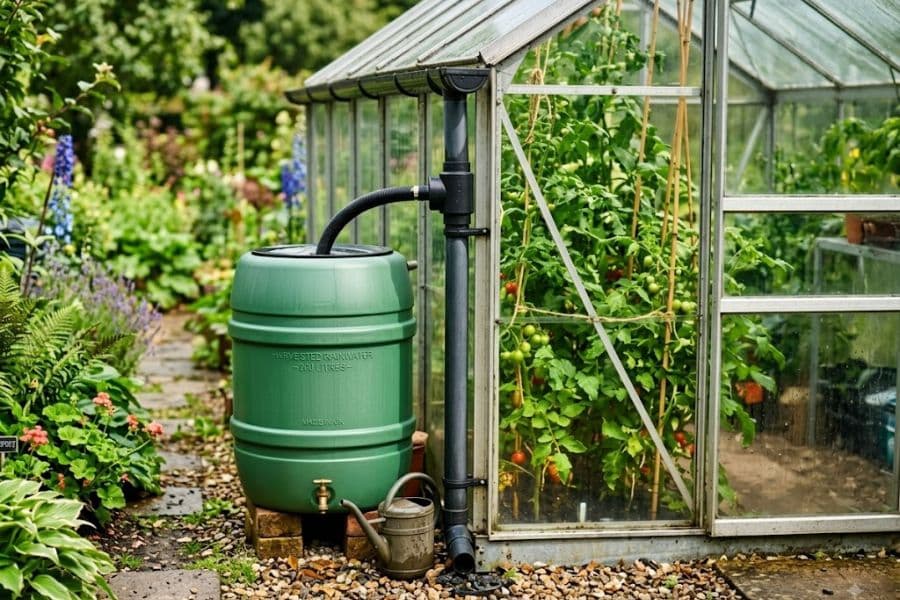
Start With Where the Water Actually Goes
Before you buy anything, go outside next time it rains and just watch. Walk around your yard while it’s coming down and see where the water is going.
You want to know which downspouts are the busiest, where puddles form, which bits of the yard stay dry even in a storm because a fence or an overhang is deflecting the rain elsewhere.
When I did this at our place, I realized the downspout I’d put my barrel under was actually one of the slower ones, and the corner of the shed I’d never paid attention to was gushing like a small waterfall.
The shed roof alone was throwing off enough rain to fill two barrels easily. That corner is now where the bulk of my catchment lives, and the original barrel just tops up whatever the shed misses.
While you’re out there, look at where you actually use water in the yard. If your veg beds are 60 feet from the nearest downspout and there’s a lawn in between, you need to think about whether you’re going to lug watering cans that whole way or run a hose from a raised barrel. Rainwater is heavy, about 8 pounds per gallon, and I promise you the novelty wears off fast.
One Barrel Is a Start, Three Is a System
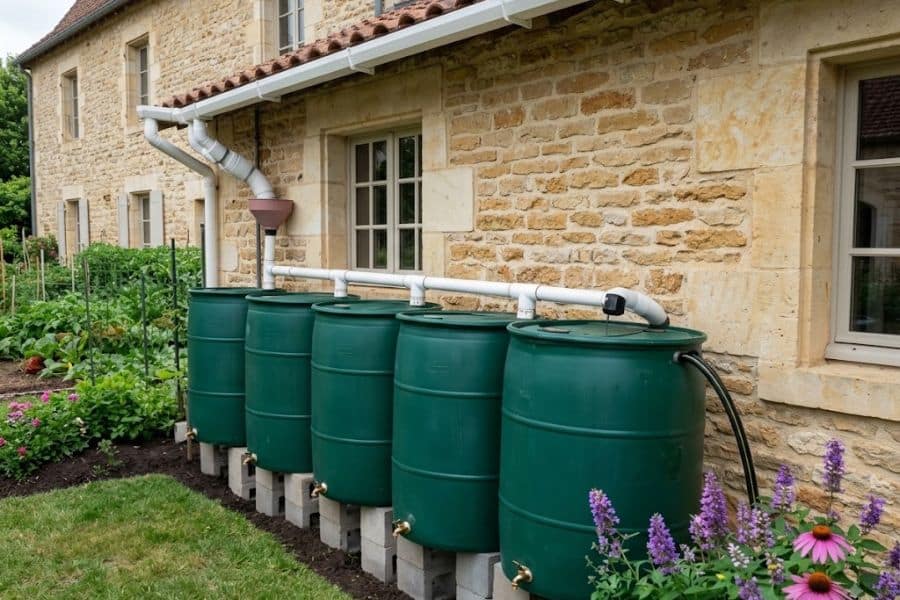
The trick that made the biggest difference for me was linking barrels together. It’s called a daisy chain. You put your first barrel under the downspout, and near the top of that barrel you drill a bulkhead fitting and run a short hose across to a second barrel, and from that one to a third.
When the first fills up, the overflow goes into the next one instead of onto the ground. You’ve tripled your storage without needing a bigger single tank, which would be more expensive and much harder to move if you ever changed your mind.
You can pick up food-grade 55-gallon barrels secondhand for anywhere between $20 and $50 if you keep an eye on local classifieds. Car washes, soda bottlers and food factories go through them and often want rid.
Get the ones that used to hold something benign like olives or syrup, not industrial chemicals. Give them a good rinse and you’re away.
A few things that will save you grief:
- Put every barrel on something solid and raised. Cinder blocks work fine. A raised barrel gives you enough head height to fill a watering can underneath the faucet without lying on your belly, and gravity does the work of pushing water through a hose. Even 18 inches of lift makes a real difference.
- Cover every opening with fine mesh or a proper screen. Mosquitoes will find standing water within about 48 hours in summer and lay eggs, and a screen also keeps out leaves, seeds and the occasional curious mouse.
- Fit an overflow that points somewhere useful. Mine runs into a boggy corner where I’ve planted things that like wet feet. Don’t just let it puddle against your foundation, that way lies damp problems and a very cross house.
- Label which barrel feeds what.By the third one you will forget which hose does what.
Catch More Than Just the House Roof
Once you’ve got the main downspout sorted, look at every other roof surface on your property. The shed, obviously. But also the greenhouse if you have one, the garage, the chicken coop, the porch overhang, even a decent-sized dog kennel.
Anything with a slope and a gutter can feed a barrel, and anything without a gutter can have one added for about $15 in plastic gutter from any big box hardware store.
I added a short run of gutter to our woodshed last year, mostly because I’d seen a video of someone doing it and thought, well, I’ve got the barrels, might as well. That little roof now feeds another 100 gallons or so of storage that sits right next to the raised beds.
It means during the growing season I’m barely using any tap water for the vegetables, which was the whole point.
If you’re renting or you don’t want to attach anything permanent to a roof, you can also just catch water off a tarp. Rig a tarp between two posts with a low point in the middle, put a bucket underneath, and in a proper storm you’ll fill it in an hour.
Making Stored Water Last Through a Dry Spell
Storage is only half the game. The other half is not blowing through it within a week of the sun coming out.
Mulch is the big one. A 2- or 3-inch layer of straw, wood chips, grass clippings, shredded leaves, or even cardboard on top of your beds dramatically reduces evaporation. Water enters the soil, stays in the soil, and isn’t baked out by the afternoon sun.
I mulch everything now, and the difference in how often I need to water is stark. Beds I used to water every other day in an 85-degree stretch now go 4 or 5 days between drinks.

Water deeply and less often at the base of the plant, ideally in the early morning or evening. A slow soak that gets down 6 inches encourages roots to grow deep, and deep roots survive dry patches.
A quick sprinkle every day trains roots to sit near the surface where they fry the moment you skip a day. If you can, run a soaker hose off a raised barrel through your veg beds, gravity-fed, and let it drip while you’re doing something else.
A few more things worth doing:
- Group plants by thirst. Tomatoes, zucchini and squash want a lot; rosemary, lavender and thyme want almost none. Putting the thirsty ones together lets you target your stored water where it earns its keep, rather than watering the whole plot equally.
- Prioritize what actually needs it. Established shrubs and trees can generally cope with a dry stretch. Young transplants, containers, and anything fruiting cannot. If your barrels are getting low, the pots and the tomatoes win.
- Ditch the fine spray. A watering can with the rose off, or a hose end you can point at the soil, wastes far less than a sprinkler.
- Save your kitchen water too. The pot you boiled pasta in, cooled off, goes on the beds. The bowl of water you used for washing up is perfect.
What to Do When the Barrels Are Full, and It’s Still Raining
You’ve done all the work, you’ve got three barrels linked up, and then a huge storm rolls through in October, and everything’s full within the first hour. What now?
The honest answer is that you can’t catch it all, and you don’t need to. What you can do is send the overflow somewhere it will still do good instead of straight down the drain. Dig a shallow depression, sometimes called a rain garden, in a low spot in the yard and plant it up with things that don’t mind occasional flooding.
Elderberry, red-twig dogwood, sedges, Joe Pye weed, swamp milkweed, all happy to sit in wet feet for a while. Run your overflow pipe to it, and the excess water soaks in slowly, recharging the groundwater instead of running off.
You can also just direct overflow into a border you know goes dry in summer, so the soil gets a proper soaking now while there’s plenty to spare. Trees especially benefit from a deep autumn drink.
And if your winters get cold enough to freeze, remember to drain the barrels before the first hard frost. Water expands when it freezes, and it’ll split a plastic barrel like a cracker. Open the faucets, tip them upside down, tuck the hoses inside for the winter, and next spring you’ll be ready to start catching again the moment the thaw comes.