
A couple of years ago, just after COVID, I planned a road trip in Italy. However, I didn’t want to hit all the usual tourist traps with huge crowds and prices to match. What I wanted was the true, authentic Italy where they still make pasta by hand, farm truffles, and the trattorias have been run by the same family for generations.
These are the towns and villages where the streets are worn smooth by centuries of footsteps, where the history practically seeps out of the walls, and where you can wander without bumping into a tour group every five minutes.
If you really want to experience the Italian culture, pace of life, and, of course, the fabulous food, these places deliver on every level. From clifftop towns and seaside villages to Trojan legends and labyrinths built to confuse invaders, you won’t be disappointed. This is the real Italy at its absolute best.
9 Beautiful Villages In Italy To Add To Your Bucket List
This is the Italy most people never discover, and yet, it’s the perfect antidote after hitting the big cities like Rome, Florence, and Venice.
Polignano a Mare, Puglia
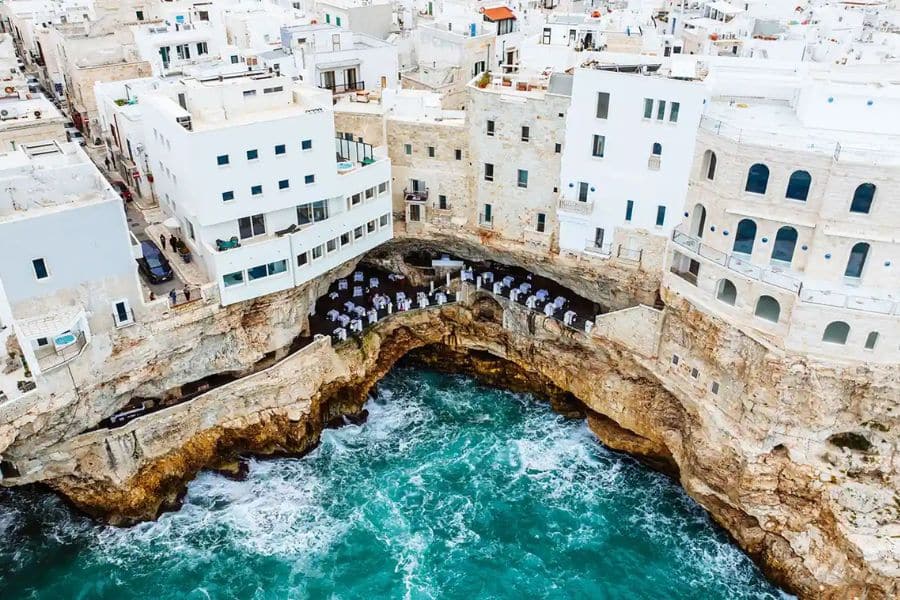
Polignano a Mare is perched on a 20-meter limestone cliff above the Adriatic Sea, about 33 kilometers south of Bari in Puglia.
Ancient legend says the town came into being when a piece of the Greek coast simply broke off and drifted across the Adriatic. The Romans were here too. Some historians credit Julius Caesar with founding the place after conquering an earlier settlement, and the ancient road Via Traiana still has a bridge crossing the cove below the old town, built around 109 AD.
Young men here proved their courage by jumping into the sea below. Since 2009, the Red Bull Cliff Diving World Series has made that tradition official, with athletes launching themselves from platforms 27 meters above the water.
Polignano is also the birthplace of Domenico Modugno, who wrote and sang “Volare,” the world’s most-played Italian song. His statue stands near the waterfront, arms outstretched, face to the sky.
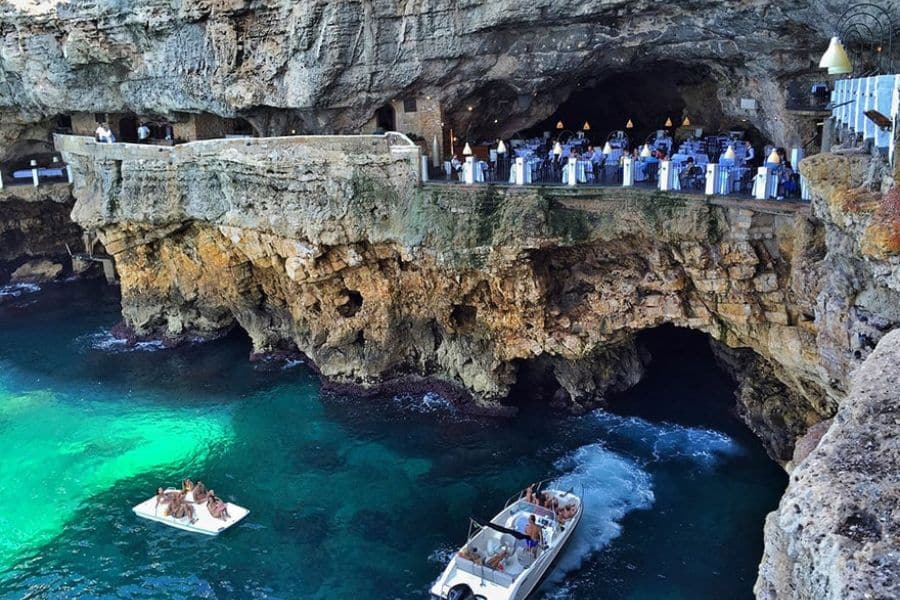
As you wander the whitewashed alleys of the old town, look for poems on the walls. A local poet who signs his work “Guido il Flaneur” has been leaving verses around the historic center since 1992. And if you can get a table at Grotta Palazzese, the restaurant inside a natural sea cave overlooking the Adriatic, do it. There’s nowhere else quite like it on earth.
What I loved: the combination of ancient stone, turquoise sea, and the sheer drama of looking down from the old town into those crystal caves below.
Where to stay in Polignano >>>
San Gimignano, Tuscany
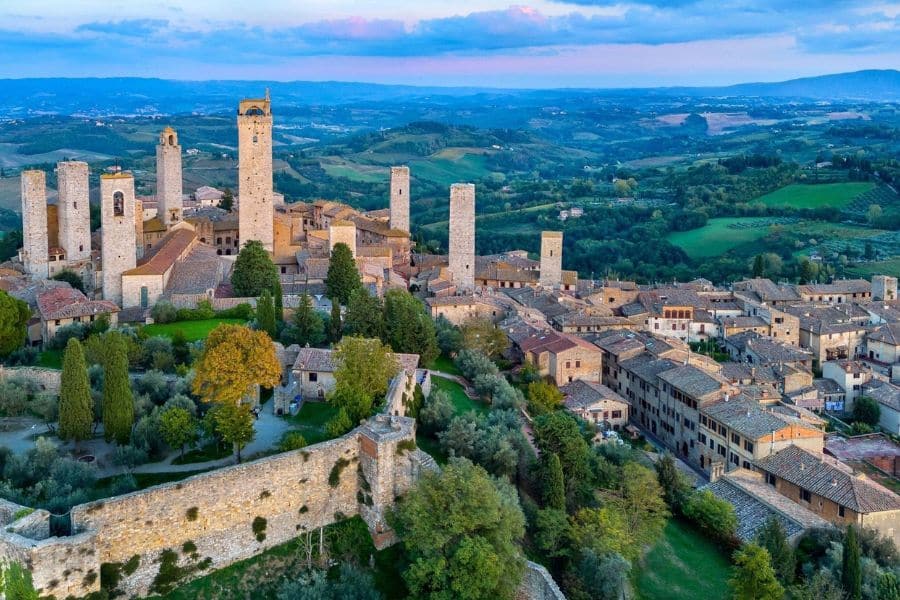
Standing on the Tuscan hillside about 56 kilometers south of Florence is San Gimignano, with medieval towers rising above the vineyards. At their peak in the 14th century, there were 72 towers here.
Rival noble families built them in a straight-up competition for who looked wealthiest and most powerful. Each one tried to outbuild the last until the city council passed a law prohibiting any private tower from exceeding the height of the one belonging to the Town Hall. One family immediately cheated by building two towers side by side so their combined height would win. They were made to cut them down.
Then there’s the Tower of the Devil. The owner returned from a long trip to find his tower mysteriously taller than when he left. He had no explanation other than the obvious one.
In May 1300, Dante Alighieri visited San Gimignano on a diplomatic mission, and the room where he spoke to the town council is still there.
Only 14 towers remain today, but that’s enough to earn the nickname “the Manhattan of the Middle Ages.” The Vernaccia white wine produced in the surrounding hills was on the tables of popes and kings in the 13th century, and it’s still exceptional.
What I loved: standing in Piazza della Cisterna at dusk, when the tour groups have gone, and realizing you’re in one of the best-preserved medieval scenes in Europe.
Where to stay in San Gimignano >>>
Vernazza, Liguria
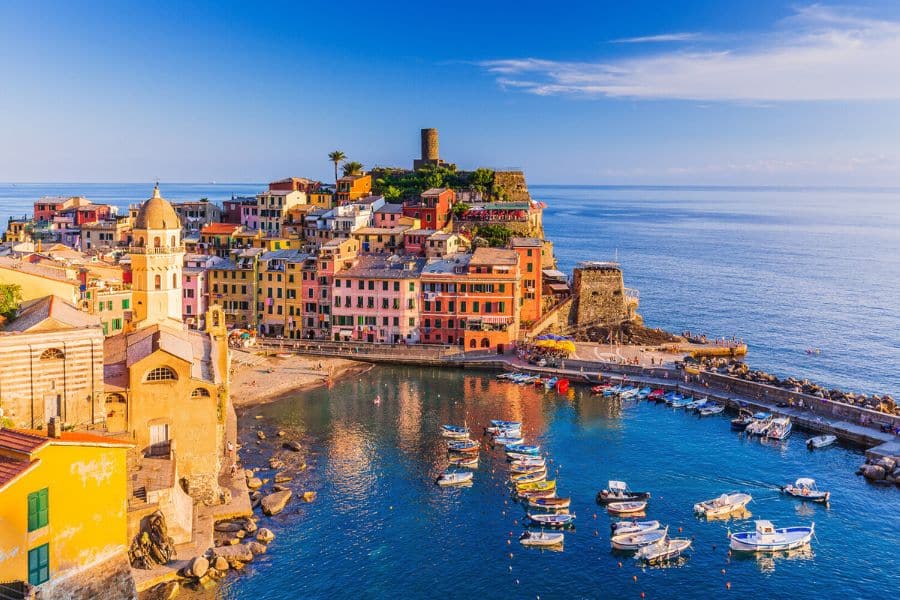
Of the five villages that make up Cinque Terre on the dramatic Ligurian coastline of northwest Italy, Vernazza is the one people can’t stop talking about. It has the only natural harbor of the five, which made it the wealthiest and most strategic for centuries.
The first written record of the village dates to 1080, when it served as a naval base for defending the coast against Saracen pirates. It later became one of the key strategic assets in the Republic of Genoa’s control of the Ligurian coastline.
The Church of Santa Margherita d’Antiochia, built in 1318, has a good origin story. Legend has it that a chest containing the saint’s hand bones washed ashore at Vernazza. When it disappeared and then turned up again in exactly the same spot, the townspeople took that as their sign. The church was built right there.
Every summer, Vernazza holds a pirate festival re-enacting the old Saracen raids.
In October 2011, the village was buried under four meters of mud after catastrophic flooding. The community dug itself out. The town you see today was rebuilt, largely by the hands of the people who live there.
What I loved: the view looking back at Vernazza from the hiking path toward Monterosso. It’s one of those rare moments where you can’t help but stop and just look. There are no words.
Where to stay in Vernazza >>>
Pacentro, Abruzzo

Few people outside Italy have heard of Pacentro. This small medieval village sits in the province of L’Aquila in Abruzzo, a few kilometers from the town of Sulmona, perched at 700 meters in the Maiella National Park.
Legend connects the village’s founding to a Trojan hero named Pacinus, who, after parting ways with Aeneas, wandered south through Italy until he reached the foot of Mount Morrone and decided to stay.
Pope Celestine V lived nearby in a mountain cave before being elected pope in 1294. He’s the only pope in history to have resigned, stepping down after just a few months. His image still appears on a fresco in Pacentro’s Church of San Marcello.
A little bit of trivia for you. The grandparents of Madonna, yes, the singer, were born here in 1901 and 1902.
Every September, local men run barefoot down a rocky hillside from a hill called Ardingo all the way to the Madonna di Loreto Church. Bloody feet are expected. Originally, the race was used by a medieval military commander to identify the toughest recruits for his army.
What I loved: the absolute silence of the historic center in the early morning. It’s the perfect time to walk around and let yourself be absorbed into the streets and take it all in.
Where to stay in Pacentro >>>
Civita di Bagnoregio, Lazio
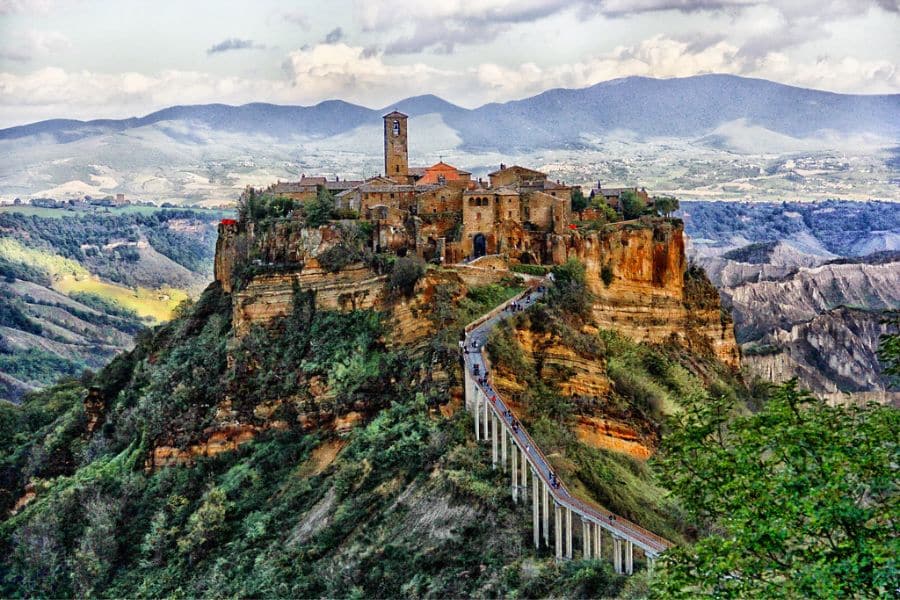
You approach it across a narrow footbridge suspended high above a lunar landscape of eroded clay and volcanic rock. At the end of the bridge, a medieval village appears on its tuff plateau, completely unexpected.
The Etruscans founded Civita di Bagnoregio over 2,500 years ago. It sits in the province of Viterbo in Lazio, about 120 kilometers north of Rome. It passed through Roman, Lombard, and Frankish hands before becoming part of the Papal States.
The Lombard king Desiderius once had his wounds treated in the area’s hot springs. He named the settlement Balneum Regis, meaning “the bath of the king.”
Saint Bonaventure was born here in the 13th century. The location of his childhood home has long since fallen off the cliff.
Sadly, the tuff plateau it sits on is being eroded by two streams and by centuries of wind and rain, earning it the nickname, “La città che muore,” the dying city. Today, only around 16 people call it home. You can only reach it on foot, across that footbridge, and you pay a small entry fee to cross.
What I loved: arriving on a foggy morning when the village appears to be floating in mid-air, completely detached from the world below. There is nowhere else in Italy that feels quite so suspended in time.
Where to stay in Civita di Bagnoregio >>>
Ostuni, Puglia
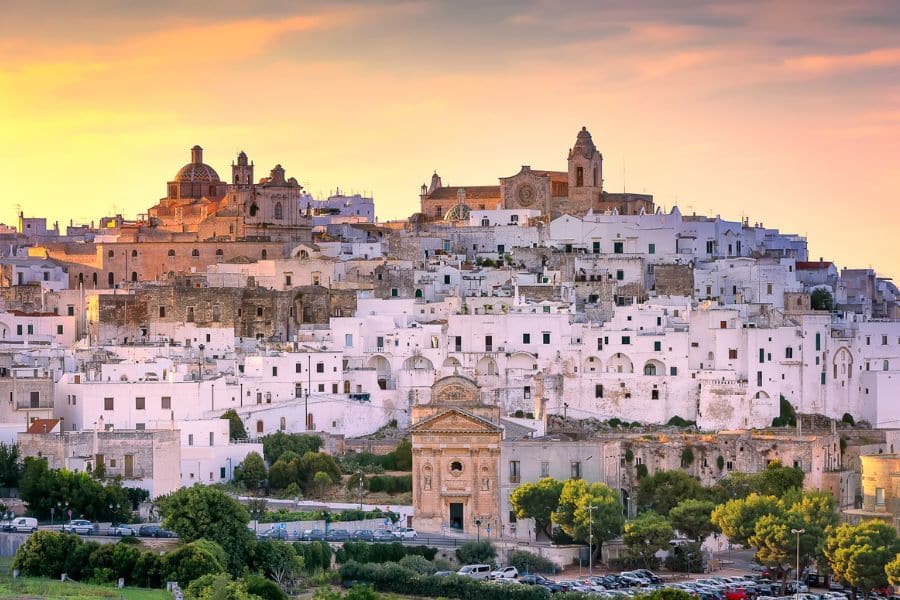
Back in Puglia, about 40 kilometers from Brindisi, Ostuni looks from a distance like a pile of snow sitting on top of a hill. Up close, you realize those brilliant white walls go all the way down through centuries of history.
The area has been inhabited since the Stone Age. The Messapii tribe built the original settlement, Hannibal destroyed it during the Punic Wars, and the Greeks rebuilt it and renamed it Astynéon, meaning “new town,” which is where “Ostuni” eventually came from.
The story behind all that white is more practical than decorative. During a devastating plague in the 17th century, residents covered every surface in lime wash, believing it would protect them through their patron saint Sant’Oronzo. Ostuni lost fewer people than the surrounding towns. We now know that lime’s antibacterial properties genuinely helped slow the spread of disease.
The historic center was built as a deliberate labyrinth. Narrow alleys, dead ends, staircases that go nowhere obvious. The medieval designers wanted invaders to get completely lost. It still works.
What I loved: standing at the old city walls at sunset, watching the white buildings turn gold, the olive groves stretching to the Adriatic, and the whole place smelling of warm stone and olive oil.
Where to stay in Ostuni >>>
Pitigliano, Tuscany
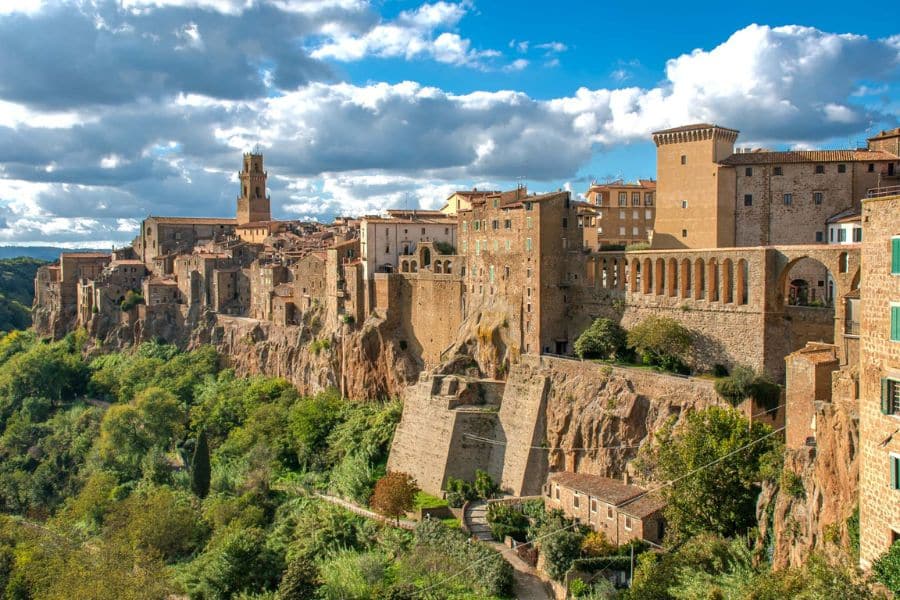
Pitigliano sits at the far southern edge of Tuscany, near the Lazio border, and rises from a ridge of rust-colored volcanic rock.
An ancient legend says the name Pitigliano comes from combining the names of two Romans, Petilio and Celiano, who are said to have founded the settlement.
From the 16th century onwards, Pitigliano became a refuge for Jewish people fleeing persecution in Rome and Florence, where Pope Paul IV had confined Jews to ghettos under oppressive conditions.
The independent Orsini rulers of Pitigliano had no interest in following papal orders, and the Jewish community was welcomed. By the mid-19th century, around 11.5 percent of the town’s population was Jewish, a proportion unmatched by any other Italian town at the time.
When Nazi racial laws came into force in 1938, the townspeople hid their Jewish neighbors in farms and caves throughout the surrounding hills. In 2002, the Yad Vashem Institute in Jerusalem awarded the honor of “Righteous Among the Nations” to several families from Pitigliano for their actions during that time.
The old synagogue, the kosher bakery, the ritual bath, and the wine cellar are still there, all carved into the tuff rock beneath the town, and open to visit.
What I loved: the spirit of community that you feel here, that’s still very much alive as you walk around.
Where to stay in Pitigliano >>>
Portofino, Liguria
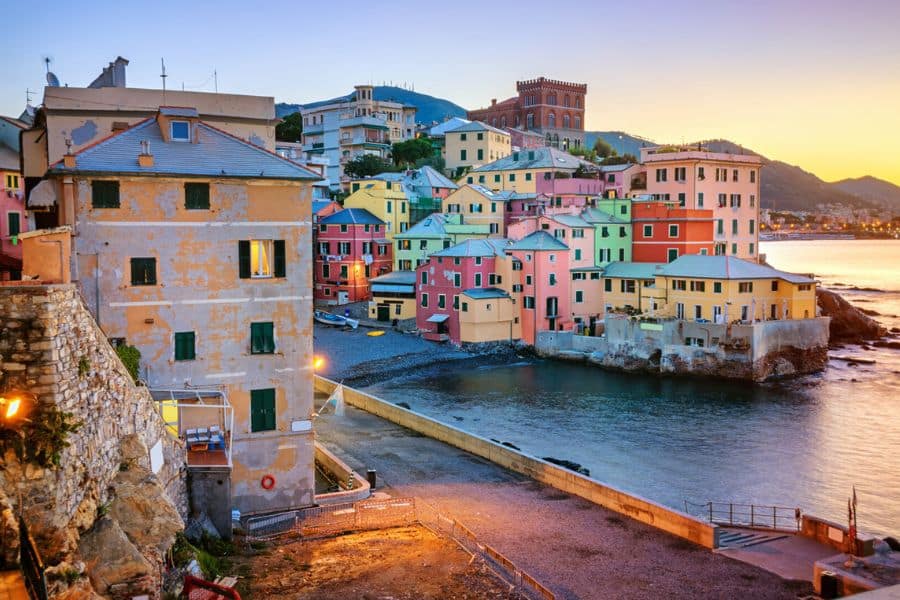
Portofino sits on a tiny peninsula on the Italian Riviera southeast of Genoa, in Liguria. Around 500 people live here permanently. In summer, that number changes considerably when the superyachts arrive.
The Romans were drawn here early. The historian Pliny the Elder called it Portus Delphini, Port of the Dolphins, because of the large dolphin pods that swam through its bay. That name has softened into Portofino over the centuries, but the dolphins still come.
A bronze statue of Christ of the Abyss sits 17 meters underwater between Portofino and Camogli. It was placed in 1954 in memory of Dario Gonzatti, the first Italian to use scuba gear, who died testing it in 1947.
The monastery of La Cervara, just 2.5 kilometers away, hosted Pope Gregory XI on his journey from Avignon to Rome in 1377. In 1525, Francis I of France was imprisoned there after the Battle of Pavia.
Richard Burton proposed to Elizabeth Taylor at the Hotel Splendido. Elizabeth Taylor, for what it’s worth, brought all four of her husbands to Portofino at one point or another.
What I loved: the piazzetta at the harbor’s edge, early on a weekday morning before the day boats arrive, when the pastel houses are reflected in the water, and you can pretend, just for a moment, that it all belongs to you.
Where to stay in Portofino >>>
Savoca, Sicily

Savoca is in the hills above the Ionian coast of Sicily, in the province of Messina, about 30 kilometers from Taormina.
Romans, Byzantines, Normans, and Arabs all left their mark here. Saracen pirates attacked repeatedly. The medieval nobility of Messina built their palaces here. The village has a name that likely comes from the Sicilian word for the elder tree, “savucu,” which grows throughout the surrounding hills.
In 1971, Francis Ford Coppola arrived in Sicily to film the Sicilian scenes of The Godfather. He originally planned to use the actual town of Corleone, but organized crime groups demanded payment from Paramount for the privilege of filming on their territory. Coppola walked away and eventually found Savoca, which looked far closer to the Corleone of Mario Puzo’s novel than the real Corleone ever did.
Bar Vitelli, on the main square, is where Michael Corleone asks Apollonia’s father for her hand in marriage. The bar still operates today, filled with original memorabilia and photos from the shoot. Local residents were cast as extras, and many can still tell you what those filming days were like.
The Church of San Nicolò, just above the bar, served as the setting for Michael and Apollonia’s wedding. The Capuchin monastery has a crypt where mummified bodies of local nobility, still in their original robes, are on display.
What I loved: sitting at Bar Vitelli with a lemon granita, looking out over the Gulf of Taormina, in a village that hasn’t changed much since Al Pacino sat in roughly the same spot in 1971.
Where to stay in Savoca >>>
Disclaimer: This article is for general information only and is not professional advice. It may contain affiliate links. Please see our full Editorial Policy for details.

Kylie Lang is a nationally syndicated travel journalist with bylines on the Associated Press Wire & more, a lifestyle writer, and the founder and editor of Your Lifestyle Library (yourlifestylelibrary.com). She holds a BA (Honours) in History from the University of Kent and is a member of the British Guild of Travel Writers.